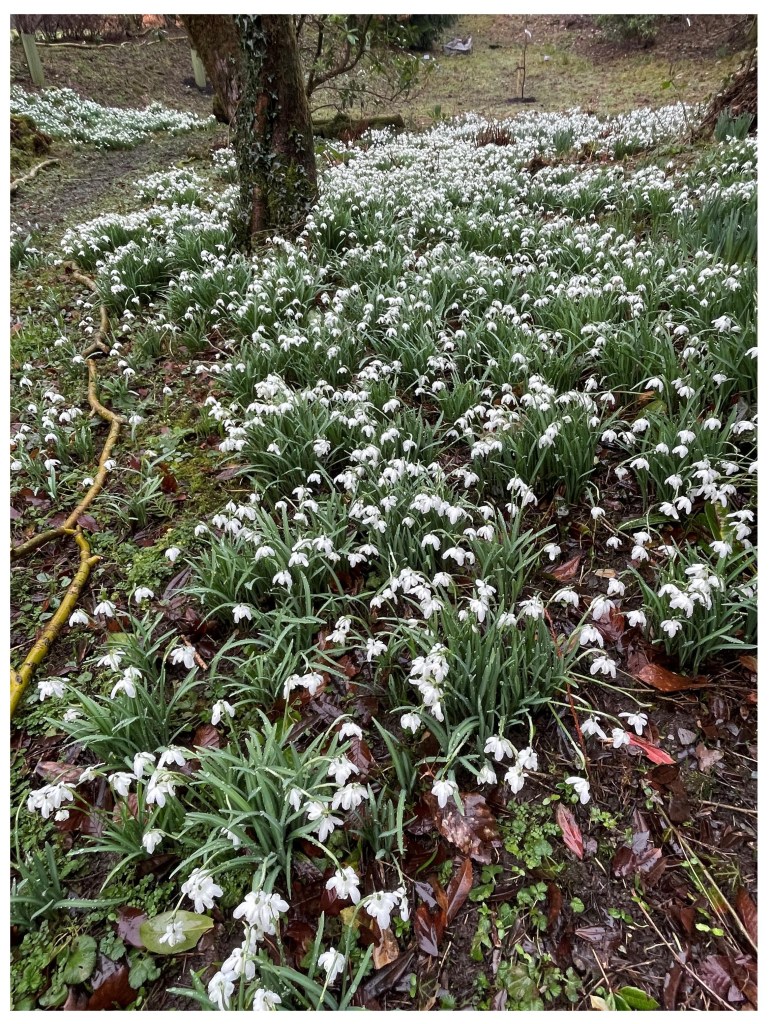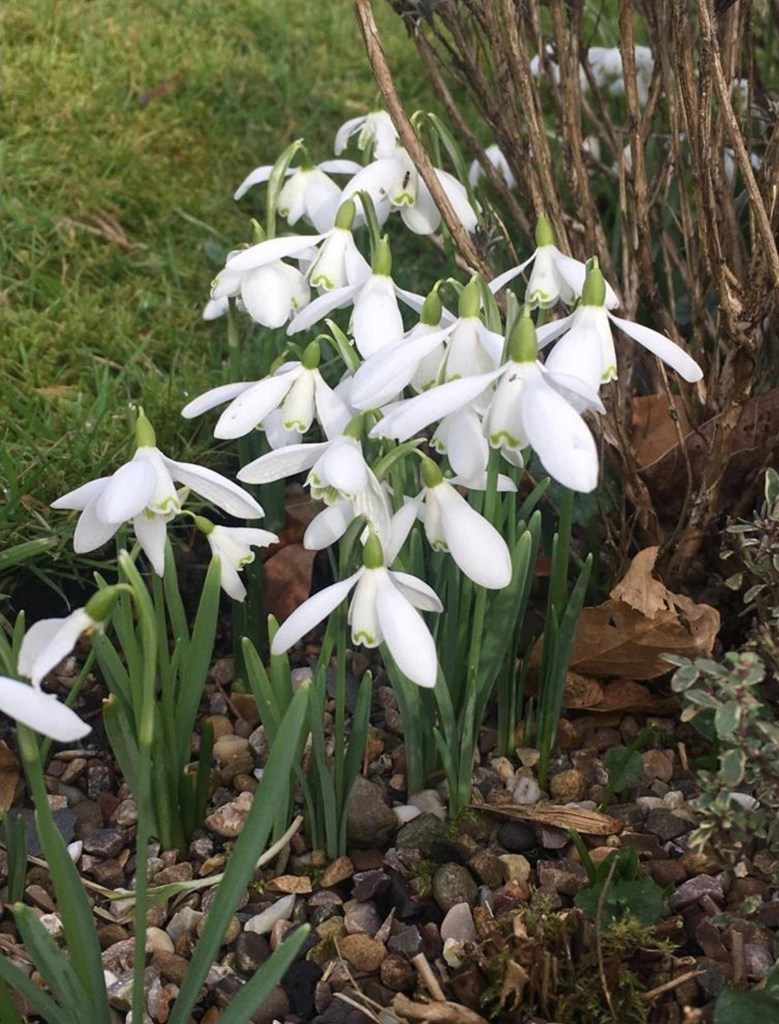
Snowdrop carpet photographed by my friend, Gill Henwood
Lakeland carpet thoughts :
Seven years on… the old snowdrops have drifted for a hundred years or more. Now cleared of overgrowth (though brambles will keep growing due to the seeds in the ground), they are a dancing carpet – here in the gentle February rain.
The sticks mark an edge so we don’t tread on the shoots…
In the dell meadow beyond, we’ve planted a black walnut tree and a hornbeam, both native. The grass is full of old wood anemones running through it (creeping a little further each year, now they have some light).
Joy in wet mid February!
Gill.
February tiptoes across a winter landscape, dressed in white array, luring us away from cold depression of dark, dank January, with dazzling brightness; promising the hope of Spring beyond.
Ah! What trembling beauty lays a carpet of expectant joy!
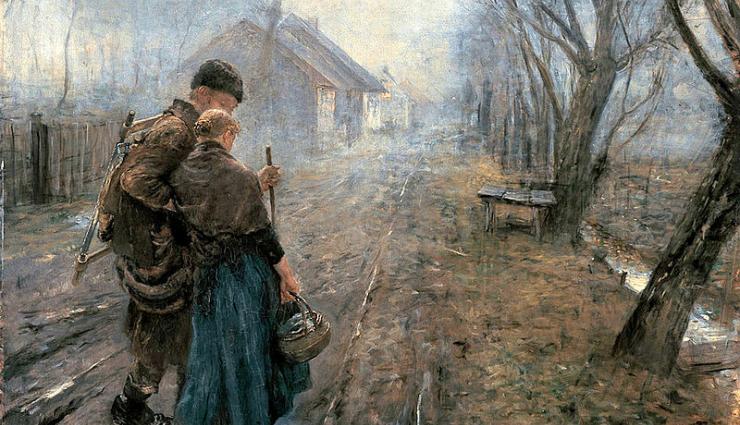
Difficult Journey is a painting by the German artist, Fritz von UHDE. Its original title was Transition to Bethlehem which locates the scene and therefore the subject. It is the journey of Joseph and Mary to Bethlehem for the Census. It depicts something of the difficulties they had in bringing Jesus into the world.
Many paintings of this journey and arrival are much more sentimental but this has a realism which roots it into a more contemporary interpretation. It isn’t located in the desert or the climate of the Middle East. This is Northern Europe. The road is muddy and uneven. There are no other people around and there is none of the bustle and crowded feel of a city where there is no room at an inn. There is, however, a sense of isolation and desolation. There are no people and no sense that the couple are welcome. They are dressed as outcasts, he carries the sign of his trade, a saw over his shoulder and she, a cooking pot. They could be refugees today, unwanted and uncared about.
There is a sign that Mary and Joseph are exhausted. No donkey carries them as in some accounts, though not in St. Luke’s Gospel. What is strongly portrayed is Joseph’s role as protector of Mary and therefore of Jesus. She leans into him and he holds her. He is concerned and caring. His love is obvious.
It is this which set me thinking again about Joseph’s role in the Nativity and a partial possible answer is in the poem below which I have written about this.
Difficult Journey
Against all judgement, honourable, obedient Joseph took Mary to be his wife.
It would be difficult stepping into God’s shoes. Overshadowed by an angel, Joseph was appointed to watch over the God-bearer; the gentle, honest, open, faithful maid who had conquered his heart.
It would be hard to fulfil God’s hopes, God’s plan, worked out with angels who were centre-stage of a sacred drama played out on earth. Joseph could see where Mary fitted in, but what of himself?
Legitimate descendant of David, the sling-thrower warrior, Joseph threw only wood on a lathe – turning, shaping, forming, revealing what was there; allowing the inner core of wood to show itself – its soul.
Joseph, gentle, watchful carpenter, who strokes the grain, and feels the beauty within, holds Mary and the babe in her womb, on the difficult road to Bethlehem with its uncertain future.
He draws her carefully into the folds of his caress, exhausted woman, with kicking inner child, who needs him.
The dawning realization: he knew why God had called – and that He held him too.
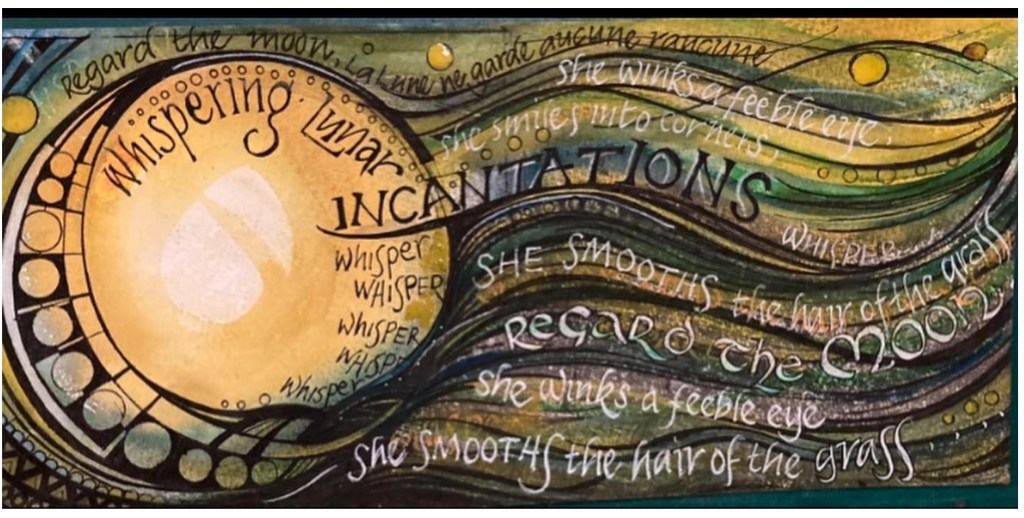
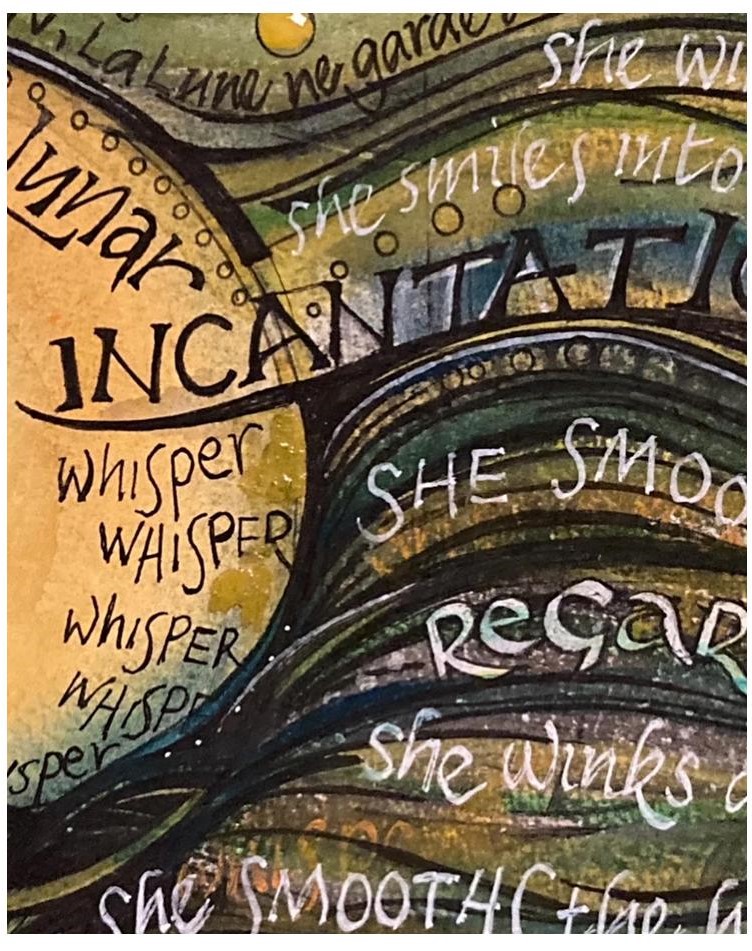
I have been a friend of Kay Gibbons for quite some time but recently I have also got to know her art as well. She recently produced the Calligraphy art above. I asked her if she would write something about the personal and artistic process involved
Lunar Incantations by Kay Gibbons
…..’half past three, The lamp sputtered, the lamp muttered in the dark, the lamp hummed ; ‘Regard the moon, La lune ne garde aucune rancune, She winks a feeble eye, She smiles into corners, She smooths the hair of the grass…. The moon has lost her memory .. A washed out smallpox cracks her face ….
T. S. Eliot, Rhapsody on a windy night.
These descriptive words about the moon inspired me to explore lunar imagery in Eliot’s poetry , especially in this poem, Rhapsody on a Windy Night.
I attempted to paint an image but was dissatisfied with the outcome and left it for a couple of days . When I returned I could see within the image ‘the moon smoothing the hair of the grass,’as in the lines of the poetry and I played along with the drawn lines and emerging image before me.
I added the words and their imprecise lines seemed symbolic of being lost in the dark of the night, partially visible by the light of the moon across the landscape. A happy accident for the Calligrapher within, to be able to add a sense of meaning to something which jarred against my need for the perfect line.
My process is one of thought and quiet meditation lifted with the joy of a babbling brook when it all falls into place and my understanding of Eliot’s words is satisfied by the art before me … tinged with a niggling desire to tweek a bit here and there as Eliot would have done too ..
T S Eliot inspires within me a creative welling response to a dialogue between word and image; between poet and artist. I am delighted to encounter and explore Eliot’s poetry with its imagery and translate it into my own visual interpretation born out of a lively response to his own expression of feeling and emotion.
My work is a personal visual translation of Eliot’s words and intonations, the incongruities, the dichotomies, the discordant resonance inspiring a intriguing , meditative yet playful reflection on his words . Poet , Artist . Artist , Poet .
The arid dry texts of the ‘A’ level set texts transitioned during lockdown into a passion to interpret visually. Eliot’s words with my own subjective interpretation onto the artists paper . A dialogue between words and pictures .the pouring out of creative energy in response to an emotional , intellectual stimulus.
An interplay between two destinies .. Poet and Artist
And so in the dialogue between La lune and Earth .
Kay Gibbons.
[] Kay is an artist who lives in Oxfordshire. She will be exhibiting there next year. You can find lots more of her art on Instatgram – kaygibbons_art.glass.sculpture.
This poem, by my friend Piers Northam, takes its inspiration from a Pilgrimage to the Shrine of St James in Santiago de Compostela. The poem is written at the beginning of the Anglican Lambeth Conference. The Conference gathers Bishops and others from member churches of the Anglican Communion. It is a diverse group with differing opinions on many issues. It can be viewed as a ‘scattered family’ which gets together to celebrate a fellowship which is best described as Koinonia – a fellowship with each other brought together by the Holy Spirit and held by that same Spirit in a Communion with each other.
Sometimes, because of its diversity, there is disagreement and some heart-searching as a compromise is sought. Sometimes because of our separate cultures, it isn’t always possible to agree, at least not at present. The member churches seek to listen and keep talking and praying together under God’s guidance until a new understanding is reached.
Another way of seeing things is as a Pilgrimage to God’s Kingdom which we approach from differing directions – as with the Camino where pilgrims walk from many different places. Conversations, prayers and walking together produces many experiences as we share in the common adventure. Finally each of these ‘ways’ converge. The Camino symbol, tracing the cockle shell (emblem of St. James the fisherman) shows us the paths converging to the same point.
Piers reflects on this as he thinks of what is the nature of the Anglican Communion. There are parallels to be discovered between the Camino and the Anglican Communion. Might it, therefore, be possible to see a positive way forward, not just for Anglicans, but also for Christians of all denominations. Could we be even more brave and see some way forward for inter-faith friendship.
The Anglican mystic and teacher of prayer, Evelyn Underhill, had a belief that our differing views and beliefs are as Chapels in the Cathedral of the Holy Spirit. It is both a lovely and dynamic thought !