
Holy Saturday 2022
Prayer by Mr G
Photo: Chapel at Pleshey Retreat House, Chelmsford
Retreat by St. Mary-at-Latton
Tag: Poetry
Holy Saturday 2022
Prayer by Mr G
Photo: Chapel at Pleshey Retreat House, Chelmsford
Retreat by St. Mary-at-Latton

‘Keep watch’, he says,
but weighted lids pull me down
into the dark, deaf waters of sleep
and I drift – yielding consciousness…
Then strain to resurface again
to what’s unfolding.
He kneels, a stone’s-throw close,
his pleading just perceptible.
Yet he is far-off:
unreachable in his anguish.
As I sink back into the swaddle of sleep
I sense betrayal close.
Then voices and torchlight
yank me to the surface –
suddenly alert.
Now, he is calm –
resolved:
a still centre
in the uproar.
Fear’s chill seeps into me –
for he foretold denial:
will I have the courage to stay true?
Piers Northam
Holy Thursday 2022
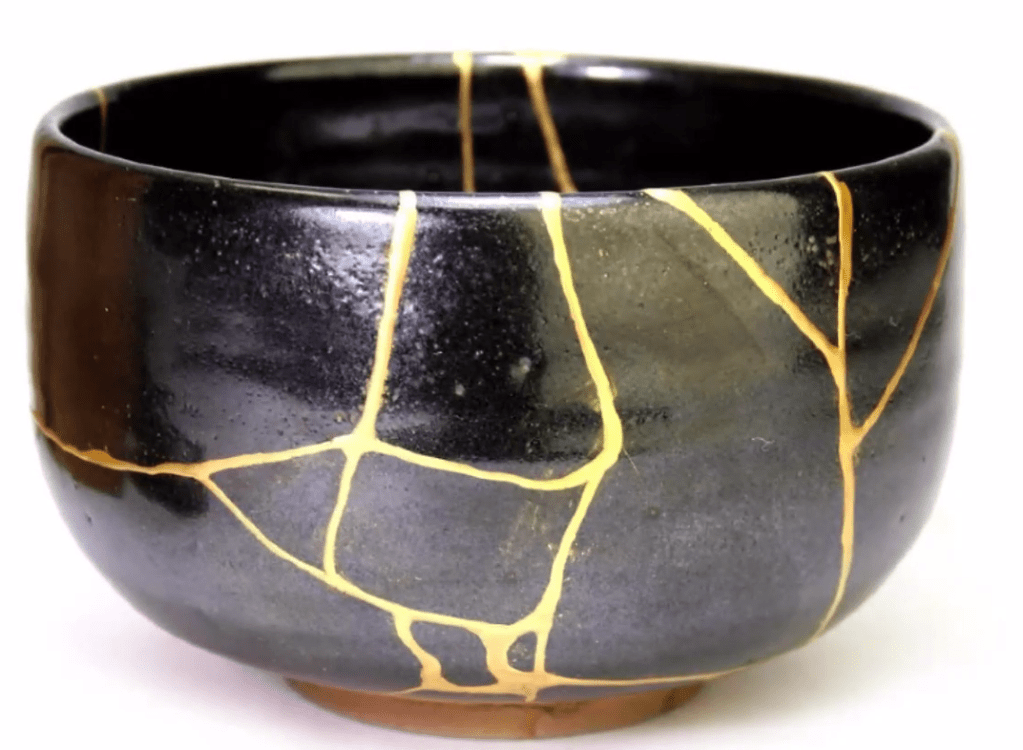
Kintsugi
We come as broken shards
to be pieced together –
our sharp edges,
patiently softened
and held by the glowing flux
which traces what has gone before,
transforming regret into strength and beauty.
Not mending but creating anew…
[Piers Northam]
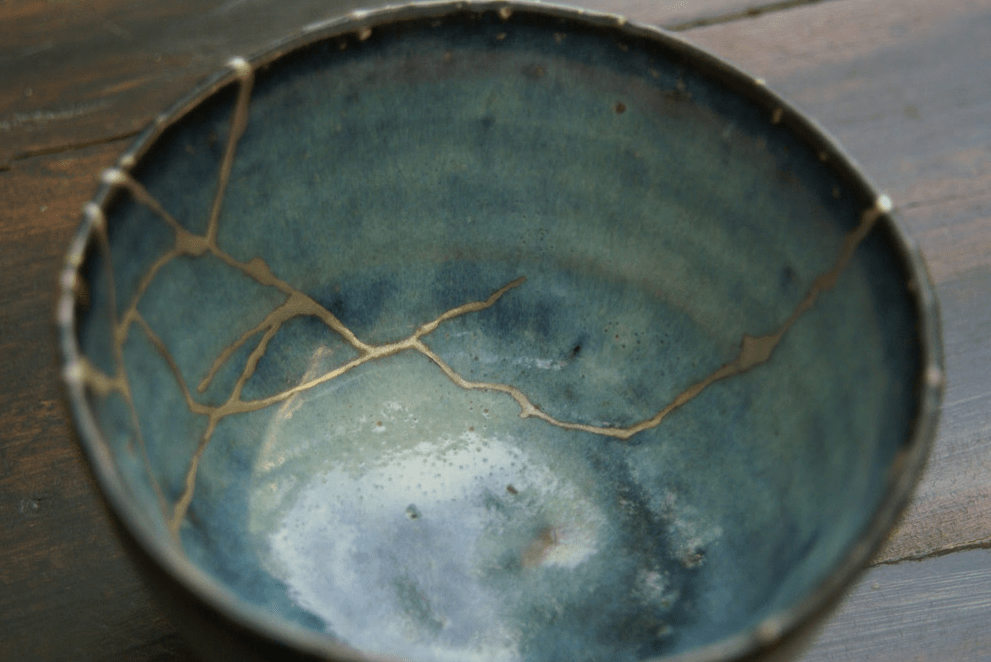
Kintsugi is the ancient Japanese art of repairing broken pottery with seams of gold. When the brokenness is repaired, the object becomes more beautiful and unique than it was before. Instead of hiding the scars, it makes a feature of them.
The word Kintsugi means Gold (Kint) and to Mend (Sugi)
One of the leading artists promoting and teaching Kintsugi is Makoto Fijimura.
He gives his insight into the meaning of Kintsugi in a video he recorded as part of his programme known as Culture Care Creative, of which he is the founder.
In seeking to mend what is broken, this is the opposite to our prevailing disposable culture. Instead of throwing away and buying new, it is about valuing what you have.
Makoto describes the mending not as ‘fixing’ but as a redemptive journey which leads to a new creation.
He tells of the aftermath of an earthquake in Japan. Homes were destroyed but the concern of many was to mend their bowls. Bowls were all that was left the mending became a ‘safe zone’ which has the power to heal people.
In the mending you stand between repairing and creating. The imperfect becomes a symbol of the beauty of broken things.
We live with trauma, he says, and we are looking for healing in the midst of all that.Never more true than in our own times of conflict and destructive brokeness.
There is a physical process but it belies a kind of spiritual meaning.
At a popular level, the British TV Programme, Repair Shop´ in which people bring favourite broken objects which are steeped in memory, involves a kind of Kintsugi. The Team restore and renew what is presented to them because they are skilled in particular crafts. However, it is a work of love which is fed by the stories behind the damaged objects.
Old memories are reshaped and recreated into a new ones. Often we can be moved to tears, and certainly the ones seeking repairs are, because this is the real renewal.
In Kingsugi, the bowl or object seems just like a broken bowl but the cracks are filled with gold – what Makoto calls a gold river running through it.
Makoto emphasises healing and he draws from that a Gospel message.
Christ, he says, came not just to fix us but to restore us to create something new, which is more valuable than what we began with.
Redemption is re-making us in the image of Christ and the result of that is the river of Gold that reconnects us is God Himself holding us.
Kintsugi = God mends
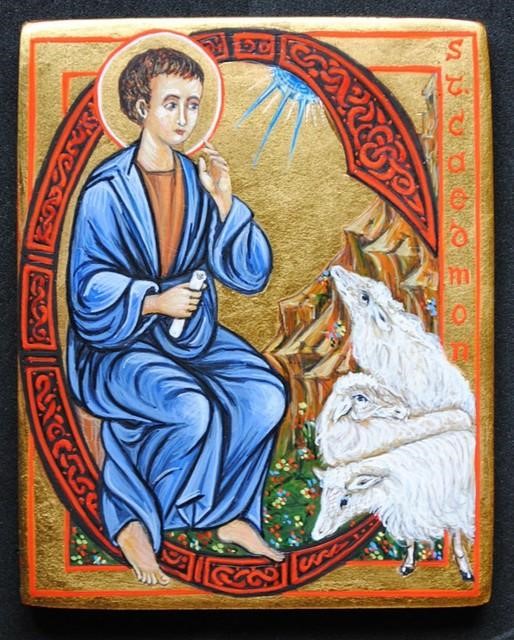
CAEDMON, herder of cows and stirrer of souls
I cannot speak, unless You loose my tongue;
I only stammer, and I speak uncertainly;
but if You touch my mouth, my Lord,
then I will sing the story of Your wonders!
(Words from the Northumbrian Community)
Today (February 11th) we remember Caedmon of Whitby.
He was encouraged in faith by St. Hilda (Hild) who,whilst she was a player on the big stage of England of its time, was also a discerner of almost unknown individuals. She was to them an encourager and one who awakened and nourished the gifts of God in others. This was especially true of Caedmon.
We owe the story to the Venerable Bede, the monk of Jarrow .
Caedmon, according to Bede, was an illiterate cowherd at Hild’s Abbey in Whitby. Beyond tending the cows he thought that he had little to offer and when those who farmed beside him would gather for an early form of Karaoke, taking turns to perform songs and poetry, Caedmon would often find an excuse to absent himself. One night, as he slipped away to be with his cows instead, he fell asleep in the cowshed. During his sleep he dreamt of a mysterious stranger who urged him to sing a song about the Creation of the world.
At first Caedmon resisted but the man in the vision persuaded him and Caedmon sang praise to God.
When he awoke he remembered his dream and told the steward. Immediately he was taken to the Abbey and Hild. She recognized that God had worked a special miracle in Caedmon. She was entranced by his singing not least because he had, hitherto, led a life in which no poetry had a part.
Hild knew that she must encourage the gift shown to him.
She called scholars and learned men to meet with him and to them he explained his dream. They then opened to him a piece of Scripture and invited him to turn it into a poem. Next morning he returned and sang a poem which captured the bible passage in verse.
Hild was thrilled and persuaded him to become a monk at the Abbey where he soon became a companion of the others. He was instructed in the bible, sacred history and tales. Like a cow chewing its cud, Caedmon ruminated and turned what he learned into beautiful music and song. The book of Genesis and the flight of God’s people from Egypt to the promised land were followed by other Old Testament tales leading to songs of Christ’s Incarnation, His Passion and Ascension.
So, Caedmon enlightened people with the Holy Word of God and enriched others not only by his compositions but also by the beauty with which he sang.
He became the first English Poet and his extraordinary story became a reminder that God often takes what seems ordinary and makes it extraordinary – or rather takes ordinary people and reveals in them (in us) extraordinary gifts. All it took was a visitation from God and a Holy woman who knew that God was up to something and encouraged the development of a vocation and of a soul who enriched the church.
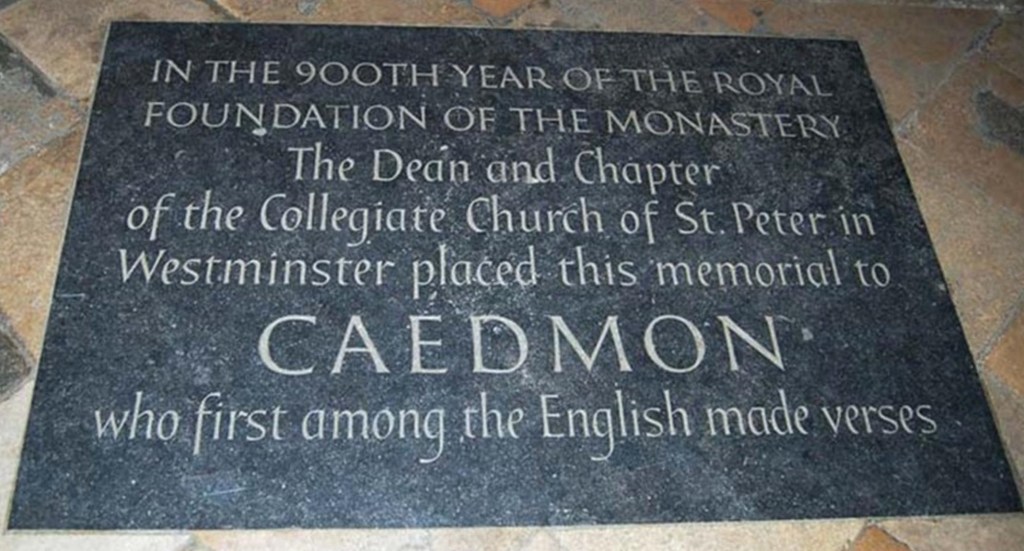
Though little remains of Caedmon’s poetry, most of it being oral, we have a few lines, thanks to Bede but also he began a poetic tradition which others took on board and developed. His poetry and singing was destined to lead to the growth of a deep and lasting Anglo-Saxon / Old English poetic tradition.
Caedmon’s poem
Now we must honour the guardian of heaven
the might of the architect and his purpose,
the work of the father of glory as he, the eternal Lord,
established the beginning of wonders.
He first created for the children of men
heaven as a roof, the holy creator.
Then the guardian of mankind, the eternal Lord,
afterwards appointed the middle earth,
the lands of men, the Lord Almighty
 Mr G's Ponderings