(From Mr G)
Tag: Prayer

(From Mr G)

A Prayer for our broken world.
Yesterday, at church in Fakenham, we sang the hymn, For the healing of the Nations, by Fred Kaan. The second line begins, ‘Lord we pray’, a reminder that hymns are musical prayers which begin life as prayer/poems. As such they are an important part of our devotional resource, whether they be as hymns, psalms, anthems of chants. This prayer by Fred Kaan speaks deeply to our human condition which cries out for healing of our brokenness in so many ways.
For the healing of the nations,
Lord, we pray with one accord,
for a just and equal sharing
of the things that earth affords.
To a life of love in action
help us rise and pledge our word.
Lead us forward into freedom,
from despair your world release,
that, redeemed from war and hatred,
all may come and go in peace.
Show us how through care and goodness
fear will die and hope increase.
All that kills abundant living,
let it from the earth be banned:
pride of status, race or schooling,
dogmas that obscure your plan.
In our common quest for justice
may we hallow brief life’s span.
You, Creator God, have written
your great name on humankind;
for our growing in your likeness
bring the life of Christ to mind;
that by our response and service
earth its destiny may find.
Fred Kaan
Fred Kaan was uniquely placed to offer this poetic insight of a world in need of healing. As a child of the occupation of the Netherlands, he experienced first-hand the horrors of Nazism, His parents were part of the Resistance in Holland and they also sheltered a young Jewish woman who was kept safe for over two years. Fred was doubtless shaped by a global conflict which was also experienced personally. He was filled with a passion for social justice, global peace and a reconciliation between people. When he discovered Christ, this strong desire met the explosive love of the Gospel. His faith was expressed in Christian ministry and a spirituality that found expression in prayer/poems which could be sung powerfully as hymns or quietly as Gospel -based prayers as part of personal devotion.
It is offered here as a pinprick of soul-light for our praying.
After all, for many, the best action for human justice, freedom and the outpouring of love, is through prayer. Action flows from prayer because it changes us.
To a life of love in action
help us rise and pledge our word.
[Mr G]
***for more on Fred Kaan see my blog entry June 29th 2023

My friend Gill Henwood has sent me the photo posted above. It is a view of Langdale Pikes from Grizedale Forest, in the Lake District.
There is a certain broodiness about it with its different shades of light and dark which is rather in keeping with the extremities of weather at present in the UK.
The Lake District is a microcosm of our weather patterns and it is always wise, when walking in the Lakeland hills, to have a healthy respect for what Nature offers us. At one level we may call it fickle in that the conditions often change quickly. In another sense, it is a reminder that Planet Earth, and therefore its weather, is not something we can control. Sadly, we are messing things up with our human attempts at superiority over everything on earth.
The current preoccupation with the Northern Lights and with rare sightings of spectacular comets, along with other special things such as solar flares, remind us that these amazing displays from the cosmos are not of our making. They tell us, in fact, how small we are in the Universal scheme of things.
Unfortunately, the human race isn’t very good at learning lessons and applying them with humility to our borrowed and temporary life on earth. It was the poet T.S.Eliot who coined the phrase, humankind cannot bear very much reality so perhaps we shall continue to destroy the earth – and, of course, each other!
It would be good, therefore, if the human race might wake up to itself and accept that, as tenants with a life-span lower than many trees, a bit of humility might not go amiss.
As T. S. Eliot puts it in in his poem East Coker, “The only wisdom we can hope to acquire is the wisdom of humility: humility is endless.”
A large part of the lesson of humility can be found in contemplating the gifts God gives us through Creation. How can we not look at the scene depicted in the Gill’s photo above and be unmoved by what nature is trying to tell us about the Planet which is our home for the time being.
The light shimmering on the hills and the blue sky quietly folding itself around the clouds offers us a message of hope. It is just as true of a tuft of grass or a tiny flower pushing aside the tar of an urban footpath.
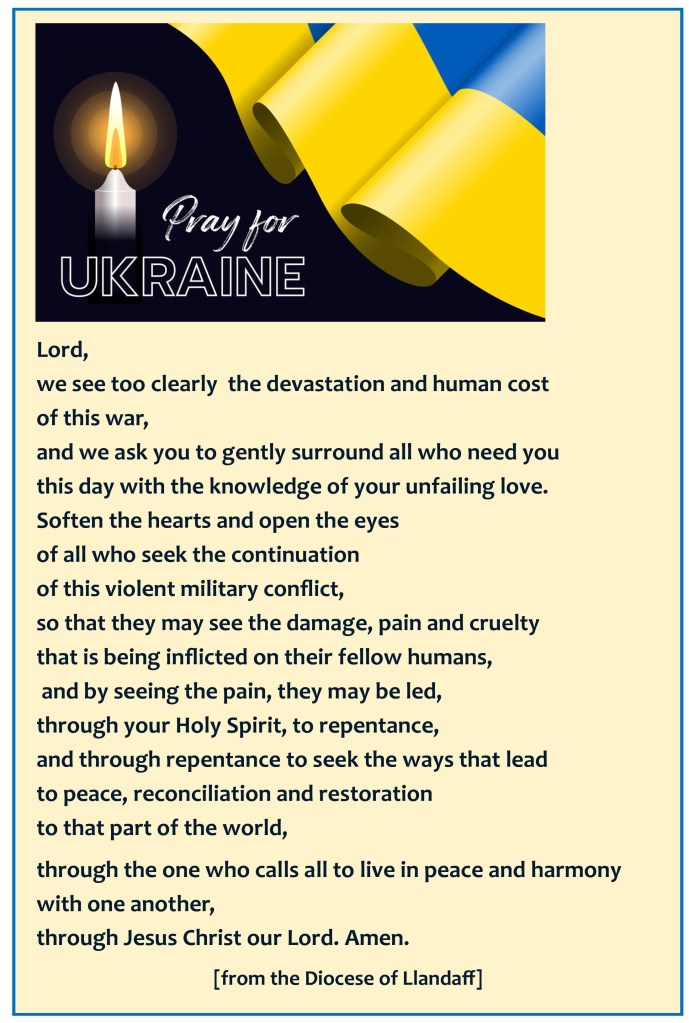
When the warmongers of the Middle East and the Russian invasion of Ukraine come to an end, they will leave desolation but it won’t be long before a blade of grass or a microscopic flower spring to life.
Gill’s photo gives me hope. I have added a few words from a lovely hymn by Folliott Sandford Pierpont. He sat on a hill near Bath and was exhilarated by the beauty of creation which was laid out before him. Inspired by what he saw, he was filled with gratitude to God and he wrote his hymn in thanksgiving.
That too is another clue coming from Gill’s photograph ~ thanksgiving.
When we give thanks for Creation and for God who created it, we find ourself in a different place from lordship, conceit and self-centredness. In fact, thanksgiving, turns our attention towards others, towards providence and therefore towards God as Creator.
The photo is filled with the promise. of light and that is a source of joy and hope. If none of this means anything, then perhaps another thought might help – remember the Dinosaurs!
[Mr G] 14th October 2024

The Beauty of Nature
O God, we thank you for this earth, our home;
For the wide sky and the blessed sun,
For the salt sea and the running water,
For the everlasting hills
And the never-resting winds,
For trees and the common grass underfoot.
We thank you for our senses
By which we hear the songs of birds,
And see the splendour of the summer fields,
And taste of the autumn fruits,
And rejoice in the feel of the snow,
And smell the breath of the spring.
Grant us a heart wide open to all this beauty;
And save our souls from being so blind
That we pass unseeing
When even the common thorn bush
Is aflame with your glory,
O God our creator,
Who lives and reigns forever and ever.
– Walter Rauschenbusch

Yesterday, October 4th, Christians remembered St. Francis of Assisi.
Many people know of him and stories about him. There is the famous story about how he cared for a leper who was shunned by everyone because of his disease. Another popular image was of Francis feeding the birds and so he has become synonymous with the care of animals. At this time of year, the Church of England and other groups help us to think about Animal Welfare and, through a Creation Season, Nature generally.
Francis is also famous for his preaching and missionary work, including drawing people to live a more simple and dedicated life in the love and service of God.
One story about his comes from a collection of stories, The Little Flowers of Saint Francis. Collected and published in the Middle Ages, it captures and presents a spirit which is truly Franciscan. It was translated into Italian by an unknown Franciscan friar, from a much larger work. It has 53 short chapters .
The Little Flowers sheds a light on the way Francis and his Companions (with St.Clare and those who prayed with her), paved the way for an imitation of the Franciscan way of life, witness and spirituality which continues to enrich both church and world today.
Here’s a story from the collection.
Francis and a companion once visited the home of a rich man, late in the evening. The nobleman welcomed them with open arms and, we are told, received them as if they had been angels of God, with courtesy and devotion.
The man embraced them, washed their feet, wiped them and humbly kissed them. He kindled a fire, made ready the table with much food and served it with a joyful countenance.
He then prepared beds and offered many gifts. In the morning, he provided fresh clothing. He told them that if the brothers needed clothing, he would always pay for it. He professed that he was ready to provide for all their needs. He could do this willingly because of all that God had provided him. He willingly would give of this to the poor.
When Francis left him with great rejoicing he held the man in his heart and in his prayers.The man, had done such a lovely thing also rejoiced and prayed for Francis.
Francis knew however that there was more. He had looked into his eyes and had not rested until he saw into his soul.
He said to his companions “He would make a good friar. He is so grateful and thankful to God and so kind and courteous to his neighbour and to the poor.”
He reminded his brother that courtesy is one of the attributes of God who gives us all we need and is courteous and kind and loving towards us. These things he found in the man’s soul – the divine imprint.
Francis determined to return again soon to his house.
When Francis re-visited the area, he called on the man again.
First, he knelt in prayer at the gate.
The man saw him and rushed down the drive to kneel besides Francis.
God was speaking to both their hearts and Francis lifted him up, and ‘in fervour and gladness of heart embraced him and kissed him devoutly giving thanks to God,’ who had brought to him a new friar.
The man asked, ‘what do you command me to do, my father? Lo I am ready to do your bidding and give all that I possess to the poor and thus, no longer held back by worldly things, to follow Christ with you.’
And so he did.
The nobleman had given out of the generosity of his heart and his means when Francis first visited him. He gave so much for the mission of Jesus Christ being carried out by Francis and his companions. But for him, there was something missing. Something he still had to give. The only gift that God truly wants from any and all of us. He gave himself. He joined Francis in his work. He gave his life, heart, his soul.
Make of this story what you will!
[Mr G]