The 80th commemoration of VE (Victory in Europe) Day on May 8th and events surrounding it was bound to be a time of emotion for many and of quiet reflection. At a time when there are increasing conflicts around the world it is hard not to feel a sense of futility. Can we talk meaningfully about the Victory of Peace over War when humanity is seemingly locked in battles and struggles with each other. The futility is even greater when we note that a few leaders of nations are mainly responsible for what is happening. Just about a dozen men are holding the world to ransom. The real tragedy is that 8.2 billion of us are letting them. A proportion are even physically involved in fighting at the whim of those leaders. Not surprisingly there is increasing talk of a Third World War, this time with the probability of using nuclear weaponry and all the horror that brings with it.
Conflicts are being witnessed in other places where there is a battle of a differing kind. The fear of difference; racial, sexual, gender issues, poverty, malnutrition, injustice are all part of a mix in which might swamps right and bullies impose their views. Sadly, some of that fear can be laid at the feet of religion and an insistence that ‘truth’ can only exist if it is ‘my’ truth. In his book, The Dignity of Difference, the Late Chief Rabbi, Jonathan Sacks said that “Truth on earthis not, nor can it aspire to be, the whole truth. It is limited, not comprehensive; particular, not universal. When propositions conflict it is not necessarily because one is true, the other false. He suggests that the difference is because we are coming at something from a different angle but both are only part of the truth because, he says, only in heaven there is truth; on earth there are truths.“ Something I try to remember when I think I am right!
This week of remembrance has therefore a deeper meaning than gratitude and thanksgiving. It is also a time of going forward with new resolve and with a seeking of a new attitude and deeper sense of care for each other. This means that we must seek the well-being of others, with compassion, a sense of justice and kindness. Celebrating, not fearing, difference.
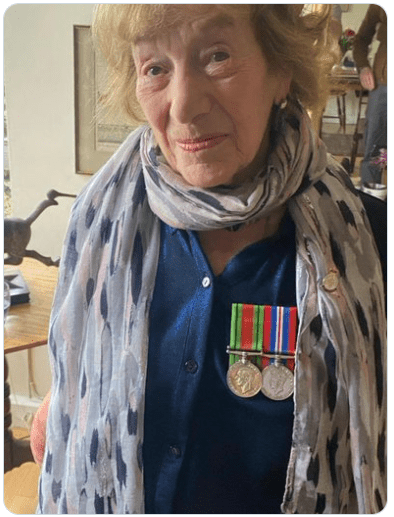
This came home to me when a lady called Ruth Klauber was interviewed on the BBC programme on Bank Holiday Monday.
Ruth is 101 years old and in 1933 her father brought his family to England from a Germany which was just becoming ruled by the Nazi party. He had read Hitler’s book ‘Mein Kampf’ and realized what was happening, not least to Jewish families such as his.
His daughter Ruth settled in England and when War broke out, she decided to join up to share in the fight against Hitler and his dictatorship which was already destroying those in German society who were different and considered ‘impure’. Amongst them of course were Jewish people but also gay people and Romanies.
Ruth joined the Royal Air Force where it was suggested that she might be a cook, or a batwoman, someone who looks after officers’ uniforms! She said ‘no’ to these suggestions so they said, “well, you can be a flight mechanic”. Which she thought might be interesting so that is what she did.
In 1942, she joined an RAF crew fixing the bombers that helped the Allies to turn the tide of the war. These included Lancaster Bombers and she, with a handful of women worked alongside male mechanics. She spoke of working with people from different backgrounds but everyone got on with each other. They grew to trust each other’. This became a key to how we might live and work together on common tasks.
Ruth said,“We all got on together and I just wish we could learn to trust each other. People couldn’t waste time emphasizing differences. We had to learn to work together and just get things done.”
Ruth then had something to say to us today:
“I do think that difference is what people fear and that’s something we have to think about, how we can make it possible (to get on with each other) when there isn’t a common enemy – we need to trust each other more.”
She has lived a long time and has a deep insight and wisdom of the human condition. She is a voice with that common-sense authority which is born out of a life which has been forged in times of persecution, and making the most of things. When she tells us that we must learn to get along with each other and TRUST one another, she speaks to us from the heart. We should listen to her.
A Ponder Quote :
“Even with the most deeply held differences, treating the other person with respect and as a fellow human being, is always a good first step towards a greater understanding.”
-Queen Elizabeth II – Christmas message 2018
Amen to that.
[Mr G]
{}{}{} for more information about Ruth Klauber, there are many articles about including from the Jewish Chronicle.
Sermon preached on the birth of the Virgin Mary with reflection on the death of our beloved Queen, Elizabeth the Second. St Mary-at-Latton by Piers Northam
I always love the story of the young Mary, who is expecting her child, rushing off to the hill country to see her cousin Elizabeth. To begin with, it seems as though it’s going to be a joyful reunion between two friends, but then the Holy Spirit comes to the party, inspiring Elizabeth to cry out:
Blessed are you among women, and blessed is the fruit of your womb!
And the child that she is expecting leaps inside her in recognition of Jesus, the child forming in Mary’s womb. And Elizabeth goes on to acknowledge Mary’s faith and trust in the Lord:
And blessed is she who believed that there would be a fulfilment of what was spoken to her by the Lord.
So as we celebrate the Birth of the Blessed Virgin Mary, we give thanks for the Mother of our Lord: the one who believed and trusted in the God, accepting what was asked of her. And who, in so doing, brought a great blessing on all humanity.
Mary – long foretold by the prophet Isaiah:
‘Hear then, O house of David! […] The Lord himself will give you a sign. Look, the young woman is with child and shall bear a son, and shall name him Immanuel.’
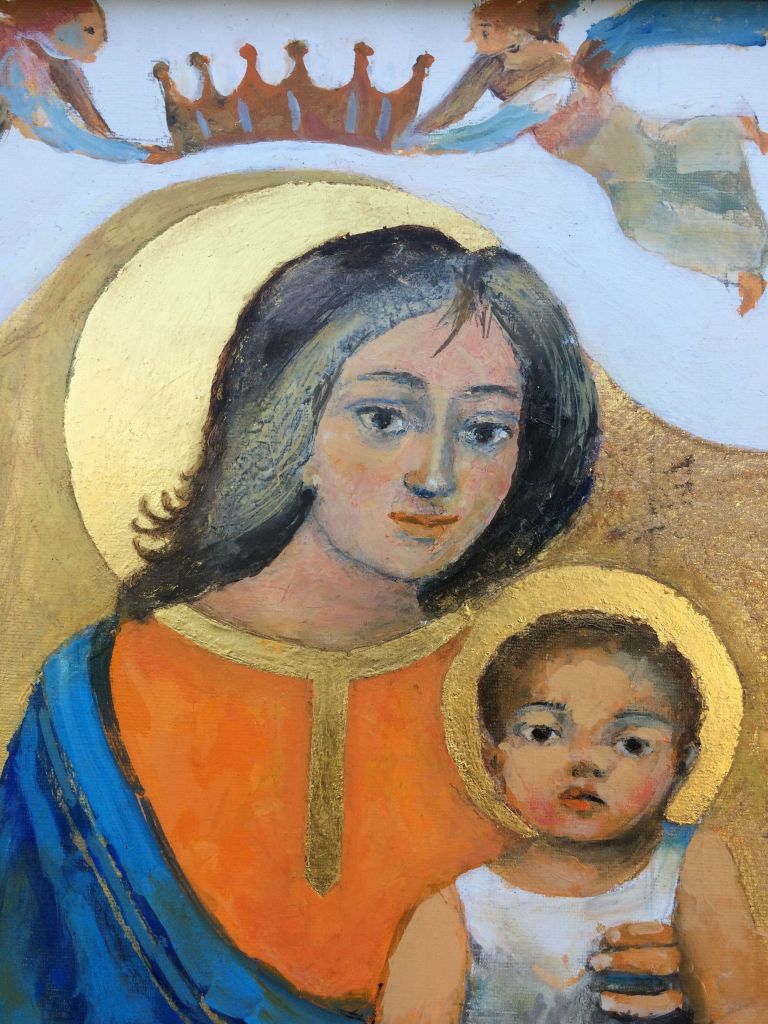
Isaiah foretells the birth of Jesus, and Mary is the sign that the Lord gives; a seemingly weak and vulnerable sign; a seemingly ordinary, insignificant sign; a deeply human sign. She is the person whom God chooses to work with to bring about his plan to draw all humanity to Himself. This choice tells us something of the heart of God, for the sign that he chooses is not a sign of great glory and power, but a sign of vulnerability and simplicity. A simple young woman who will go on to bring his Son – a defenceless baby – into the world.
So who is this Mary? At the beginning of Matthew’s gospel, if you go and look it up, you will see the genealogy of Jesus the Messiah, the descendant of Abraham and of David – because of course Kings and Queens have traceable lineages; complex and often interconnected family trees. So Joseph, Mary’s husband, comes from the lineage of the House of David and can trace his ancestry back to Abraham, the Father of the Nations.
But Mary’s family background is rather less well-defined. Her parents, Joachim and Anne, aren’t mentioned in the Bible itself and only come to us through tradition and the apocryphal proto-Gospel of James, but they are venerated in the Orthodox, Anglican and Roman Catholic Churches. And that’s about all we know of Mary’s background – other than that she had a cousin called Elizabeth whom we see her visiting in this Gospel passage.
And in a way, is her own lineage important? Wherever she has come from, she is the one that God chooses to be the mother of his Son; to bear Jesus into the world and call his name Immanuel (meaning ‘God with us’).
And she stands at the point where the direct traceability and importance of lineage falls away; where, through her son, such things are set aside; where notions of literal family and the importance of bloodline fade; for the family that she fosters through Jesus is not one that can be traced through a family tree. It is one that opens up to include us all. We don’t have to be Jewish and directly descended from the House of David; it doesn’t matter if we’re from Tonga or Finland, from Warsaw or Wolverhampton; it doesn’t matter if we speak Urdu or Welsh, Chinese or Ukrainian, through her son we’re all Mary’s descendants; all members of the family that she made possible by saying ‘yes’ to God.
for the Mighty One has done great things for me, and holy is his name.
For, as we read in Galatians, through Mary, God sent his Son in order to redeem us ‘so that we might receive adoption as children’. Through Jesus, we are no longer slaves, but beloved children; offered a personal and intimate relationship with God – so much so, that we are invited to call him Abba – Daddy.
The Spirit comes into our hearts and encourages us to call Almighty God ‘Father’…
As I read those words, they chimed with words written by King Charles on Thursday:
‘The death of my beloved Mother, Her Majesty The Queen, is a moment of the greatest sadness for me and all members of my family. We mourn profoundly the passing of a cherished Sovereign and a much-loved Mother. I know her loss will be deeply felt throughout the country, the Realms and the Commonwealth, and by countless people around the world.’
In his message we see that same holding together of the two things: the personal and the shared. He and his family are mourning a mother, grandmother, great-grandmother; and we are all mourning the death of our Sovereign – for very many of us the only one we’ve ever known – but one with whom so many of us feel a strong, personal connection.
At the Platinum Jubilee, earlier this summer, the then Prince Charles began his speech ‘Your Majesty… Mummy…’ to huge applause. For Queen Elizabeth inhabited both those roles and in so doing, she became the person who drew us together as a worldwide family – through national ties, but also through ties across the Commonwealth and beyond. She inspired love and that drew people of all races, colours, creeds and classes together. Only yesterday I saw a post on Instagram from one of my ex-students, an American, born and raised, who felt a deep love and connection to Her Majesty – a feeling that transcended borders and nationality. This was her gift and, in her way, like Mary, she made possible a drawing together of people.
For Mary stands at a fulcrum: with Joseph she stands in the Kingly lineage that traces back through time to King David and to Abraham. But she pulls in both directions: her family reaches out to include all people – it is vast, sprawling and global – and yet she also pulls us in and calls us to intimacy and relationship. We are called to know each other as siblings; to care for one another as members of the same family; to see beyond external differences and barriers; boundaries and diversities – and for all of that to fall away and become simple kinship.
Queen Elizabeth’s lineage was very clearly defined with links to Queen Victoria and further back to Margaret of Scotland – the sister of Henry VIII. Her bloodline was well established. But what both Mary, the Mother of our Lord and Queen Elizabeth point to is a move from bloodline to love-line. God’s love for each and every one of us, his beloved children who, through Jesus are drawn into a global and eternal family of love.
Her Majesty, in her Christmas broadcasts, clearly proclaimed her belief in the importance of community: In 2001 she said this:
‘I believe that strong and open communities matter both in good times as well as in bad. Certainly they provide a way of helping one another. Communities also give us an important sense of belonging which is a compelling need in all of us. We all enjoy moments of great happiness and suffer times of profound sadness; the happiness is heightened, the sadness softened when it is shared. But there is more than that. A sense of belonging to a group, which has in common the same desire for a fair and ordered society, helps to overcome differences and misunderstanding by reducing prejudice, ignorance and fear. We all have something to learn from one another, whatever our faith… whatever our background, whether we be young or old.’
But her understanding went further than that, saying in 2007:
Jesus of Nazareth reached out and made friends with people whom others ignored or despised. It was in this way that he proclaimed his belief that, in the end, we are all brothers and sisters in one human family.
As I have listened to tributes being made to Queen Elizabeth over the last few days, two themes have emerged for me: one is that she had a deep interest and love for people. At an individual level, so many have talked of how when they met her, she paid them her full attention; really listening to them; entirely focused on them during their exchange. There is that sense that in so doing, she honoured their identity, openly and without judgement.
And the other theme is the way that at a national and international level, she was able to draw us together; to point to something bigger than our own private concerns. Her ability to forge a connection with us; to show her love and care and concern for us in that long, long life of service – service to the Nation, the Commonwealth and the wider global community;– has helped us to feel that vital sense of connection to each other; helped us to see beyond ourselves and given us a sense of belonging.
All of this sprang from her deep faith and trust in God. Mary’s cousin Elizabeth could equally well have been speaking of The Queen when she said of Mary:
And blessed is she who believed that there would be a fulfilment of what was spoken to her by the Lord.’
Both these women – Her Majesty, Queen Elizabeth and the Blessed Virgin Mary – had profound faith and trust in God and it allowed them to do great things.
So my prayer is that we might honour them both
by following their example;
by trusting in the goodness of God and his ability to do great things;
by looking beyond ourselves to others;
by seeking to draw all people into family;
by honouring each of God’s beloved children who are our brothers and sisters;
It’s a prayer perhaps best summed up in the opening words of a favourite blessing of Queen Elizabeth’s.
Go forth into the world in peace; be of good courage; hold fast that which is good; render to no one evil for evil; strengthen the fainthearted; support the weak; help the afflicted; honour all people; love and serve the Lord, rejoicing in the power of the Holy Spirit.
 Mr G's Ponderings