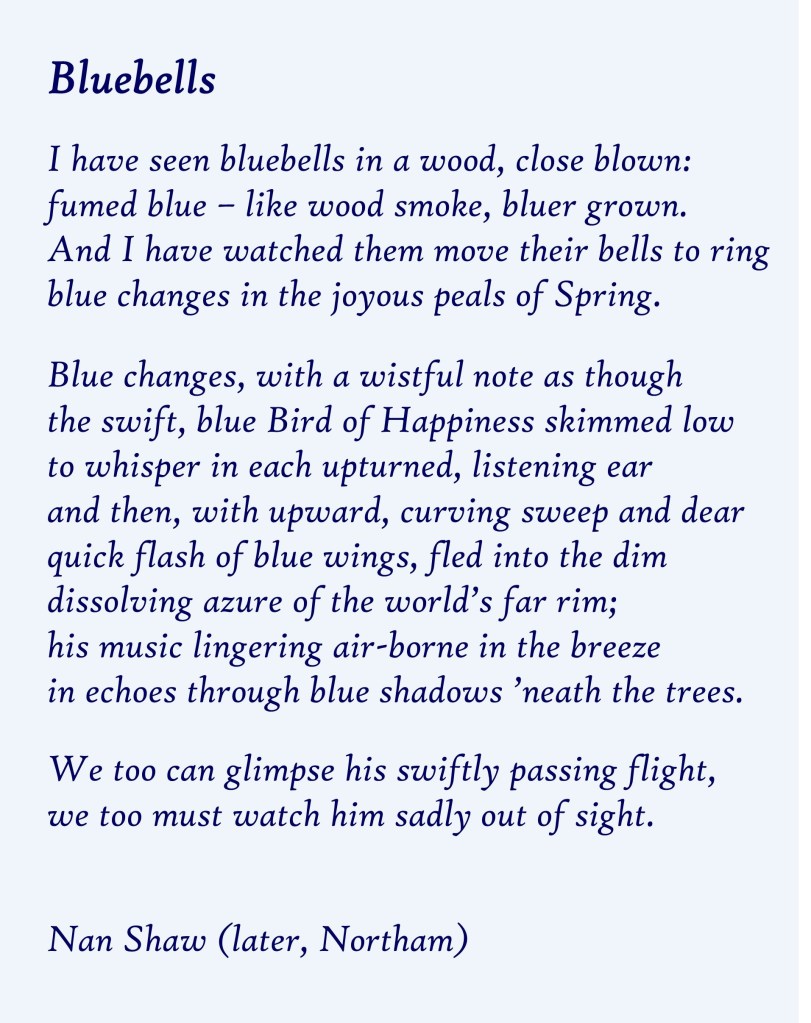
This poem was written in the 1930’s by a dear friend of mine, Nan Northam It seems good to celebrate Rogationtide as a way of a rite of passage in Spring and a thanksgiving for creation.
O GOD, we thank you for this earth, our home; for the wide sky and the blessed sun, for the ocean and streams, for the towering hills and the whispering wind, for the trees and green grass. We thank you for our senses by which we hear the songs of birds, and see the splendour of fields of golden wheat, and taste autumn’s fruit, and rejoice in the feel of snow, and smell the breath of spring flowers.
GRANT US a heart opened wide to all this beauty; and save us from being so blind that we pass unseeing when even the common thornbush is aflame with your glory.
We come to God with seeds of divinity tucked deep inside us and he tends and cares for us, enabling us to grow, to put down roots and send out branches… (Piers Northam)
Rogation
The days before Ascension Day are known in the Church as Rogation days. The word Rogation comes from the Latin rogare meaning to ask.In the Book of Common Prayer, the Gospel for this Sunday includes the words of Jesus ‘Whatsoever ye shall ask for in my Name, I will give it you’.
Traditionally what is asked for during this period before Ascension Day is for God to bless the crops. It is a religious festival observed these days more in the countryside than in the town but all of us need to give thanks not only for the food we eat but also for those who work to provide it — Farmers and sea fishermen in this country and many others throughout the world. We take so many of these for granted and often care little to know how the food reached the supermarket shelves.
It’s the same, of course, with other goods made cheaply in the Third World. It is only when events like the collapse of a factory in Bangladesh hit the headlines that we begin to question the ethics of slave-labour and inhuman working conditions. Labels saying made in India, made in China, etc are giveaways. Such goods are more than likely made cheaply and using slave-labour. Unless we want a troubled conscience, it’s best not to think of that!
But, Christians are working for a fairer world in which workers are respected, given decent conditions in the workplace, and given a fair wage. We are also at war with the child abuse which sends small children into factories. Historians can remind us that in Victorian times we sent them up chimneys but hopefully we’ve moved on from that. We want other countries to move on too. Which is where agencies like Christian Aid come in. Christian Aid is a charity set up by British Churches who work through the Church communities of the third world. So it’s our Charity and through its agency it does a number of things on our behalf.
First and foremost it helps the world’s poor in pragmatic ways through direct help in fighting poverty, malnutrition and disease. It works through local people in order to help them own the work being done. Christian Aid also challenges Governments including our own. Much that passes for overseas aid is tied aid. It helps our own industry as much as it helps the poor. There are often conditions placed on the aid we give. And, of course, Governments can withdraw such Aid whenever they like, often without discussion. This leaves the country being helped in a desperate plight. So Christian Aid is political though not in the party sense.
It challenges not just Governments but Industry, commerce, and all who make money out of the poor. It is a legitimate part of Christian Aid’s work. It also challenges us as individual Christians and as Church communities. It challenges us to pray for the world’s poor and to be in solidarity with them. It challenges us too to act fairly in the things we buy.
One of the great successes of Christians working with others is the Fair Trade movement. Even the most die-hard supermarkets stock some Fair Trade goods these days. Not more than 10 years ago, you could only buy Fair Trade goods in the Co-op and in the Oxfam shop. Today Fairtrade is more widespread. In Churches, Traidcraft stalls are also more popular and are making a big difference to Third world towns, villages, hamlets. Those making the goods we buy are happier, better provided for and, most of all, they are given human dignity. They can be proud of what they make and we can be both proud and humbled in buying those things.
It is no accident that Christian Aid Week comes usually near to Rogationtide. Those taking out envelopes, distibuting leaflets and those organizing events are asking. They are asking people to share amazing week when ordinary people throughout the land, giving small and large amounts, are really making a difference and changing lives.
Alongside the asking comes the thanking. In asking for justice, mercy and love for the third world we are mindful of the rich and bountiful provision God has made for all who live on Planet Earth. God has also given the means to replenish the land and the sea so that all can be fed, watered, sheltered and fulfilled, The fact that we misuse and abuse this is not God’s fault. If the World Governments willed it, poverty could be ended at a stroke. But it isn’t and whilst we might ask why not, it will be God who will make the final judgement. It has been said that when we meet God the question he will ask each one of us is, How much have you loved? It demands more than words for an answer. Those who withhold what can help others should not be surprised if God is not impressed! St. Ambrose, long ago, said that when we give to the poor we are merely giving back to them the portion that is rightly theirs. What he said is worth considering at Rogationtide.
It is not from your own possessions that you are bestowing alms on the poor, you are but restoring to them what is theirs by right. For what was given to everyone for the use of all, you have taken for your exclusive use. The earth belongs not to the rich, but to everyone. Thus, far from giving lavishly, you are but paying part of your debt.
St. Ambrose.
Almighty and eternal God, you crown the year with your goodness and give us the fruits of the earth in their season: grant that we may use them to your glory; so that none may hunger, none may thirst, and all may cherish the gifts of your creation; through Jesus Christ, our Lord, who lives and reigns with you, in the unity of the Holy Spirit, one God, world without end.
Rogation (meaning ’to ask’) has traditionally been a time when we ask for God’s blessing on the land and the crops growing in the fields. This was combined with a tradition known as ‘beating the bounds’. A Church procession would walk the boundary of the parish, pausing to pray for God’s bountiful goodness for the farming community as well as ensuring the parish boundary was observed and marked. I know of an ancient custom in the Northern town of Oldham of erecting seven crosses around the boundary of the parish thus claiming – or re-claiming – the land for God (and, less spiritually, ensuring that tithes were paid to the Church!)
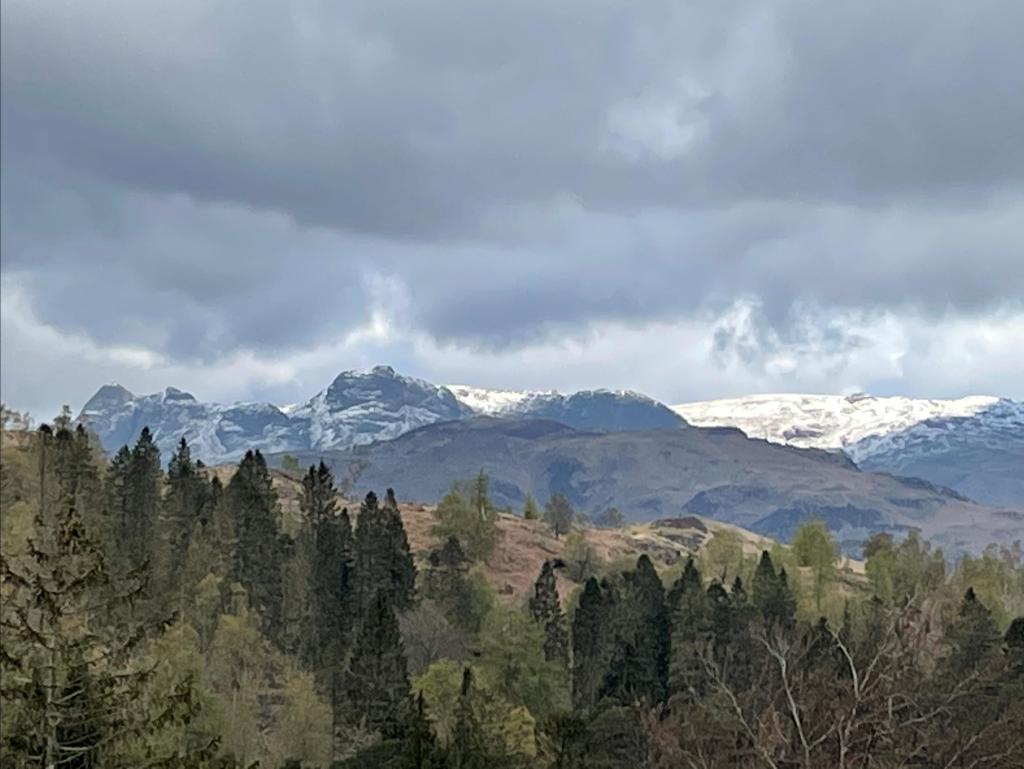
When I lived deep in the countryside, we fought shy of actually beating the bounds because a part of the boundary was up a fell which peaked at 1059 ft. Whilst it would have been easy for a fit person like myself, (I may be telling an untruth here) we had to consider more delicate flowers in the congregation. So we contented ourselves with a gentle ramble through bluebell woods and an open air service at the local Scout camp. I think Gill Henwood, who took this photo of Langdale Pikes draped with snow last week, may well remember the bluebell wood walk.
The priest/poet George Herbert, writing in 1630 commended the custom for 4 reasons:
As a blessing of God on the fruits of the field.
As justice in the preservation of the boundaries.
As an act of charity in loving, walking and neighbourly accompanying one another, reconciling differences and forgiving wrongs.
As an act of mercy: as the blessing of God was invoked, the people were to be mindful of the needs of the poor and give them what was needed for their well-being.
This blessing of God’s earth was sometimes given a wide interpretation! Once, when I told a clergy friend about our bluebell walk, he responded rather sniffily that he had done something much more spectacular – he had blessed the Atlantic Ocean. So there!
As he was Vicar of a landlocked parish up on the North Lancashire moors I expressed my disbelief. So he told me:
“We had a service at one of our local farms and running through it was a little stream. I blessed that. The stream flows into a local river which then joins the River Ribble. The Ribble flows into Morecambe Bay and from there to the Irish Sea which eventually becomes the Atlantic Ocean.So I blessed the Atlantic Ocean.“
I had to give it to him – he either had a fanciful imagination or a big, big vision!
God has a big vision for his world and for all he has created. We tarnish that vision with our selfishness and our failure to bless, care for and feed a world in great need. Our desire for the well-being of others and a healing for our earth are needs that we have to respond to as well. It is no accident that Christian Aid Week, when money is raised to help countries and peoples less fortunate than ourselves, is linked to Rogationtide. At a time of blessing, we should become people of blessing to others. I write this just days after we have been told that Her Majesty’s Government has considerably reduced aid given to developing countries. This is, in my view, a lack of vision and also a failure to see that Global means Global (to recoin a phrase!). As the Psalmist reminds us:
The earth is the Lord’s and all that is in it, the world, and those who live in it. (Psalm 24. 1)
Never more than today is that vision needed for India, Brazil and so many other places on our planet. It isn’t enough to look after ourselves – the vaccines God has given us the knowledge to find are not our property but for sharing.
As St. Ambrose says:
“It is not from your own possessions that you are bestowing alms on the poor, you are but restoring to them what is theirs by right. For what was given to everyone for the use of all, you have taken for your exclusive use. The earth belongs not to the rich, but to everyone. Thus, far from giving lavishly, you are but paying part of your debt.”
It is hard to argue with St Ambrose, but why should you want to?
In Britain, Christian Aid Weekthis year is 10th—16th May.Because of Covid, door to door collections are risky for collectors.
If you wish to help the poor, the hungry, the sick and needy, please visit Christian Aid’s Website or support through the Roman Catholic CAFOD website.


 Mr G's Ponderings