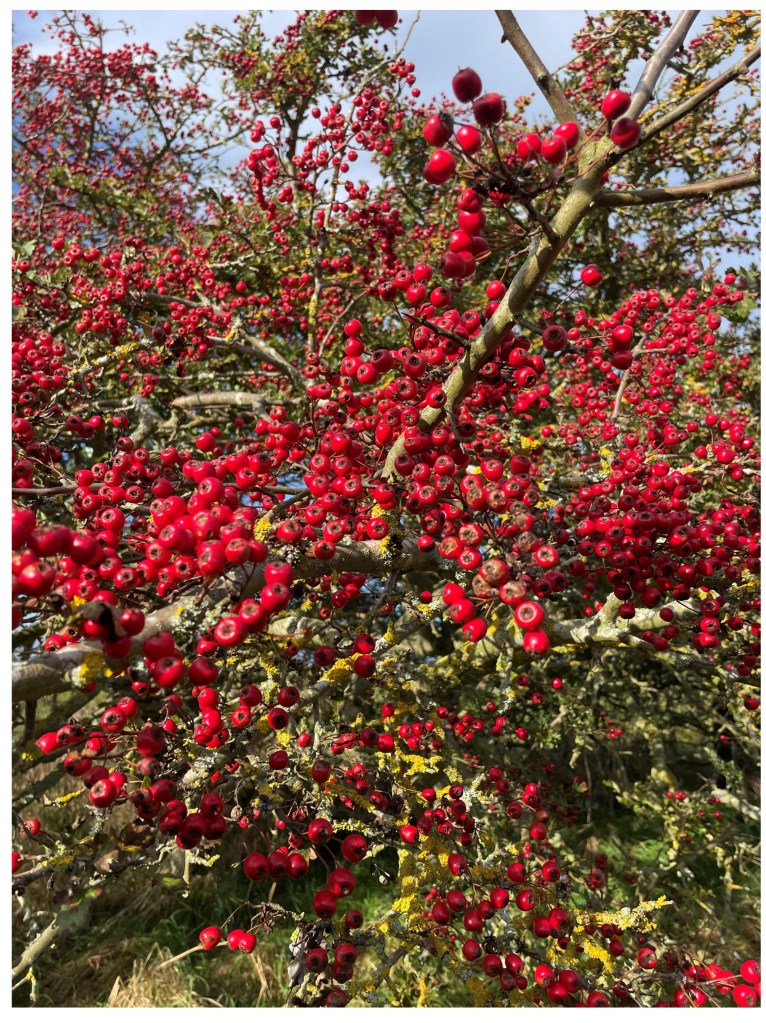
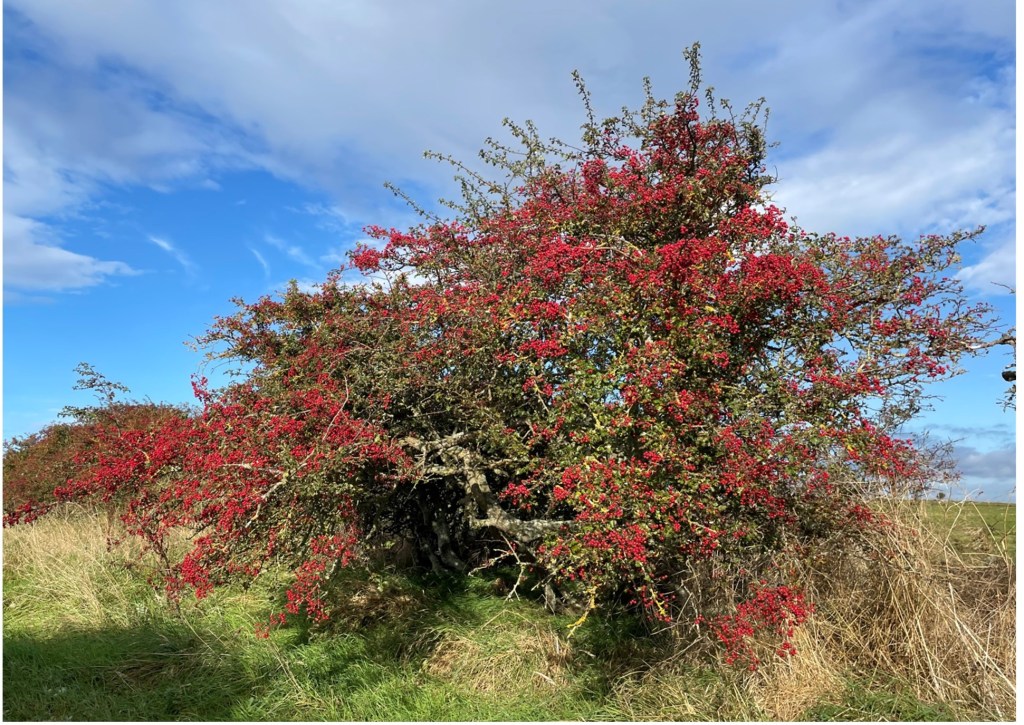
Photo by Gill Henwood of Hawthorn bush on Lindisfarne.
My friend, Gill Henwood, has sent me photos of a Hawthorn bush on the Holy Island of Lindisfarne, in all its autumn finery. It is too delicious not to share it.
The Woodland Trust says that the Hawthorn has great value to wildlife. “Common hawthorn can support hundreds of other species. It is the foodplant for caterpillars of moths, including the hawthorn, orchard ermine, pear leaf blister, rhomboid tortrix, light emerald, lackey, vapourer, fruitlet-mining tortrix, small eggar and lappet moths. Its flowers are eaten by dormice and provide nectar and pollen for bees and other pollinating insects. The haws are rich in antioxidants and are eaten by migrating birds, such as redwings, fieldfares and thrushes, as well as small mammals. The dense, thorny foliage makes fantastic nesting shelter for many species of bird.”
Autumn dripping leaves of weary gold Exits quietly, fading through the trees. Hawthorn shakes her cloak of ruby fire. Naked to the woods and twisting breeze….. … Winter’s breath now lingers in the air.
The human reputation about care and preservation of Nature and God’s Creation is not always a good one. On the whole humans are more prone to exploitation, persecution, destruction than we are on preservation and protection. A reading of the poem of Creation, which begins the book of Genesis in the Bible, could convince us that human beings have a superior place in the pecking order of Creation. Indeed the writer of the poem observes that according to God’s word we are to subdue the world and have dominion over every living thing. This has led to a view that we have power over Creation which is exercised through control and domination. A development of this is that everything exists for the sake and use of the human race. This has led to a wanton destruction of the natural world—animals, birds, creatures of the sea and also of the natural resources which we have exploited for our own ends. Too often we have lost sight of something else expressed in the Genesis Creation poem, that everything in precious in the sight of God, the Creator. He clothes the lilies of the field and he watches over the birds of the air. Alongside the idea of ‘dominion’ is the principle of stewardship. We are custodians of the earth and of the world of nature and we are to be stewards. Stewards have to give account of their stewardship—and to God. So it is good to highlight something good that we have done in this respect.
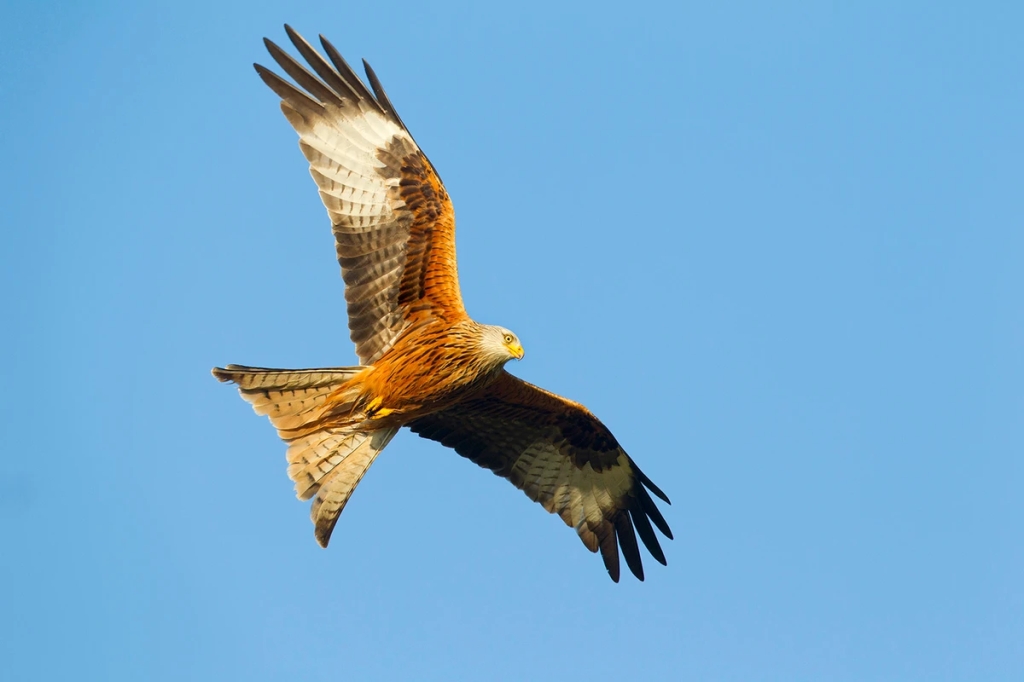
I was reading recently about the successful project to save the Red Kite bird of prey which was facing extinction. I first met these birds a few years ago when I was walking along the Ridgeway on the Buckingham/Oxfordshire border. My attention was attracted by large swooping birds which danced and wheeled on the horizon and then through the valley below before soaring up into the sky way above my head. These birds were common in Shakespeare’s time. He mentions them in some of his plays. In later times, they had a particular function when they were common in towns and cities where they scavenged for scraps. It was a crime to kill one as they were so useful for rubbish management. Then things changed for them. Persecuted and made almost extinct, these amazing birds with their 185cm wingspan and striking eyes were in great danger. Successful reintroduction projects have now helped the species to recover. They can be seen in a number of places. The best areas to find them in the UK are central Wales, central England – especially the Chilterns, central Scotland – at Argaty and along the Galloway Kite Trail. They are a protected species under Schedule 1 of The Wildlife and Countryside Act.
Woodland Trust
RED KITES (Poem) GC 19.6.2023
We soar and swirl on the uplift of the wind swooping gracefully, wheeling majestically. Free to be.
It was not ever thus. Humans hated us, hunted, poisoned, drove us away on orgy of persecution. Lordship over the earth, over the world of nature, is seemingly always stronger than stewardship.
A new choreography for our dance of life was composed, nurturing, protecting the few of us left but we did not trust them.
Yet over time, hesitantly, responding to infinite patience and soft actions, we became tender again to each other. We bore young who knew no fear nor the hate of others. Springing into life they took flight, joyfully circling and chasing and with speed. Quite a performance!
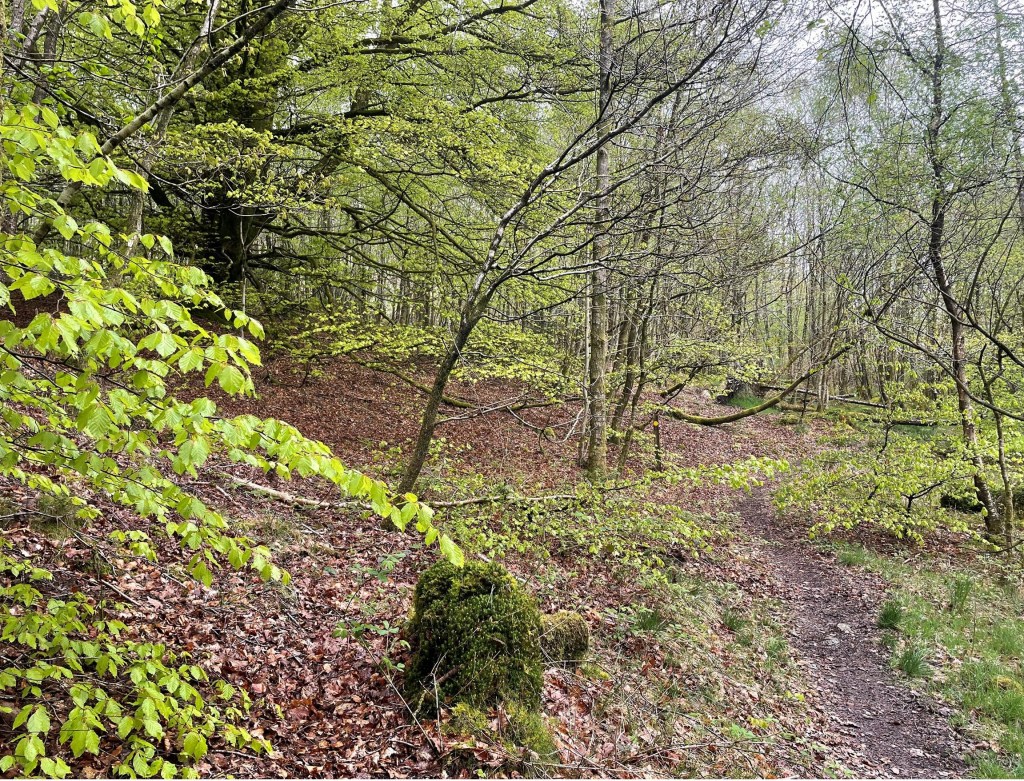
Photo by Gill Henwood. The old Beech reclothed in finest greenery
After a concentrated time in the heart of a rather wet London (albeit in front of the television screen!) it’s good to move away on the day after King Charles & Queen Camilla’s Coronation into the more tranquil climes of English woodland awakening fresh in the Maytime light.
So when my friend Gill Henwood sent me some more photographs of nature filling all around with beauty and expectation, I exchanged the joyful emotions of pageant and symbol and human pledging of life to a new degree of service, for something rather different.
In the woodlands and countryside of the Northern hills of the Lake District a busy beauty is going on as plants, new-born lambs and birds and creeping things and teeming fish playing joyfully, splashing through waterfalls. We are well into the wonders of new-birth as Eastertide unfolds and spirit-filled life offers a new joy.
So, Gill speaks of the emergence of the Lousewort and other signs of new growth:
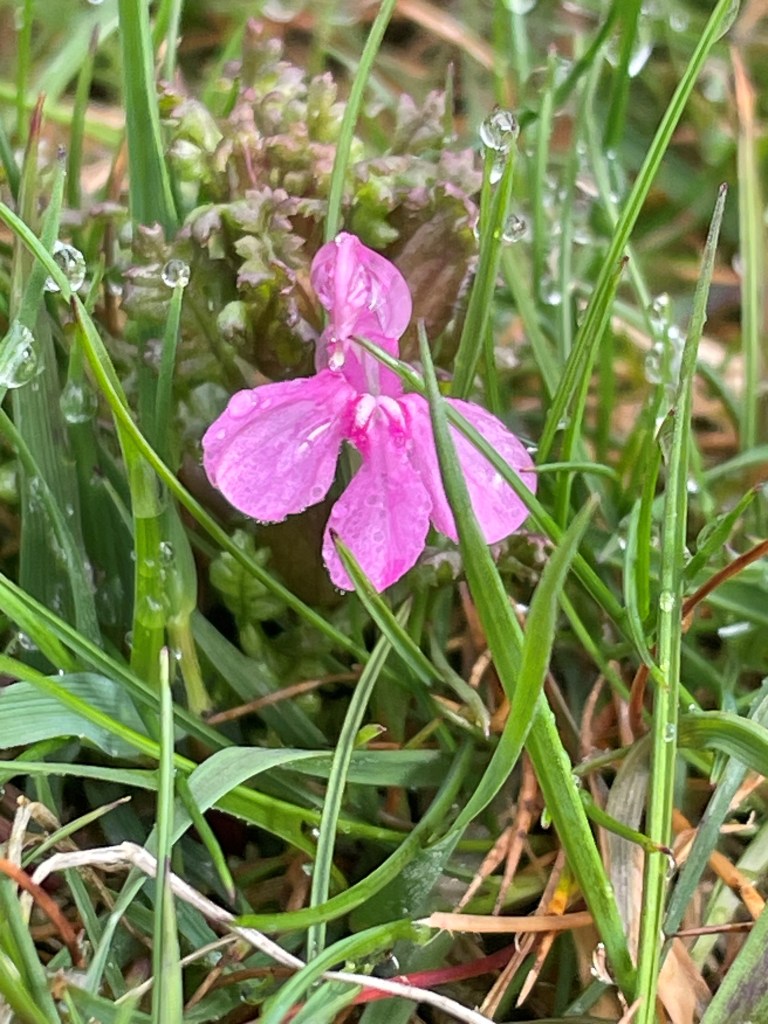
Lousewort flower, photographed by Gill
“Tiny pink heath plant just in flower for the coronation weekend. 5mm across, a sign of the heaths and high meadows coming into growth. No sign yet of the hundreds of orchids that flowered in this field in 2020, during lockdown when no cattle were grazing the field.
A new spring and a new royal era – eastertide hope of renewal after loss and bereavement.
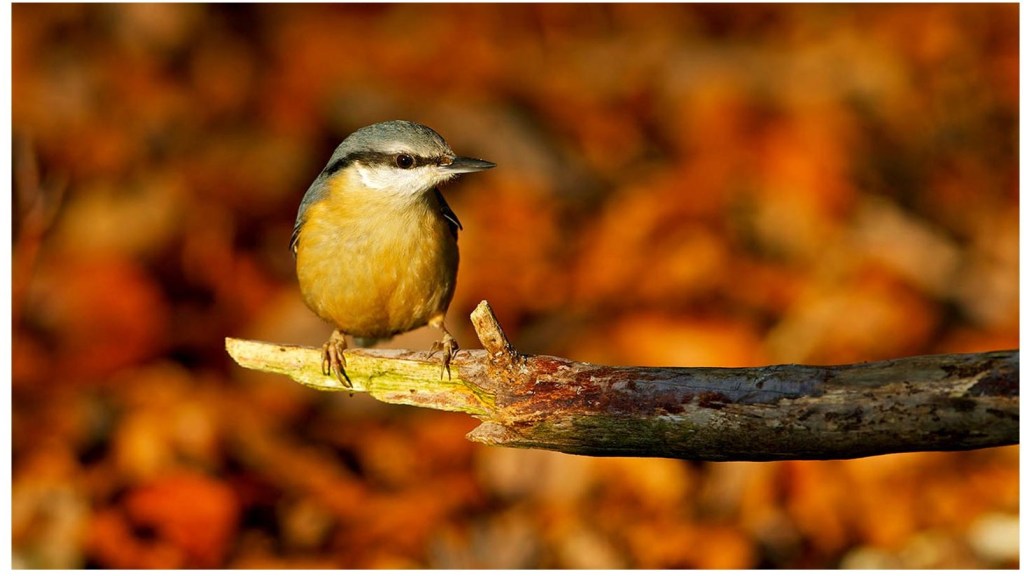
“And the songbirds are singing their choral anthem all around, with a cuckoo punctuation. Now the nuthatch is sounding its single-note call, it’s time to stroll through the newly furnished delicate dewy leaves of the beeches…“
photo of Nuthatch c/o Woodland Trust.
This is also the ancient time of Beltane, of May and summer’s beginning.
“– the dainty woodland floor and hedgerow flowers are all compact and individually almost missed. Primroses, violets, greater stitchwort and even native drooping headed bluebells make their impact growing together. A patterned tapestry on a bank and an unfurling mosaic on a heath or in the woods. Responding to long days of light and the increasing warmth of the sun towards the June solstice.
A parable in nature of Gods love given in and through all creation – if only we stop and notice the myriad glimpses all around us….“
Photo: Gill Henwood
Take a breather.
Breathe, be filled with amazement, purposefulness,


 Mr G's Ponderings