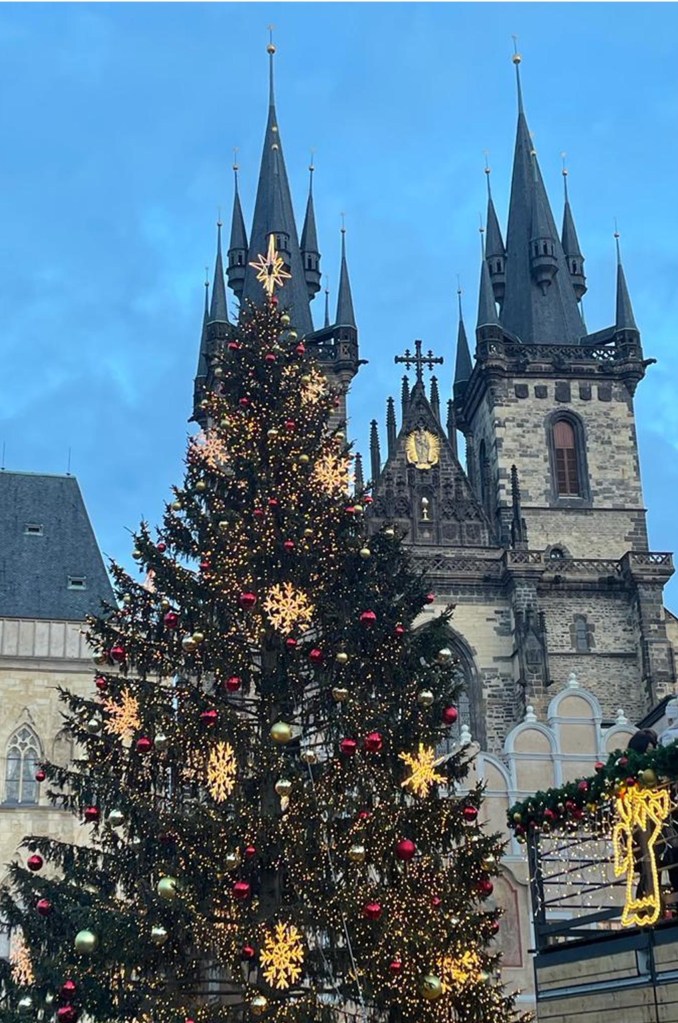
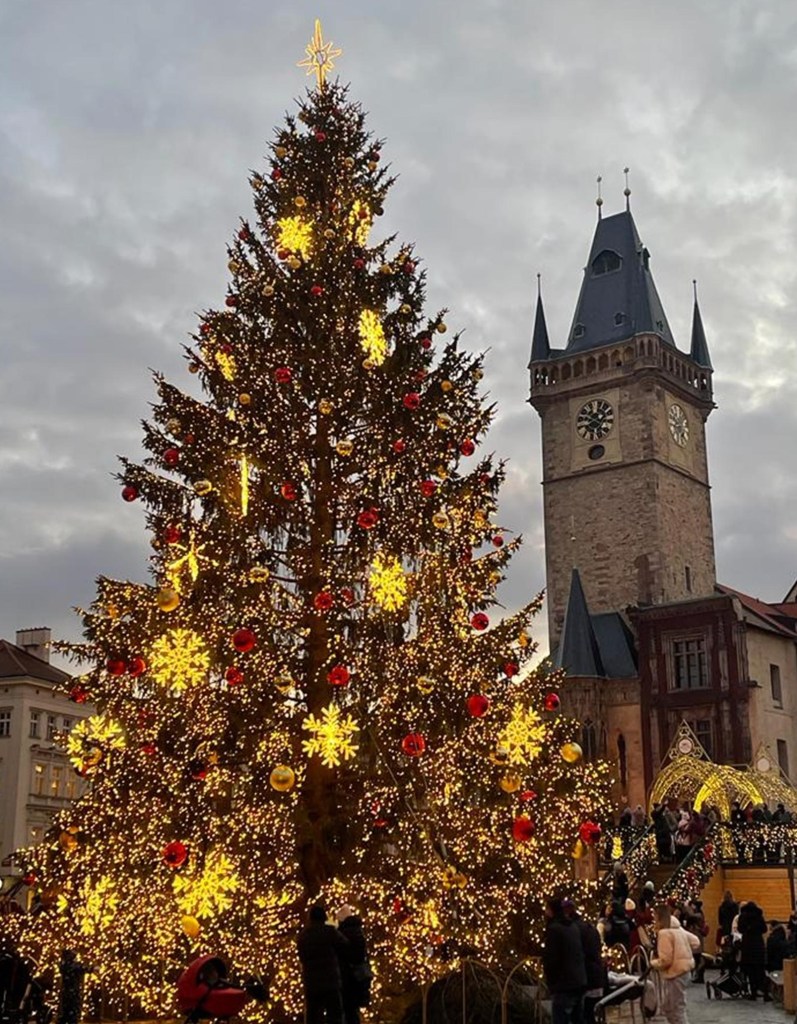
My friend Gill has sent me more photos of Prague getting ready for Christmas. As Christmas approaches there is a build up of excitement in many places. We wait to celebrate, yet again, the Christ-child. We wait, but perhaps we need to ask ourselves. Who waits for whom? Here is a prayer adapted from the renowned Dutch theologian and poet, Huub Oosterhuis, who takes a different view and suggests that it is God who is waiting for us. ‘
Here’s a prayer he wrote. Try to pray it and see what insight it brings.
You wait for us until we are open to you. We wait for your word to make us receptive.
Attune us to your voice to your silence, Speak and bring your Son to us – Jesus, the word of your peace. Your word is near, O Lord our God your grace is near.
Come to us, then, with mildness and power. Do not let us be deaf to you, but make us receptive and open to Jesus Christ your Son, who will come to look for us and save us today and every day for ever and ever.
You, God, arouse faith in our hearts, whoever we are. You know and accept all your people, whatever their thoughts are of you. Speak to the world, then, your word, Come with your heaven among us, give to good and to bad your Son, For ever and ever.
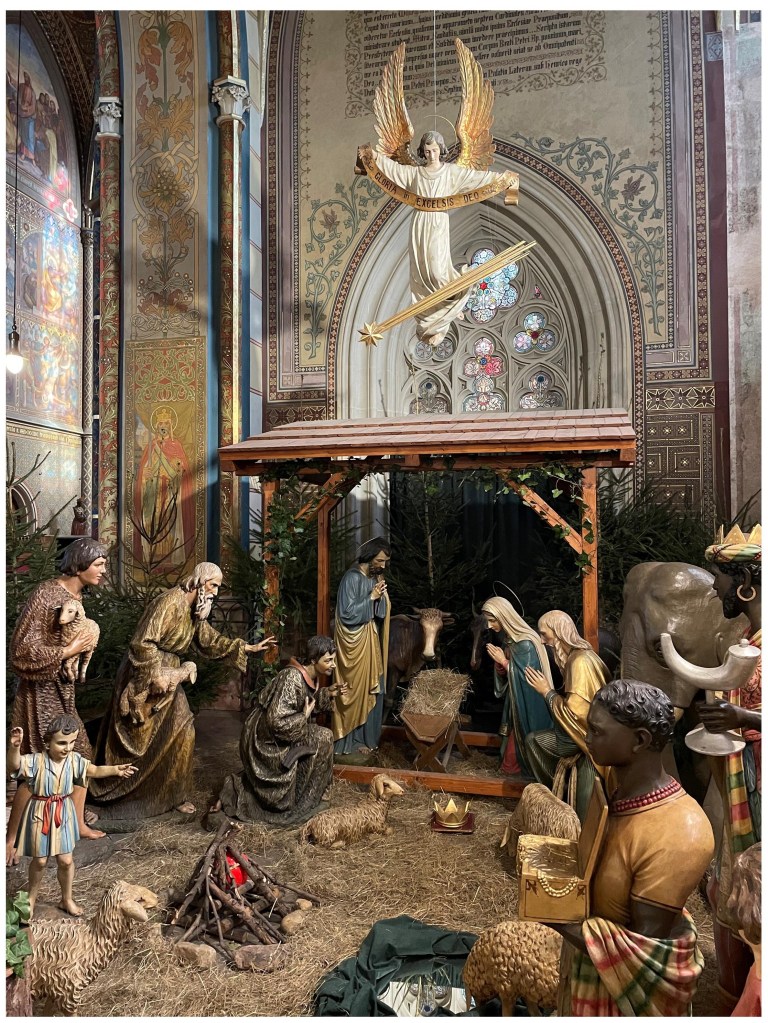
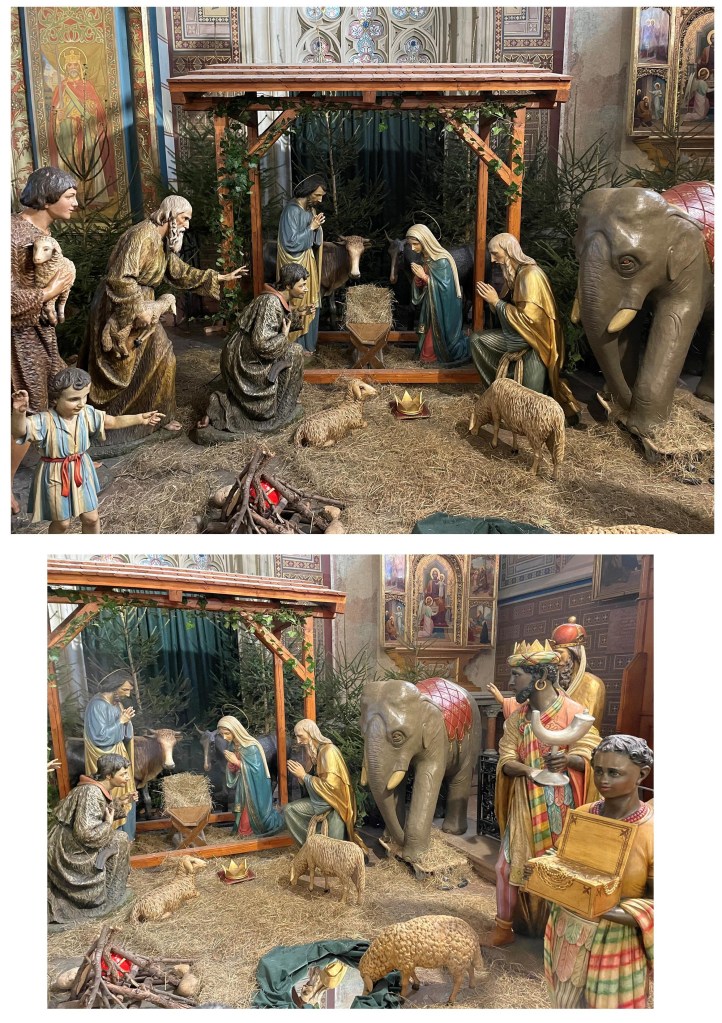
‘Bethlehem’ at the Basilica of St Peter & St Paul, Prague. Photoby Gill Henwood
My friend Gill Henwood is joining the people of Prague as they wait to celebrate the birth of the Christ –Child at Christmas. Here are some photos she has sent of the crib scene in the basilica of St. Peter & St Paul. When I first visited Prague in 1993 the churches were only just being restored after the ravages of communism, and the celebration of Christmas was less exuberant. Gill writes…
Greetings from Prague! and SS Peter & Paul Basilica ‘Bethlehem’, as they call their crib scenes. This is the only one seen so far with the manger waiting for the birth of the Christ child in the dark night of Christmas Eve. We have noticed that the wise men are accompanied by an elephant (and a camel, usually), which is a new thought for our crib scenes at home! Families bring little children to see, and hear the story. School groups seem to be taken to visit too. There are fewer tourists this year, so local people are much in evidence, enjoying their beautiful city.
There are two very lifelike shaggy sheep by the Charles Bridge with just an angel, each made from hay and straw. Perhaps they’re being rounded up!
Adapted from an Advent sermon preached by Piers Northam at St Mary-at-Latton.
On this fourth Sunday of Advent we’ve just lit the fourth candle in our Advent Ring – saving the central, white candle for Christmas when we will light it to acknowledge the birth of the Christ-child, the Light of the World.
Each week through Advent, as we’ve lit the four smaller candles, we’ve remembered figures from Scripture who have pointed to God and to the coming Messiah. In the first week, we gave thanks for the Patriarchs (the likes of Abraham and Moses) who long ago answered calls from God and drew the people to him. In the second week it was the Prophets, who point us to God but who also warn us of things to come, who call us to account and have visions and messages for us. Last week it was the turn of John the Baptist – the voice in the wilderness calling people to prepare the way for the coming Messiah. And this week it is Mary herself – the God-bearer – who will bring Christ into the world.
As I was thinking about these candles, it struck me that the first two tell us about where we have come from – the heritage that we have in the Patriarchs and the Prophets – whilst the second two, in the persons of John and Mary, point us how we should be.
John proclaimed the Good News, called people to repent – to turn around so as to come closer to God – and, more than anything else, he pointed to Jesus; led people to Jesus. Think of this morning’s story of Mary’s visit to her cousin Elizabeth: even before he was born, John was pointing towards Jesus, for didn’t his mother Elizabeth came to understand the importance of the child that Mary was carrying because John leapt in her womb? And of course we are called to follow John’s example: to share the Good News, to turn ourselves to God and to point people to Jesus…
And then we see Mary, the expectant mother who carried Jesus inside her, filled with the Holy Spirit and speaking prophetically in her great song, the Magnificat.
But this story is also about two ordinary women called by God to extraordinary things – chosen by God to help play out his plan. Elizabeth and Zechariah, like Abraham and Sarah so many centuries before, were childless, but in their advancing years, God gives them the surprising gift of a son who is destined for important things.
And then he sends Gabriel to Mary and, in the words of a poem by Denise Levertov,
‘God waited. She was free to accept or refuse, choice integral to humanness.’ [1]
Mary has the choice – and has sufficient faith and trust in God to say yes. But for me, the fact that Mary, whilst clearly exceptional, is an ordinary human being – that she’s not some immaculate, semi-divine super-woman – is really important: because it says so much about the way that God involves himself in our lives. God chooses a simple, young girl to be the mother of his Son; to bear God in her womb. As Mary herself says: ‘The Mighty One has done great things for me, and holy is his name.’ [2]
She affirms that in his Holiness God can do great things for us. She may be talking of herself, yet what she proclaims can be true for everyone who engages with God. The Mighty One can do great things for us – and I would want to add that he can do great things, through us… Mary’s experience is one of working with God so that together they can bring Jesus into the world. And we see a similar approach in the way that Jesus later entrusts his mission to that motley band of friends and followers: women, tax collectors, fishermen and the like whom he gathers around himself; and how that mission, in turn, is entrusted to us.
Mary’s song begins by telling us how the Mighty Lord has brought blessing on her life, but then she goes on – in the vein of the prophets – to tell us about the nature of God and of his topsy-turvy vision for the world. And this is the radical stuff; the counter-intuitive stuff that normal society wouldn’t recognise as she talks of the values of the Kingdom: – She speaks of God’s mercy to those who fear him; for those who see their need of God. – She speaks of his faithfulness down the generations. – She speaks of how he lifts up the lowly, the poor, the dispossessed; the humble and meek – her message is Good News for all those on the margins; those who are excluded and side-lined; but her words are also a warning for those who misuse worldly power; who are proud and rich. To all those who turn a blind eye to the poverty and struggle that surrounds us. – She speaks of how he feeds the hungry with good things; and is concerned for those who need protection – this is where his heart is… – And finally, she speaks of how he keeps his long-held promises; promises made to the people of Israel, but which, in Jesus apply to all humanity…
These powerful, radical words are spoken by a young woman in first century Palestine – not your classic mouthpiece. I’m guessing that such words, spoken by a young, poor Middle Eastern woman today, wouldn’t get much exposure on the world stage. Our society seems more set on condemning such people to live in refugee camps or letting them drown in the Channel than listening to what they might have to tell us. Yet even if they aren’t saying such things in so many words, doesn’t the simple fact that so many live in such fear and misery on our very borders and hidden in our societies shout the message loud and clear?
Mary’s words resonate as an urgent warning:
He has scattered the proud in the thoughts of their hearts. He has brought down the powerful from their thrones and lifted up the lowly; he has filled the hungry with good things, and sent the rich away empty… [3]
Her words put me in mind of those words from Isaiah which Jesus reads out in the synagogue and which we have taken as our inspiration for the Good News Project here at Latton:
‘The spirit of the Lord God is upon me, because the Lord has anointed me; he has sent me to bring good news to the oppressed, to bind up the broken-hearted, to proclaim liberty to the captives, and release to the prisoners’ [4]
This is the promise held in the Christ-child, but also in those who follow him. These words hold the same challenge to question the values of society and to turn things around. Powerful stuff…
There’s a danger at Christmas that Mary becomes this sweet, but rather meek, mute, Christmas card figure – all pretty and adoring and dressed in blue; but this morning we see her, filled with the Holy Spirit, proclaiming radical, dangerous, political words…
This is anything but chocolate-box. Mary is being both prophet and God-bearer; radical in her speech as she is nurturing in her motherhood. And we need these uncomfortable words to challenge us out of our complacency; to bring us up short and stop us coasting along on autopilot; to help us see beyond our own lives to where God’s concerns lie.
Mary experienced the mystery of the Incarnation – God becoming human in Jesus – in the most intimate and physical of ways. But we are each of us called to be God-bearers. To carry God within ourselves; allowing him to shape our view of the world; giving us the courage to stand up, like Mary, and speak truth to power; to sing her prophetic and radical song and to shine with the light of Christ, so that, with him, we can bring God’s values and vision to bear in the world.
That’s the real challenge – the living gift at the heart of Christmas.
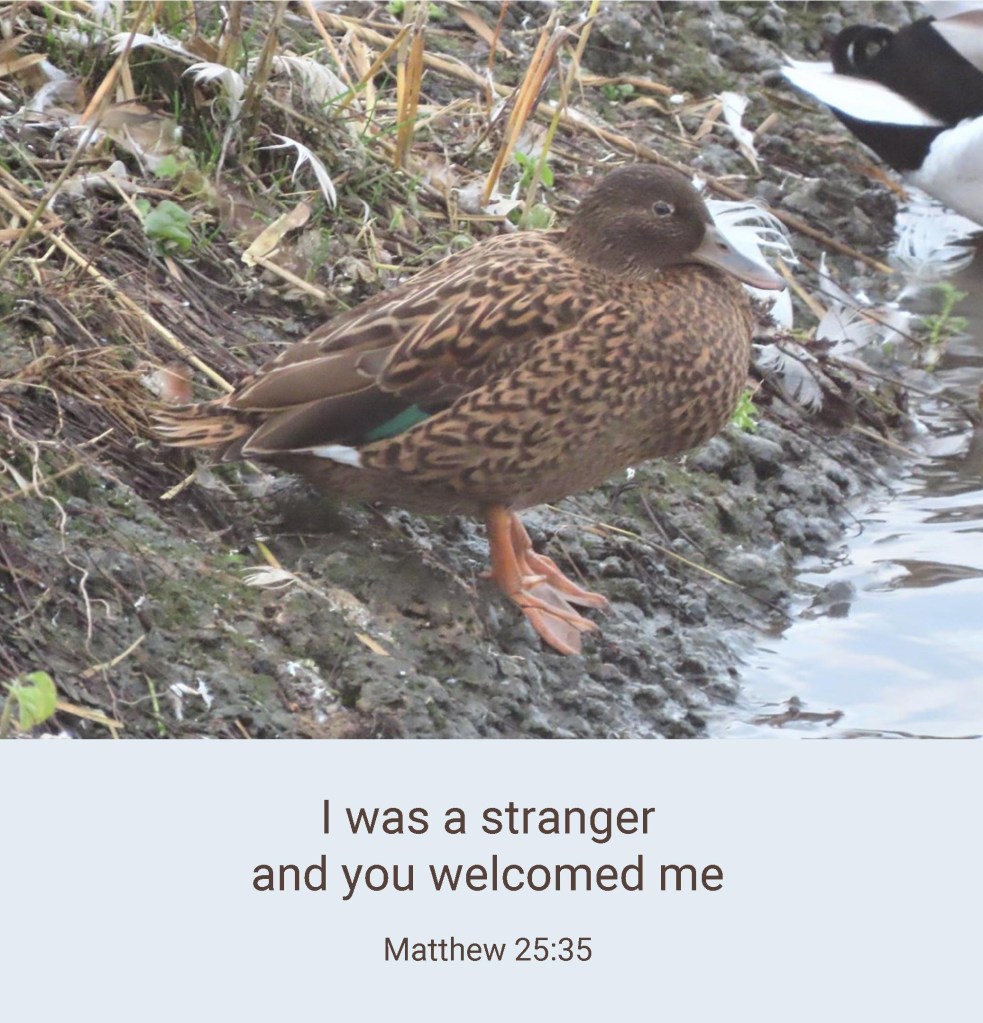
Joyce sent this picture tweet recently. She commented: In spite of being a stranger, this lone Laysan Teal seems to have been accepted by the other waterfowl at Welney nature reserve. It got me thinking about hospitality.
There is an ancient rune or poem about Celtic Hospitality which begins:
I saw a stranger yestere’en: I put food in the eating place, Drink in the drinking place, Music in the listening place.
All this because the guest brings a blessing from God because, as the poem ends:
Often, often, often Goes the Christ in the stranger’s guise.
The idea of seeing Christ Jesus in others, especially in strangers and visitors has its root in early church practice. It was particularly central to the teaching of St. Benedict. St. Benedict wrote a rule for living, for his monks, which has become enshrined in the practice of Benedictine communities and the wider Christian Church ever since. Amongst the things he put into his rule, St. Benedict said this:
All visitors who call are to be welcomed as if they were Christ, for he will one day say: I was a stranger and you took me in (Mt 25).
Benedict then set down how guests should be received and how they should be treated. His teaching has its roots in ancient practice which was as much part of Judaism as it was Christianity. Both are doubtless mindful of what the epistle to the Hebrews calls entertaining angels unawares – without knowing it. (Hb 13:1). There is an echo here in the Old Testament story of Abraham’s hospitality to the three angels at the oak of Mamre in Genesis 18.
Seeing Christ in each other is something which ought to make a huge difference to how we treat each other. St. Benedict in his rule cautions about self-centredness and offers hospitality towards others as an antidote to this.
One of the stories about how we should treat others as if they were Christ is Luke 7: 36-50.It begins with a Pharisee called Simon who seemingly offered hospitality to Jesus. His motives however, were suspect and we quickly see that he had no intention of treating Jesus as the honoured guest. In contrast a woman, who had the notoriety locally of being a sinner, entered the house bearing an alabaster jar, out of which she poured ointment and began to wash Jesus’ feet. It was an act of profound love and honour, though the gathering greeted what she did in the kind of shock-horror which is the hallmark of certain kinds of so-called newspapers today! Surely if he were a prophet, they began to murmur, he would know what kind of woman was touching him! Whatever her sin, theirs was all the greater because they had failed in hospitality. Jewish Law was extremely strict in how the stranger and visitor are to be received. From the time of Abraham onwards, great importance was attached to hospitality. It is described as a sacred obligation. In biblical times, certain customs are attached to it such as providing water for washing the feet, greeting a guest with a kiss on both cheeks, offering olive oil mixed with spices to anoint the hair, all these demonstrated hospitality – loving strangers – in a practical way: which is why Benedict was careful to highlight hospitality in his Rule. Jesus saw Simon’s hospitality as a complete sham and the self-righteous outpouring from his lips condemns him as a bigot whose religious practice is equally bogus. By contrast the woman, says Jesus, has done much more than follow Jewish custom. What she did came straight from her heart. She had, said Jesus, shown great love. She demonstrated true hospitality and Jesus saw beyond what others saw in her. He saw The Spirit at work in her heart.
The final part of this story moves our attention away from the Pharisees towards the woman whom Jesus forgives, grants peace and makes whole. Apart from being shown a lesson in true hospitality we are also reminded that Jesus has an inclusive view of humanity by which all who turn to God are accepted, blessed and made whole. God who makes us in his image and in Jesus Christ restores that image within us, excludes no one from his Gospel net of love. By implication, neither must we. Equally, there is a warning here – if we fail to embrace others with loving hospitality then we condemn ourselves. If we fail to see Christ in others then we are failing in our witness to His Good News of eternal love and salvation. Our welcome of others must be authentic and real and lead to true loving openness as a Christian community. As Benedict reminds us, at the heart of Christian hospitality is the recognition that all are of infinite value to God; all are precious and all are worthy of being treated lovingly.
Sometimes Christianity can appear harsh, judgemental and unloving. It can seem to be exclusive, unyielding and so righteous that it is off-putting. Sometimes we can erect barriers which keep people out if they don’t fit into our own view of how things should be. The trouble with barriers, of course, is that they not only keep people out – they imprison people within. By the way he treats the woman who anointed his feet Jesus makes it quite plain that God’s saving love is available to all and none are excluded. It opens our lives and hearts to a deeper love and joy and acceptance of and by God that should be a great comfort to us.
It certainly seemed to be to the Laysan Teal. Thank you Joyce for sharing.

 Mr G's Ponderings