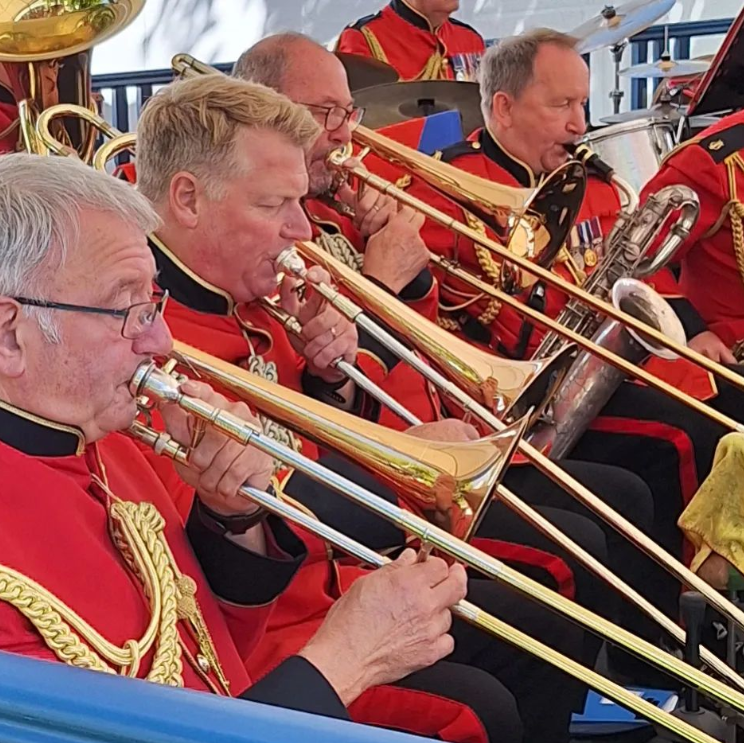
This week has been Brass Band Week, a new annual event launched by Brass Bands England to raise awareness of our nation’s brass bands and everything they have to offer.
Here is something of my own experience.
One of my abiding memories is of a three week ‘work experience’ I had at the Black Dyke Mills, home of the world famous band. My aunt lived in Queensbury between Halifax and Bradford, where the mill was situated. I’m vague as to how it came about but she arranged the work experience for me but I remember enjoying working there, without pay! I was however given my reward when on the final Friday afternoon, I was taken to the ‘Band Room’, a vast space which was full of trophies and other memorabilia amassed by the famous band with its distinct sound that I can still instantly recognize today.
It wasn’t my first association with Brass Bands. In the North West of England there was a custom of ‘Whit Walks’. Usually on Whit Sunday (now known as Pentecost). Churches held processions round the streets of each parish, not just Anglicans but Methodists too. In my town, Roman Catholics walked on the following Friday (whit Friday). The big features of the Processions were the huge, embroidered Banners which identified the Churches and were adorned with Christian symbols; and the Brass Band which was hired to lead the Processions.
Saddleworth on the Lancashire and Yorkshire border is an area of 11 villages.
Each Whit Friday they hold a Band Contest. Each of the villages host the competition and brass bands march and play in each one. The band judged to be the best receives a monetary prize and the prestige of taking part. There is also an overall prize. Earlier this year 117 bands took part as coaches raced them between the villages. The overall winner this year was the famous Brighouse and Rastrick Band. It is one of the top bands in the UK. Their version of the Floral Dance,’ reached the dizzy heights of the Top of the Pops chart in 1976.
It was the Saddleworth Festival which brought to fame another tune – ‘Hail, Shining Morn’ – which complete with vocals, was composed by Reginald Spofforth in 1810. It has become a signature tune for the Saddleworth Festival as well as a Festival at Selkirk commemorating the Battle against the English at Flodden in 1513! It is labelled as a ‘glee’ song which is derived from the Old English, ‘gléo’ – music or entertainment.
Many Brass Bands are associated with mining and manufacturing, such as the Foden Motor Works Band, and bands associated with Collieries and coal mining.
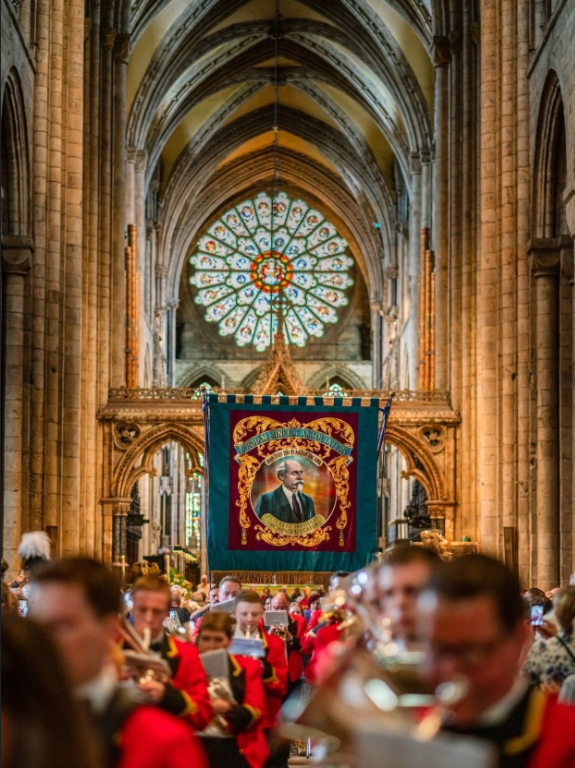
The bands are proud offsprings of the mining industry and with huge secular versions of the Whitsuntide Religious banners, they marched and brought music which raised the spirits of people often living in harsh and deprived communities. Their biggest gathering has always been the Durham Miners Gala, held annually, in the City of Durham which was the spiritual centre of the County Durham mining villages and communities. Whilst the Gala is often seen as a political occasion with huge rallies; for the Durham miners it is the spiritual march behind the Bands and Banners of the various collieries, up the hill to Palace Green and the Cathedral that is the central part of their day.
One of the most moving experiences I’ve had was to be in the Cathedral as the West Doors were flung open and the band marched up the aisle, followed by many miners, to be blessed by and give praise to God. This was at a time when mining was facing a great struggle with the Government to simply exist. As the mines closed in County Durham and throughout the country, it was vulnerability and poverty which seemed to take over people’s lives but there was pride and tenacity mixed with dignity that ruled the day. Poor materially, these communities were rich in spirit (and still are). On one level the miners were defeated in a struggle which was the result of a battle between the Prime Minister, Mrs Thatcher and Arthur Scargill, the Miners Union leader, but the marching band and the proud carrying of the banners, to be blessed by ‘their’ bishop, showed a people who stood tall and with deep integrity enfolded in God’s protective and loving arms.
Both that procession and those of my Sunday School days were acts of witnesses both to faith and a knowledge of God’s care and love.
Brass Bands play a huge part in the lives of communities in almost every Nation.In Britain many village and church fêtes rely on them to bring excitement and pleasure and they are a feature of events such as the Henley Royal Regatta, where I was last week and where I took the photo above. Many towns have their own bands which from New Year to Christmas enhance community gatherings. Nor must we forget our Military Bands, but that’s another story!
What is at the heart of Brass Bands is that they are so distinctive. It is not just their stories stretching back into history but the way they encourage young people to learn instruments and to make music. The music that they play stretches from stirring, uplifting marches to quiet reflective pieces which are more contemplative. Such music raises my spirit, produces goose-pimples on my skin and exercise for my feet as I tap along to the sound. Most of all, it gladdens my heart.
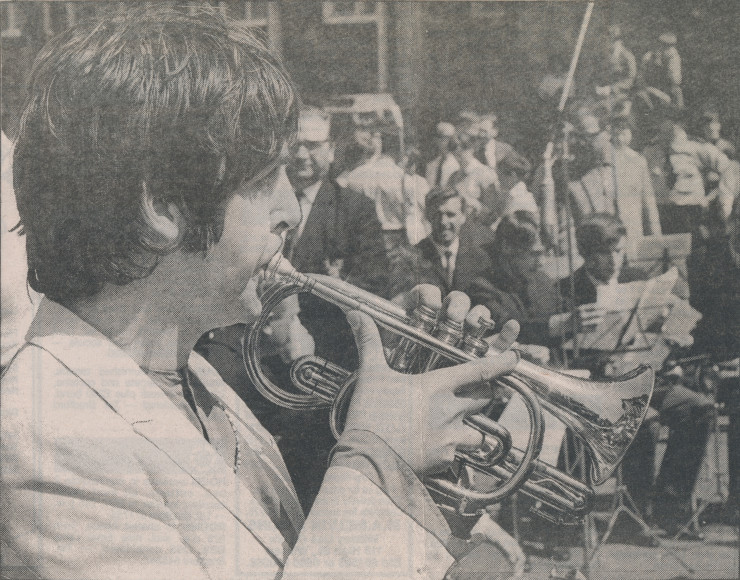
Make a joyful noise to the Lord, all the earth;
break forth into joyous song and sing praises.
Sing praises to the Lord with the lyre,
with the lyre and the sound of melody.
With trumpets and the sound of the horn
make a joyful noise before the King, the Lord.
Psalm 98:4-9

 Mr G's Ponderings