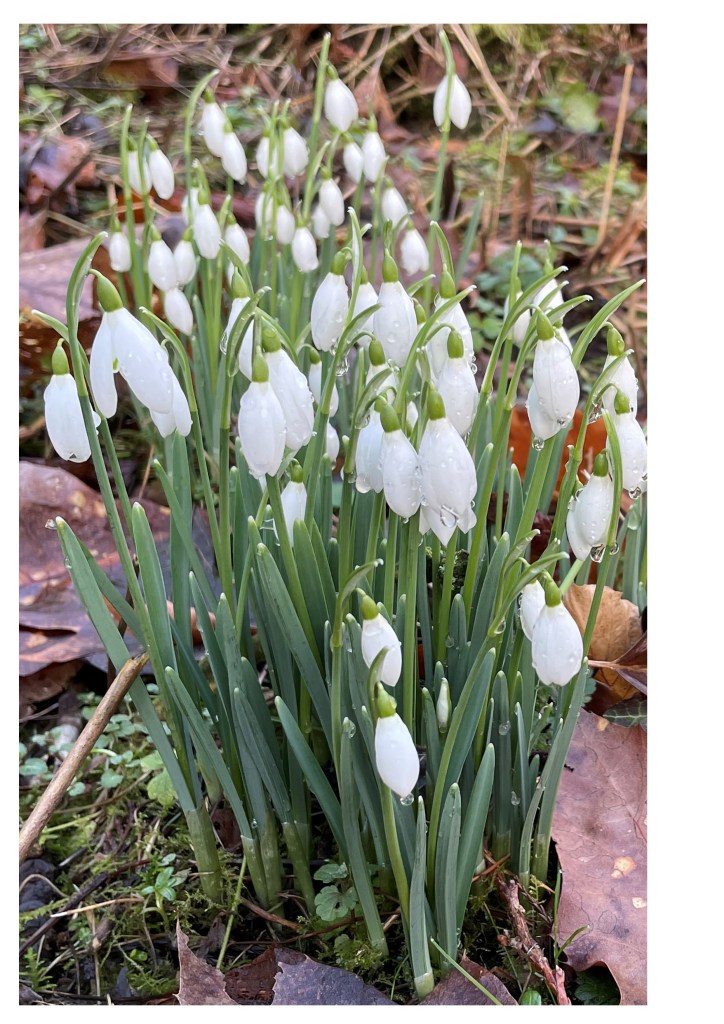
Snowdrops photographed by Gill Henwood in her Lake District garden.
February tiptoes across a winter landscape, dressed in white array, luring us away from cold depression of dark, dank January, with dazzling brightness; promising the hope of Spring beyond.
Ah! What trembling beauty lays a carpet of expectant joy!
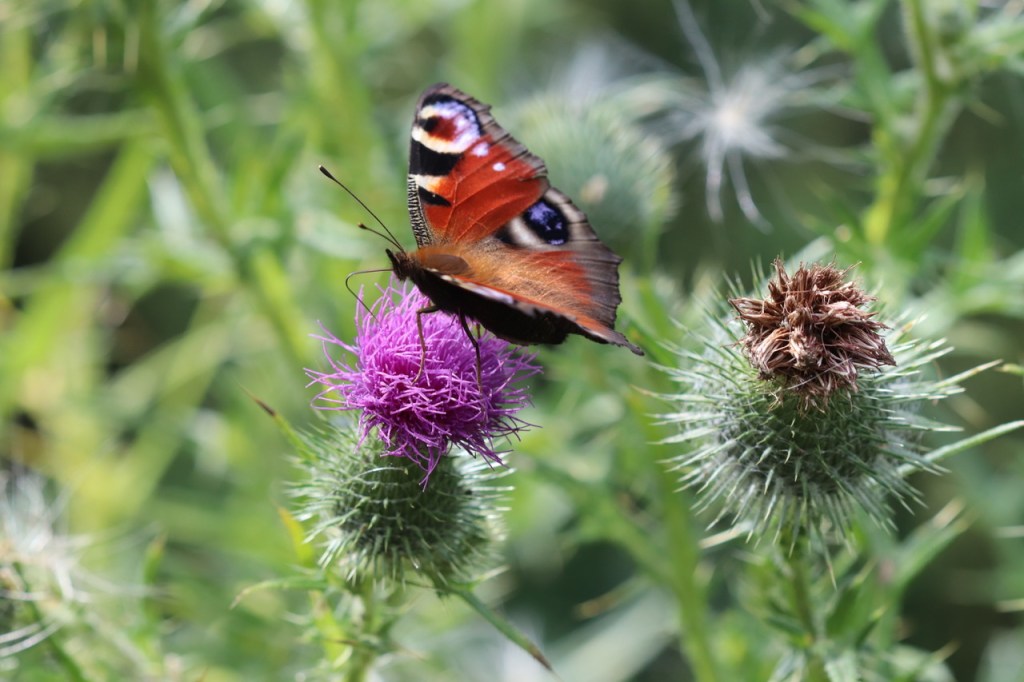
Peacock Butterfly on thistle. photo by The Revd Lynn Hurry
Striving to forgive
Dr ELISABETH KUBLER-ROSS , a Swiss-born psychiatrist, who died in 2004, was renowned for her pioneering work on Death & Dying including identifying the stages of grief. She was also influential, with others, in the establishment of the hospice movement caring for dying children. It may be that a profound influence for the development of this work began in 1946 when she visited a concentration camp in Maidanek, in Poland, where she met a young woman whose story affected her greatly.
On this National Holocaust Day 2025, the 80th anniversary of the liberation of Auschwitz, her story of that meeting is best told in her own words
“It started in Maidanek, in a concentration camp, where I tried to see how children had gone into the gas chambers after having lost their families, their homes, their schools and everything. The walls in the camp were filled with pictures of butterflies, drawn by these children. It was incomprehensible to me. Thousands of children going into the gas chamber, and this is the message they leave behind–a butterfly. That was really the beginning.
In this concentration camp there was a Jewish girl, and she watched me. I hope you understand, I was a very young kid naturally, who hadn’t gone through any windstorms in life. When you grow up in Switzerland, there is no race problem, no poverty, no unemployment, no slums, no nothing. And I went right into the nightmare of postwar Europe. So I asked her, how can men and women, like you and I, kill hundreds and thousands of innocent children, and the same day they do that, day after day, they worry about their own child at home who has chicken pox. It just didn’t compute in my brain, you know, being very innocent and ignorant. This young woman had lost all her brothers and sisters, parents and grandparents in a gas chamber. She was the last one they tried to squash in, and there wasn’t room for one more person, so they pulled her out. What she didn’t understand was that she had already been crossed off the list of the living. They never got back to her. She spent the rest of the war years in this concentration camp swearing that she would stay alive to tell the world about all the atrocities that she witnessed. When the people came to liberate the camp, she said to herself, “Oh my God, if I spend the rest of my life telling about all these horrible things, I would not be any better than Hitler himself. I would plant seeds of hate and negativity.” She made at that moment a promise to whoever she talked to, God presumably, that she would stay in the concentration camp until she could learn to forgive even a Hitler. When she had learned that lesson, then she would be worthy of leaving. Do you understand that? The last thing she said to me was, “If you would only know that there is a Hitler in every human being!” If we can acknowledge that Hitler and get rid of it, she said, we could then become like, what we now would say is, Mother Theresa.”
May that young lady’s story help us to hear a message we need to learn and to give thanks that her story led to Elisabeth Kubler-Ross to pioneer palliative care for suffering children.
[** You can learn more about Elisabeth Kubler-Ross on the Website of the EKS Foundation.]
Hawkshead Church in early morning mist. Photo by Gill Henwood.
This photo was taken by my friend, Gill Henwood and is of Hawkshead Church emerging from the morning mist. This mist speaks to me of ‘revealing’, of something that will become clearer as the mist rises; of a beauty present but not yet fully defined.
Today is the time the Christian Church remembers the Conversion of St. Paul, the moment when all that clouded his mind and darkened his thoughts, were lifted by an encounter with the Risen Christ. We are told of it in the Book of Acts, chapter 9 verses 1 to 19.
Paul or as he was then known, Saul, a zealous Jewish Rabbi, had made it his mission to persecute Christians, those Jews who had chosen to follow the teaching of the Apostles about Jesus. He was responsible for the death and imprisonment of many and was thus thwarting the work of proclaiming the Good News of Jesus.
Something had to be done to stop him and it was the Risen Christ who did so. As Paul travelled along the road to Damascus, the Risen Christ appeared and light flashed around him. Paul was blinded by the light and fell to the ground. It was as if a dark mist enveloped him and in the darkness Jesus challenged him, Why are you persecuting me?’ Paul asked who he was and the revelation came to him that it was Jesus. Paul’s heart was converted but though his eyes were opened, he could still not see. First, his spiritual blindness had to be lifted; something Jesus arranged and then Paul became the great champion of Christianity he was destined by God to be.
For me there is something autobiographical in Paul’s famous passage in his first letter to the Corinthians, chapter 13. Having written his classic definition of ‘love’, He made the point that only love will carry us through to the heart of God and that is both our faith and hope. He referred back to his own lack of understanding of the power of God’s love (verse 8 following) and reminds us that on our spiritual journey we move, often haltingly, to a deeper knowledge of love, as God shares His divine love with us. At first our perception of God’s love is as if we are looking through a mirror dimly’ or as the King James Version puts it, through a glass darkly, but then, as God continues to reveal his Love to us, we shall one day meet Him as Love face to face.
Gill’s photograph of Hawkshead Church suggests to me another illustration of this. Our experience of God’s love for us, may seem at times to be as if we are looking through the mist of understanding. It contains all that will be revealed but we must let God work in our souls as he did in Paul’s. Then, slowly but surely, the mist will lift and the glorious vision will open our eyes and our hearts to a deep and abiding love. In the photo we already see the promise coming clearer. The scene contains all that needs to be revealed. So that is for us. If we open ourselves to the possibility of God lifting from us all that prevents His love to flourish, then it will become a reality.
The Conversion of Saint Paul
Brooding mist blurs edges of perception. Colours muted. A whisper of wind kisses the air rippling through the soul. Visibility impaired, a cloak of quietness drawn across the mind. Stilling all movement. Intentions passionately held, melt into deep darkness. Yet this is not the cause of fearfulness nor of despair. Out of the shadows, of seeing “through a glass darkly” there is a pinprick of growing light which slowly, perceptively, burns away the haze as new vision takes shape.
A Voice, crisp, gently directive, unfettered by illusion, beckons, touching eyes to see a wonder, “face to face.” The waypath is irrevocably changed.
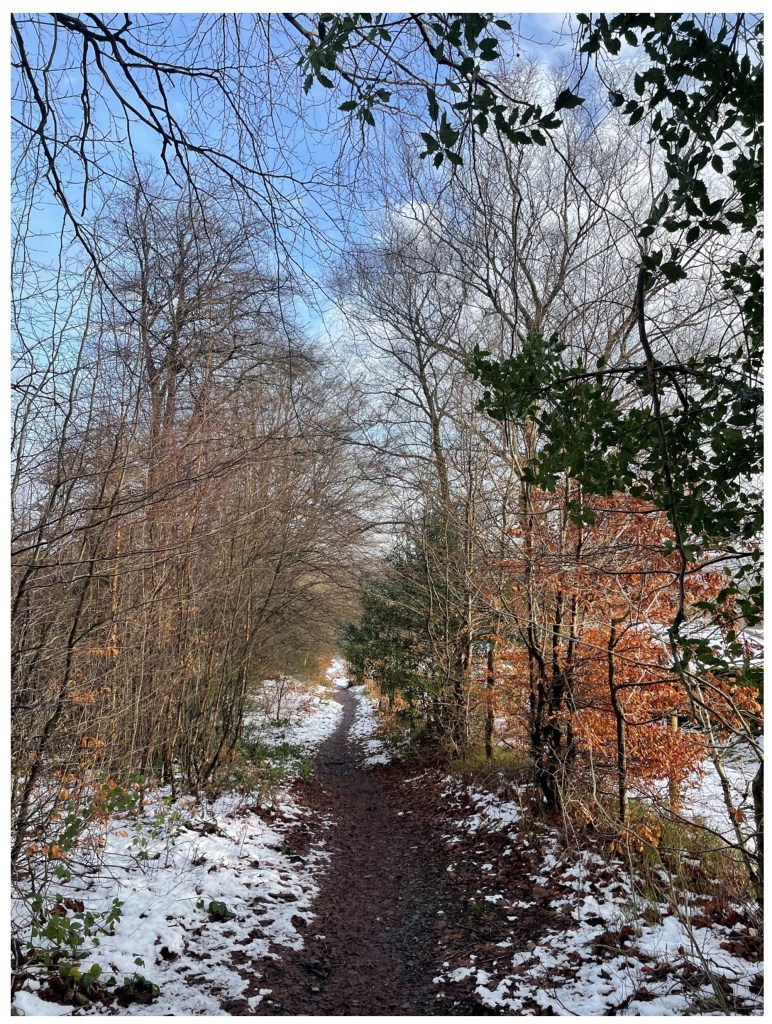
Gill Henwood, photo towards Gooseyfoot Tarn, Lake District.
Behold I make all things new (Book of Revelation 21: 5) This is a hope expressed at the end of the New Testament and it is re-enacted each year as Spring approaches.Despite the effects of climate change, Nature is determined to keep Planet Earth going. This, despite attempts by some of the human species to do the opposite. But we can rejoice and have hope. The Witch-Hazel in my garden is already producing its leaves on which it will build new growth. Tulips, daffodils and other bulbs are beginning to peep over the parapets of their pots. Things are being made new.
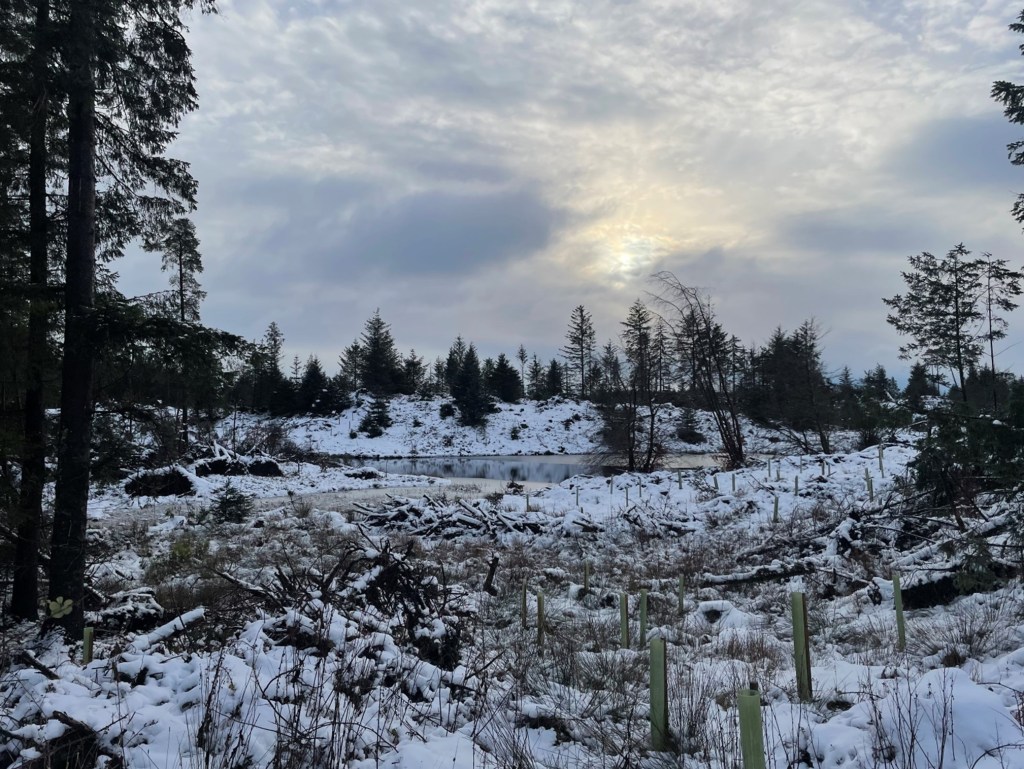
Gooseyfoot Tarn. (Photo by Gill Henwood)
My friend Gill who sent me the photos of Nature at work in her part of the Lake District, at Gooseyfoot Tarn, has also sent me this comment:
“Young beech saplings keep their copper leaves during the harshest weather – a promise of new growth in the slender buds along their twigs The green tubes in the foreground of Gooseyfoot Tarn (above) are seedlings planted among the roots of fallen and felled trees. All the larches were diseased and beeches on the tarn fringe were taken down too. It’s now open, with natural generation of conifer saplings and planted native deciduous woodland. Gooseyfoot Tarn is thought to be an old duck pond shoot from before the forestation, when Grizedale was moorland. There is still a wide variety of fungi in the soil and wild flowers along the tracks, despite the forestry activity. The ‘naff daff’ shoots are naturalised old bulbs from when this track was a field boundary. They started flowering a few years ago after the waterlogged land drains were restored and now line the path with jolly profusion! Survivors when much else drowned…
As February approaches, in the Northern Hemisphere, we can look forward to more light and the greening of new growth. Life in our world is far from easy just now and sometimes it is hard to have hope. The world’s political situation is very uncertain and wildfires and other climatic disasters make it hard for many others. Yet, there is a renewal and regeneration which tells us a different story. Below is a prayer which many will find helpful. In whatever way we are able, may we all try to take up what it is telling us about our Stewardship of the earth and our share in the creative process of God.
A Prayer: Heavenly Father, creator of all things, help us to realize that we are custodians of the wonderful heritage with which you have so generously endowed us. Give us the minds and the hearts to rejoice in your creation, and to walk through your beautiful world with seeing eyes. Help us to save the good earth, the stately trees, the dainty wildflowers, the birds and all things that have no voice to protest against destruction. We thank you for your bounty and pray we may be worthy of it. Amen


 Mr G's Ponderings