Lakeland hills appearing like a desert. photo by Gill Henwood.
A Voice from the Desert ~ St. Antony of Egypt. (f.d. 17th January)
There are significant dates in our lives, which can lead to a change of direction and a new way of living.This was very true of St. Antony of Egypt, also known as ‘the great’. Antony was born in Egypt in 250AD, the son of a prosperous farmer. His family were Christian and he grew up hearing the Gospel read each Sunday in his local church. His parents died and Antony gained a rich inheritance which he shared with his sister.
The significant day in his life was when he was 20. He went to church one Sunday morning and he heard the Gospel including the words: Go, sell all you have, and give to the poor; and come, follow me. Antony heard God calling to him through those words and he left the church, made provision for his sister and then sold all his goods and gave the money to the poor. He then left home and, after a time of spiritual preparation, he eventually set up a simple hut in the Desert of Egypt where, for the rest of his long life, he lived in solitude and prayer. He became one of the founders of the monastic life.
We might think that Antony was rather extreme in his interpretation of the Gospel. After all, how many times have we heard those words and not acted upon them in that way. Yet Antony knew that he had heard God’s voice. For him this was a clear sign of his vocation and he had the courage to respond. He lived a life dedicated to prayer, fasting, daily recitation of the psalms and to combating those forces in the world that are against God, including personal temptations and the battle for true holiness. Others were attracted to his way of life and communities began to be formed of people who sought a pure prayerful life. Antony became a spiritual guide to many, including streams of Christians living in towns and cities and who came to him for guidance. Some of that guidance was collected as ‘words’ which remain available to us today in collections of sayings’ of the Desert Fathers and Mothers.
Antony died in 356, over 100 years old. By the time he died he had learned the most important thing that every Christian must learn—he learned how to love God and to respond through this love to the immense and unconditional love that God had for him, as God has for all of us.
Few of us today are likely to be called to live in a deserted place, though those who have found time to do so, even for a short while, know just how valuable and precious that time is for communing with God without distraction. Some, of course, are called, like Antony, to live as members of Religious Communities as monks and nuns. But all of us are called to dedicate our lives to God and to serve him in whatever way is right for us. We can’t get away with saying something like, “it’s all right for Antony and the other desert dwellers.. They had a spiritual greatness that few of us can even get near.” Actually they wouldn’t claim to be specially great. But they did recognize the greatness of God and they wanted to respond to this in some way. Saints are important for us simply because they are ordinary Christians like us but who knew the Gospel to be extraordinary. It changes lives. If it doesn’t then we wouldn’t be Christians at all. Because it changed Antony’s life, the Church became more Godly and the world more lovely. That can be just as true for us today. Listen and let God tell you how.
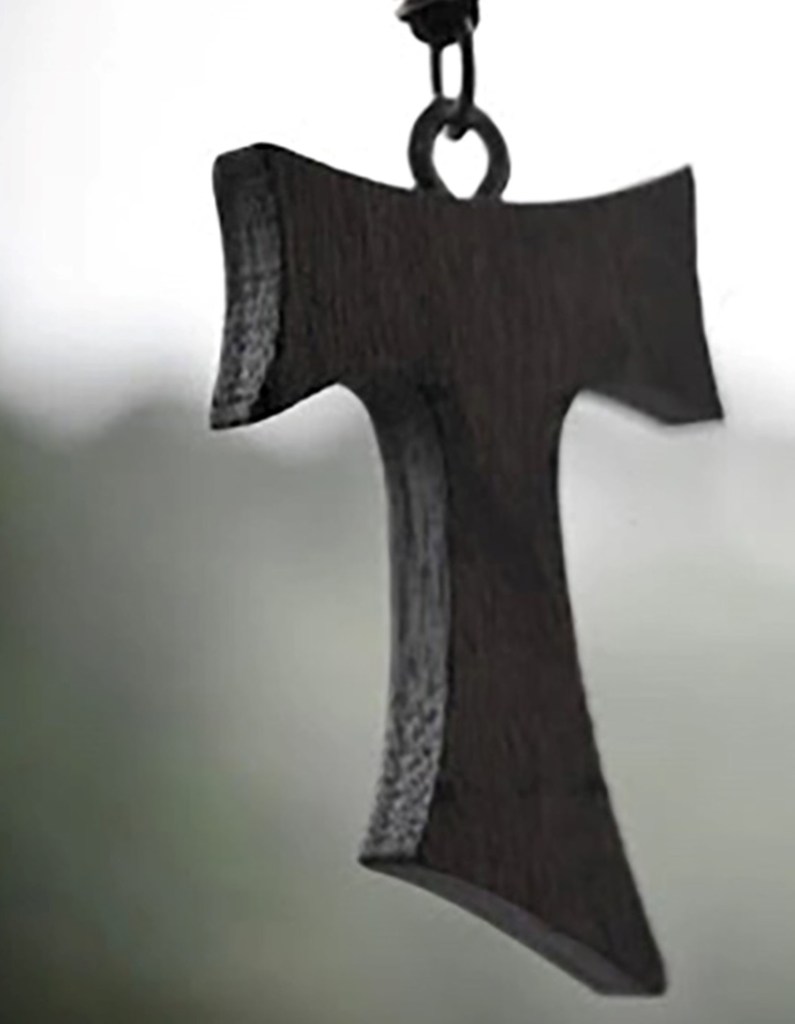
Tau Cross. Symbol of St. Antony of Egypt.
St Antony, You had everything. Then one day you heard the voice of God. “Antony, go sell all you possess and have nothing.” So you did, and then you had everything.
Star I saw the star at its rising * flaming the dying night sky with light. New Day, empty still of events that will define it, and give it a shape which will date it. Perhaps promises fulfilled, adjusted, stillborn? Expectations tinged with hope colouring the blackness, pushing dreams into memories. half remembered, half forgotten. half heeded, half not.
Shall we become whatever this Morning Star** will make of us? bursting over the horizon of our hearts, golden rays offering us a different kind of day.
[Mr G] Epiphany 2025
*a reference to St Matthew’s Gospel, 2:2 to words attributed to the Three Magi
** Morning Star Is usually associated in astronomy with the Planet Venus. In the Book of Revelation 22: 16, the risen Jesus acclaimed himself as the Bright Morning Star. It is with this meaning that the words appear in my poem
The photo is of the Bede Memorial in the Galilee Chapel of Durham Cathedral. It is in Latin and English and is a quotation from the Book of Revelation: “Christ is the morning star who when the night of this world is past, brings to his saints, the promise of the light of life and open everlasting day.
The With-ness of God, a reflection on Luke 2:41-52, by The Revd Piers Northam.
The phrase that particularly strikes me in Luke’s account of Jesus, as a 12-year-old, in the Temple is: His mother treasured all these things in her heart. It’s a phrase we hear at Christmas, when the shepherds come to Bethlehem and find Jesus lying in the manger: When they saw this, they made known what had been told them about this child; and all who heard it were amazed at what the shepherds told them. But Mary treasured all these words and pondered them in her heart. I love the way that Mary takes these words and events and turns them over, treasuring them and pondering on them. There is the sense that she is slowly piecing together the real importance of her son. Before his birth, she was told by the Angel Gabriel that her son, conceived by the Holy Spirit, was himself to be holy and to be the Son of God – but of course that’s still a lot to fully comprehend. When Jesus is born, the shepherds arrive and tell his parents about the angels appearing to them on the hillside outside Bethlehem; later, Mary and Joseph will present their son at the Temple, and Simeon and Anna will speak strange words about him; then the Magi will come with their peculiar gifts – all these words and events hinting at the life her son will lead. And now, in this scene in the Temple when Jesus is twelve years old, we see him speaking strange words himself: sitting with the teachers and referring to the Temple as ‘my Father’s house’ – and so, by implication, specifically referring to God as his Father. More mysterious things for Mary to take to her heart, to treasure and to ponder over…
Another word – or rather the name – that we hear at Christmas is Emmanuel. In Matthew’s account of Jesus’ birth we hear him quoting the prophet Isaiah: All this took place to fulfil what had been spoken by the Lord through the prophet: ‘Look, the virgin shall conceive and bear a son, and they shall name him Emmanuel’, which means, ‘God is with us.’
God-with-us. That’s the extraordinary and particular thing about the Christian faith. Where other religions worship a god or gods who are other; who are distant and out there, far away, we believe that God who came to earth for us; and ‘lived on earth and went about among us’ to use that familiar phrase. God – in Jesus – became human and so understands our lived experience intimately; and, in the Holy Spirit, continues to live with and in us. That name Emmanuel is hugely important since it encapsulates what lies at the very heart of our relationship with God.
Ali’s story
Last week, a friend shared an article which reflects on the experience of Emmanuel / God with us. It’s written by Ali Kendall, a nurse living in Hampshire who shares her family’s story and what she refers to as God’s With-ness – God’s being with them. Things haven’t been easy for Ali and her family. She spent years nursing in London at the Royal Marsden before moving to Hampshire to start a family. Initially, this was hard for them, but she and her husband Matt did have a first son, Joseph and all seemed well. Then her husband started to have a series of what were to become regular seizures, which stopped his work as a teacher and completely changed their lives. At the same time, they had tried for another baby and Zachary was born – along with the unexpected news that he had Downs Syndrome. She writes:
I remember thinking ‘we were already meandering off script, but we are well and truly off-piste now’. Life’s going to look different. Very different. It’s just gone from hard to harder. My husband has a chronic illness and disability and now I have a newborn whose challenges are not yet known to me, but likely to be significant.’ A few years later Zachary was diagnosed with autism.
Ali then goes on to say: Life is beautiful and life is hard. Beautiful-hard. They both co-exist, like dancers, weaving themselves in and out of our lives. The joy is that God is with us and others have joined in. […] Our day to day is transformed by withness; when friends come along side us, and travel with us for a while at the slower pace that we’ve been forced to go, navigating the hurdles and the curve balls.
Matt’s seizures are debilitating. The daily grind of a chronic illness is often lived in secret, behind closed doors, in the hidden places. Parenting a child with special needs, while trying to be everything you want to be to your other child, is exhausting and can feel lonely. On a bad day it can all feel crushingly hard, but on a good day it can feel like you are in on the most beautiful secret of watching your family do life differently with our challenges and unique way of being.
What strikes me the most about Ali’s account is the way that she has discovered those secret moments – moments that she has been pondering in her own heart – where she notices the beauty (even in the midst of the difficulty and the challenge); where she notices the withness of God… She goes on to say:
Being with someone who is not finding life easy or is trying to live in a world not set up for them can take you to what I now call the “secret places”. The places you might never have chosen to be in. […] Coaxing a child with autism to watch a Christmas show you have paid good money to enjoy. Our seats, surrounded by people and lots of noise, make it all too overwhelming for Zachary. So we sit in the quiet, on the stairs, where no-one pays to sit, watching the show from our secret place. We hug and cuddle quietly as the show goes on and it feels somehow almost a sacred moment. These secret hidden moments are where the gold is really forged. Where the love grows deep. Withness blesses the person being held and the person holding.
Withness, as she puts it, blesses both the person who is being accompanied and the person who is sitting with them or holding them or offering their support. Because in doing so, they are being Emmanuel to them. And Ali fully acknowledges that this is hard and costly – but ultimately, but it’s a cost that is worth it:
[…] it’s hard. Beautiful and hard. But being with people mattered enough for Jesus to come to earth to embody “Emmanuel”. And you get taken to those secret places you might not have ever seen had it not been for the journey the other takes you on.
‘Being with’ takes you to those secret moments which become sacred.
Paul, in his letter to the Colossians, says, ‘Let the Word of Christ dwell in you richly.’ He’s inviting us to treasure Christ’s words and ponder them in our hearts, for living them out brings unexpected riches and secret joys. As I reflected on the 12-year-old Jesus, sitting with the teachers in the Temple, holding his own with a wisdom beyond his years, I was struck by the final part of Ali’s story:
[Joseph,] my eleven-year-old, has heard me say so many times “we are with you” to Matt as his body shakes into another seizure. Matt is usually unable to speak, often he looks afraid, and his usually strong body is jerking with such strength we need to keep him safe. But “I am with you” has become what I say. And I mean it. It’s all I can offer in those moments. I can’t take it away, but I can sit with him in the pain and disappointment of another disrupted plan, another unfinished conversation, another fun trip cut short, another day where we watch the world bustle on as we crumple to the floor.
My Joseph has learnt the art of being with. He will often silently take my husband’s hand, and my heart melts when I hear the strength and tenderness in his words,“I am with you Daddy. We are here.” As Jesus showed his Emmanuel to me, and the beauty and peace that brings, we can show it to each other.
‘I am with you…’ Young Joseph has heard those words and they now dwell in him… Richly…
Ali’s story has moved me profoundly – I find my thoughts returning to her and her family and I sense they will continue to do so. Above all, it is the way that she has pondered on her experiences and has noticed Emmanuel / God-with-us in both the joyous times and the hard ones. She has found those secret moments and treasured them in her heart. It’s something that God invites us all to do, so I pray that we will all take time to ponder and to notice Emmanuel/ God-with-us in our own lives – and at times to respond to the call to be God-with-us to others… God is always with us – but we have to take the time to notice where – and in whom – He is to be found…



 Mr G's Ponderings