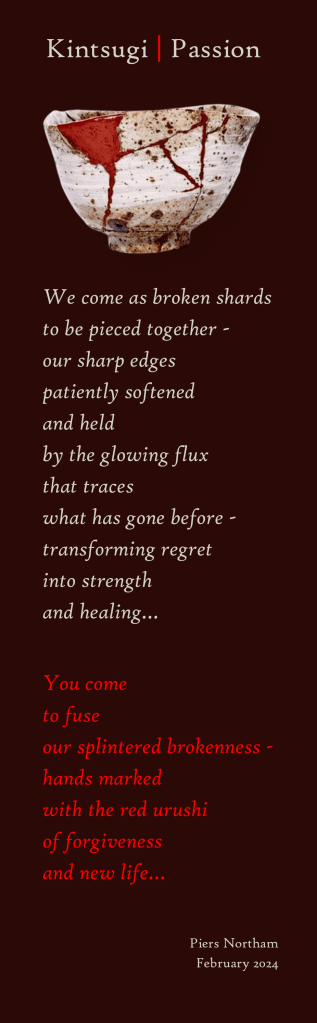
Kintsugi – Passion
Author: mrgsponderings
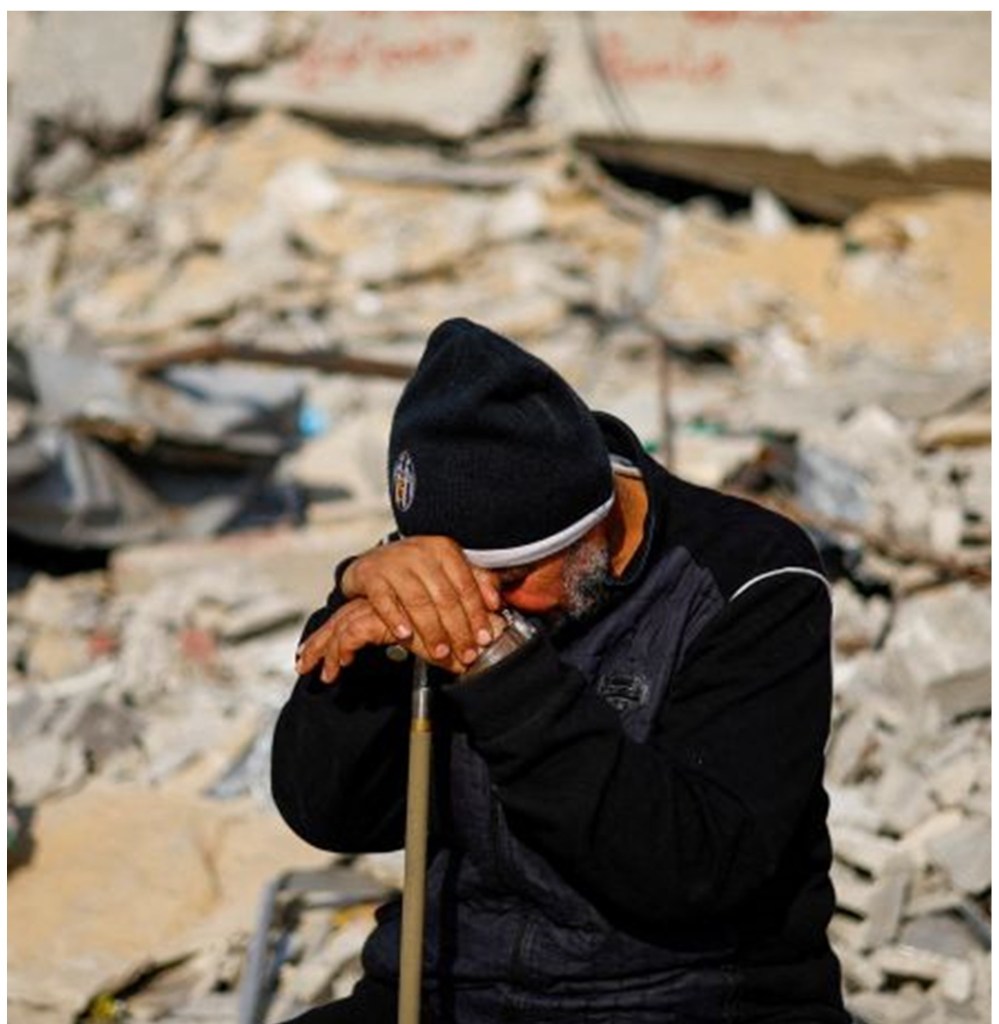
Mohammed R Mhawish’s story
Reporting from Gaza City Published by Aljazeera On 5 Feb 2024
‘How can I explain to the world, the ones that even read our words, that what is being endured is not only painful but avoidable?’ writes Mohammed Mhawish from Gaza City
For us in Gaza City, enduring the daily struggles like staying safe, fighting hunger and protecting ourselves against the biting cold is a war in and of itself as Israel’s assault on Gaza grinds on past 120 days. Hundreds of thousands of people have lost their homes at a time when that was all they had. Then after that came the loss of a simple place to shelter as Israel bombed them all: hospitals, schools, clinics, and any open space where civilians gathered. The entire population of Gaza has been displaced. The entire population.
What does ‘home’ mean?
After our house was bombed, I was no longer just a witness to the thousands of people fleeing their homes to find safety wherever they could. We went to the United Nations shelter in the north of Gaza, my family and I gathering whatever would help us survive and becoming displaced like our country people.
There are about 600,000 people in north Gaza grappling with loss amid deprivation, starvation and disease because they do not want to leave their land.
It breaks my heart, but I have to admit we’ve lost the sense of what “home” means.
Just finding the bare minimum space and shelter from the elements we need to rest has become a journey of heartache and pain, our miserable daily routine of looking around to see where we can possibly sleep.
My family – father, mother, sister, wife, and two-year-old son – and I are seeking relative refuge in the parking garage of a destroyed apartment building.
We dread looking at the weather in these winter conditions. All day, we’re trying to find the forecast, breathless, worried that rain would be expected that night.
On rainy nights, I take off my coat and wrap it around my baby, making it both a blanket and protection for him against the cold, with hope and prayer that it will be enough for his small body.
Survival rations
Beyond shelter is the struggle for food. I cannot recall the last proper meal my son had.
Wheat is nowhere to be found so we have been using animal feed-grade barley and corn to grind into flour for bread. Even these alternatives are scarce, but they are our only means to get through the day.
It’s not like there is the space and security to grow your own food either, with the bombs and intentional choking off of supplies, even water. The aid entering this besieged enclave is very limited and cannot cover our basic daily needs. So we have had to try to survive for these past four months, with no incomes or livelihoods as the prices of essentials skyrocket, if you can find them at all.
As a result, starvation is beyond widespread in the north of Gaza. Babies, children, adults and the elderly all are suffering from the lack of food. An ounce of coffee used to be 10 shekels (about $2.75) and now it costs 120 shekels ($33); a litre of drinking water that cost a shekel (less than $0.30) is now 15 shekels ($4).
If you secure food, you still have to cook it and, with no cooking gas, people are combing the ruins to find anything they can burn for a cooking fire, exposing themselves to bombing at any time.
And so, when every hour of the day is spent either looking for food or a means to make it, we cannot always worry about staying safe.
Unrecorded deaths
Medical services in north Gaza have been nearly inoperable since the beginning of the ground invasion, and now there is little more than first aid services for the injured or those in need of intensive medical care. Israel has arrested and killed hundreds of medical personnel, bombed hundreds of medical facilities of various sizes out of service or depleted their capacity with cuts of fuel and water.
For the little that remains functional, how would the wounded get there when at least 122 ambulances have been targeted and bombed? Then comes the danger of the streets: air strikes, soldiers kidnapping Palestinians or shooting them dead, and the mountains of rubble across Gaza.
Even basic medications like antibiotics and painkillers have been scarce for the thousands suffering injuries from Israeli attacks, and so they get infections and respiratory diseases.
People need to understand that the number of Palestinians killed in this aggression is much higher than what is being reported. Palestinians dying from kidney failure, from cancer, from disease, from a lack of prenatal care – all of these are not being recorded.
With every passing hour, fewer and fewer Palestinians in Gaza can appeal to the world. Every day brings more death, and the rest of us remain, trying to fight off death.
In closing
I do not write of the struggle we are living to engender sorrow. Had sorrow moved people, we wouldn’t be where we are now. I outline our struggle because, at this point, we have either already been killed or are in the process of being killed slowly. We are appealing to the healthy ones, the ones with a bed to sleep on, the ones whose voices can be heard outside this slaughterhouse.
I write to equip you with the knowledge of what humanity is undergoing. We the Palestinians of Gaza are being starved, are sleeping on the streets with no cover from air strikes.
We are being denied our humanity by an army that continues to inflict some of the most painful and inhumane practices of war we know in our modern day.
It’s time for the world to defy the abuses, to give regard to human life, to keep it simple and basic, like the needs we require to maintain breath.

To the innocent who live in the shadow of war and terror,
especially the frightened children,
the homeless,the elderly, the injured and the despairing,
LORD,
be a shelter and strength, their haven and hope.

The photo speaks its own message.
Very still, chilly breeze, birds singing for Imbolc/Candlemas ….But fallen giant conifer trees from the storms are on slopes exposed and waterlogged ground. After the storms, the birds sing of hope, for Spring, new life, another season to grow. Bittersweet calm, but the low sun rising is warming the cold wet land and her creatures. [Gill]
February
tiptoes across a winter landscape,
luring us away, from cold depression
of dark, dank January.
Weak, shy strengthening Sun,
practices dazzling us with brightness;
whispering promises of hope
about Spring beyond.
Ah! What trembling beauty
lays a carpet of expectant joy!
Mr G February 2024
The festival day of St Brigid (also known as Brigit, Bride, Brighid, amongst others) is an important day in Ireland because with St Patrick and St Columba, she is regarded as one of the Patron Saints of that fair isle!
She was born in the mid 6th century (about 451) and died in 525AD. Her father was a pagan chieftain at Leinster and her mother was a Christian. It is said that her mother was born in Portugal and her arrival in Ireland was as a result of Irish pirates who kidnapped her to work as a slave. There is a similarity here with the story of how Patrick came to Ireland.
She was probably influenced in developing her Christian faith from her mother but it is also said of her that she was influenced by the preaching of St Patrick.
Despite strong opposition from her father she became a nun and soon established a reputation for compassionate care of the sick and those in need.
She became head (Abbess) of her convent at Kildare which, following an Irish tradition was known as a double monastery in that both women and men shared a common vocation and life together. Brigid was head of both.
When the Irish Christian influence spread to Northumbria, this practice was introduced there by the Saintly Abbess Hilda first at Hartlepool and then at Whitby.
As with many of the early saints, legends and stories became linked to them and Brigid was no exception.
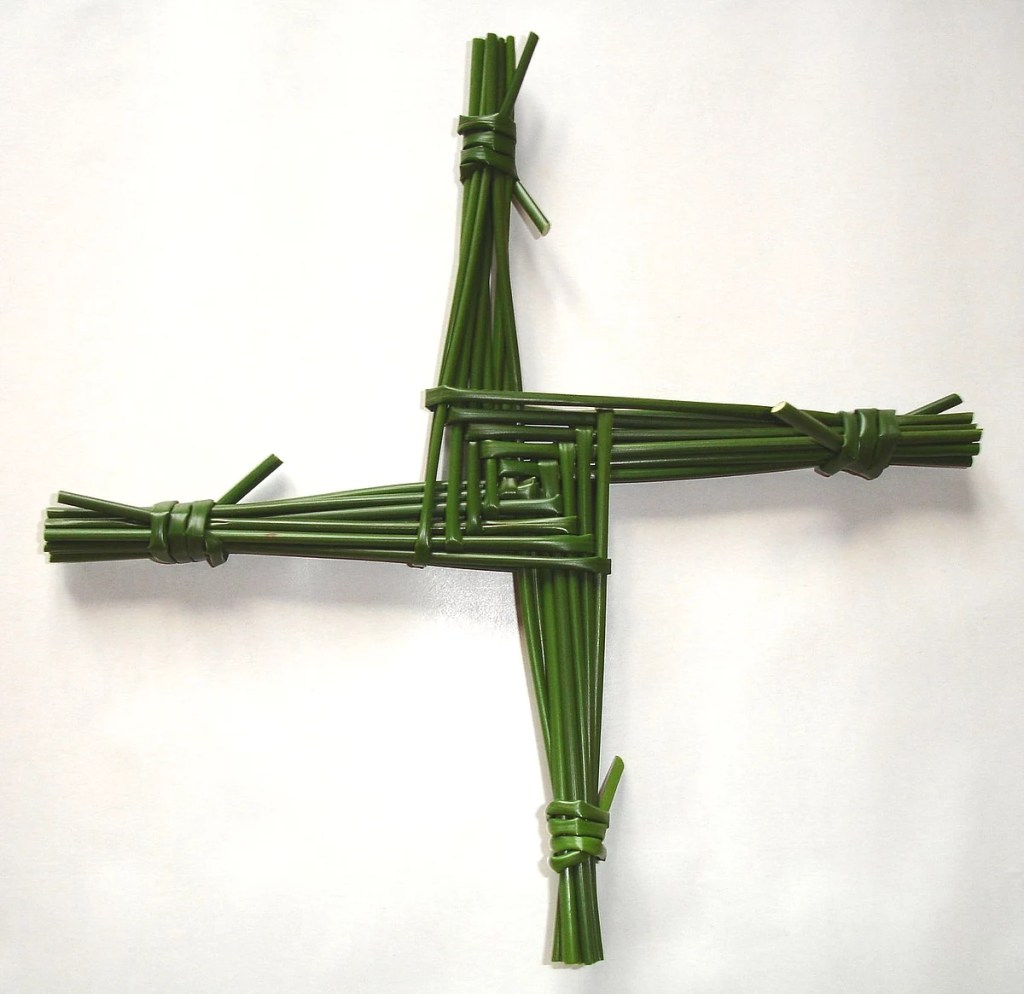
One particular story is certainly true and it provided the Church in Ireland with a link between Christmas and Easter. It comes in the form of what is now called St. Brigid’s Cross, a picture of which heads this article.
It’s a rather lovely story.
A pagan chieftain from the neighbourhood of Kildare lay dying. Christians in his household sent for Brigid to talk to him about Christ. When she arrived the chieftain was raving. As it was impossible to instruct this delirious man, hopes for his conversion seemed doubtful. Brigid sat down at his bedside and began consoling him. As was customary, the dirt floor was strewn with rushes both for warmth and cleanliness. Brigid stooped down and started to weave them into a cross, fastening the points together. The sick man asked what she was doing. She began to explain the cross, and as she talked his delirium quieted and he questioned her with growing interest. Through her weaving, he became a Christian and was baptized just before he died. Since then the cross of rushes has been venerated in Ireland.
There are, of course, several versions.
This one can be found on the website for St. Brigid’s School in Glasnevin in Dublin and gives a rich description of her background and life.
Christianity is often a faith of paradoxes and none more so than the connection of birth with death. At Candlemass, February 2nd, we complete our Christmas celebration of Christ the Light and then begin our journey towards Holy Week and Jesus’s death on the Cross. Yet there is nothing strange in this. Christ’s victory over the human heart and the darkness which so often besets our lives begins in the Christmas event but needs Calvary to complete it. There Christ’s love shone from the Cross as it had from the Manger and in the light of that love we can claim our place in God’s heart.
Brigid’s cross, woven from simple straw became a sign of healing and of life.
The straw of the Manger and the Wood of the Cross woven together are symbols of this healing and salvation linked to God’s Saving Love.
Another story connected with St. Brigid is without doubt highly popular in Ireland. It may be viewed as Ireland’s own version of Jesus’s miracle at Cana,
One day, while working in a leper colony, Brigid discovered to her horror that they had run out of beer. It’s important to understand that in those times, centuries ago, beer was consumed on a daily basis as a source of hydration and nourishment.
Back in those times many of the water sources close to villages and towns were often polluted to the point where consumption would likely result in illness or, worse still, death. Alcohol offered an (almost) germ free alternative.
So, to be faced with a beer drought was nothing short of disastrous.
Brigid knew exactly what to do. She asked God for help and He answered her prayer. The bathwater was miraculously turned into beer and not just any beer, but a genuinely brilliant beer that was enjoyed by one and all!
Obviously this secured her reputation, not least because she was fond of beer herself! Lest it be thought she acted as much out of self-interest as well as those in need, she is thought to have written a prayer/ poem about giving God his Divine Share!
The version we have here is from the 10th Century and some doubt that she wrote it but it’s always unwise to doubt a Saint, especially a lady one!
St. Brigid’s Prayer
(Poem attributed to St. Brigid herself)
I’d like to give a lake of beer to God.
I’d love the heavenly
Host to be tippling there
For all eternity.
I’d love the men of Heaven to live with me,
To dance and sing.
If they wanted, I’d put at their disposal
Vats of suffering.
White cups of love I’d give them
With a heart and a half;
Sweet pitchers of mercy I’d offer
To everyone.
I’d make Heaven a cheerful spot
Because the happy heart is true.
I’d make all contented for their own sake.
I’d like Jesus to love me too.
I’d like the people of heaven to gather
From all the parishes around.
I’d give a special welcome to the women,
The three Marys of great renown.
I’d sit with the men, the women and God
There by the lake of beer.
We’d be drinking good health forever
And every drop would be a prayer.
[Mr G]
 Mr G's Ponderings