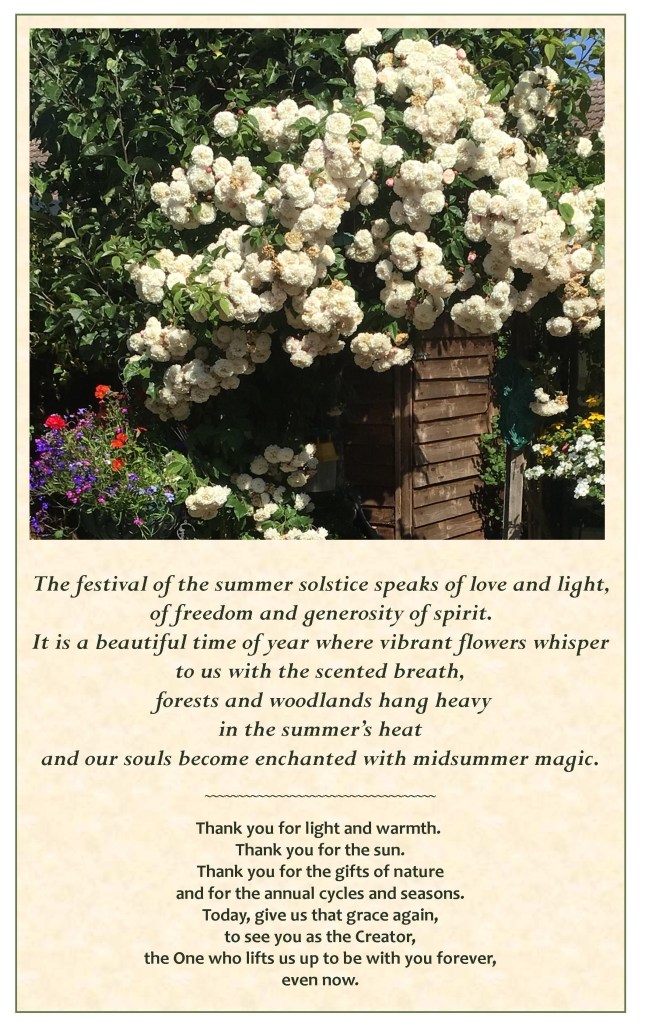
Climbing Rose Felicity & Perpetua. Photographed by Alan Roden
The photo was sent to me by my friend Alan Roden. It is of a special rose named after the early Christian martyrs, Felicity and Perpetua who were put to death for their faith in Jesus Christ, on March 7th, 203AD
The Félicité-Perpétue, was developed in 1827 by Antoine A. Jacques was head gardener to the Duc d’Orleans, the future Louis-Philippe I, in Château de Neuilly. It is a sempervirens (everblooming) hybrid with a delicate primrose fragrance. It’s reported that Jacques named it after Saints Felicity and Perpetua, , when there was an unexpected birth of twins in his own family; and the newborns were given the saints’ names. It was introduced into Britain in 1928 and, in 1993, it was given the RHS Award of Garden Merit.
Alan told me that Three years ago I bought this climbing rose named after the two Saints and being inquisitive as always, researched them and was greatly moved. Alan told me, “The rose now produces masses of flowers over an arch I made and transforms our garden for an all too brief time.” It is often known as The Martyr’s Rose.
It is also a sign of Summer and it is blooming now to celebrate Midsummer Day. Another friend, Vincent , has sent me this short but profound observation.
Photo: Alan Roden Text from Vincent Emms. Prayer from Gill Henwood.
The human reputation about care and preservation of Nature and God’s Creation is not always a good one. On the whole humans are more prone to exploitation, persecution, destruction than we are on preservation and protection. A reading of the poem of Creation, which begins the book of Genesis in the Bible, could convince us that human beings have a superior place in the pecking order of Creation. Indeed the writer of the poem observes that according to God’s word we are to subdue the world and have dominion over every living thing. This has led to a view that we have power over Creation which is exercised through control and domination. A development of this is that everything exists for the sake and use of the human race. This has led to a wanton destruction of the natural world—animals, birds, creatures of the sea and also of the natural resources which we have exploited for our own ends. Too often we have lost sight of something else expressed in the Genesis Creation poem, that everything in precious in the sight of God, the Creator. He clothes the lilies of the field and he watches over the birds of the air. Alongside the idea of ‘dominion’ is the principle of stewardship. We are custodians of the earth and of the world of nature and we are to be stewards. Stewards have to give account of their stewardship—and to God. So it is good to highlight something good that we have done in this respect.
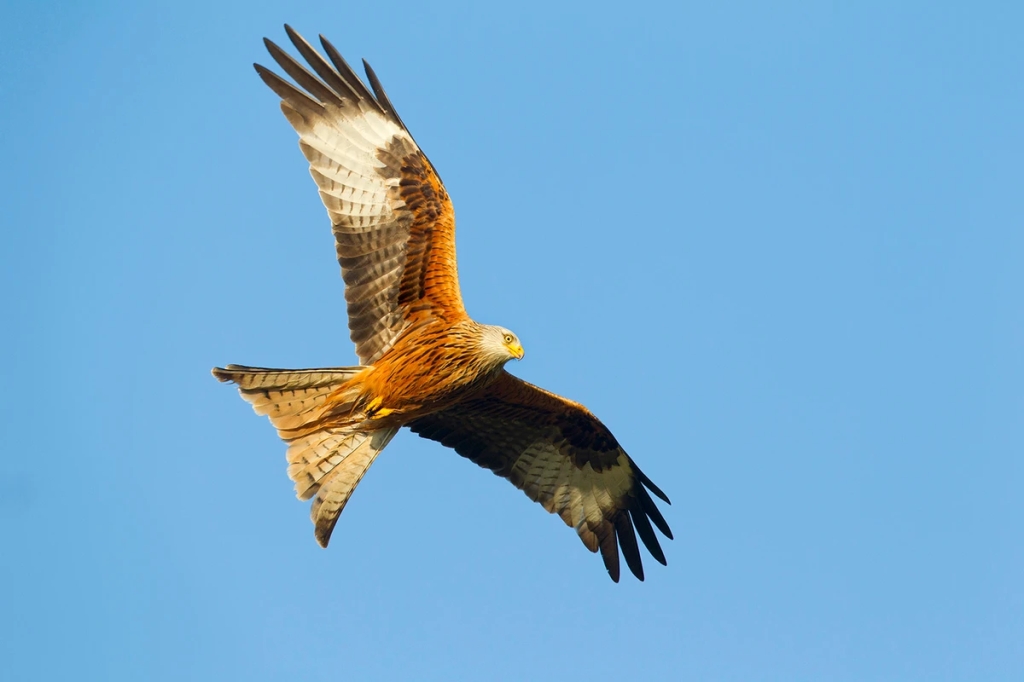
I was reading recently about the successful project to save the Red Kite bird of prey which was facing extinction. I first met these birds a few years ago when I was walking along the Ridgeway on the Buckingham/Oxfordshire border. My attention was attracted by large swooping birds which danced and wheeled on the horizon and then through the valley below before soaring up into the sky way above my head. These birds were common in Shakespeare’s time. He mentions them in some of his plays. In later times, they had a particular function when they were common in towns and cities where they scavenged for scraps. It was a crime to kill one as they were so useful for rubbish management. Then things changed for them. Persecuted and made almost extinct, these amazing birds with their 185cm wingspan and striking eyes were in great danger. Successful reintroduction projects have now helped the species to recover. They can be seen in a number of places. The best areas to find them in the UK are central Wales, central England – especially the Chilterns, central Scotland – at Argaty and along the Galloway Kite Trail. They are a protected species under Schedule 1 of The Wildlife and Countryside Act.
Woodland Trust
RED KITES (Poem) GC 19.6.2023
We soar and swirl on the uplift of the wind swooping gracefully, wheeling majestically. Free to be.
It was not ever thus. Humans hated us, hunted, poisoned, drove us away on orgy of persecution. Lordship over the earth, over the world of nature, is seemingly always stronger than stewardship.
A new choreography for our dance of life was composed, nurturing, protecting the few of us left but we did not trust them.
Yet over time, hesitantly, responding to infinite patience and soft actions, we became tender again to each other. We bore young who knew no fear nor the hate of others. Springing into life they took flight, joyfully circling and chasing and with speed. Quite a performance!
What is happening this week in Nottingham has brought home to us once again what our society continues to face with the tragedies of knife crime. Every week, almost every day in places like London, someone’s family is being destroyed by someone attacking and often killing a member of the family. Many are young people, a high proportion from an ethnic background. Whoever they are they are plunged into grief. It is a grief all the more distressing because there is rarely any reason for the action. When I was searching for an appropriate prayer to pray for the young students and the faithful school caretaker approaching retirement – that is, Barnaby, Grace and Ian – I found a moving one which has come from the people and city of Nottingham. I also became acquainted with the Knife Angel and a prayer associated with it, which I have put below.
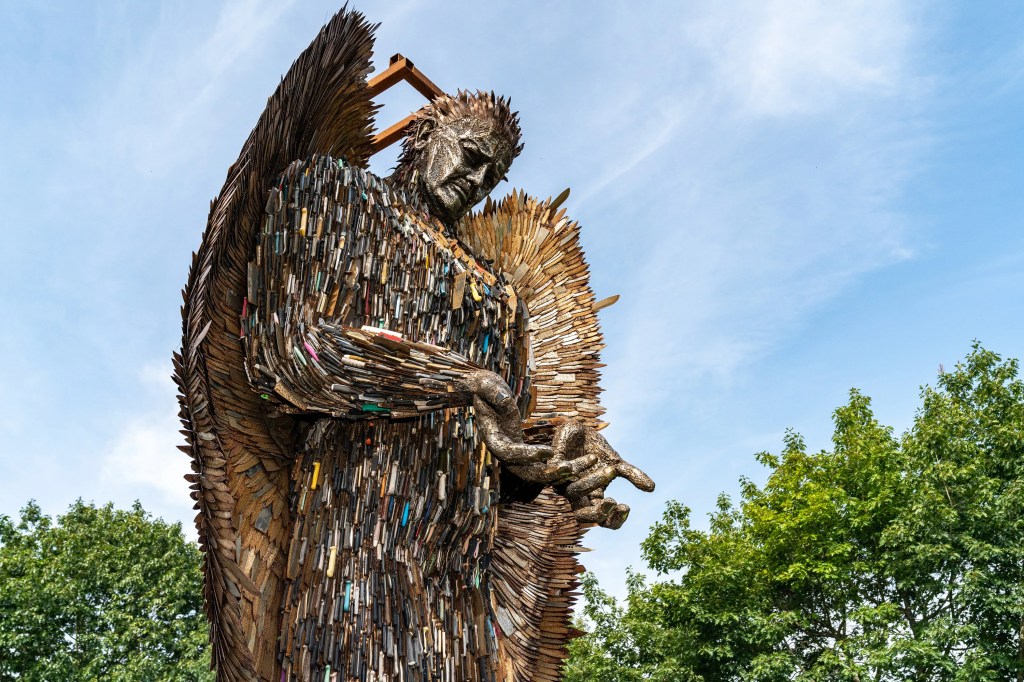
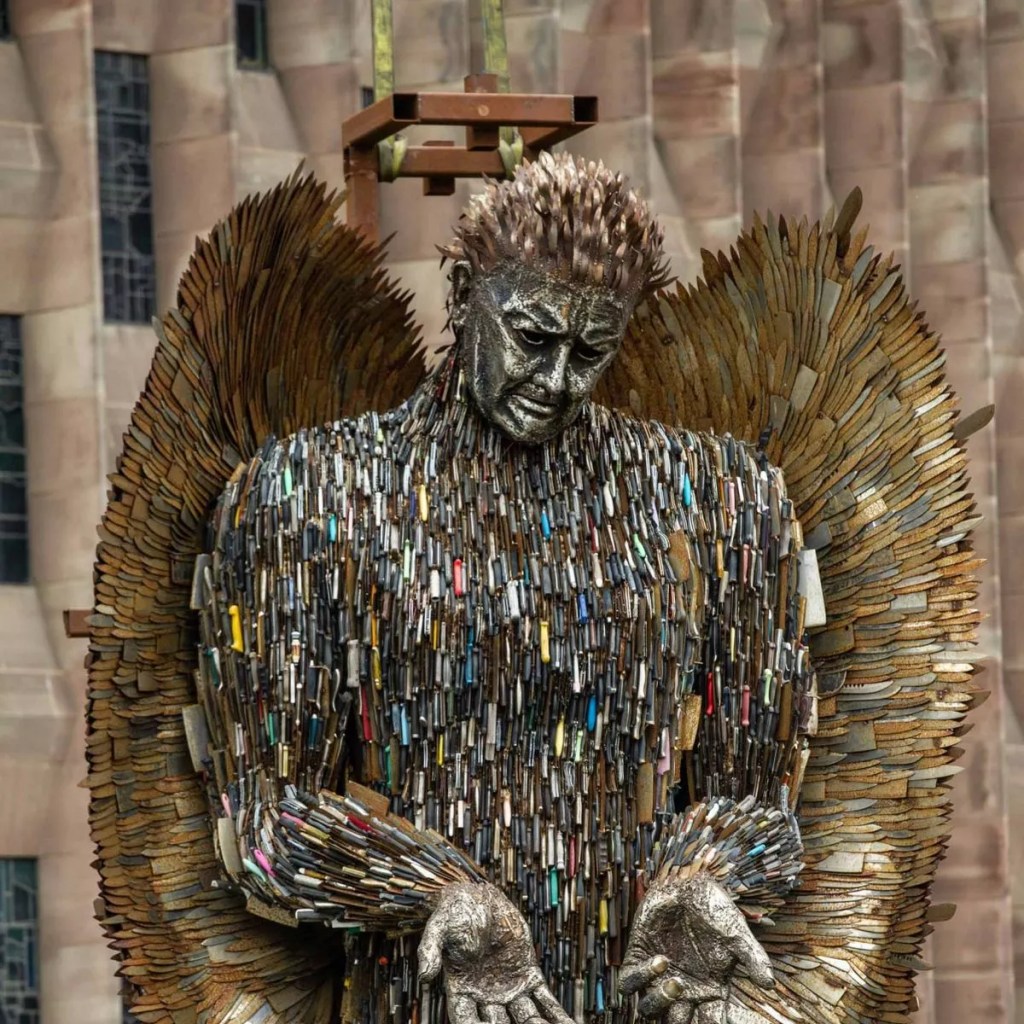
The Knife Angel Project is an initiative of the National Youth Anti-Violence Tour & Programme. It is a striking sculpture made from over 100,000 seized blades. Information linked with the Project says that: it was “specifically created to highlight the negative effects of violent behaviour whilst solidifying our critical need for social change. Not only does the Angel act as a catalyst for turning the tide on violent and aggressive behaviour, but it is also acts as a beautiful memorial designed to celebrate those lives who have been lost through these violent and thoughtless actions.”
The main goal is about educating and raising national awareness around anti-violence and anti-aggression. That hope has been realised thanks to a co-operation between communities, police constabularies, local councils and the Home Office. Hundreds of thousands of knives have been removed from the streets of where the Angel has visited but its legacy continues far beyond the actual visits. In the lead up to the creation of the Angel, the police had been organizing ‘knife banks’ and holding amnesties to remove as many knives out of circulation where they could no harm. No one was assisting and they had to pay for this initiative themselves. National Youth Anti-Violence Tour & Programme, with its special expertise were able to help. They were able to set up and help pay for the creation of over 200 banks! You can learn more about the work by reading their website.
The idea of the Knife Angel followed on from the collecting of the knives.
Knife Angel Objectives
National Youth Anti-Violence Group say that , Since the Knife Angel’s very conception, we have always had a singular objective in mind – to bring about social change. The Knife Angel was always intended to educate children, young people and adults about the harmful effects that violent behaviour has on communities all across our nation. It has also helped to raise better awareness, helped those carrying knives to renounce violence as a solution for solving disputes, and encouraged leading bodies to create better initiatives to turn the tide on aggressive behaviour. It symbolises a call for change whilst acting as a National Memorial for victims of knife crime and their loved ones.
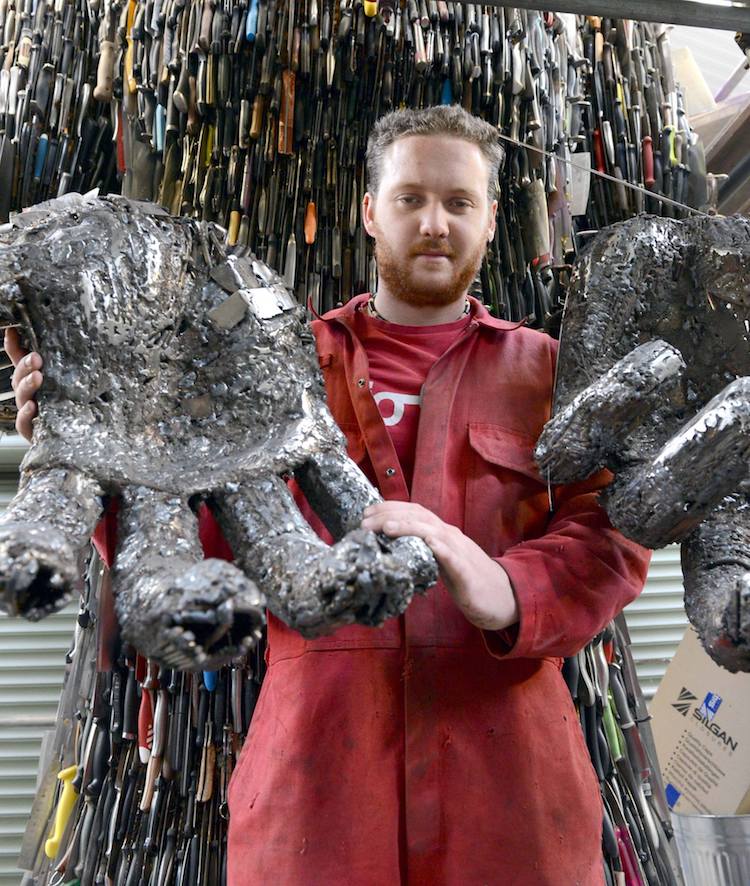
The Sculpture is known as the National Monument against Violence and Aggression. The Knife Angel is a contemporary sculpture formed of 100,000 knives created by artist Alfie Bradley and the British Ironworks Centre based in Oswestry, England. It was in the form of an angel and it is 27ft (8.2 m) high. It was completed in 2018. The construction was complex, involving sheet metal to form the basic shape. Alfie then worked through the collection of knives and weapons, very carefully, to determine what he had to work with. Each blade was blunted and sterilised before he could contemplate working with them. Each knife was carefully welded onto the form. Alfie then turned his attention to the most focal point of the angel, its wings. Each blade’s handle was removed and place on the wings to give a featherlike appearance. Many of the blades contain inscriptions – in memory of loved ones who have died so violently; some asked for forgiveness; others were offered it. Some expressed disbelief and astonishment at the scale of what is happening on our streets. But the Angel is more than functional. Many think it to be incredibly beautiful but it is more than a work of art. Those who made it possible state this as its legacy: The Knife Angel is so much more than the artwork itself. We want to create a legacy that travels with and beyond the Angel’s presence. We want each hosting location to continue spreading awareness for anti-violence, and all that the Angel stands for, long after it has left their location. The Angel is a catalyst for nationwide change.
The ‘Angel’ is taking its message on its travels which began in Liverpool Cathedral. Since then it has travelled far and wide, Birkenhead, Redcar, Newport, Gloucester Cathedral, Slough, Guildford Cathedral, Crewe, Nuneaton, Lichfield, Harlow in Essex …. And so the journey with its message goes on. The impetus for it all can be summed her by a saying of Helen Keller:
“Alone, we can do so little; together, we can do so much”
Loving God, you call us to turn our swords into ploughshares, and our spears into pruning hooks. Begin your work of transformation in all whose lives are overshadowed by knife crime, Replacing violence with peace, grief with consolation, fear with your perfect love. Where communities are broken, send your Holy Spirit to heal. And show us how we can join in your great work of reconciliation, As you mend and restore all things
Icon, St Colmba takes leave of his horse. copyright, Monastery of St. Macarius the Great
One of the stories about Columba is that he had a much loved horse. On the day that St. Columba was going to die, his horse approached him and knew he was about to lose his dear friend and so the horse begins to weep and they share some time of grief together. This story was told by Adamnan, 9th Abbot of Iona, in his Life of St. Columba
Taking Leave.
It had been hard to say goodbye to Erin. With heavy heart Columba followed the voice of God calling him through the words of Finnian the wise. It was long ago now when the seas, rushing to and fro, took him and companions to a place of new beginnings. It was a penance. As he crossed the dark waters he inhabited a dark place of his soul and wept. Beloved Erin, out of view but still deep settled in his heart.
That had been long ago now. On this blessed isle, watched over by angels, the Good News of Christ had been taken to foreign parts. Gospel seed scattered and rooted in heart after heart, blossoming in soul upon soul. Holy men of Iona, led by the sinner saint, opened souls to become guest-houses of the Spirit,; opened eyes to see visions of eternity; opened lives to pilgrimage with Christ on a joyful pathway of faith, building cairns of joy and forgiveness. Waymarks by which to experience the generous, freely-given love of God.
Columba gathered now at the final waymark. It was over now for him, though his saintly tale would go on inspiring many. But now, on the hill where they dwelt, the angels waited. Soon it would be time.
And then she came, as he rested by the millstone. A flurry of white, like the milk she often carried from cowshed to refectory table. She knelt in quiet homage, laying her head on his bosom. This pack horse had, by Columba’s love discovered a greater love God had for all creatures.
Sighing deeply, she knew that her master would soon leave. Wailing, she sang her funeral dirge, whilst the dear brother attending sought to chase her away. Columba stayed his hand. “Let her be. She is fond of me. Let her grieve and pour out her great need. The Creator has revealed to her what you have yet to perceive.” Raising frail hand, he blessed her. Sadly, but comforted, she left him, seeing perhaps,in the corner of her tearful eyes, myriad angels waiting to take him, no longer to Erin but with great joy, to eternity.