in York on July 15th.
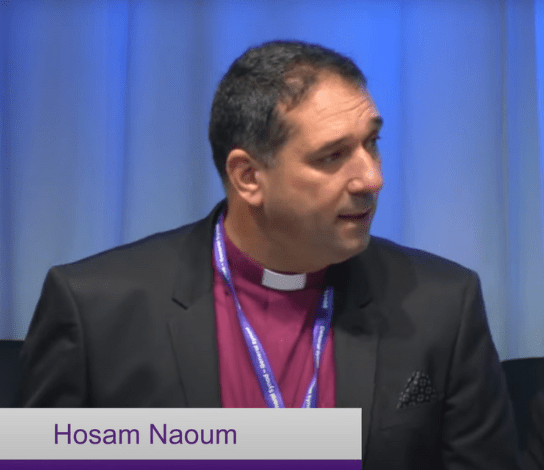
The address given by Archbishop Hosam about the situation in the Holy Land was so moving that the Archbishop received two standing ovations and was held deeply in prayer. This is the Report from the Anglican Commmunion News Service (ACNS) and other sources.
In his address Bishop Naoum said that hospitals continue to be bombed in Gaza, with medical supplies in short supply and a ‘horrifying’ system of food distribution, comparable to the dystopian series The Hunger Games, with three sites open one hour a day for two million people.
Calling for a restoration of humanitarian supplies including food and medicine, under UN supervision, Archbishop Hosam said there should be no targeting of civilians, especially emergency workers and medical staff.
He called for the release of all hostages and captives and a permanent ceasefire for the end of the war and rebuilding of Gaza – ‘not ethnic cleansing that is presently being discussed by the Israeli and US Government.”
As always,the church is committed to peace building and reconciliation – a message that he has repeated ‘time and time again’ – but these are ‘alien terms’ that people across both sides of the divide refuse to talk about or even listen to, he said.
“I realise that as a church we live and embody the gospel and we are not politicians.
However, we need to speak out in the face of injustices and be prophetic for the sake of our people and our calling as Christians.”
“I’m grateful for the (Church of England) House of Bishops’ statements that have been taking our story as Christians in the Middle East and especially in Jerusalem, very seriously.”
Archbishop Hosam spoke of his desire for peace in the region, for the humanitarian aid system to be reformed and for an end to acts which oppose the Geneva Conventions. He stated that, “Medical supplies are in short supply. The food distribution system is horrifying.
“Advocacy is urgently needed for Israel’s adherence to the Geneva Conventions, as its current practices are unacceptable.” He called for “no bombing of hospitals, lifting of the siege, restoration of humanitarian supplies, including food and medicine, under UN supervision, no targeting of civilians, especially emergency workers and medical staff and the release of all hostages and captives.”
In the face of this, Bishop Hosam said that “We are battered and bruised but not crushed.”. As a Church we must be committed to peace and reconciliation and be deeply committed to our Lord’s teaching of Peace and Love. We are called to a ministry of presence and resilience and of support, sustenance and healing. The Church is call to be a source of hope in an hopeless situation, but where a church is wounded and constrained, we need the wider body of Christ to help us to be the church in brutal and damaging times.”
The Most Revd Stephen Cottrell, the Archbishop of York in the Church of England, led a prayer for Archbishop Hosam at the conclusion of his address.
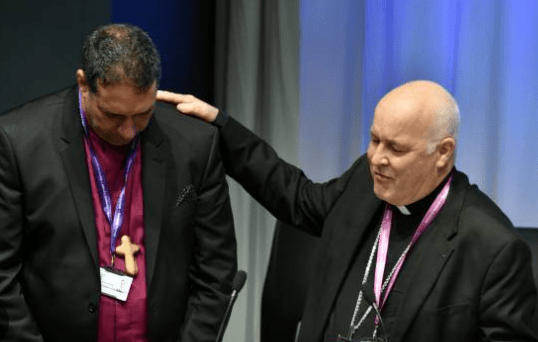
“Father, we pray for the peace of Jerusalem. We thank God for the faithfulness, friendship and ministry of our dear brother Hosam. We cry out to you for peace and justice in our world and especially in Israel, Palestine, in Gaza and in that whole region. We ask for the leading of your spirit, for the peace of your world. We ask this in Jesus’ name.”
In the words of Archbishop Hosam, with people around the world, we pray:
O God of all justice and peace
we cry out to you in the midst of the pain and trauma
of violence and fear which prevails in the Holy Land.
Be with those who need you in these days of suffering;
we pray for people of all faiths – Jews, Muslims and Christians and for all people of the land.
While we pray to you, O Lord, for an end to violence and the establishment of peace,
we also call for you to bring justice and equity to the peoples.
Guide us into your kingdom
where all people are treated with dignity and honour as your children
for, to all of us, you are our Heavenly Father.
In Jesus’ name we pray. Amen.
{}{}{}{}{}{}{}{}{}{}{}{}{}{}{}{}{}{}{}{}{}{}{}{}{}{}
The Most Reverend Hosam Naoum is the 15th Anglican Bishop in Jerusalem, a role he has held since 2021. He was born in Haifa and grew up in Shefa’amr in Galilee.
The Episcopal Diocese of Jerusalem is home to about 7,000 Anglicans worshipping within twenty-eight different congregations. It is also responsible for more than thirty institutions, including hospitals, schools, clinics and rehabilitation centres. The Diocese is scattered across five separate countries or territories: Jordan, Palestine, Lebanon, Syria, and Israel.
[Compiled by Mr G]



 Mr G's Ponderings