Collops & Pancakes

Pre Lent. Festivity and Fasting

In the past, the days before Lent were used to eat up all the food in the house which were traditionally ‘banned’ during the period of Fasting. It was the period of ‘Carnival’ (Carnivale) which is still popular in parts of Southern Europe. One of the most popular being in Venice with its parades and fancy dress and general merriment. Sadly because of the Virus, like many things, it won’t be happening this year. ‘Carnivale’ means, literally, ‘farewell to meat’ – a reminder that in Lent meat was not eaten. The Monday before Ash Wednesday is known as Collop Monday because on this day, any meat remaining in the house was fried into collops (like a medallion) and eaten. A traditional recipe involves bacon collops with eggs. Then on the day before Lent, Shrove Tuesday, the remaining eggs were used to produce pancakes (a tradition still extremely popular). Like meat, eggs were forbidden in Lent. This Tuesday was also the day when people confessed their sins and made themselves ready for the Lenten Fast. The word ‘Shrove’ comes from ‘shriven’ meaning ‘to confess and receive God’s absolution/ forgiveness’.

A more unusual festivity, and a unique one, is associated with the village of Whitechapel in North Lancashire, where I was Vicar for a time. The School children would go round the houses and farms in the area and  would knock on doors and  say ‘Please –a– pancake’. In the past they no doubt got pancakes but in more modern times, it was much more healthy—the children each received an orange! (sadly not this year of course).

Nowadays some of the festivity continues but the meaning behind it is lost. Lent is no longer a time for absolute fasting though many ‘give up’ things like chocolate or alcohol. (Sometimes the motive for this abstinence is to do with losing weight for the summer!). Fasting is a good spiritual discipline for all sorts of reasons. It is meant to train the body so that the soul is free to communicate more closely with God; it is a reminder of our Lord’s desert time when, after fasting he was tempted by the devil and resisted—and we are called to resist the temptations that beset us. Going without food of any kind and perhaps eating more simply at all times helps us to identify with so many in the world who are suffering from malnutrition—people we can help if we give the money saved by avoiding luxury foods to Third World charities and causes.

More than anything, fasting is also about giving up earthly things in order to concentrate on heavenly ones. A proper Fast must be accompanied by a deeper praying. In our modern world we could give up things other than food—such as watching less television—and using the time saved to read a spiritual book . A negative should always be accompanied by a positive. Lent can be a time to ‘take on’ something as well as ‘give up’. Setting an aim to be a better, more equipped, Christian is a good goal and turns Lent into a positive time. Lent is not a time of gloom but as the word itself means—a spring time for spiritual growth. An exciting time of opportunity to spend more time with God.

[GC]
The Greening Power of Spring comes ever near

Another lovely Tweet from my friend Joyce Smith. Here’s what she has to say about it:

Dear Friends,

It’s now getting lighter in the mornings and the birdsong is great to hear.
During my hour’s birdwatch last week I saw robins, blue tits, great tits, starlings, blackbirds and wood pigeons – all competing with the squirrels! At other times a wren sang beautifully on my fence and a crowd of long tailed twists twittered on the bird feeders. I guess some of you saw more than I did?

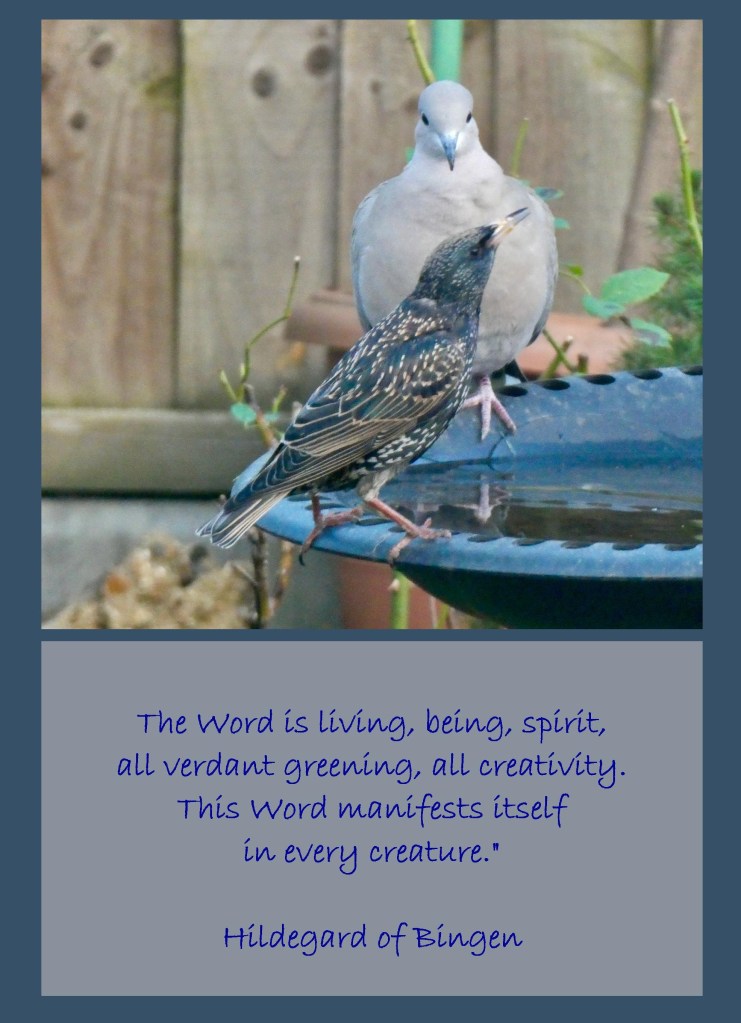
This starling and wood pigeon were a display of being in unity and sharing together. Joyce


A note about Hildegard of Bingen by Matthew Fox who said this about her in his book Original Blessing.

Hildegard was one of the “great creation-centered mystics of the West.” This multitalented and prolific abbess of a Benedictine abbey was an influential preacher, healer, scientist, composer, theologian, artist, and poet. She coined the term viriditas, or greening power, connecting it closely with creativity.

All in it together

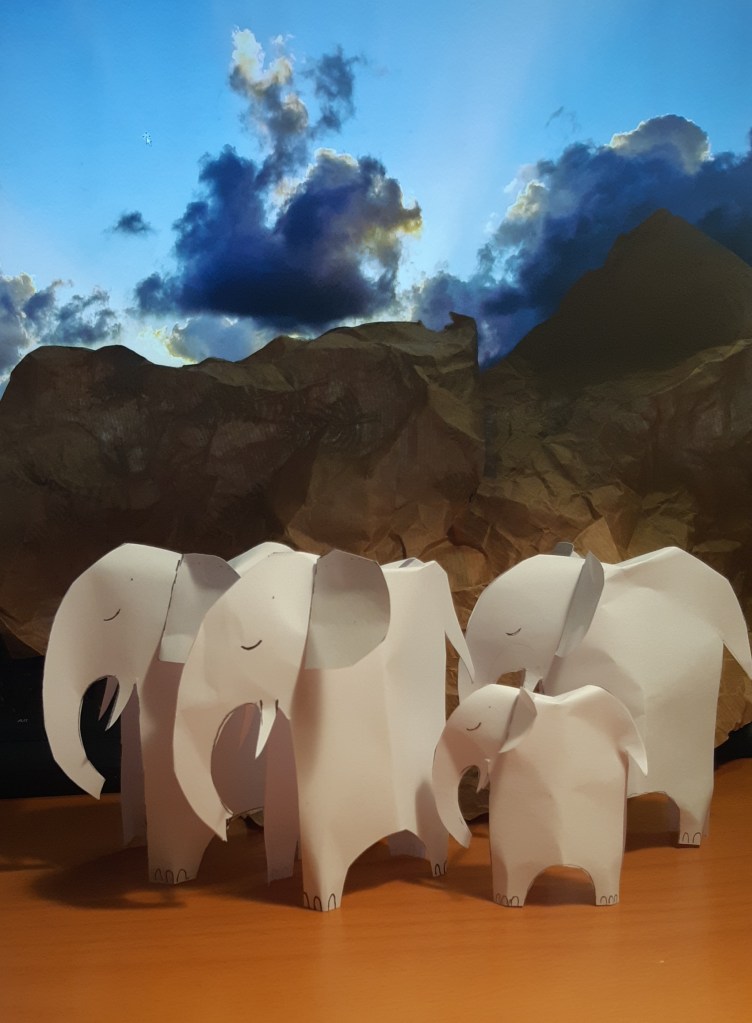
Elephant family in harmony with creation,
made, arranged & photographed by Piers Northam

Last Sunday at St Mary-at-Latton our Family Service had a Creation theme. Piers, the leader told a story based on A Year Full of Stories, 52 Folk Tales and Legends from around the world.

The particular story was called Elephant and the Rain Spirit which was sub-titled An African Bushman Story.

It told of an Elephant which was very proud of being the largest and strongest animal, the greatest in the land. Being a big animal no-one dared to argue with him. Until, that is, the Rain Spirit challenged the Elephant.
The Elephant wasn’t used to being challenged and began to protest. What about his great trunk and his fine tusks, not to mention his great big feet which made the earth tremble.
The Rain Spirit then reminded him that it was she who filled all the watering holes so that the animals can drink and watered the plants so that they could grow.
The elephant got quite annoyed at this and insisted that he could find his own food and drink.
The Rain Spirit said that the Elephant could therefore fend for himself and with a flash of lightning off the Spirit went. The Elephant laughed. He had seen the Rain Spirit off. He really was the greatest.

All went well until the Rainy season arrived but there was no Rain Spirit to fill the lakes and water holes, nor water for the plants. The other animals became thirsty and hungry so they went to the Elephant. They asked him to provide water for them to drink and water the plants so they had food to eat. The Elephant was a bit stuck so he told Crow to make water.  Crow did her best but very soon what little was produced was soon used up. Except for one watering hole that Elephant kept for himself. He told Tortoise to guard it which he tried to do.
All the animals tried to persuade Tortoise but to no avail. Until, that is, the Lion came. He moved Tortoise away with his paw and began to drink. The other animals took advantage until all the water was gone.
When the Elephant returned and saw what happened, he became very angry. The Tortoise tried to defend himself but the Elephant punished him by swallowing him up. The Tortoise wasn’t happy either and he made a great commotion in the Elephant’s stomach. The Elephant sunk to his knees in agony.
Then the Rain Spirit returned and the Elephant begged for help. The Rain Spirit said that surely, as the Elephant was the greatest in the land, why would he need help.

The Elephant then realized something. He told the Rain Spirit that though he was the greatest on earth, he wasn’t the greatest in the sky. The Rain Spirit laughed and laughed and the rain splashed down. When Tortoise heard the rain he gave Elephant a great thump and Elephant coughed him out again.

This delightful story has a big lesson. No one is more important than anyone else and that we all depend on each other. Gifts and food and water have all been provided for all of us by God. To enjoy this Providence all we have to do is share it with each other. That also means that we have to look after all of Creation. We are called Stewards which really means lookers-after. We have accountability for this stewardship. That goes for Mother Earth too. We have been given the work of caring for the climate and looking after this wonderful planet of which we are currently the tenants.

But we know all too well that we are failing.
Politicians, world leaders, those who exploit animals, rain forests, oceans, poor people and natural resources because they are greedy or who, like the Elephant in the story think they are the greatest are leading the world into extinction are all failing. So are we!

David Attenborough, the elder statesman of planet and nature conservation together with Greta Thumberg, one of our youngest activists have done more to alert and educate people of our Universal plight than any politician. Young voices are being heard in our own country. The proposed Future Generations Bill with its simple aim to put the well-being of those who follow us at the heart of decision making today. The Bill has been promoted by The Big Issue Foundation and Lord Bird who does so much for the homeless and vulnerable.

The Pandemic is a time when our own vulnerability as  the human race, is something we are being made to face. Whatever happens as we try to tackle the Virus, things are no longer the same and never ever will be. We are discovering that we aren’t the greatest and we never will be. There are truly vital lessons to be learned.

In the Christian religion there is a word – Repentance-  it means expressing sorrow for our mistakes and failings and self-centredness but most of all, out of this, there needs to come a turning round towards God, (The heart of what Repentance means) returning to the source of love and self-lessness. We are to return to the one who is our Provider – who gives and gives and gives all we need.

The Elephant had to learn a big, big lesson about our mutual dependency on each other. We all have a special place in the life of the world. However, that special place is not greater or better than anyone else. We have to try and help people to realize that and also, that together we can do lovely and wonderful and beautiful things.This depends on mutual care, love, acceptance, celebration and cherishing each other. Also, developing a growing recognition and gratitude that God who really is our provider, makes life (ours and all creatures that inhabit our Planet) very special.

Our picture above shows a family of rather gentle elephants. All those at the service made their own versions of it. May it remind them and us of how much better it is if we work together with others – human and otherwise!

[Mr.G.]


#The book, A year full of stories. 52 Folk Tales and Legends from around the world, is written by Angela McAllister and is wonderfully illustrated by Christopher Corr. Published by Francis Lincoln Children’s books 2016 ISBN 978-1-84780-859-2

#There are a few photos of the children’s elephants on the St. Mary-at-Latton Facebook page (under photos).

Reverence for all creation

This prayer is the Church of England’s alternative Collect for last Sunday.

It moved me by the beauty of its words and the desire for a love of our world. Creation and our planet as well as us as God’s people and Stewards, need all of that very much at the moment.

I’ve had the photo in my library for some time and as an expression of the prayer it feels just right.

Please pray the prayer and live it as gently and meaningfully as those lovely collared doves.

[Mr G]