[photo from Gill Henwood – of the area near the Black Mountains, Bhutan]
Jesus prays in Gethsemane
On the night of his betrayal, Jesus took his disciples to the Garden of Gethsemane, near the Mount of Olives. He asked them to pray for themselves and then went to a place by himself. He prayed to his Father that he might be released from the trial and crucifixion ahead of him. But he also prayed that his Father’s will should prevail. The humanity of Jesus cried out and his anguish caused his sweat to fall like drops of blood. An angel from heaven came to strengthen him. His disciples were fast asleep. Then the Roman soldiers came to the garden to arrest him…. (St Luke’s Gospel Chapter 22: 39-53)
Gethsemane
This is his Passion. Darkness wraps around his very being, not a warming cloak but a shroud. Silence, punctured by friends snoring off the wellbeing of food, minds sloshed with wine. Alone with the shivers of the night, everything in him protests.
Sometimes, when we know our destiny, our minds close. Not this! No! Never! But our hearts are our undoing: our resolve begins; ends there. So he battles with his need to say ‘Yes’, for himself, for others, for us. How else can the world know what it is to be loved?
Kneeling on the damp ground, tense, numb, scared, uncertain, he waits. And the Father waits too as demons and angels whirl, stirring up the black air, a vortex of cosmic battle. Below them, sweat drops as blood. And still the Father waits, listening expectantly, daring to hope…
God wrestling desperately with God with everything – just everything – at stake. This really is the Passion. He sighs, deeply, calm descends. “Yes, let it be.”
The Father wraps his love around him – and so too around us.
Four years ago, my friend Joyce wrote a little story about the Palm Sunday Donkey. It was specifically for the children of Ninefields Church of England School, near Waltham Abbey in Essex. Each child got a printed copy as a gift from Joyce. One or two others of us also got one. With Joyce’s permission, I was able to Blog it as an entry for March 28th 2021. Sadly since then Joyce died unexpectedly and though some will have read the story, it’s worth repeating as I pause in prayer and remember a delightful person who understood more than most, what it means to be child-like.
[Mr G # Palm Sunday 2025]
It promised to be a hot and sunny day as the early morning sunlight played on the little donkey’s face. Benji lazily opened first one eye and then the other, but although the sunshine was warm on his face, he shivered a little and huddled closer to his mother. It was, after all, only yesterday that he had seen the old donkey who lived along the road being cruelly beaten by his master. Benji’s mother gently nuzzled her son’s face and slowly licked one long ear followed by the other. Then, at the sound of their master’s voice, they trotted over to the edge of their field and had a long drink from the bucket of water he had brought for them, before turning to munch the hay which was piled up in the corner.
Even though their master was a kind man, Benji was still very frightened of the world outside his field and the scar on his mother’s back would always remind him of how cruel some people could be even to a donkey who had done nothing wrong. Sometimes, as Benji watched his mother carrying a person down the hill to the big city of Jerusalem, he could almost feel the pain of her scar and he longed to do something to help her. But the trouble was, whenever anybody asked for a ride on Benji, he was so frightened that he would begin to shake all over and no one wanted to ride him when he was like that. And so, in his short life, nobody had ever ridden on Benji’s back. But perhaps, just perhaps, today would be different……….
When Benji and his mother had finished eating, their master returned and, as he gently tickled their ears, he began to speak softly to them:
‘There will be lots of people going down to Jerusalem today to celebrate the Feast of the Passover’ he said ‘and I think that someone will need you to carry him today, Benji, so I’m going to get you both ready and I want you to stand quietly for me by the house.’
Then, using a long length of rope so that the donkeys could still graze from the grass, their master tied them to the trunk of a tree and they began to wait to see who might come by. They hadn’t been waiting long, however, when two men hurried towards the donkeys and, turning to their owner they said:
‘The Lord needs them’‘ That’s just fine’ said their master and as he untied Benji and his mother he whispered in their ears, ‘today will be your special day.’
The two men led the donkeys to the end of a dusty path and as they stood there, waiting, Benji turned his head and from where he was standing he could see right to the bottom of the big hill and all of the city of Jerusalem surrounded by big stone walls and lots of people, who looked as small as ants, hurrying around. Just then Benji’s gaze was arrested by a pile of rubbish outside the walls of the city and he began to tremble. He had often seen donkeys carrying rotting rubbish down to the tip and, sometimes, his mother told him, bad people were hung on crosses and killed there. At that thought, Benji shook even more, but just as he was beginning to feel so weak that he thought he would fall over, he felt a hand on his head and a gentle voice saying:
‘Not today, little donkey, not today; the rubbish tip’s not for today. Don’t be afraid little donkey, today I want you to carry me.’
Benji turned his head and found himself looking into the most understanding man’s face he had ever seen and suddenly his shaking stopped and he felt strangely calm. Yes, he would be able to carry this man because he knew he understood and he gently nuzzled Jesus’ hand. While his friends put their coats on Benji’s back, Jesus gently patted the scar on the older donkey’s back and this time she didn’t wince as she normally did, but she too, gently rubbed her head against him.
When they were ready, Jesus climbed on Benji’s back and began to ride down the hill towards Jerusalem. To his surprise, with this man on his back, Benji suddenly felt quite strong and sure of himself. Somehow, being with Jesus, had taken away his scary feelings and now he really did feel that he could carry him all the way to Jerusalem. And Benji’s mother was just a few paces behind trotting along quite contentedly. They hadn’t gone very far, however, when people started to come to the edge of the road and they began to cheer and wave palm branches as Jesus rode by on the little donkey. People even spread their cloaks and more palm branches on the ground so that Benji had a very soft road to walk on. People then began to shout:
‘Hosanna to the Son of David! Blessed is he who comes in the name of the Lord Hosanna in the highest’
‘Yes, Jesus must be very special’ thought Benji, ‘ but I could have told all these people that from the moment he first spoke to me.’ And as he continued to trot down the road he, too, felt special and so happy.
But as we know, donkeys are very sensitive and after a little while, amidst all the cheering, Benji’s long ears began to pick up some whispers from people at the back of the crowd, people who said they didn’t like Jesus and even that they wanted to kill him. When he heard this, Benji began to shake again, but the man on his back gently patted him and said again; ‘Not today little donkey, not today.’ So, reassured once more, Benji trotted on right through a gate in the wall and into the city of Jerusalem, right up to the temple.
When they arrived there, Jesus jumped off Benji’s back, ‘ thank you, little donkey’ he said, ‘now you go back home with your mother and rest – well done little donkey, well done.’ Benji was so happy, he didn’t want to leave, but after rubbing Jesus’ arm with his muzzle one more, he turned and trotted back up the hill with his mother.
When he got home, he turned his head and looked at the city of Jerusalem once more and he wondered what Jesus was doing now. Then, as his gaze again took in the rubbish tip, a big tear rolled down his face and he heard that gentle voice saying ‘not today, not today, little donkey’ and he wondered what tomorrow might bring……
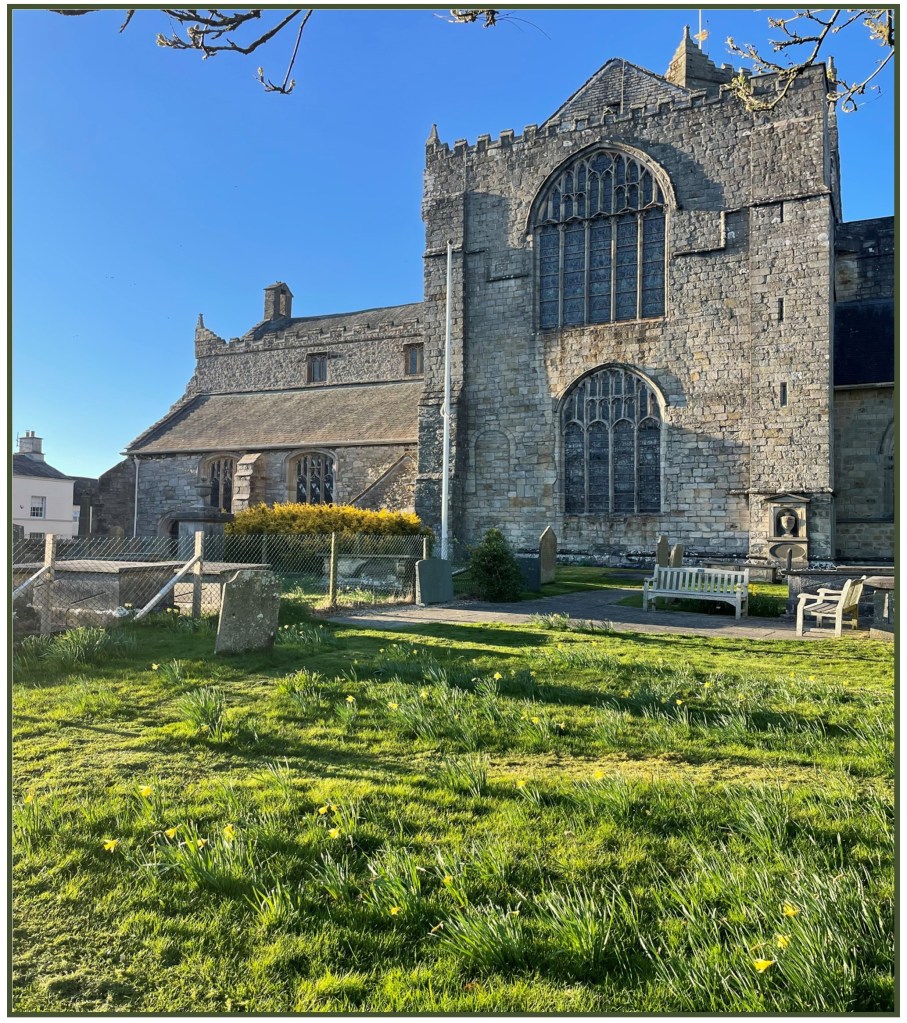
Cartmel Priory, Cumbria ~ Remembrance garden. photo by Gill Henwood.
Posted the day after President Trump sent shockwaves of uncertainty around the world, this beautiful Oasis of peace at Cartmel reminds us how much the world is actually caught up in the love of God. Cartmel Priory has been a reminder of that love for centuries and will go on being so long after the world has forgotten who Mr Trump was. Gill’s words below help us to refocus.
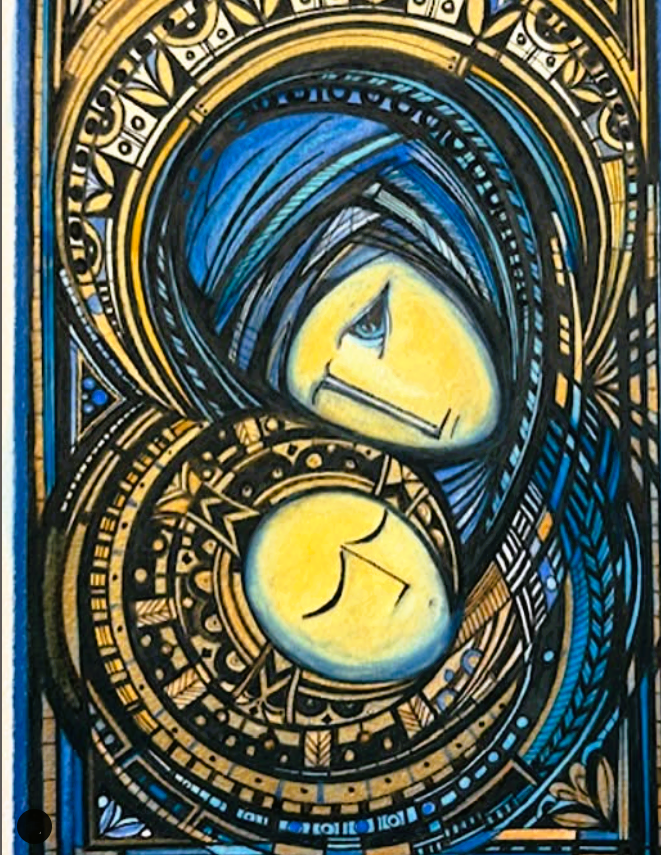
The drawing above of the Blessed Virgin Mary and Jesus is by my artist friend, Kay Gibbons. It was recently exhibited in The Oxford Arts Society Show. Kate works in various mediums, especially stained glass; glass sculpture; water colour; sculpture; oil and much more. Her designs are often striking and bold and she has a tremendous eye for colour. To see more examples of her work, visit her on Instagram. (PS, I am a big fan!)
A Thought on Mothering Sunday from Kay
When all around is busy , crazy and chaotic … I like to sit quietly and draw and think and ponder and wonder… about this , that and the other …..
[Kay Gibbons]
Mothering Sunday is aChristian holy day, celebrated throughout Europe, that falls on the 4th Sunday inLent. It is a time when we traditionally celebrate the church as the place where our Christian family finds its home.In the past many people worked away from home—many children in service to big households—but on this day they were given time off to return home to their families, and to their ‘mother church’. They would pick flowers along the way to give to their mothers. It was also a day in Lent when the rules about fasting were relaxed, and it was a time when special Easter cakes were prepared, so it also became known as Refreshment Sunday, Pudding Pie Sunday and Simnel Sunday – after the practice of baking Simnel cakes to celebrate the reuniting of families during Lent. Mother’s Day** is a more recent invention when is a celebration of the role of mothers and families. It is celebrated on the same day that Mothering Sunday so the two celebrations have now been combined.
{ ** mothers’ day is kept at another time of the year in the USA and other places}
A Prayer on Mothering Sunday and beyond
Loving God, you have given us the right to be called children of God.Help us to show your love in our homes that they may be places of love, security and truth. Loving God, Jesus, your Son, was born into the family of Mary and Joseph; bless all parents and all who care for children; strengthen those families living under stress and may your love be known where no human love is found.Loving God, we thank you for the family of the Church. We pray that all may find in her their true home; that the lonely, the marginalized, the rejected may be welcomed and loved in the name of Jesus.Loving God, as we see the brokenness of our world we pray for healing among the nations; for food where there is hunger; for freedom where there is oppression; for joy where there is pain; that your love may bring peace to all your children. Amen



 Mr G's Ponderings