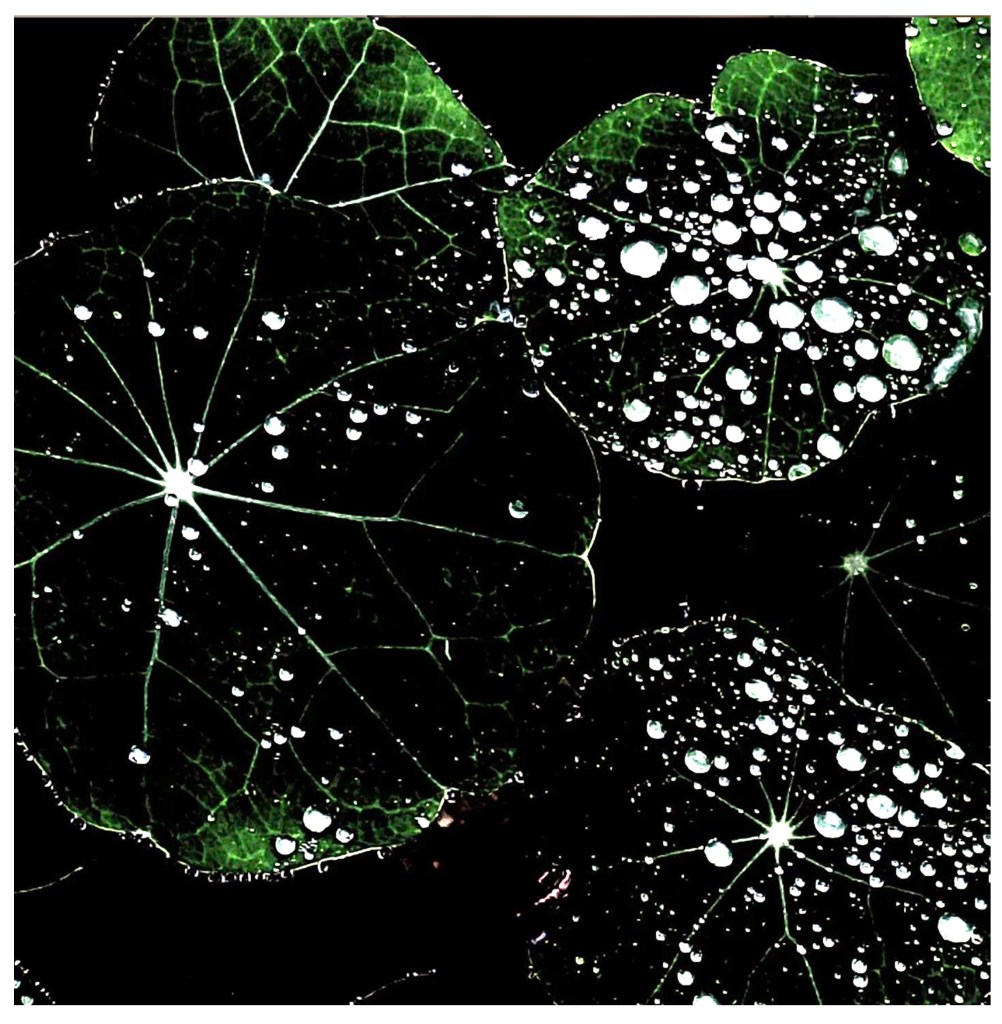
Rainwater dazzling on dark leaves – photo composition by Mr G.
Last night I was at a vigil of prayer led by my friend Julia Sheffield. A group of us gathered in a small, intimate chapel which was a symbol of Gethsemane, the Garden where Jesus took his disciples before his arrest. We were the modern day disciples gathered with Jesus in contemplation of Good Friday about to dawn once again. Julia led us sensitively and beautifully with prose, music and silence in a three hour meditation. As ever, in a confined space we become aware of our friends praying with us. Silence is rarely easy, especially when tired but atmosphere can work wonders. Even so, I found myself shuffling a little, so I thought about this and wrote these words.
Reflective thoughts on Gethsemane.
Lord, you asked us to stay, to wait, to watch. Be still…
Language of vigil.
Attentiveness, companionship. Faithful believers invited to devoted watchfulness.
Is that us Lord? Is our fidgeting, our drooping eyes, shuffling feet, punctuated snores, stifled coughs, wandering thoughts, enough?
You said, Watch and pray. You also say, I will love you and whatever you bring, it is enough.
Your faith, however dim you think it is, lightens the darkest of nights. Together we cannot be quenched, diminished, dimmed. in a world in need, We dazzle!
In my final two years at Grammar School it was decided that I might be technically challenged if I continued to attempt metal work. The advice I received bemused me a little because it was thought I should do better at Art. I was not noted for my skills with pencil, charcoal or paintbrush! Responding once to a request from my teacher for a self-portrait, I placed paper on the floor, lay down and proceeded to draw an outline of my head onto the paper. A semblance of a nose, two eyes and a mouth, drawn freehand completed the masterpiece. Mr Turner, my art teacher, was not impressed!
However, in one area, I soaked up all that Mr Turner taught us. Half the lessons were about Art Appreciation. I discovered things like perspective, use of colour and how portrait art differed from landscape. I was introduced to Piero della Francesca, Fra Angelica, Velasquez, Gaugin, Turner, Constable and art movements such as Pre-Raphaelite, modernism and so much more. I learned about the place of art in life and about using one’s eyes and other senses to notice things. Appreciation of other arts such as Music, were to follow. I wish I had been able to talk with Mr Turner later in life. I would have thanked him for opening up such a gift. I have looked at art in many galleries, smaller exhibitions and in studios in of the homes of artist friends. I have also collected many paintings. Each one has its own story to tell. Each is a ‘go to’ when I have needed solace, inspiration or just an insight into the working of the soul.
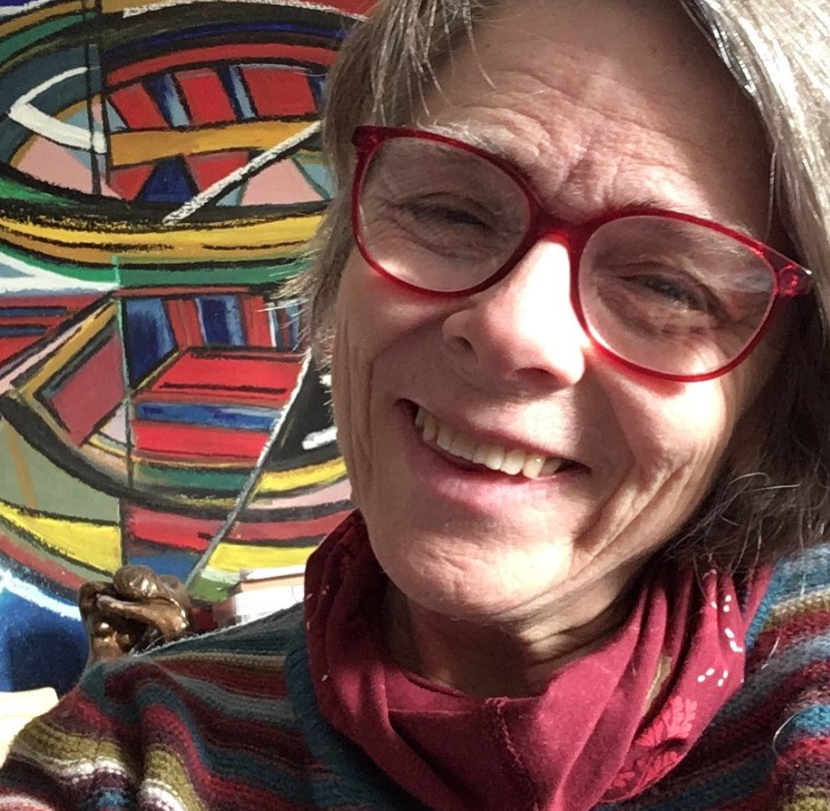
I have enjoyed many conversations with artists of different kinds from a village potter in a north Essex village to people exhibiting paintings and collages and strange beings sculpted in country fairs or Tate Moderns. I have also got to know artists whom I now count as my friends. One such is Kay Gibbons and I have used some of her work in my blog entries. Kay lives now in Oxfordshire but I first became her friend when we were both in the North East.
She was interviewed recently on the Arts Musing Podcast, which is based in Oxford. The subject of the interview was Art as Healing . She was introduced as a multi-media artist. Her work includes large abstract paintings, fluid sculpture some with sharp angles, drawing, paintings in oil, water colour, etc. She has specialized in stained glass with sections separated by lead as with church stained glass. Her first such stained glass window was a large window installed in the Phoenix ward in Littlemore Hospital, a major mental health unit. Her second window was the Warneford Window, of which there is an illustration in this article. Art was, I think, part of a personal self-exploration. It has been a life-long journey and in this respect plays a huge part in her personal development. It is the powerhouse of her creativity and a kind of anchor in times storm, of sadness and loss but also it has a role in bringing a calmness and an enjoyment. Coping with Long Covid has been a particular challenge but out of it her work with glass, in its decorated and colour forms has blossomed. She has come to a deeper understanding of symbolism and of the place art plays in creating wholeness of being. She combines this with a more meaningful association with literature. She says: “My art is a visual poem with as many interpretations as there are viewers.” Sometimes what we create takes on a deeper significance … quite unaware , quite unexpectedly.” “Art”, she says, “is a precious gift in us all , whether with a pen, a brush , a chisel , the crafters knife, or with thread and needle or a ball of clay … or just a reassuring hand and simple smile.”
As someone who is discovering the place of poetry, of creative writing, of the use of pen rather than brush, I found some resonance in what she says. Mr Turner might even be pleased.” Musicians and writers would understand it too!
Her studio, which is mostly her home, teems with energy and enthusiasm. Examples of the various styles of art bring warmth and joy to the room. A sense of being part of a process of ‘becoming’. She speaks of the day that she recognized that she really was an artist. It brought great joy, (expressed as, Whoosh!) She loves what she is seeking to express because her art speaks when, in other ways, she has no voice. In such circumstances, art becomes a way of communication. For Kay, art is not just a healing process, for the artist and for many who look on it is an act of contemplation. It digs deep into who we are as well as who the artis is. It is also something to be enjoyed. Kay says that it “it is precious. It can lighten dark spaces. It can be both an anchor and a casting fishing line. It can sculpt words into poems and take us to the furthest stars. It can bring summer to our winter. It is a precious gift not a pressured burden.” That makes a lot of sense to me.
The Warneford Window by Kay Gibbons
I owe a great deal to Mr Turner who helped me to put the appreciation of art firmly into my soul. I owe even more to all the artists who have spoken to me with their work and who have given me insights not only into the creative process but to a way of allowing the soul to communicate with the world. As a Christian, it has also been a way in which God communicates with me. God is the original and constant artist who paints images onto our souls and gives us words to understand them.
Kay is one of those who have helped me to celebrate that. How grateful I am for her creative spirit and the joy with which she shares it. She says that the greatest joy about her art is to share a valuable experience and the excitement of life. That excitement has been born from many tests, darknesses, disappointments; from, darkness into light. In it, faith has become real; art has become real; We become real.
To see much more of Kay’s art, simply look her up on Instagram.
To hear her on Sally Anne Stewart and Carole Theriault’s Oxford-based Podcast ArtMusings, look it up. I did on Google and it was easy to find.
Finally: If a teacher has inspired you and helped in your personal development and appreciation in ways like Mr Turner did, don’t wait too long to thank them for the difference and enrichment of your life which came through them.
Cross in the Gospel Garden on the Holy Island of Lindisfarne, carved by Fenwick Lawson. Photo: Mr G.
St Cuthbert, Praying and Doing
Yesterday, on March 20th, the Church celebrated Saint Cuthbert. Nowhere more so than the North East of England where Cuthbert came to faith, ministered to people during a difficult time in the life of the Church and led people to deepen their love for God and discover more clearly God’s love for them.
His ministry did not end with his birthday in heaven. The Holy Island of Lindisfarne off the North East coast near Bamburgh remains a centre of pilgrimage and prayerful inspiration to this day. The amazing and richly beautiful Lindisfarne Gospels, created in his honour, are still regarded as one of the most stunning illustrated Gospels alongside the Book of Kells. They can still be seen in the British Library though there is a facsimile in the museum on Holy Island and it’s much more accessible and actually fun to see it in situ. There are of course many printed versions. The Gospel was the offering of Lindisfarne monks to God as a thanksgiving for all that Cuthbert had illuminated the world with his faith, Gospel love and prayer. Things that he shared with all the people he met. When the Vikings raised the East Coast of England, the monks took the Gospel alongside other artifacts of Cuthbert to safety on a journey which took a very long time. This was to lead eventually to Durham where the story of Cuthbert continues.
His first journey in faith was very different.
Long before, above the Lammermuir hills bright light in the borders of England and Scotland a light brightened the night sky and attracted the attention of a young shepherd boy. A vision came to him of a holy soul being taken by angels to heaven. Next morning, he heard that the great St Aidan of Lindisfarne had died. The boy, Cuthbert, was moved to go his local monastery at Melrose and seek instruction in order to become a monk. the story of one of the greatest English saints was born. St Cuthbert was to serve God at Melrose, Ripon and Lindisfarne. He was, for a time, Bishop of Lindisfarne.
Cuthbert’s real fame was amongst ordinary people to whom he took the Gospel. Travelling with a portable altar he crossed and criss-crossed Northern England from the Solway to the Tyne. He encouraged Christians in Cumbria, North Yorkshire, Durham and Northumbria. He was a tireless missionary for God. He was also a focus of unity when the Church split after an argument about when and how Easter was to be kept (amongst other things). The Celtic party lost to the Roman one at a Synod of Whitby in 664AD. Many of the Celtic monks returned to Ireland and the church was in total disarray. It fell to Cuthbert and his spiritual companion, St Hilda, to hold the broken church in love and prayer and bring healing and a new unity. Eventually he retreated to the Inner Farne Islands, where on this day, 20th March in the year 687, he died.
When, after the Viking raids, the Body of St. Cuthbert was carried by the monks of Lindisfarne to safety, the journey was long and arduous. It involved a stay in Chester-le-Street and a journey over the Cleveland Hills now known as the Lyke Wake Walk or Coffin Walk.
An account of the final part of the journey is to be found in a ‘History of the Church in Durham’ by a medieval monk, Symeon. He describes the arrival of the shrine at a place on the east side of what is now the city of Durham. The vehicle on which it rested could not be moved and the bishop directed his monks “that they should solicit an explanation of this sign from heaven by a fast of three days, which should be spent in watching and prayer, in order that they might discover where they should take their abode along with the holy body of the father”. This was done and Symeon goes on to relate that “a revelation was made to a certain religious person named Eadmer, to the purport that they were required to remove the body to Durham and prepare a suitable resting place for it”. This resting place was found when the monks were led to a place called Dun Cow Hill Durham), where a wooden cathedral was built to house the remains. This simple church was eventually replaced by the great Norman Cathedral of Durham, where, today, under a simple slab with the word Cuthbertus ,his body still lies.
An active missionary for God, Cuthbert’s strength lay in his personal communion with God. He was one of those busy saints who, in the words of Cardinal Basil Hume, was always nostalgic for the desert when busy in the market place. Like the Lord he followed, he would withdraw to be alone with God. Often this meant that he had to steal away in the middle of the night. Once, when he stood in the sea near St Abbs Head, a monk spied on him. all night Cuthbert stood in the Cross position of prayer, arms outstretched as he gazed on God. In the morning, when he came ashore, sea otters followed him. They wrapped themselves round his legs and warmed his frozen feet. Then, after a blessing, they returned to the sea.
When busy on Lindisfarne, Cuthbert would steal away to a piece of land which was cut of from the main island at high tide. It’s known today as Cuddy’s Isle. A cross stands where a little cell used to be. For six hours he could enjoy solitude for prayer. He ended his life as a hermit on the Farne Islands. His life of busyness and the mission he carried out, were only possible because he forced out time (often against all odds) to be still before God. Great things in the name of Jesus can only be achieved when they are backed up by real prayer. Only when we attend to our praying will our ‘doing’ have any effect. It’s a lesson worth re-learning.
[Mr G]– with a lot of help from the Venerable Bede, Simeon of Durham, the spirit of the North East, the witness of Durham Cathedral and the sanctified knowledge ofKate Tristram.
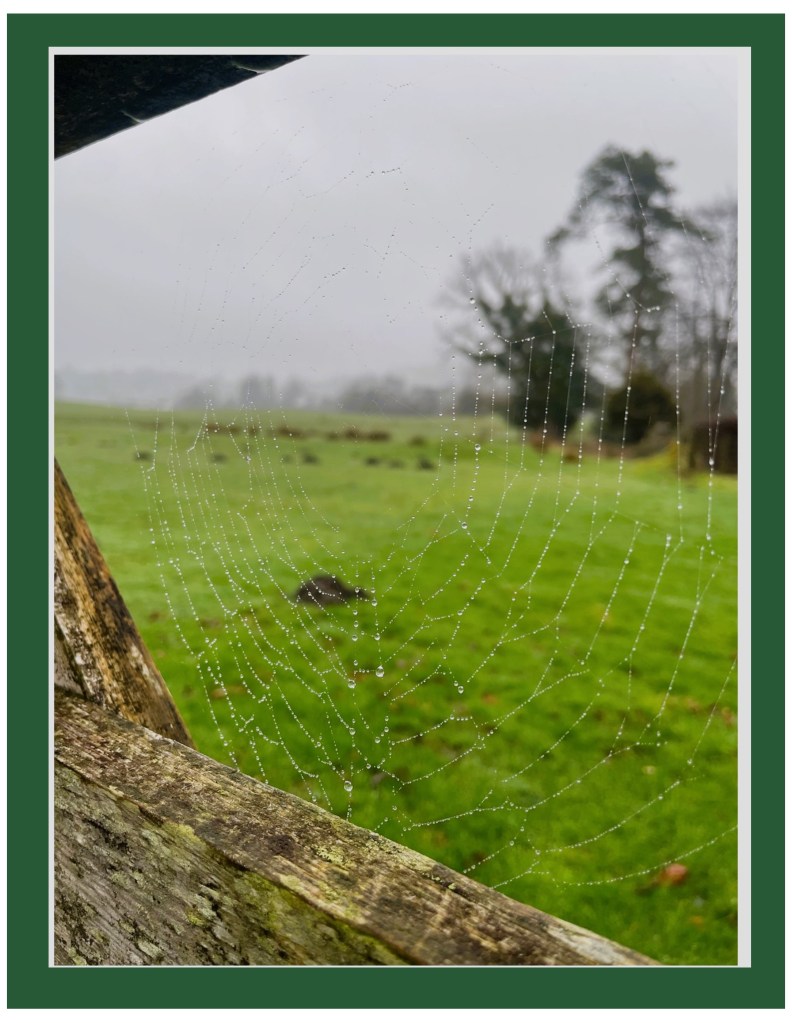
Dewdrops on spider’s web. photograph by Gill Henwood
My friend Gill has recently sent me this photograph of dewdrops on a cobweb near her home in the Lake District. My thoughts centred on the fragility and ephemeral nature of the scene. A word often associated with spiders’ webs is ‘gossamer’ – a fine filmy substance consisting of cobwebs spun by spiders; light, thin, delicate, almost insubstantial. Certainly short-lived. But another way of seeing it is that of a thin place, a tissue paper kind of boundary between two worlds.
‘Thin Place’ is an idea many of us use to describe places where God seems spiritually and, in a way, physically present to us. Obvious thin places are religious shrines, like that at Santiago de Compostella where pilgrims walk from many places in Europe to the Northern area of Spain, to a journey end at the Shrine of St. James the Great there. When I made the pilgrimage there a few years ago, I was deeply moved by the experience of God I had and I knew then what a thin place truly is. There are many such places, such as Iona, the Holy Island of Lindisfarne and legions of other places. Every religion has such holy places which have been sanctified by God and by prayers of the pilgrims. Not all are huge centres like Lisieux in Northern France or Lourdes where many go to pray for healing. Some are almost backwaters like Little Gidding near Huntingdon, Cambridgeshire. It is a quiet oasis and not that easy to find. However, those who visit, certainly can say of it, words which the great poet T.S.Eliot coined in the Quartet Poem to which he gave it’s name. It is a place where Prayer has been valid. It is valid still. It is truly a thin place where it feels very easy to meet God.
Though all that is true, Gill’s photo reminds me that not all thin places are permanent nor beyond the immediate moment, spectacular. God sanctifies all our meetings with him, it’s just that we don’t often recognize it. (at least, I don’t !) I have to keep remind myself of something St. Teresa of Avila said – God walks among the pots and pans. Her soul friend, St John of the Cross, puts that rather more beautifully, when he says, “God passes through the thicket of the world, and wherever His glance falls He turns all things to beauty.”
In the spider’s web decorated with dewdrops we can be aware of that. It becomes a way in which God reveals his presence and it is a personal revelation so everything could be experienced as a thin place. Whether it be cleaning the dishes in the kitchen or catching our breath at some lovely sight in the world. Being touched by God, becoming aware of the spiritual in the midst of the ordinariness of life, can be a breath-giving moment. Such an experience can be seen as an act of love on God’s part. In such ways, he presents his ‘calling card’ to us In the war torn areas of our world it may not seem like that but even there,maybe especially there, in kindnesses and moments when people are touched by love, care and by prayer, almost unawares, certainly not always invited, God comes to call.


 Mr G's Ponderings