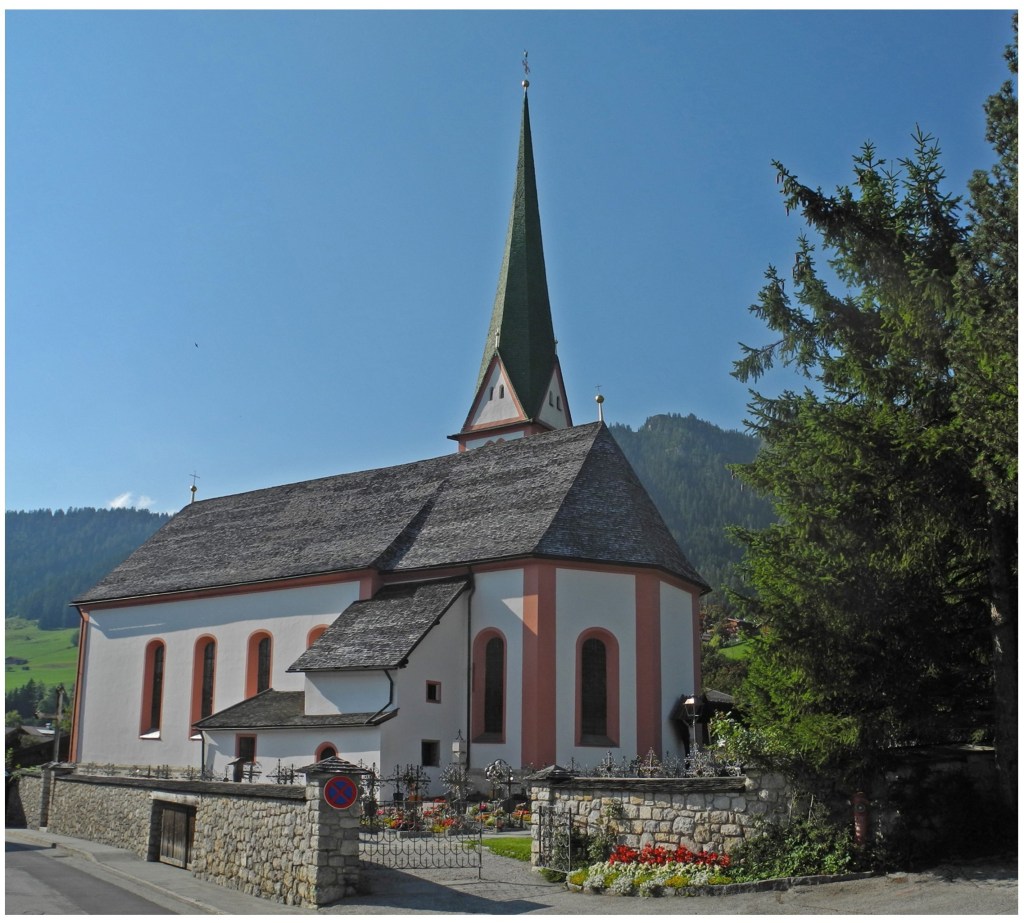
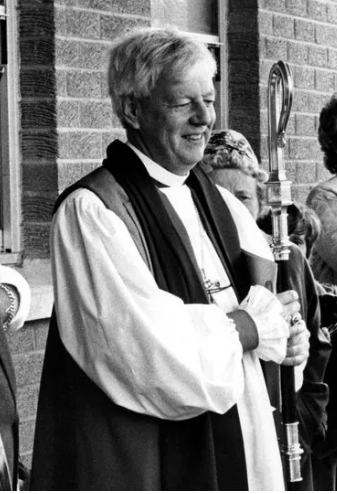
When Bishop David Jenkins was Bishop of Durham, he often spent his summer holiday leading tours to Christian places. On one such occasion he found himself at a place in Western Austria, the mountain village of Alfbach. He visited the church and, to his surprise he found that it was dedicated to St. Oswald of Northumbria. His own Cathedral in Durham was the place where some physical remains of St. Oswald rested alongside Saint Cuthbert. David Jenkins fell to wondering why this Austrian Church had this dedication to a saint in faraway Northumberland. He found a tourist leaflet which said that in the 7th and 8th centuries Christianity was brought to the region by Irish and Northumbrian monks. The bishop’s journey to the village had been in an air-conditioned coach but it had still been a difficult journey along narrow mountain roads. How much more difficult must it have been for those monks who had travelled through darkest Europe to bring the Gospel to that place. The bishop could only imagine what it must have been like and what hardships they endured.
More importantly, why did they bother? The Bishop asked himself that question and this is the answer he came up with: They had discovered in Jesus, that God loved them so they fell in love with God. As a result they wanted to share that love with others.
That was what took them through Europe at a time when the flame of Christianity was burning dim—and their mission—to spread the Good News of God’s love renewed the faith of Europe and took the Gospel to new places.
In an age when, for the majority of people, the Christian light burns dimly —God continues to love us so much that we too might fall back in love with Him—and when we do, like those monks, we will want to tell others. A way of describing mission. That’s a good thought for Lent.
Mindful of Valentine’s Day and Ash Wednesday coinciding this year, I want to share with you a prayer that I received by email. The prayer draws its inspiration from 1 Corinthians 13 verses 4-7 (recommended reading!) It was compiled by Holley Gerth. If we put into practice what the prayer suggests, not only on Valentine’s Day but also during Lent , then we will use both to good purpose.
Dear God, Because love is patient… Help me to be slow to judge, but quick to listen, hesitant to criticize but eager to encourage, remembering your endless patience with me.
Because love is kind…. Help my words to be gentle and my actions to be thoughtful. Remind me to smile and to say “Please” and “Thank You, ” because those little things mean so much.
Because love does not envy or boast, and is not proud…. Help me to have a heart that is humble and sees the good in others. May I celebrate and appreciate all that I have and all that I am, as well as doing the same for those around me.
Because love is not rude or self-seeking …. Help me to speak words that are easy on the ear and on the heart. When I’m tempted to get wrapped up in my own little world, remind me there’s a great big world out there full of needs and huts.
Because love is not easily angered and keeps no record of wrongs …. Help me to forgive others as you have forgiven me. When I want to hold onto a grudge, gently help me to release it so that I can reach out with a hand of love instead.
Because love does not delight in evil but rejoices with the truth …. Help me to stand up for what is right and good. May I defend the defenseless and help the helpless. Show me how I can make a difference.
Because love always protects and trusts …. Help me to be a refuge for those around me. When the world is harsh and cold, may my heart be a place of acceptance and warmth.
Finally, because love always perseveres …. Help my heart continually to beat with love for You and others and for showing us what that word really means.
Mohammed R Mhawish’s story Reporting from Gaza City Published by Aljazeera On 5 Feb 2024
‘How can I explain to the world, the ones that even read our words, that what is being endured is not only painful but avoidable?’ writes Mohammed Mhawish from Gaza City
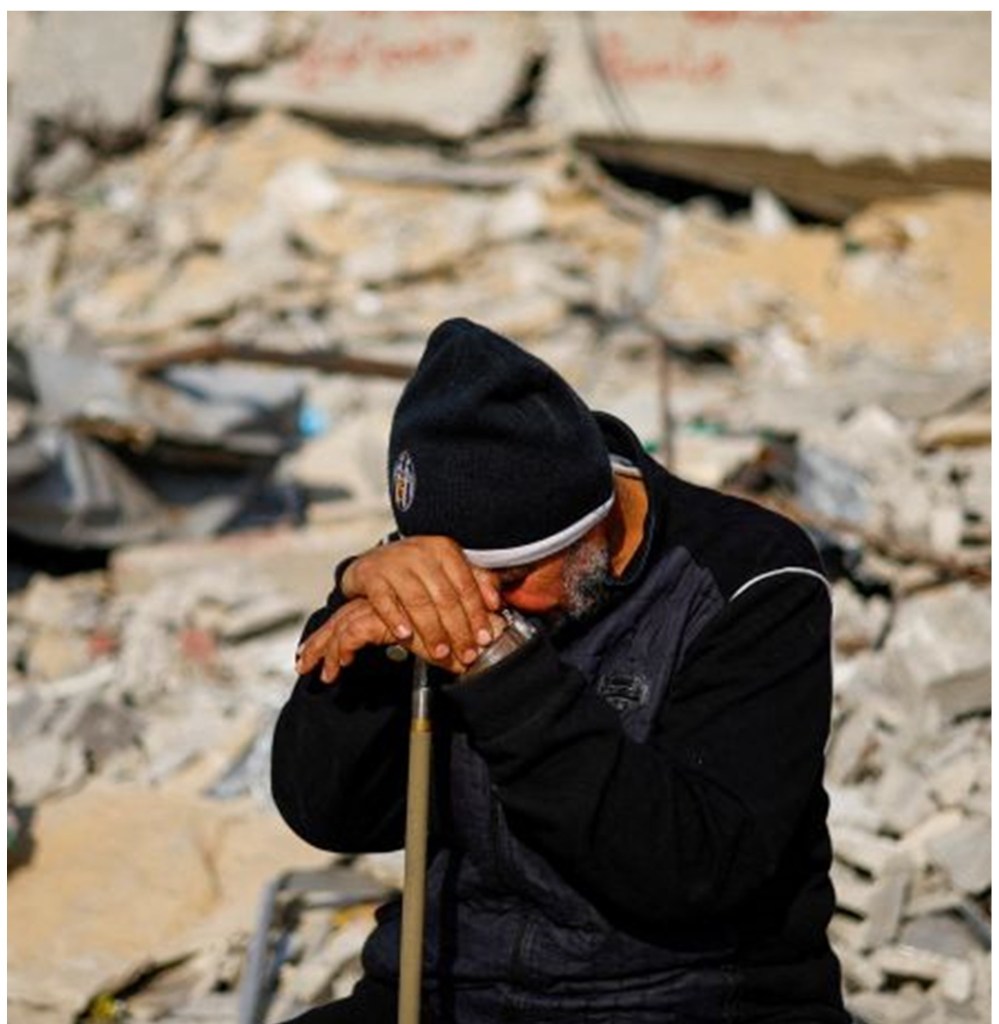
For us in Gaza City, enduring the daily struggles like staying safe, fighting hunger and protecting ourselves against the biting cold is a war in and of itself as Israel’s assault on Gaza grinds on past 120 days. Hundreds of thousands of people have lost their homes at a time when that was all they had. Then after that came the loss of a simple place to shelter as Israel bombed them all: hospitals, schools, clinics, and any open space where civilians gathered. The entire population of Gaza has been displaced. The entire population.
What does ‘home’ mean? After our house was bombed, I was no longer just a witness to the thousands of people fleeing their homes to find safety wherever they could. We went to the United Nations shelter in the north of Gaza, my family and I gathering whatever would help us survive and becoming displaced like our country people. There are about 600,000 people in north Gaza grappling with loss amid deprivation, starvation and disease because they do not want to leave their land. It breaks my heart, but I have to admit we’ve lost the sense of what “home” means. Just finding the bare minimum space and shelter from the elements we need to rest has become a journey of heartache and pain, our miserable daily routine of looking around to see where we can possibly sleep.
My family – father, mother, sister, wife, and two-year-old son – and I are seeking relative refuge in the parking garage of a destroyed apartment building. We dread looking at the weather in these winter conditions. All day, we’re trying to find the forecast, breathless, worried that rain would be expected that night. On rainy nights, I take off my coat and wrap it around my baby, making it both a blanket and protection for him against the cold, with hope and prayer that it will be enough for his small body.
Survival rations Beyond shelter is the struggle for food. I cannot recall the last proper meal my son had. Wheat is nowhere to be found so we have been using animal feed-grade barley and corn to grind into flour for bread. Even these alternatives are scarce, but they are our only means to get through the day. It’s not like there is the space and security to grow your own food either, with the bombs and intentional choking off of supplies, even water. The aid entering this besieged enclave is very limited and cannot cover our basic daily needs. So we have had to try to survive for these past four months, with no incomes or livelihoods as the prices of essentials skyrocket, if you can find them at all. As a result, starvation is beyond widespread in the north of Gaza. Babies, children, adults and the elderly all are suffering from the lack of food. An ounce of coffee used to be 10 shekels (about $2.75) and now it costs 120 shekels ($33); a litre of drinking water that cost a shekel (less than $0.30) is now 15 shekels ($4).
If you secure food, you still have to cook it and, with no cooking gas, people are combing the ruins to find anything they can burn for a cooking fire, exposing themselves to bombing at any time. And so, when every hour of the day is spent either looking for food or a means to make it, we cannot always worry about staying safe.
Unrecorded deaths Medical services in north Gaza have been nearly inoperable since the beginning of the ground invasion, and now there is little more than first aid services for the injured or those in need of intensive medical care. Israel has arrested and killed hundreds of medical personnel, bombed hundreds of medical facilities of various sizes out of service or depleted their capacity with cuts of fuel and water. For the little that remains functional, how would the wounded get there when at least 122 ambulances have been targeted and bombed? Then comes the danger of the streets: air strikes, soldiers kidnapping Palestinians or shooting them dead, and the mountains of rubble across Gaza. Even basic medications like antibiotics and painkillers have been scarce for the thousands suffering injuries from Israeli attacks, and so they get infections and respiratory diseases.
People need to understand that the number of Palestinians killed in this aggression is much higher than what is being reported. Palestinians dying from kidney failure, from cancer, from disease, from a lack of prenatal care – all of these are not being recorded. With every passing hour, fewer and fewer Palestinians in Gaza can appeal to the world. Every day brings more death, and the rest of us remain, trying to fight off death.
In closing I do not write of the struggle we are living to engender sorrow. Had sorrow moved people, we wouldn’t be where we are now. I outline our struggle because, at this point, we have either already been killed or are in the process of being killed slowly. We are appealing to the healthy ones, the ones with a bed to sleep on, the ones whose voices can be heard outside this slaughterhouse.
I write to equip you with the knowledge of what humanity is undergoing. We the Palestinians of Gaza are being starved, are sleeping on the streets with no cover from air strikes. We are being denied our humanity by an army that continues to inflict some of the most painful and inhumane practices of war we know in our modern day. It’s time for the world to defy the abuses, to give regard to human life, to keep it simple and basic, like the needs we require to maintain breath.
To the innocent who live in the shadow of war and terror, especially the frightened children, the homeless,the elderly, the injured and the despairing, LORD, be a shelter and strength, their haven and hope.



 Mr G's Ponderings