Tag: Bible Sunday

The Invitation

A Pondering on BIBLE SUNDAY, by my friend, The Revd. Becs Challis.

So, it’s Bible Sunday, this is a time where we pay special attention to and give thanks for the Bible in our lives as disciples….
I’ll be honest, for me I find this easier said than done….

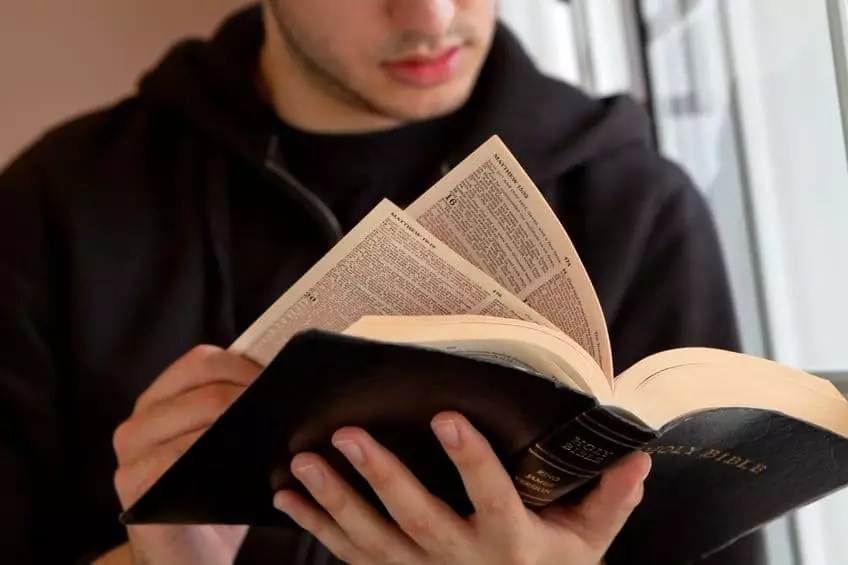
  • First, the bible that I am currently paying most attention to is the NIV study bible (a big large hardback book) and I’m paying attention not because I am referencing it  but because it’s just the right size as a laptop stand on my desk.
  • Secondly, rather than simply give thanks  in my inner thoughts, I want to add “but did it really have to be SO long and SO complicated (not only to read but also to understand)
    And I’m not being flippant I am just recognizing my human condition and the fact that actually the bible if I think about it as a “book”,  for me is the source of a lot of shame. And I am going to hedge my bets that I am not totally alone in sometimes slipping into thinking things along these lines?

Yet this is actually the one day when many churches will be praying and giving thanks for the bible, so it’s worth us really understanding what we mean when we say that we are paying attention to and giving thanks for, the Bible. So let’s use this time to take away any  barriers we may have to connecting with God when we are thinking, praying or blowing the dust off and potentially even reading the bible!

So what is it, that we are actually giving thanks for, and can we put words to the impact that that has had on our lives and those around us?
We’re told in 2 Timothy (3:14-4:5) that all scripture is inspired by God, all of it. – The passages we love, the passages we’ve read over and over again, the verses we can recite and the bit’s we’re less familiar with, those sections we skim over or the ones we’ve never read, those passages that we can’t quite reconcile with our view of God, and those ones that have been interpreted differently and used as weapons against us or those we love…. All of them every word is inspired by God.
The bible is God breathed; all 66 books all 700 thousand plus words are inspired words of God. It is the most sold book  (not necessarily most read) but most controversial books in the world.
Yet it’s not a book at all, it’s an invitation into relationship with Jesus, it’s admittedly a very large, dense, wordy invitation. But it is an invitation all the same…

This is an invitation of hope:

  • an invitation to us here in church.
  • an invitation to those who we know aren’t here today
  • an invitation to those who ‘have never’ and ‘will never’ come here….
  • an invitation to the whole human race, the whole world, to all of us grace gifted misfits[1] that in some way don’t think we are good enough

    But what do we do, how do we access this invitation?

Well in Paul’s letter to Timothy there’s a sense of urgency, whatever you do, do something because the Bible is invitation into relationship with Jesus, it is not something to put off for a rainy day.

“Hold fast to what you have learned.”
It might be just one word or one phrase but hold onto it. However, right at the heart of this instruction, it isn’t about gripping tightly with fists closed. Instead, it’s a reminder to hold on with an openness, with a heart ready to receive, a mind willing to explore. The Bible, or “scripture” for Paul, is not a cage meant to confine us. It’s Jesus as light within us, illuminating dark corners, showing us paths of justice, mercy and peace.

The bible, this invitation, is not just to know Jesus, but to be known. This is wisdom for salvation, Paul says – not salvation only in some distant, other-worldly sense, but salvation that reaches into the here and now, into our living, breathing lives on the good days and on those that are more challenging.
The Bible when we let it breathe, has the power to show us how to live in rhythm with God’s grace, in sync with God’s love. – This invitation instead of us reading it, allows us to be read and in turn, to be known.

The interesting thing about invitations is that they generally come with an RSVP, it’s not good enough to just receive the invitation of the Bible we have to respond as well:

In John’s Gospel (5:36b-end) Jesus says:
You study the Scriptures diligently because you think that in them you have eternal life. These are the very Scriptures that testify about me, yet you refuse to come to me to have life.

The RSVP to the invitation we have all been given is not found in echo chambers and divisions, or in those voices that are heard louder and more confidently than the rest, it’s not found in words that flatter rather than challenge…
The response, the real response to us receiving the gift of the Bible, the inspired word of God, is to take it in with each breath we take , each pause, each silence each chaotic unplanned moment, each waking minute of every day move closer to Jesus.

And as with all invitations, they generally always come with a +1
For Timothy, and for us the invitation to be in relationship with Jesus is not about how much you’ve read or whether you can quote it word for word, it is about how you respond in the ordinariness of your life. How you embody the Good news in all you say and do. It’s about living life in a way that others can see Jesus through and in you.
So if you do nothing else, just find a way that works for you to connect and engage with the Bible and let God’s inspired breath become part of all of us. This invitation is to a dynamic relationship, one with a God that is very much alive, not a relic of the past covered in dust,  but rather, a living breathing divinely inspired word unfolding all around us, calling us to new depths of love and wisdom and inviting us to be shaped, transformed and in turn transform others.


(based on a sermon preached at St. Mary-at-Latton, Harlow. on Sunday October 27th 2024.

[Becs Challis,
Programme Manager Mission & Ministry, Diocese of Chelmsford
Meeting God in Scripture

Thoughts on Bible Sunday   

When I was at Junior School I remember John Garnett telling our teacher that he had just completed a reading of the entire Bible. He was quite smug about it and I suppose for an eleven year old boy it was quite an achievement. Not to be outdone, I decided that I also would read the Bible from cover to cover. I set off eagerly through the pages of Genesis and Exodus and all went well until I got to Leviticus when, sadly, I abandoned the project. Trying to read the Bible from cover to cover as a way of beating John Garnett rather missed the point of why we read the Bible. I know that now!

When we read the Bible and especially when we pray its pages we enter into a loving relationship with God. As Christians, we are part God’s story and it remains a continuous story of God’s Love Affair with His people – with us! We don’t read the Bible in order to chuck quotes at others, still less to prove some argument or opinion we hold – though sadly the Bible has been used and continues to be used by people in just such a way.

The Orthodox spiritual leader, Kallistos Ware, wrote that:
The real purpose of Bible Study is to feed our love for Christ, to kindle our hearts into prayer and to provide us with guidance for our personal life. The study of words should give place to an immediate dialogue with the living Word himself  – with God, with Jesus Christ.

To be reminded that the sacred words of the Bible lead us into an encounter with Christ is very important. We are in relationship with a Living God, and not just a book. An Orthodox Saint, St Tikhon, said that Whenever you read the Gospel, Christ himself is speaking to you. And while you read, you are praying and talking to him. This conversation must never be rushed.

A friend of mine once said that we should read the Bible in digestible bits rather than indigestible chunks! Modern translations of the Bible helpfully divide the text up into sections rather than chapters and one section at a time can be enough to feed our praying..

Today, we keep Bible Sunday and it is a reminder of how very important the Word of God revealed in  Scripture is for our life of faith. How can we tell God’s story and be part of that story if we neglect the Bible? I love this quotation from Richard Carter, Associate Vicar for Mission at St. Martins-in-the-Fields, London. I offer it as a little Ponder Point.

“Sometimes, you just have to read the Bible with your heart.
It’s not a theory, it’s not an argument, it’s not a weapon, it’s not words.
It’s the Word made flesh.
It’s God’s love deeper and wider and more expansive than your dreams.”

[Mr G]

A Fragment on a Fragment

Today, (October 25th) the Church of England keeps Bible Sunday.
For Christians, hopefully, every day is Bible Day! Yet it’s good to be reminded of the importance of reading God’s story in order to be shaped by it and then to tell it.
The word ‘Gospel’ means Good News. In Greek the word for Gospel is ‘Euangelion’ which can be seen as the root of ‘evangelism.’ The Gospel writers are known, collectively, as the 4 Evangelists.
Quite simply evangelists ‘tell’ the Good News of Jesus Christ, in words but also in deeds and in seeking to live lives shaped by Jesus and therefore to grow in His likeness. St. Paul’s favourite phrase is ‘en Christo’ – ‘in Christ’. I understand he uses it 64 times. The Word of God which is both Jesus and the words of and about him are what move people to grow in prayer (relationship with God) and holiness (growing in God’s likeness).

Every Christian is called to be an evangelist – one who, in the words of 1 Peter 2:9, proclaims the mighty acts of him (God) who called you out of darkness into his marvellous light.

We discover these mighty acts of God in the Bible which is why Bible Sunday is such an important day. We become part of God’s mighty acts when the Bible infuses our lives with God’s love. It is the story of that love.

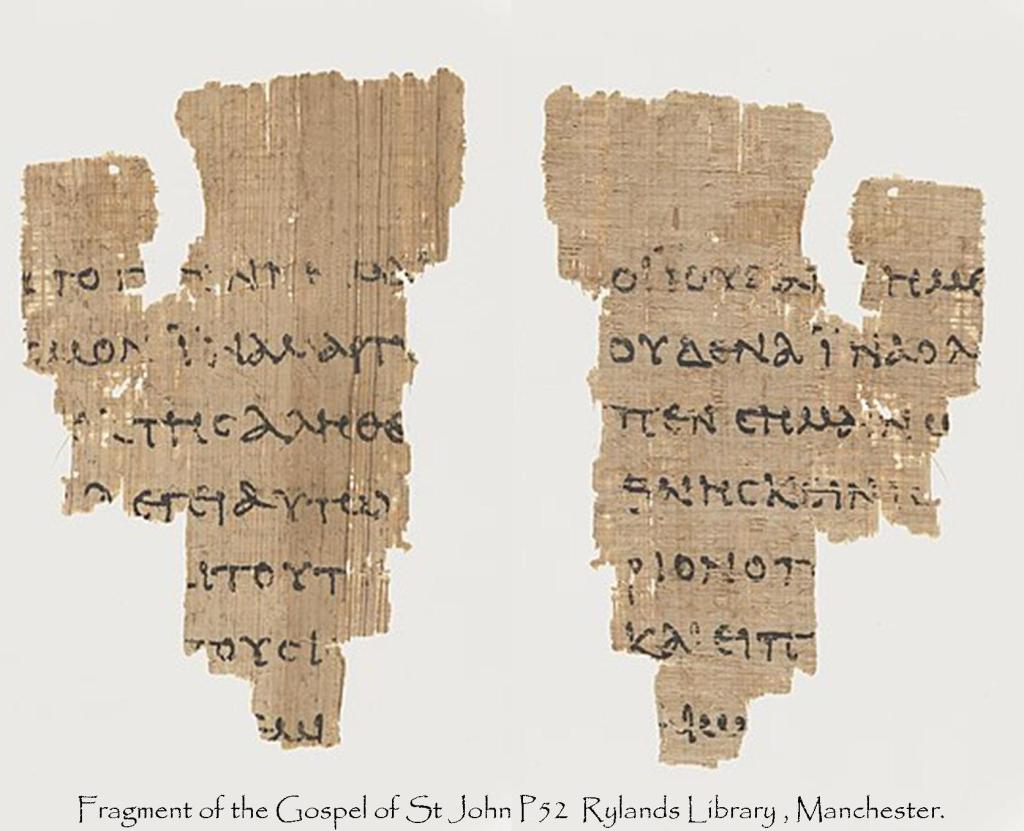
The earliest access we have to the New Testament story of God’s love is to be found – wait for it! – in Manchester!
In my late teens and early twenties I discovered how God’s love for me was touching my heart. I was a young civil  servant working in Manchester and one day I found myself on Deansgate where there is a beautiful building that, externally, could double up as a Cathedral. Internally even more so – though devotees of Harry Potter may believe that it is actually ‘Hogwarts’! There is a rumour!

In reality it is a neo-Gothic structure which was built as a library and opened to the public in 1900. It was founded by Enriqueta Augustina Rylands in memory of her husband, John Ryland. Today it is part of the University of Manchester.

Exciting though the building is, my first visit revealed something even more exciting. Within it there is the earliest known New Testament document. It is a small fragment of the Gospel of St. John. It is on papyrus and it measures 8.9 x 6.0 cms. It is displayed so that you can view both sides. On one side there are seven lines from John 18:31-33 and on the other the end of seven lines from John 18: 37-38. The fragment was found in Egypt in 1920 and it has been dated by experts as between AD 100  and AD150. It may have come from a copy not long after the Gospel itself was first written. It was purchased on the Egyptian market in the 1920s by Bernard Grenfell but it was 1934 before it was transcribed and translated by Colin H Roberts. It is classified as ‘Rylands Library Papyrus P52’ Scholars have had great fun musing over it, dating it, and discussing it: why was it written, when was it written and for whom? sort of questions.

But, you know what, there is something even more important about this fragment. When I stood before it all those years ago, I experienced a thrill and a sense of awe. Here I was in front of the Word of God which was written to tell me how much He loves me. I was faced with this truth in a unique and very special way.

It was only a fragment but it brought me to Jesus in a deeply personal way. Like an Icon which reveals its subject in an intimate way, I was drawn, through this fragment, into an intimacy with Jesus which was both simple and profound. This fragment became something which fragmented my soul and allowed Jesus to slip in. For me that’s its real significance.

It’s why the Bible is so very important – both Testaments for Christians, Old Testament for Jewish people and, because it has echoes within the sacred Koran, it has its place in Muslim spirituality too.
For those who want to know God it is essential.