The Daily Reflections on Scripture Readings by the Church of England over the past 2 days have been based on the Book of Genesis, Chapter One. This inspired me to think of it as a Love Poem from God.
Father God,
Your poem spoke creation into being telling us of our origins, our companions, the light and darkness of our existence, the moments of our being; your gift, which is the earth.
You appoint us custodians of all that you have made and go on making, stamping your image on us and all that we receive; showing us how good it is.
Help us to hear your poem and fulfill its meaning of who and where and what we are, of all that you have given us to cherish ~ a poem spoken out of pure love.
Wood Anemone photographed by Gill Henwood in the Lake District.
Wood Anemone…. A little story.
According to the poem at the beginning of the Book of Genesis, God completed the creative action on Planet earth after six days of total activity. Genesis informs us that on the 7th day, God rested. But rest rarely means inaction, especially for God. There is no way that The Maker of everything can either unmake nor stop the inbuilt process of evolving, developing, deepening, the love which God had poured into all that was made. You see, in order to ‘make’, God had to use the very essence of being to do this and that same essence, being God, is never absent. That’s a quick way of saying that God is always God and always making things in his and her own image! God broods over creation like a father and a mother, holding it in being, trying to save it from harm, and guiding with all encompassing ‘love’. That’s the work chosen by God, Father, Son and Holy Spirit.
But none of that needed to be explained on that first Sunday morning. Later, God would invent and make some very clever people called ‘theologians’ who could mull over everything that God has made and decide whether it is good or not so good. They will helpfully disagree on this which makes it very simple for us to ignore them, or become one of them. (tongue in cheek remark!) On that first Sunday morning, God wasn’t prepared to get too involved in all that. He was resting. I suppose, being, God it wasn’t the forty-winks kind of rest that we know it to be now. It was a creative rather than restorative rest.
As God the Father rested, God the Son pointed up at the lovely stars and noticed that, appropriately, one of the stars had six points, one for each day of creation. In fact, many people would give it the name of The Creator’s Star. These 6 ‘pinpricks’ touched the darkness and so it wasn’t as dark as it would be without them. In fact, the light had a bright and luminous beauty which simply shone amazingly.
As God the Father, watched this, God the Holy Spirit allowed inspiration to flow. Earlier, a joint effort had created things like paper, pens and pencils, paint and ink and paint brushes. So God the Spirit set to work. Gently, the pencil floated over the paper as God thought what to make of the stars with six points drawn on the paper. What had emerged was a flower, robust but also vulnerable. It would live amongst the trees and in the Spring, it would shine with a brilliant light. Ah!, thought God. This little flower will become part of something very special.
God knew that one day it would be necessary for some extremely Good News to be announced and the Son of God would make it. The plan, still to be unfolded, would involve the Son in a supreme act of love though as with all acts of self-giving, it would come at a price. So, in using the little flower to be part of the message of hope and joy to lighten a dark world, God knew that it would perhaps not live very long because as we all know, when we light a candle, as it burns to give us light, it dies. But in the case of the little white flower, there would be no permanent death because death merely continues a journey of life but in another place. Well, almost, because what the flower leaves behind is a root system which means it will come alive on earth again.
God loved the little flower and as the Son held it up, the Spirit breathed on it and it danced. It moved as if in the wind, so God said that it would be known as ‘wind flower’. The Spirit then pronounced the Name which would be ‘Anemone’ – Daughter of the wind.
Jesus loved the white colour because it would be the Easter colour of Resurrection and the anemone would live in forests and woodlands because that would remind people of the wood of the Cross. It would therefore suggest to the people who saw it that through the love of God poured out from the Crucifixion, the world would be a brighter, lighter, more joyful place. It would be a world able to celebrate hope and beauty and love again. The little white flower would remind people of this
… and the little Wood Anemone? Having done her job she would rest a little until next year.
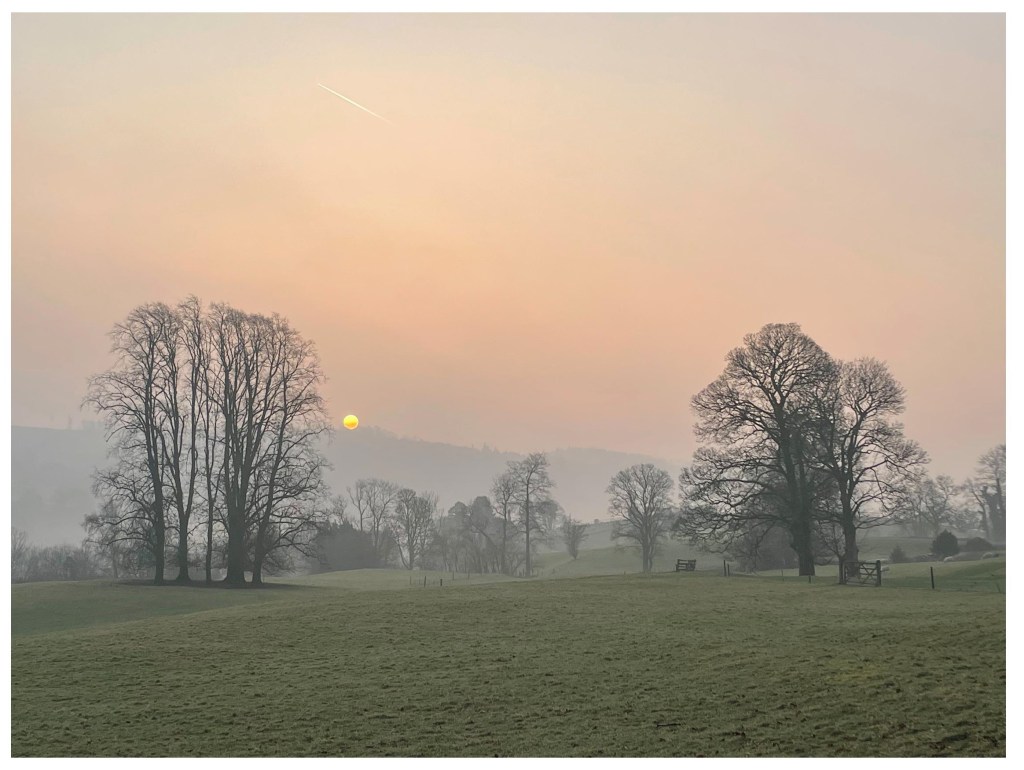
Valentine’s Day dawn over Hawkshead Church. Photograph by Gill Henwood.
Today we celebrate St Valentine who was martyred in Rome about the year 269AD. At that time there was a persecution of Christians under the reign of the Emperor Claudius. Valentine’s association with expressions of love to those special to you isn’t really known. In Medieval times it was thought that on this day birds began to mate but there are other ideas.
Today it is associated with the sending of cards to someone you would like to express your love to. However, as there is a custom that this is sent anonymously, it rather defeats the object! It is also one of those festivals when purveyors of love signs – flowers, chocolates, cards etc – encourage us to express our love in some tangible way. Obligingly those who supply these needs increase the cost of purchase, just to prove that you really mean it!
The One who truly expresses His deep love for us is God, though as ever, he pays the price Himself. God is busily renewing our world at this time and all around us are signs of His love in the joy of creation beginning to show itself in the bursting forth of new life. Valentine’s day can therefore be a day when we give thanks to God for creating us, loving us and sustaining us.
There is much that is dark in our world right now so it is good to be able to pause from our anxiety, pain and despair to look also at what is hopeful and what sustains us in the depth of our souls. The Valentine’s day message from God is that we are to love one another as He loves us. That is what Jesus tells us and it is when we put that into practice we have already turned the world into a lighter and brighter and more loving place.
Meanwhile, thanks to my friend Gill Henwood, God has sent us a Valentine’s card full of beauty and vision. Look around you. God really does want you to be filled with His joy and love. Give Him thanks.
Here’s another reminder of the beauty of Creation, and below it, a suggested text for your Valentine’s Card to God. (Don’t forget to sign it – Amen!)
[Mr G]
Creator God, We acknowledge that as your handiwork, we stand alongside all that you have made. Trees and rivers, mountains and valleys, soaring birds and scuttling creatures, all are held within your care. May we grow in our love and appreciation for the fabulous variety around us; and may our awe and wonder draw us closer to the natural world, and through it to you, the God of all things. We pray in Jesus name, Amen
Prayer by Revd Cate Williams, Mission and Evangelism Officer Diocese of Gloucester
At the end of the Eucharist at our church, our Vicar, Lynn (a.k.a photographer Lynn as above!) prays a blessing which includes the wish that God’s blessing may “be upon you, those you love and on those you find difficult to love.”
When I received her photo of two magpies, a mother and her young, I remembered that not everyone loves magpies. Many members of the farming community are amongst those who not only find it difficult to love them, they actually wage war on them. Others, less violently, dislike the way Magpies treat other birds; how they steal food and how they generally act as bullies.
So the photo from Lynn, showing a mother magpie and her young (clearly demanding food) seems at odds with the views many hold. Yet there is a tenderness which is endearing. Maybe it’s the vulnerability which appeals to the mothering instinct in some of us. Or maybe we are reminded of the way Creation is being destroyed and we are moved by the increasing importance of protecting all of God’s created things. Even aggressive magpies!
Before we get carried away with thinking that Magpies are aggressive creatures who don’t deserve our protection, we might turn the spotlight round. After all, whatever aggression we see in the Animal world, we humans can beat them. Arguably, we are the most aggressive, exploitative and self-centred species on God’s earth – yet many claim that we reflect God’s image! I don’t suppose that it’s a view you find easy to keep if you happen to be a Ukrainian facing the force of Putin’s army – those we find not, those we find difficult to love, but rather, absolutely impossible’
Yet there is a way in which we can move on from the hatred which destroys into a better, if difficult , place. Today, I read about the trial of the men convicted of killing 130 people, in a terrorist attack in Paris nearly 7 years ago. As the trial ends, it brings a difficult future for the family of Nick Alexander, the only British victim.
His sister Zoe, says that she refuses to hate the terrorists. Each day for 10 months she has been listening to the evidence of what happened in Paris on the night of November 13th, 2015 – the night that her brother Nick was shot dead. Zoe knew that it was important to be in the same room as her younger brother’s killers (14 of the 20 of them). She was struck by how similar in age they were to Nick, who was 35 when he died. She feels the futility and enormity of the tragedy.
Giving evidence, Zoe was determined they would learn they had not won. She would never subscribe to the legacy the terrorists wanted to leave, of hate and intolerance. “We are not at war with you” she told them, “you’re at war with yourselves. I hope you can honestly look inside your heart and say it was worth it.”
The trial didn’t give her closure, “We will never close the door on what happened to Nick because it’s part of our family story.” Speaking of the terrorists, Zoe said: “I can’t forgive them yet; that would be to condone what they had done, but we have to moved forwards without hate.” Zoe believes that the only way we can learn from the attackers is to make sure we never join them. You can’t neutralize poison with more poison. If we don’t learn anything from this, it has been a huge and tragic waste. The family, are now setting up a Nick Alexander Music Trust – to help disadvantaged community groups to come together through music. Zoe says, “Nick’s killers wanted to leave us with fear and hatred and darkness, and we have turned it round.”
Maybe Zoe’s amazing testimony will teach us that, difficult and impossible it can sometimes be, we might find it in our heart to ask for God’s blessing on those we find it difficult to love and in making that a prayer we might find we can take halting steps in the right direction.
Meanwhile may our outreach in love stretch towards little magpies! Vulnerable creation needs that love very much.




 Mr G's Ponderings