Their eyes never leave you, together confronting the agony as you are pinioned to the cross and crucified.
Three long hours.
Their presence is unwavering, their gaze unflinching, though a sword pierces their own anguished hearts.
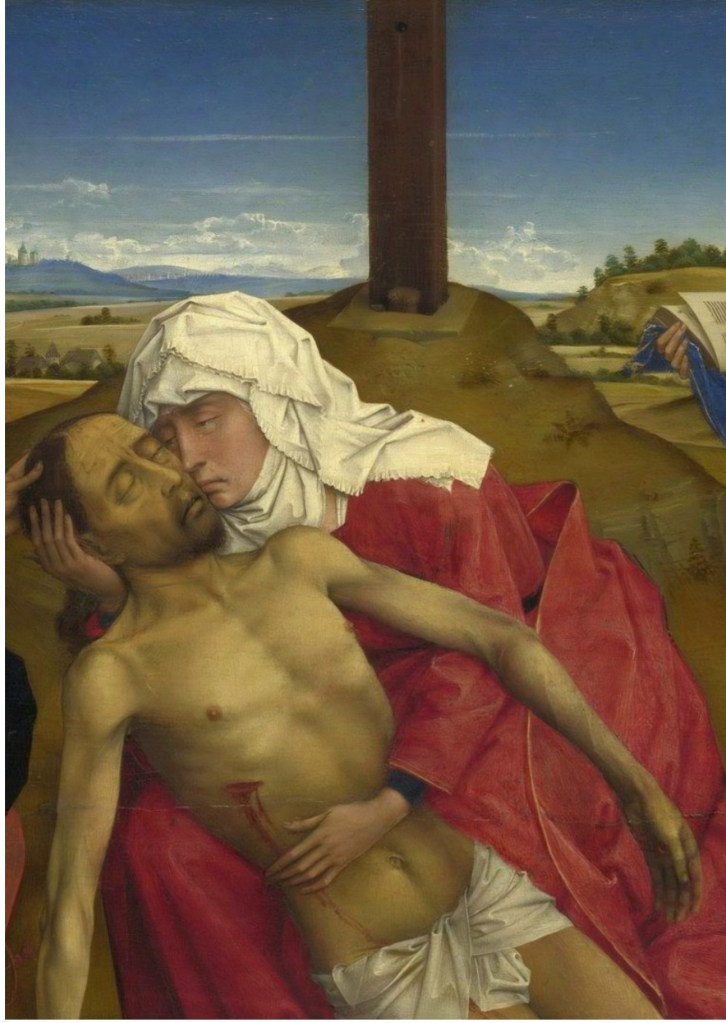
Among them, the one who endured the agonies of bringing you into the world: who cradled the infant you. Now you are held in her gaze, her eyes fixed on you as she stands close by. Soon she will cradle your stiffening, lifeless body.
Where others have faltered and fled, these are the ones who remain, their presence, all that is left to give: a wilful resistance, a faithful standing by, a harrowing witness.
Here, at the foot of the cross, is true strength, true devotion: a love that is unsparing and never turns away…
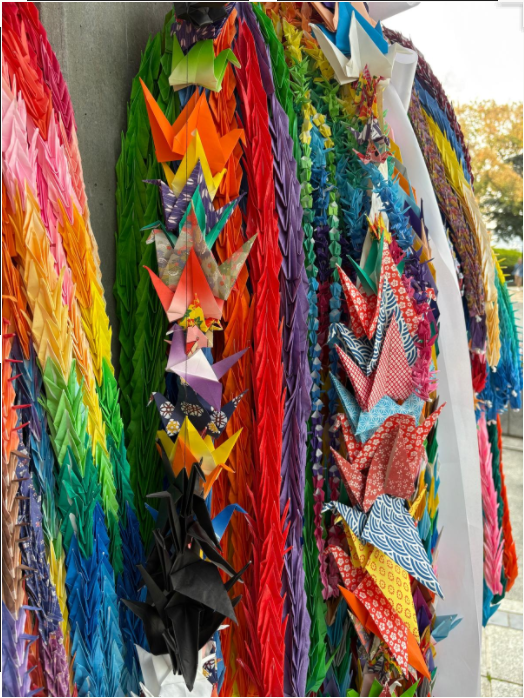
Paper Cranes at the Hiroshima Childrens’ memorial, Japan Photo by Gill Henwood
My friend, Gill, is touring Japan at present and has sent me photos of a visit to the Hiroshima Peace Memorial.
Whilst there she was able to share in the practice of making Origami Cranes (Orizuru). This is a traditional Japanese craft of paper-folding symbolizing hope, peace and healing.
It became linked with the Childrens’ Memorial at Hiroshima through the inspiration of Sadako Sasaki, a 12 year old girl who survived the 1945 atomic bombing of Japan by the USA, but who later died from leukemia. She was encouraged by a Japanese legend that folding 1,000 cranes grants a wish. When she was suffering and facing death she folded the paper cranes and this became a global icon for peace and the inspiration for the Children’s Peace Monument.
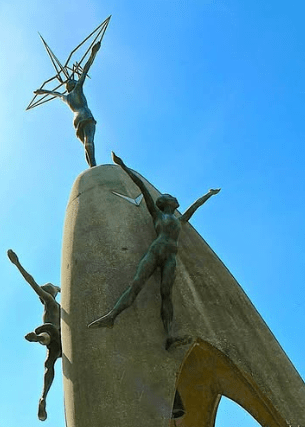
A Monument in the Peace Park is entitled ‘Atomic Bomb Children’. It was designed by Kazuo Kikuchi and Kiyoshi Ikebe, using money raised by Japanese school children. The figure of Sadako Sasaki is on the top and a boy and girl at the sides. Sadako holds a wire crane above her head. Behind the Statue are glass cases containing paper cranes.
Sadako’s wish, when making the paper cranes, was doubtless of personal healing, but her greater wish was to have a world without nuclear weapons.
When Gill and friends made their paper cranes they left behind a statement common to thousands of visitors of a desire for a world without nuclear war.
This desire is in forefront in many minds just now as we try to live with Global upheaval threatening the whole human race. Ukraine, Gaza, Sudan are names that easily trip off the tongue but are easily forgotten when other struggles take up the media’s attention. Even the struggle between Israel, the USA and Iran have become linked with whether the cost of petrol might spoil our Easter holiday! Humanity is sadly fickle and can be self seeking. Yesterday Holy Week began with the ‘Hosannas’ of Palm Sunday but how quickly that moved to ‘Crucify Him!’ by Good Friday.
It is often hard to fathom human motives.
We know that the regime in power in Iran is a danger and threat to the world (not least to its own oppressed people!) It might therefore be a justification by Mr Trump and his ally in Israel for the action they are undertaking. Yet there appear to be other motives which are drawing humanity to the kind of brink we saw in mid-1930’s Germany.
Perhaps the difficulty in trying to see similarities between the Nazi era and now is that it is far more complex. Too many vested interests are swirling around a vortex of demonic activity. To me, this feels like Satan’s time and it isn’t clear who are his agents. It would be wise, I feel, to remind ourselves of the events of August 6th 1945 and take heed.
It is always much easier to make war than it is peace and easier still to use God and religion to justify it but there are consequences leading from this which are not always taken into account. For example, the World Economy and resultant poverty and anxiety.
So, yesterday’s warning by Pope Leo is pertinent. Speaking during the Palm Sunday Mass, he said:
“Jesus is the King of Peace, who rejects war, whom no one can use to justify war. He does not listen to the prayers of those who wage war but rejects them.” He lamented the many wounds of the human family in our world today, as people cry out to God with the “painful groans of all those who are oppressed by violence and are victims of war.” “Christ, King of Peace, cries out again from His cross: God is love! Have mercy! Lay down your weapons! Remember that you are brothers and sisters!” said the Pope. [source:Vatican News]
In this Holy Week of the Christian Church we are therefore reminded how Jesus confronted the evil, which so easily grips humanity, with the power of God’s Love. John’s Gospel makes it very clear that the Crucifixion of Jesus Christ is a Victory. It is a Victory of Love over all that is unlove (sin) in the world. It is also a victory in which God’s plan for all of Creation is renewed by a deep outpouring of total freely given Love. That seems to run counter to the way human beings seem to be behaving. However, the paper cranes have a message too. They only happen when they are fashioned and made in that chosen image of peace. So, a renewed humanity only happens when we are fashioned and remade not with paper but with the love of God.
As Professor John Barton, in his book, Love Unknown, says, Christians share Christ’s victory through sharing his … vocation to be the love of God for a fallen world, and like him going out to embody God whatever the cost.
In her own way that is what Sadako Sasaki achieved, So may we.
“The hedgerows are arching with dog rose blooms, buzzing with bees and heralding summer.”
My friend Gill has sent me this photo of a dog-rose growing in the Lakeland hedgerow near her home. It is a sign that summer is bursting forth in our part of the world, even though June rain storms try to tell us otherwise! The dog-rose is perfect for pollinators such as bees and later in autumn, as its blooms are transformed into rose-hips, it is a source of food for birds.
The legend that gave it its name is attributed to ancient times. It is suggested that the Roman naturalist, Pliny, encouraged a belief that the plant’s roots could cure the bite of a mad dog. Hence its botanical name is ‘Rosa Canina’. The plant was popular for treating bites from rabid dogs in the 18th and 19th centuries. Another view is that the name is related to the hooked prickles of the plant which have a look of dog’s teeth. It’s thorny, unruly stems make it an ideal hedge plant, giving it a density which allows it to do it’s job of protection. It may, of course, simply mean wild rose, of which there are several species, to differentiate it from cultivated and posher roses! Maybe that could remind us that wild beauty is a God-given pointer that Nature has its own way of painting our world with a rare and joyous beauty.
This can be related to some of the meanings of the dog-rose. One such meaning is that of ‘Purity’, especially in a religious and spiritual sense. It is also known for its ‘resilience’in that, whilst having delicate flowers, it can withstand harsh conditions. In affairs of the heart the Dog-Rose has been linked with ‘love and beauty’, in many cultures and mythologies. In Victorian times the flowers were given as a sign of affection which, if returned, suggested an interest in marriage. You can always trust the Victorians to find ways of expressing sentimentality.
Though there is no specific reference to the Dog-Rose in the Bible, it has been linked with the Rose of Sharon In the Song of Solomon 2:1, we read : I am the rose of Sharon, the lily of the valleys. Links have also been drawn with Isaiah 11: I – a shoot shall sprout from the stump of Jesse and from his roots a bud shall blossom, which has been interpreted as a reference to Jesus. There is no real link with the Dog-Rose in either passages and the Rose of Sharon is usually taken to refer to the plant, Hibiscus Synacus.
However, in one symbolic meaning of the plant, there is a direct link with Jesus Christ. The Dog-Rose is strongly associated with Rebirth-and Resurrection. This is partly because of its association with love and purity but it is also linked with a legend about the Crucifixion of Jesus. In this legend there is a suggestion that the tree was once very large and the wood was strong. It was thus able to be used in Crucifixion. According to the story it was the dogwood tree that was used to make the Cross on which Jesus was crucified. Because of this, it is said that God both cursed and blessed it. It was destined to be forever small so that it could never grow strong and tall again and be used as a cross for crucifixion. Also, its branches would be crooked and twisted which would make it useless for such a purpose. Then God also blessed it. It would produced beautiful flowers each Spring, white or pink, as a sign of Easter glory. God also made its petals in the shape of the Cross, each flower having four such petals. In the centre was a crown of gold.
Like all legends there are things that could be disputed but, legends are never made-up stories nor fanciful thoughts. They always contain a truth which, whilst sometimes clothed in mystery, leads us into a deeper understanding. God is always bigger than the words and thoughts we have of him and we would be wise to see His signs and hear His language in Nature and in the Cosmos and also in our hearts where God’s Spirit constantly dwells. So the lovely Dog-Rose has much to teach us and we who seek God’s truth have always more to learn.
In this spirit, I print below an anonymous version of the Legend. Make of it what you will but don’t just dismiss it for it may be that otherwise you will, to quote the poet Frances Thompson, you may miss the many splendid thing.
In Jesus’ time, the dogwood grew To a stately size and a lovely hue. ‘Twas strong and firm, its branches interwoven. For the cross of Christ its timbers were chosen. Seeing the distress at this use of their wood Christ made a promise which still holds good: “Never again shall the dogwood grow Large enough to be used so. Slender and twisted, it shall be With blossoms like the cross for all to see. As blood stains the petals marked in brown, The blossom’s centre wears a thorny crown. All who see it will remember Me Crucified on a cross from the dogwood tree. Cherished and protected, this tree shall be A reminder to all of My agony.
‘Work in Progress’ by Kay Gibbons: a Good Friday reflection in glass
My artist friend Kay sent me photos of an arrangement she produced today, created with pieces of glass remnants. Glass is one of her particular mediums.
They were placed slightly haphazardly but Kay saw that, as they sat in pieces on her work table a shape formed which was deeply suggestive to her of the Crucifixion. She commented,
“I wasn’t sure how to refine them but as they sat in pieces on my work table, I actually like the way they are, symbolic of the jagged edge of the crucifixion …”
There are two images, one unedited and quite raw and the other more presentational surrounded with traditional purple edging, a bit likea greetings card of sorts.
She is a fan of T S Eliot and so a line from East Coker (Four Quartets) came to mind:
“And they called this Friday good …
The art is still evolving and revealing its meaning so Kay calls it a Work in Progress.
She reflects that this is true of the Crucifixion too. As people discover for themselves its meaning and how it challenges, shapes and changes lives, so they are part of a ‘work in progress’. Each of us who engages with Jesus and with the immense and unconditional love of God pouring from the Cross, become caught up more and more in a life of joy, purposefulness and glory. So , Work in Progress’ is also a way of describing the Work of God in drawing all of us into His Kingdom.
and Jesus said, “Do not be afraid, little flock, for it is your Father’s good pleasure to give you the kingdom. Luke 12: 32



 Mr G's Ponderings