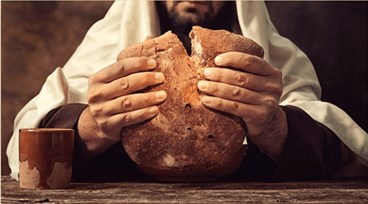
Yesterday, the Christian Church celebrated the feast of Corpus Christi. This is the time we gather to give thanks that at the Last Supper, our Lord Jesus gave us this memorial of his Passion. Through this sacrament he brought us its saving power until the end of time.In this Sacrament he feeds God’s people and strengthens us in holiness, so that the family of humankind may come to walk in the light of one faith, in one communion of love.
That’s quite a big statement and certainly more fulsome that that of Queen Elizabeth I who, of the Eucharist, said:
His was the Word that spake it,
He took the bread and brake it,
And what that Word doth make it,
I do believe and take it.
Both statements express a profound understanding of the Eucharist and, in some way, point us to the appeal of this Sacrament to the Church and to the life and journey of Christians. This journey is a pilgrimage of Love in response to the Sheer Love of God.
This Pilgrimage began in the story of the Church at the Last Supper on Maundy Thursday. This is a day of mixed solemnity, of festivity and leave-taking; of fellowship and parting; of instruction and acts of service.Overshadowing it is the Trial, Passion, Crucifixion and death of Jesus.
Only after Easter did it begin to make sense and the Eucharist take a rightful and central place in the Church.
Which is why, on the first free Thursday after the Easter Season, the Church keeps this Day of Thanksgiving for our Lord’s gift of this Blessed Sacrament, and its place at the spiritual heart of the Christian Community.
Dom Gregory Dix, in his monumental study of the Eucharist and Liturgy, The Shape of the Liturgy. reminds us of this
Ever since the Last Supper on Maundy Thursday, throughout the ages and throughout the world, the Eucharist has been done, in every conceivable circumstance….
He goes on the give a picture of this in a list which begins :
There has been no better thing than this to do for kings and Queens at their crowning and for criminals going to the scaffold; for a bride and bridegroom in a little country church… for a sick old woman afraid to die; for a schoolboy sitting an examination … in thankfulness for recovery from illness… on the beach at Dunkirk…by an old nun on the fiftieth anniversary of her vows; furtively by an exiled bishop who had hewn timber all day in a prison camp near Murmansk; gorgeously for the canonization of Mother Teresa…….
to which I may add:
For an old priest at his funeral after years of Godly Service; for Marion who painstakingly taught the faith to a would-be Christian; and Mollie, a lover of Christ who received Holy Communion moments before death; For a dear friend, returning from a Cathedral in the early morning after Confirmation by her bishop; for a student trying to make sense of his father’s death and finding comfort and nearness to him in the bread and the wine: for a retired Archbishop who delighted in celebrating the Eucharist in a College Chapel, looking forward to a breakfast of sausage and beans; and for Mary whose faith sang out joyfully in hymns in in housekeeping for her Vicar; for an autistic child ,eagerly holding out his hands to receive the holy wafer, eyes filled with laughter and wonder; for a South African Dean who in the days of Apartheid was imprisoned for giving Communion to black and white people, who in a cell where he was given even no water, celebrated a spiritual Eucharist with nothing but his memory of words he sensed a world at prayer for him; for Girl Guides gathered around a cauldron of Guiness Stew at camp after receiving simple Holy Communion; For Ishbel who, having looked after her deeply ill sister all through the night, knelt in the chapel each morning to receive Communion before rushing off to teach the little ones in the Cathedral Song School through lessons tinged with laughter and fun; along the woodland trail of the Camino, people knelt and prayed; in peoples;’ homes in Holy Week; and for those circling the altar at a family Service; and those renewing vows of faithful ministry at the Chrism Mass on Maundy Thursday; Splendidly for thousands and thousands of those who waved off a Pope on his way to Heaven; and for a elderly lady in simplicity by an armchair at a Home Communion; at a hospital bed, at the profession of a Nun and a Lover of God….
And for you and you, and you….
and all who gather, week by week and month by month, on a hundred successive Sundays, faithfully, unfailingly, across the Parishes of Christendom, the Church has celebrated the breaking of the bread and the sharing of the cup. (Dix)
And why do we do this?
Luigi Santucci, an Italian novelist who wrote a remarkable book about Jesus, Wrestling with Christ, tells it like this.
At this point I see Jesus’s eyes wandering around over the remains of the bread on the table-cloth and then shining with ineffable inspiration: this, this would be his hiding place. That’s where he would take refuge. That night they would not capture him in his entirety….So he stretched out his hand over the already broken bread, broke it into smaller bits raising it into the air. This is my body, it’s been given for you
He would hide himself in that bread.
But He would not remain hidden.
Whenever we gather around the table of the Eucharist Jesus goes on revealing himself to us. This amazing miracle which began in a point of time goes on endlessly and week after week, day after day, we gather with Jesus, as it were on the hillside and he feeds us.
In the Upper Room our Lord seeks and finds a way not simply by which we shall remember him as we remember our first lover or first car – but how we can re-member, call to mind and heart and spirit, just how much he loves us – and how, because of that love, he wants to be with us – feeding us with the food of eternal life. He enfolds us in his arms of mercy, in his embrace of sheer love, freely and joyfully given.
Do this, our Lord tells us.
And we do – gladly!
On behalf of our Lord Jesus, those who are privileged to be a part of God’s continuous reaching out in Love, His priests, offer not just the Lord’s Supper but all that follows as a result.
What follows for priests is a constant ministry of trying to make God REAL for others. This was a key mantra of Sidney Evans when he was Dean of King’s College, London.
I have not always succeeded but I do know that We all make God REAL for others when we make ourselves REAL to God at the moment God reaches out and is REAL to us in out of sheer love, not least in this Most Holy and Blessed Sacrament.
In some lovely words of Fred Kaan, in his hymn put peace into each other’s hands, I see this Realness of God’s Love in action especially in two verses which centre us on the Eucharist.
As at communion, shape your hands
into a waiting cradle;
the gift of Christ receive, revere,
united round the table.
Put Christ into each other’s hands
he is love’s deepest measure;
in love make peace, give peace a chance
and share it like a treasure.
Receive, Revere , Respond, Make Real.
The World needs that from us.
Amen
[Mr G. a sermon at St. Mary-at-Latton. Corpus Christi 2025]
[][][] Dom Gregory Dix, The Shape of the Liturgy, a study of development was first published in 1945.
A new edition was published in 2015.
{}{}{} Wrestling with Christ, by Luigi Santussi was published by Harper Collins in 1972 both as a hard-back but also in paperback. Previously owned copies are often available. Try Abe Books
[][][] Fred Kaan, minister, pastor,hymn-writer and poet. The quote comes from his moving hymn: Put Peace into each other’s hands.
it is often sung. He wrote many hymns which are devotional poems.
A Collection of his hymns (Hymn texts of Fred Kaan) was publishd by Stainer and Bell
(Hope publishing company in USA) in 1985. It is available as a previously owned copy
and is well worth hunting for it because it contains Fred’s fascinating story which includes an account
of his early life in the Nederlands, a time which spanned the German Occupation.
{}{}{} The Quote from Queen Elizabeth the First is well known and is proof that she was her father’s daughter!
At least in the respect that she inherited King Henry VIII’s grasp of Christian Theology.


 Mr G's Ponderings