My friend, Gill Henwood, has sent me a poem she has written about House Martin’s. I want to share it with you.
The house martin is a small bird with glossy blue-black upper parts and pure white under parts. It has a distinctive white rump with a forked tail and, on close inspection, white feathers covering its legs and toes. It spends much of its time on the wing collecting insect prey. The bird’s mud nest is usually sited below the eaves of buildings. They are summer migrants and spend their winters in Africa. Although still numerous and widespread, recent moderate declines earn them a place on the Red List.
To find out more go to the website of the RSPB (Royal Society for the Protection of Birds) and the website of : House Martin Conservation UK & Ireland.
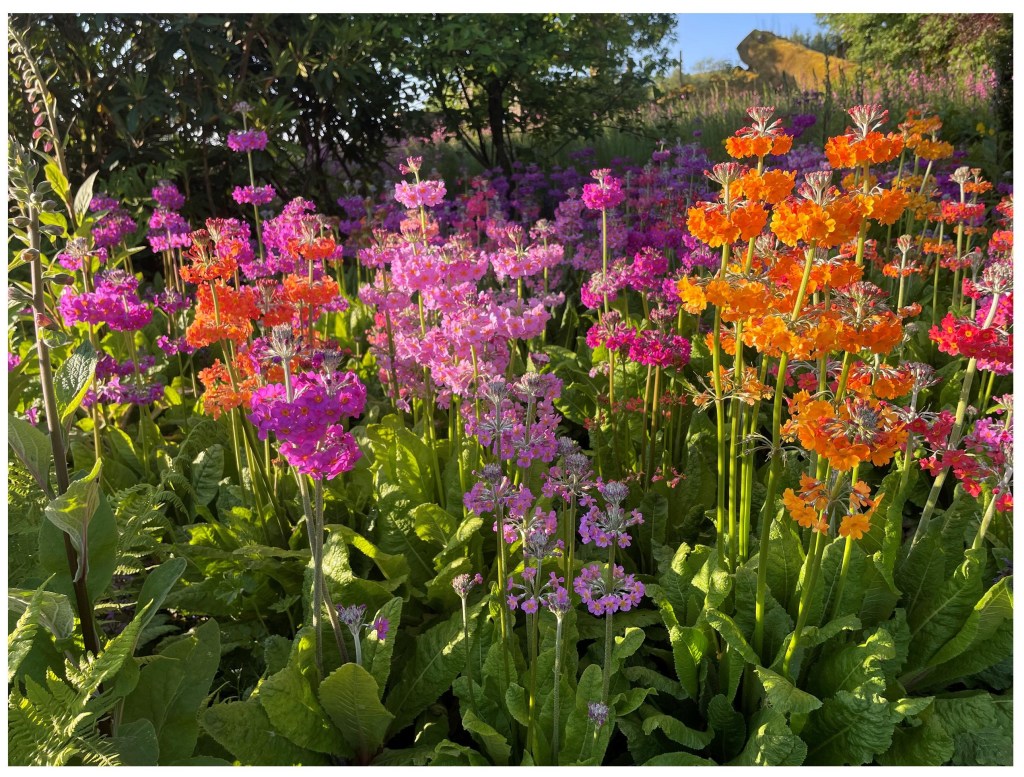
Candelabra Primulas, splashes of joyful colour. Photographed by my friend Gill Henwood, in the Lake District. ~ known to Gill’s grandsons as ‘rainbow flowers ~
Gertrude Jekyll Painting with flowers
The English National Trust announced last week that it had acquired Munstead Wood, the home of pioneering garden designer and horticulturalist, Gertrude Jekyll (pronounced Gee-Kil). Near Godalming in Surrey, Munstead Wood was her home until her death in 1932. The Trust, with help from the government, is beginning the task of restoring this gem of a garden and will open it to the public, hopefully, next year. Gertrude moved into the house in the 1890’s, first creating the 11 acre garden and then, with her friend and architect, Edward Lutyens’ help, renovating and developing the house. The garden became the prototype of the Modern English Garden.From here she bred many new plants and ran a garden centre. The National Trust’s, Andy Jasper said that “She became one of the most influential garden designers and transformed horticultural practice, collecting plants in Britain and Europe and introducing at least 30 new varieties into British gardens.”
She was born in November 1843 and developed skills as an horticulturalist, garden designer, craftswoman, photographer, writer and artist.She created over 400 gardens in the UK, Europe and the USA and was regarded as a prime influencer in gardening design. Her partnership with Edward Lutyens was especially fruitful. Both were devotees of the Arts & Crafts movement and her designs were influenced by a subtle artistic approach to garden creation. She is particularly known for the promotion of radiant colour and what is known as the brush-like strokes of her planting. This drew inspiration also from the art movement Impressionism and by the paintings of J M W Turner whom she greatly admired. So early in her studies she became interested in the creative art of planting gardens in innovative colour schemes based on ensuring different parts of the garden evolved colourfully during the differing seasons of the year. Her book, Colour Schemes for the Flower Garden, first published in 1914, (many editions until 1988) offers advice on the use of colour which keeps the garden interesting throughout the year. She believed very firmly that the most eye-catching part of a garden plant is its flower and “the most captivating element of a bloom is its colour.”
She pointed out in her book that “to plant and maintain a flower border, with a good scheme for colour, is by no means an easy thing that is commonly supposed.” Her advice was worked out through painstaking planning and in cultivating her own garden. She accepted that there are often failures, but many great successes that make it all worthwhile. She did not write just about big gardens like her own, which needed a team of gardeners. She said that the size of a garden has very little to do with its merit. “It is the size of the owner’s heart and brain and goodwill that will make the garden either delightful or dull.” Her own garden reflected a love of art which was paramount and it became a kind of outdoor studio. “My garden is my workshop, my private study and place of rest.” It was, for her, a private healing place, a palette of colour which reflected her deep love of painting. In the latter part of her life, she suffered from failing sight which made painting more difficult. Her garden became a consolation.
Her artistry, craftsmanship, garden design and planting schemes combined with her devotion to brightness and joy of colour were, according to Richard Bisgrove, writer of the 1988 preface of Colour Schemes, “humble responses to the Grand Design, works of praise from a gardener who would have liked much more but was serenely satisfied and thankful for what she had.” Perhaps that is important for any gardener though I am a great believer that there is always room for one more!
Sometimes it isn’t a design of ours, and many gardeners (if not all) are aware that Nature has its own rules and what can bring the greatest joy is the self-seeded plant which pops up in the ‘wrong’ place or a group of flowers which bloom where you least expect it, even in the midst of your own carefully crafted design. Maybe it is in those moments that you can be led to recognize that gardening is always a partnership with Nature. . (I write as one of the founding and possibly, only, member of the Dandelion Appreciation Society!)
That can remind some of us that this is a deeper partnership with, our creator God . I have heard many times the saying (the song?) that we are ‘closer to God in a garden than anywhere else on God’s earth.” It can feel a bit twee or trite but it is a truth. People like Gertrude Jekyll are pioneers in bring art and craft together, using skill and understanding in planting and design and using an artist’s palette to sweep colour across the soil. They also help us to create an outdoor room in which we can meet with God and also with friends in a quiet and restful way or which can be such a haven of peace that we are re-made by beauty and a sense of sharing in an act of love. In this we are at-one with the earth yet being lifted towards heaven.
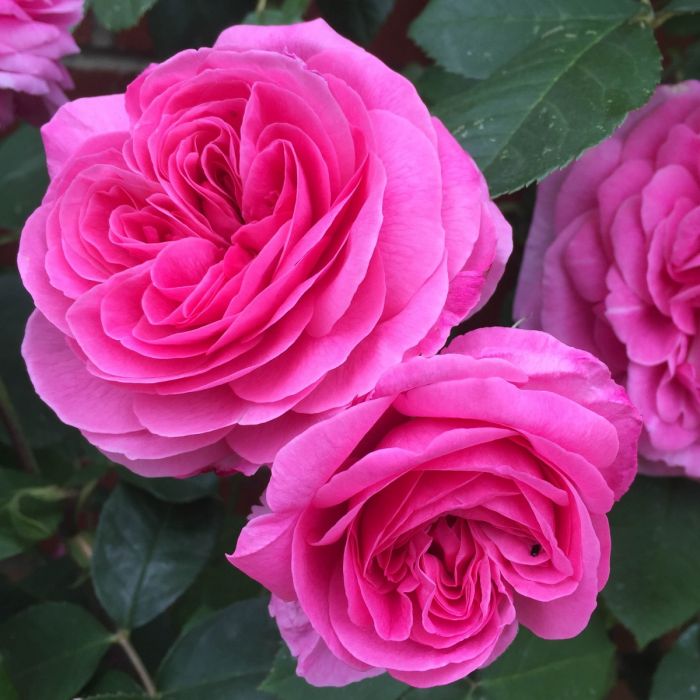
Gertrude Jekyll Rose (David Austin) widely available
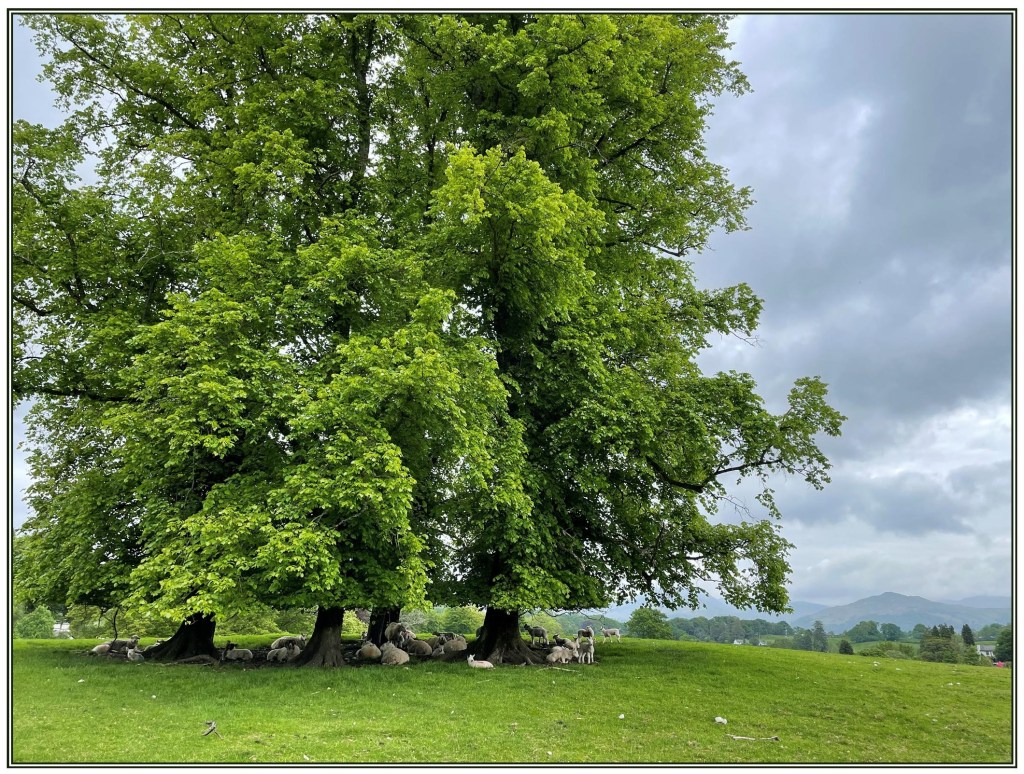
I have received this stunning photo from my friend Gill Henwood and it brought much cheer so I am sharing it with you. The comments are hers.
“Ewes and lambs in the shade of a lime tree clump in old parkland, near Hawkshead, Cumbria. Whoever dwells in the shelter of the Most High will rest in the shadow of the Almighty.Psalm 91:1
This is their favourite shelter when the strong Maytime sun shines. Though it’s cloudy at the moment, it’s warm and humid as the clouds rise and sun will break through. Too hot for woolly coats!
All around the lambs are bleating and ewes replying in their deeper alto. The semi-independent lambs gambol together and get separated from their mothers. A great baa-ing goes on if they can’t find each other. Some adventurous lambs escape under fences – leading to a great bleating as their mothers cannot follow. There must be a parable there: the good shepherd/ess who seeks out the lost sheep, of course.
Birdsong provides the mood music, with the cuckoo joining in around the vale.
A joyous morning.
Another view
Two ewes with single lambs in a shady gateway But the lone lamb is over the fence (not a Swaledale)…
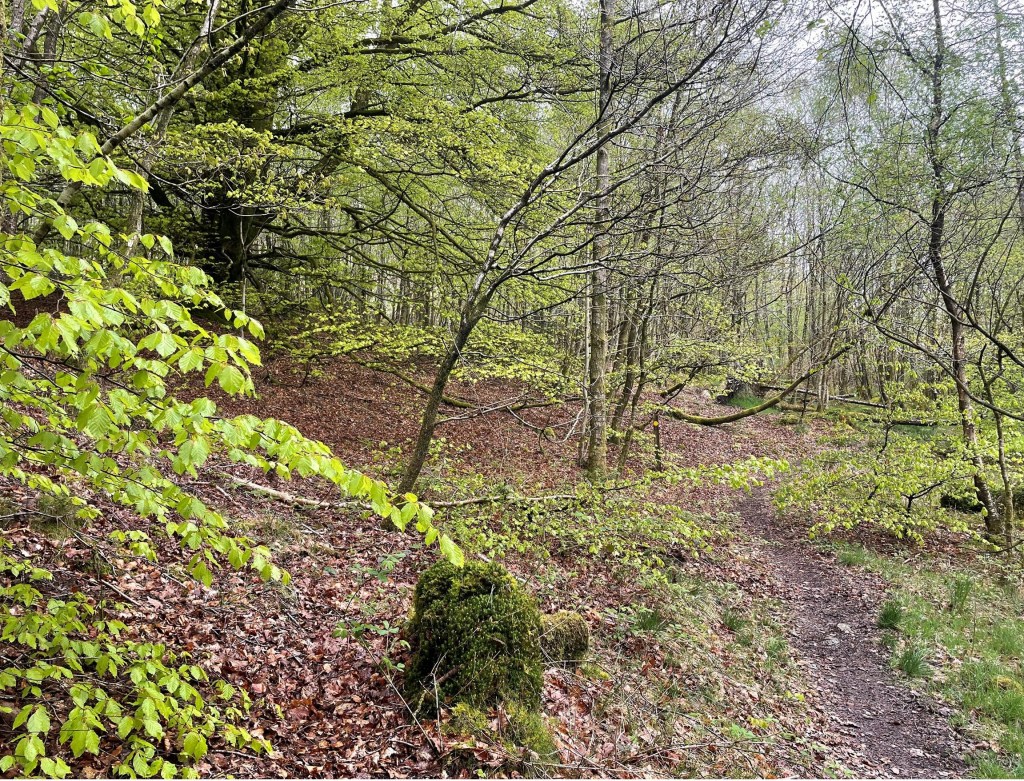
Photo by Gill Henwood. The old Beech reclothed in finest greenery
After a concentrated time in the heart of a rather wet London (albeit in front of the television screen!) it’s good to move away on the day after King Charles & Queen Camilla’s Coronation into the more tranquil climes of English woodland awakening fresh in the Maytime light.
So when my friend Gill Henwood sent me some more photographs of nature filling all around with beauty and expectation, I exchanged the joyful emotions of pageant and symbol and human pledging of life to a new degree of service, for something rather different.
In the woodlands and countryside of the Northern hills of the Lake District a busy beauty is going on as plants, new-born lambs and birds and creeping things and teeming fish playing joyfully, splashing through waterfalls. We are well into the wonders of new-birth as Eastertide unfolds and spirit-filled life offers a new joy.
So, Gill speaks of the emergence of the Lousewort and other signs of new growth:
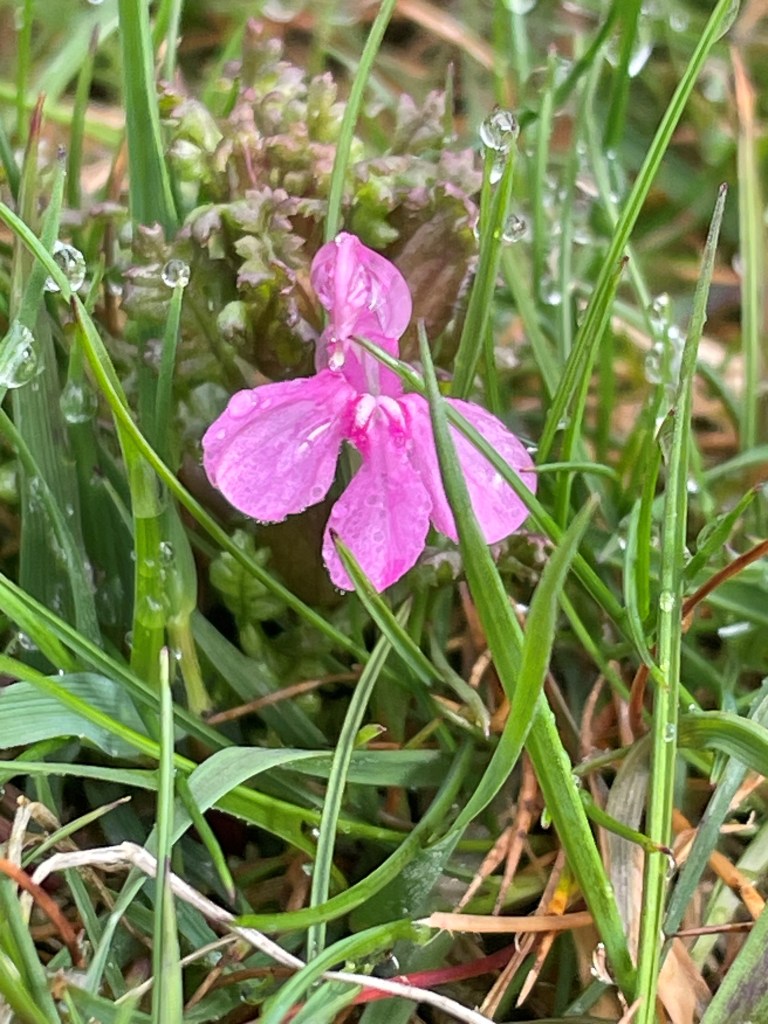
Lousewort flower, photographed by Gill
“Tiny pink heath plant just in flower for the coronation weekend. 5mm across, a sign of the heaths and high meadows coming into growth. No sign yet of the hundreds of orchids that flowered in this field in 2020, during lockdown when no cattle were grazing the field.
A new spring and a new royal era – eastertide hope of renewal after loss and bereavement.
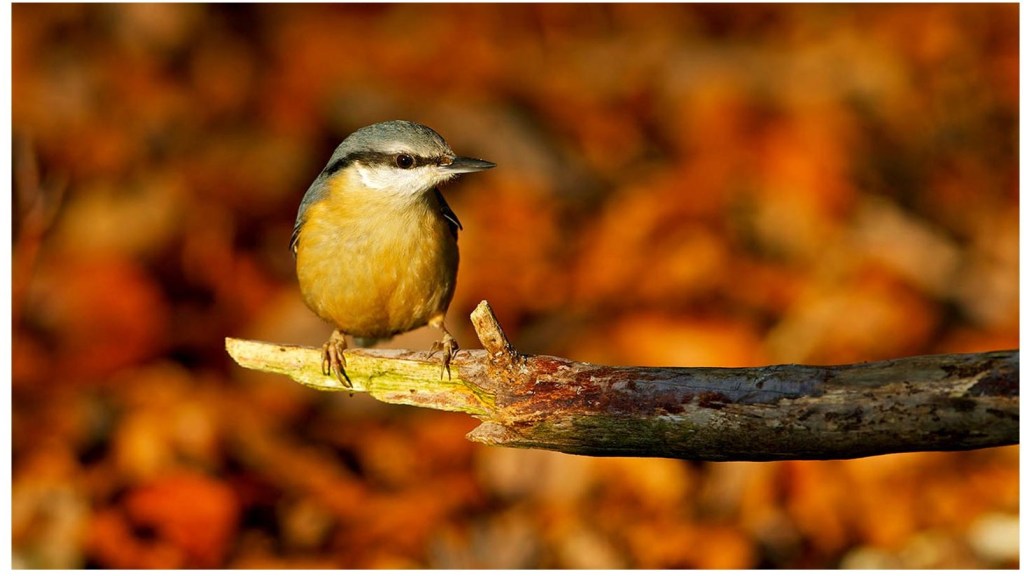
“And the songbirds are singing their choral anthem all around, with a cuckoo punctuation. Now the nuthatch is sounding its single-note call, it’s time to stroll through the newly furnished delicate dewy leaves of the beeches…“
photo of Nuthatch c/o Woodland Trust.
This is also the ancient time of Beltane, of May and summer’s beginning.
“– the dainty woodland floor and hedgerow flowers are all compact and individually almost missed. Primroses, violets, greater stitchwort and even native drooping headed bluebells make their impact growing together. A patterned tapestry on a bank and an unfurling mosaic on a heath or in the woods. Responding to long days of light and the increasing warmth of the sun towards the June solstice.
A parable in nature of Gods love given in and through all creation – if only we stop and notice the myriad glimpses all around us….“
Photo: Gill Henwood
Take a breather.
Breathe, be filled with amazement, purposefulness,




 Mr G's Ponderings