Tag: Gill Henwood

Daughter of the Wind

Wood Anemone photographed by Gill Henwood in the Lake District.

Wood Anemone…. A little story.

According to the poem at the beginning of the Book of Genesis, God completed the creative action on Planet earth after six days of total activity.
Genesis informs us that on the 7th day, God rested.
But rest rarely means inaction, especially for God. There is no way that The Maker of everything can either unmake nor stop the inbuilt process of evolving, developing, deepening, the love which God had poured into all that was made.
You see, in order to ‘make’, God had to use the very essence of being to do this and that same essence, being God, is never absent.
That’s a quick way of saying that God is always God and always making things in his and her own image!
God broods over creation like a father and a mother, holding it in being, trying to save it from harm, and guiding with all encompassing ‘love’. That’s the work chosen by God, Father, Son and Holy Spirit.

But none of that needed to be explained on that first Sunday morning. Later, God would invent and make some very clever people called ‘theologians’ who could mull over everything that God has made and decide whether it is good or not so good. They will helpfully disagree on this which makes it very simple for us to ignore them, or become one of them. (tongue in cheek remark!)
On that first Sunday morning, God wasn’t prepared to get too involved in all that. He was resting. I suppose, being, God it wasn’t the forty-winks kind of rest that we know it to be now. It was a creative rather than restorative rest.

As God the Father rested, God the Son pointed up at the lovely stars and noticed that, appropriately, one of the stars had six points, one for each day of creation. In fact, many people would give it the name of The Creator’s Star.
These 6 ‘pinpricks’ touched the darkness and so it wasn’t as dark as it would be without them. In fact, the light had a bright and luminous beauty which simply shone amazingly.

As God the Father, watched this, God the Holy Spirit allowed inspiration to flow.
Earlier, a joint effort had created things like paper, pens and pencils, paint and ink and paint brushes. So God the Spirit set to work.
Gently, the pencil floated over the paper as God thought what to make of the stars with six points drawn on the  paper.
What  had emerged was a flower, robust but also vulnerable. It would live amongst the trees and in the Spring, it would shine with a brilliant  light.
Ah!, thought God. This little flower will become part of something very special.

God knew that one day it would be necessary for some extremely Good News to be announced and the Son of God would make it.
The plan, still to be unfolded, would involve the Son in a supreme act of love though as with all acts of self-giving, it would come at a price.
So, in using the little flower to be part of the message of hope and joy to lighten a dark world, God knew that it would perhaps not live very long because as we all know, when we light a candle, as it burns to give us light, it dies.
But in the case of the little white flower, there would be no permanent death because death merely continues a journey of life but in another place. Well, almost, because what the flower leaves behind is a root system which means it will come alive on earth again.

God loved the little flower and as the Son held it up, the Spirit breathed on it and it danced. It moved as if in the wind, so God said that it would be known as  ‘wind flower’.
The Spirit then pronounced the Name which would be ‘Anemone’  – Daughter of the wind.

Jesus loved the white colour because it would be the Easter colour of Resurrection and the anemone would live in forests and woodlands because that would remind people of the wood of the Cross. It would therefore suggest to the people who saw it that through the love of God poured out from the Crucifixion, the world would be a brighter, lighter, more joyful place. It would be a world able to celebrate hope and beauty and love again. The little white flower would remind people of this

… and the little Wood Anemone? Having done her job she would rest a little until next year.


[Mr G]

with thanks to Gill for the inspiring photograph.

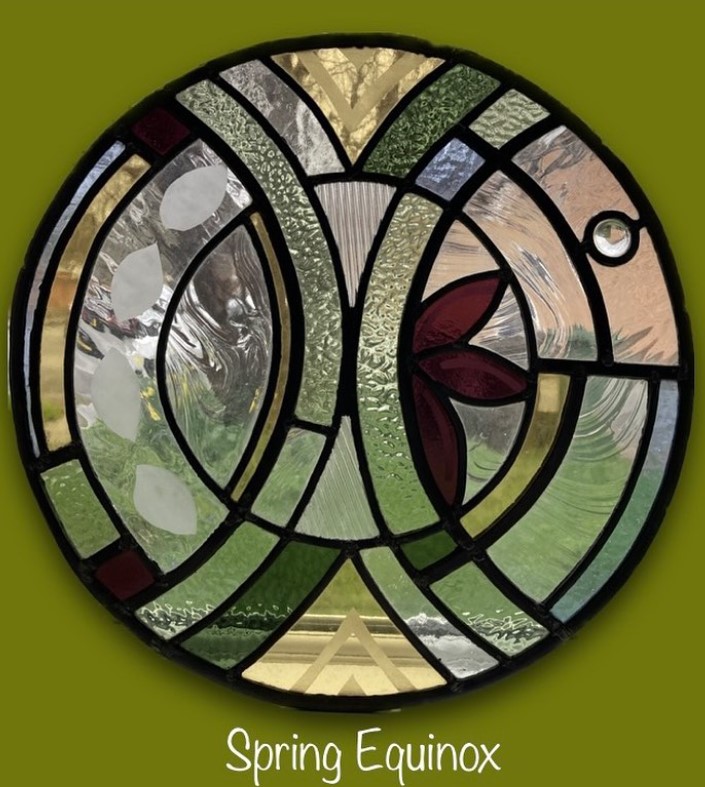
Spring Equinox

Spring Equinox. creation in glass by my artist friend, Kay Gibbons. 2023

My friend Julia has sent me the following article reflecting on yesterday’s Spring Equinox. It was written by her friend Jane Upchurch, one of a monthly series she sends out on the eve of every new moon. I am pleased to pass it on, with Jane’s permission.  For more information and further writings by her, Google her on http://janeupchurch.co.uk/category/praying-for-the-planet/

Dear friends,

Tuesday March 21st was the new moon, the time we particularly remember our beautiful planet in prayer, meditation, awareness or involvement, with love, hope and gratitude. 

This is the time of the Spring equinox.  We are moving from winter to spring, from dark to light, from cold to warmth, from bareness to the vibrant flush of spring flowers and new-born leaves.  Let us also move from anxiety and dismay at world events and the state of our planet to love and hope.  Let us sow these seeds into the thirsty soil.

Equinox

This is it, the official beginning of spring.  Oh, the long awaited date and season and sun.  The sun is white, sitting over the tops of the houses to the East, diffused through the thin cloud that heralds the start of a glorious day.   It is still cold from early evening to early morning marking the hours of the sun’s absence, but it builds to a warmth you can live in during the day.

I love this day, the changeover from winter to the early train of summer.  I love that everywhere today is the same, we all have twelve hours of day and night, equal night, equinox.  And as we sail smoothly into our opening light and new season of warmth, so the south tilts into its fall, into darkness and the call of winter.  Today is a magic day, yet most people won’t notice it save perhaps a smile at the new-found warmth of the sun.  We live on our planet like strangers, not recognising its journeys or its moods, sheltered from the weather and with a ready light to hide the dark. 

Celebrating an equinox or solstice acknowledges the birthdays of our home, enjoying the relationship we have with the earth on which we live all our days.  It is also enjoying our relationship with  the Divine, whatever that means for us, seeing God in all things – the new sun rising, the hazy air sharpening, the primroses covering the lawn in gentle yellow welcome, the quickening of spring awakening the buds, calling the call to life that echoes in our blood.

I desire to be out here today but I cannot, so can I take these elements of earth, air, fire and water and hold them in a burning cauldron safe in my heart?  Can I trust as trees do, or will I always bother and fuss before I find the path?  Is it part of the human condition, part of my makeup, a jigsaw dance between the bother and the bliss, learning to carry all the bits equally well, living in memory and faith at the same time, trusting as trees dig roots into deep soil, trying to enjoy all parts of the journey and not just the destination.  Today I have things to do that will call me away.  Today I hang my needs on the wheel of the sun and let it turn me. 

Jane Upchurch

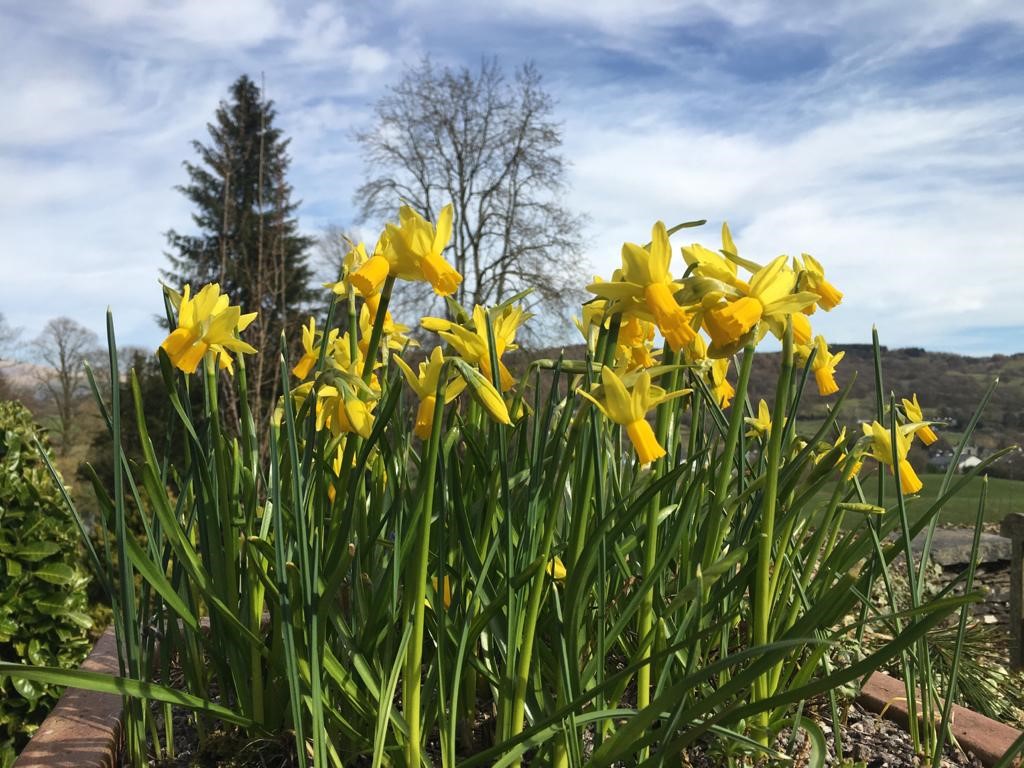
Daffodils of Spring. Photo: Gill Henwood

O GOD,

we thank you for this earth, our home;
for the wide sky and the blessed sun,
for the ocean and streams,
for the towering hills and the whispering wind,
for the trees and green grass.

We thank you for our senses by which we hear the songs of birds,
and see the splendour of fields of golden wheat,
and taste autumn’s fruit,
and rejoice in the feel of snow,
and smell the breath of spring flowers.

GRANT US a heart opened wide to all this beauty;
and save us from being so blind that we pass unseeing
when even the common thorn bush is aflame with your glory.

Amen

And all is one Love.

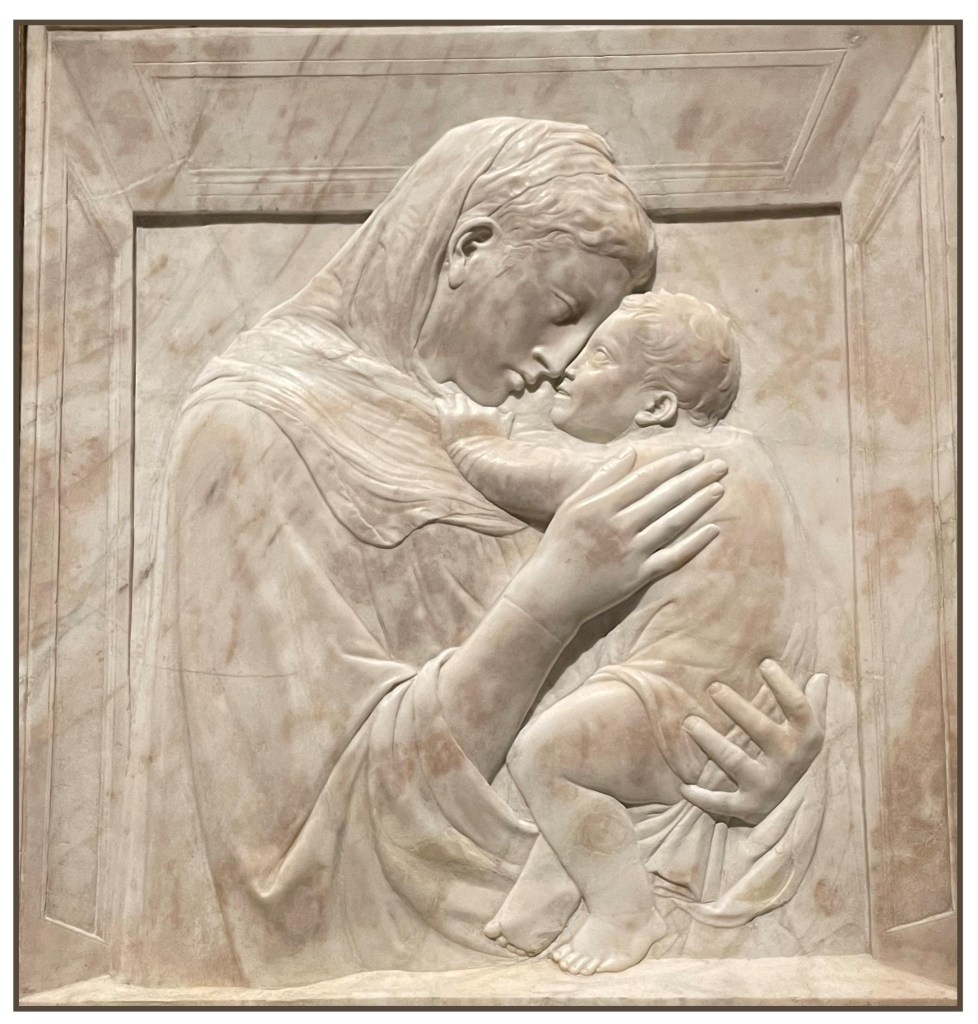
Madonna Pazzi by Donatello. Photographed by Gill Henwood **.

My friend, Gill Henwood visited the major exhibition at the Victoria & Albert Museum recently, featuring the work by sculptor, Donatello. It is entitled, Donatello, Sculpting the Renaissance. It’s the first major UK Exhibition to explore the exceptional talents of this great artist, his vision and his influence.

The Exhibition in at the V & A until Sunday June 11th. (Entry £20)

Gill has sent me some of her photographs including the one above, of Mother & Child, (Madonna Pazzi). Fitting illustration I thought, for Mothering Sunday. There is a beauty and a bond which translates into the closest intimacy.

Motherhood was not easy for Mary. She was young and inexperienced. Her pregnancy was viewed with suspicion. Her baby was born far from home in difficult and dangerous surroundings. When she took her son to the temple, only days old, Simeon’s prophecy for his future was ominous. Jesus’ childhood gave her cause for concern and in adulthood, it was clear that his life would  become increasingly dangerous and he would be marginalised. Mary had to learn to put her own feelings to one side to support him in his mission. Finally, she suffered the worst thing that can happen to a mother. She had to watch her Son die a tortured death.

God the Father’s  part in that suffering was to suffer too. Like Mary he beheld Jesus as a mother her child and to understand that a bit better, we might find help in the writings of the mystic, Julian of Norwich.

In the fourteenth century Julian of Norwich experienced and understood the motherhood of God in her visions. Mothering Sunday is a good day to share this vision and recognise that although we are distinguished by our gender, God is not. Instead God is both mother and father to us . ‘As truly as God is Father, so just as truly is he our mother.’ Said  Julian of Norwich. In both his motherhood and fatherhood, God faces up to his pain

The Theologian, Matthew Fox, muses on what Julian is saying. He says, “God is the true Father and Mother of Nature, and all natures that are made to flow out of God to work the divine will shall be restored and brought again into God.

Julian assures us that “The motherhood of God is a welcome thing on God’s part. Divinity does not consider motherhood a burden to bear for “God feels great delight to be our Mother.”

To recover the motherhood of God is to recover compassion:
Compassion is a kind and gentle property that belongs to a Motherhood in tender love. Compassion protects, increases our sensitivity, gives life, and heals.
Thus we see that the recovery of the theme of the motherhood of God flows naturally from other themes of cosmos, earthiness, blessing or goodness…A motherhood-of-God theology confronts the basic issue of letting go of the one-sided God of patriarchy and learning more about the God whose image we are.
Therefore it is also about learning more about ourselves and about our power for birthing
and creativity. Today it is especially urgent that men learn deeply how all persons, men included, are motherly as well as fatherly.” (Matthew Fox)

In the Donatello sculpture is, as I mentioned, an intimacy which is held by the bond of love, the love which creates a sense of mother and child relating as one. Increasingly, today, that same bond is being celebrated between fathers and their children, and hopefully this is leading to a broadening of the love which is reflective of God’s Trinitarian Love.

In her Revelations, Julian of Norwich said a most powerful thing:

I understood three manners of beholding of Motherhood in God: the first is grounded in our Nature’s making; the second is taking of our nature,—and there beginneth the Motherhood of Grace; the third is Motherhood of working,—and therein is a forthspreading by the same Grace, of length and breadth and height and of deepness without end. And all is one Love.

(Julian of Norwich)

Donatello’s statue opens the door to much thought. Julian of Norwich gently takes our hand and invites us to step through it.

[Mr G and others]

**The Madonna Pazzi, housed today in Berlin’s Staatliche Museen, is rectangular marble relief that dates from c. 1425. It was carved for private devotion during the beginning of the productive collaboration that Donatello formed with Michelozzo (1396-1472), an Italian architect and sculptor.

The Lord is my Shepherd

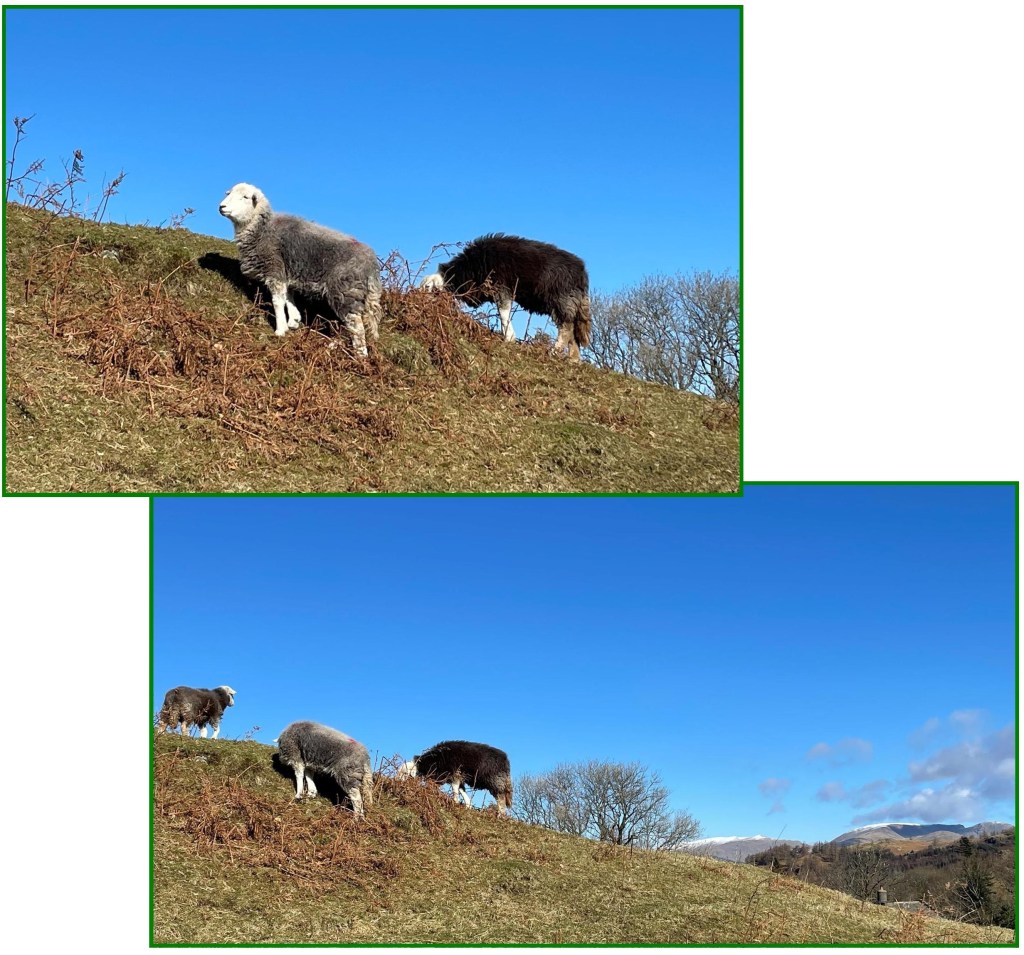
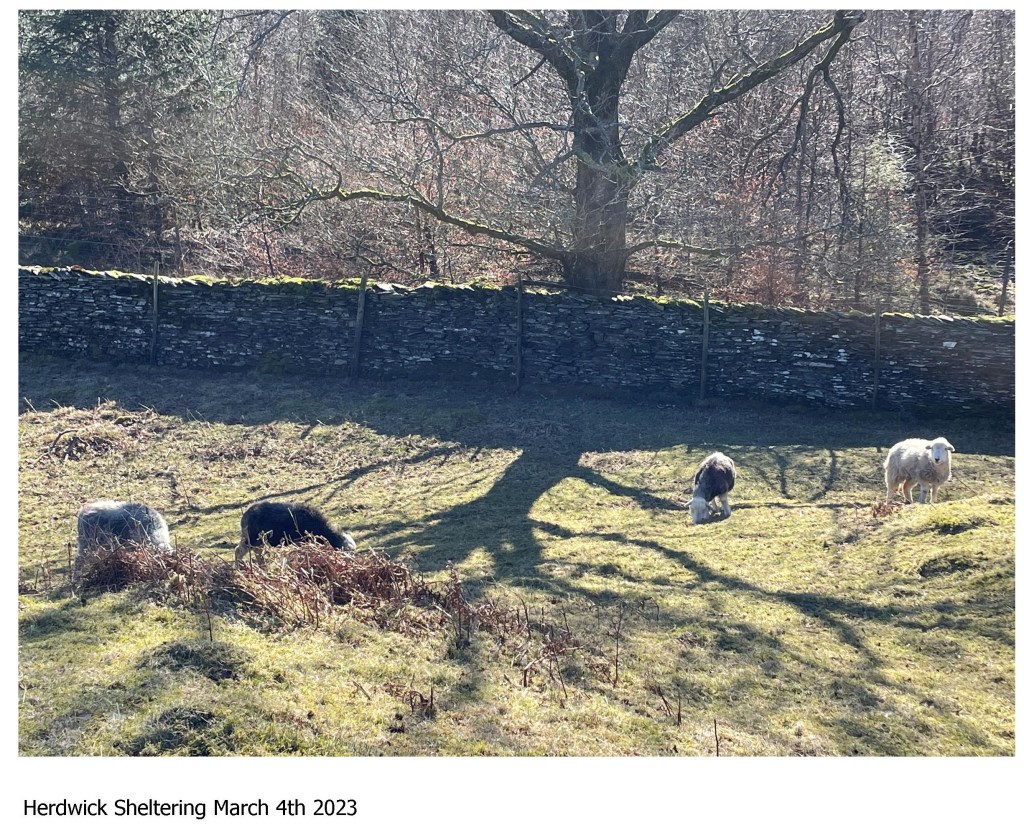
Herdwick Sheep in the Lake District enjoying the sun before more snow fell in the last few days.
The blue skies will be back soon! Photos by my friend Gill.plus the photo below.

A Reflection from the Lake District by Gill Henwood.

When you witness the care a shepherd has for his or her flock, the 23rd Psalm comes to mind:

The Lord’s my shepherd and The King of Love my shepherd is.

The young farmer below our window is only 24, and has been building up his own flock for two years.
He’s here by dawn and returns in the evenings at dusk to check his expectant ewes who wait in the long sheep shed that belongs to his retired grandfather. They baa when they hear his 4×4 coming up the track, knowing he will bring hay.
He’s working his way to a farm tenancy of his own – there is no farmhouse on this small acreage of land.

Upland fell farmers are part of the countryside and community here, and this area was cherished by Beatrix Potter a century ago, who, with the National Trust, bought and saved farms for the nation.
She too was a breeder of Herdwick sheep and a show judge.
Her shepherds, and the shepherds of today, care for their flocks and seeing them brings to mind, Jesus, the Good Shepherd.

Gill Henwood

Here is a version of Psalm 23 written by my friend,Joyce Smith in her Reflections for Lent in 2021.

Bible Reading: Psalm 23 “I will dwell in the house of the Lord, my whole life long.“

The Lord is my Shepherd;
who guides,
nourishes,
and  protects me.

My Shepherd,
who looks for me                   
when I lose my way.
and carries me
safely home.

My Shepherd,
who longs for me,
and  for
‘sheep from many different flocks’,
to dwell in his house,
both now
and for all eternity.

Jesus, my Shepherd,
help me to
fix my eyes on you
and follow
where you lead.

(Joyce Smith)