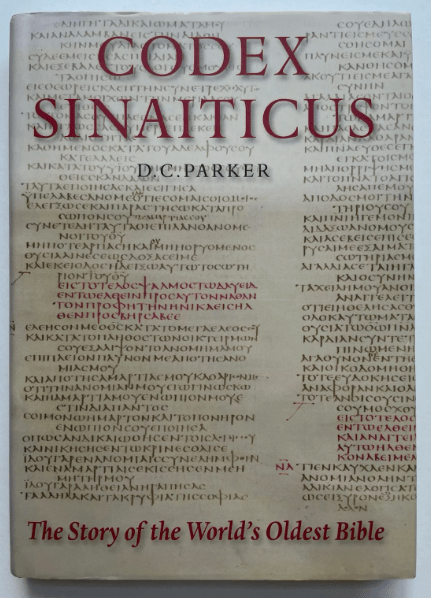
Whenever I visit the British Library in London I try to search out two very special manuscripts ~ The Codex Siniaticus and the Codex Alexandrinus. They are two of the rarest copies of Bible texts in Greek. In the case of Codex Siniaticus it is one of the most important books in the world. It is, arguably, the oldest complete copy of the New Testament that is still in existence, though not all of it is kept in London with a portion still being in Egypt, Russia and Leipzig. However, it has been digitally re-united so a complete copy now exists. From its text (and others which are less complete) all our translations of the New Testament are influenced.
It is also rather beautiful to look at in its handwritten script. To come close to what is the earliest known version of the Gospel of Jesus Christ, lovingly scripted in the 4th century at the monastery of St. Catherine on Mount Sinai, is to come close to the Living Gospel. It is the closest we get to God’s Holy Word spoken by Jesus and the New Testament apostles and evangelists. Yet this is not the only example of the Living Gospel.
I write this on All Hallows Eve or ‘Halloween’ – a night when we try not to think of ghosts and scary things but rather of the Holy Ones of God—the saints whose lives God touched and who became, in the way they lived those lives Living copies of the Good News of Jesus Christ. I think not only of the many saints we commemorate in our Church Calendars but also those whose holiness is known to but a few, though always to God. People who, through the lives and values they have tried to lead and the faith they have proclaimed, been influential and an encouragement to others. Most, if not all, of us who embrace the Christian faith, can think of such people whose nurture of our Christian understanding and practice have laid the foundation of our belief in Jesus Christ and our love for Him. These are the unsung hero’s of our Church. These we remember at All Saints’ tide. But their specialness is not about them being unique. All of us are called to be the Holy Ones of God. We are all called to saintliness and to nurture and grow the faith of others by our example, our prayers and our living out of the Gospel—a Gospel we should know by heart because it is absorbed into our souls. Someone once said that we should remember that we may be the only copy of the Gospel that others may read!
As I keep the Hallowed (sacred) evening on the cusp of All Saints’ Day, I think of those holy ones of God who have made such a difference in my own life with their outflowing of God’s love. They have been the beacons which have illuminated my journey towards God. I am thankful that they were placed in my way to bring God’s heavenly glow to my pilgrimage to heaven. They are also a reminder that, as we can read in the Book of Wisdom (Chapter 3) “The souls of the righteous are in the hands of God.“ That includes all the Saints, and all who, today, are trying to live close to God and who continue to show us the way to God’s Heart.
Sunrise from Lindisfarne over the Farne Islands, St Cedd’s day, October 26th 2025. Photo by Gill Henwood.
October 26th is St. Cedd’s Day:
The little that is known about Saint Cedd comes to us mainly from the writing of Saint Bede in his Ecclesiastical History Of The English People. Cedd was born in the kingdom of Northumbria and brought up on the island of Lindisfarne by Saint Aidan. He was one of four brothers: Chad (originally Ceadda), Cynibil and Caelin being his siblings. The first datable reference to Cedd by Bede makes clear that he was a priest by the year 653. It is likely that Cedd was oldest of the brothers and was acknowledged the head of the family. While he was alive, he seems to have taken the lead, while Chad was his chosen successor. Cedd was sent out from Lindisfarne to take the Gospel to Essex, landing after a sea journey at Bradwell where, today, there is still a Chapel built on the foundation of Cedd’s monastery. As well as this mission, Cedd also established a monastery at Lastingham in the Cleveland Hills. From here he established a mission in North Yorkshire. When he died of the Plague, his brother Chad took over. Today, at Lastingham, the crypt chapel is said to date back to Cedd’s time.
Learning of God from Island Saints.
I come to this Holy place where, when the tide turns, silence and conversation meld into stillness. God is here. His sanctuary, enclosed by the sea, welcomes those who are seeking after meaning.
What am I looking for, here on Lindisfarne, where the spirit of Aidan gathered together those chosen by God, on whom the Saint poured out his soul, his faith, into their waiting hearts?
I sense and seek the company of those who first prayed here through the storms of the sea, the blowing of the winds sweeping over the Headland Heugh, in the strange light of pale day and the fading shadows of eventide. In silence and in prayer; through learning and in listening; by becoming steeped in God’s word; twelve young monks, were inspired to mission the good, Gospel news, of Jesus Christ.
Cedd and Chad, Cynibil, Caelin and companions allowed Jesus to be etched upon their hearts, discovering a love which must be shared. How else would others inhale God’s blessing and love in their own lives and cause a world’s darkness to be bathed and transformed by the dazzling light of God’s Spirit?
And I, kneeling somewhere between the waves and shore of my inner being, must hear anew this call to open the Gospel pages illuminated by God within my soul, that through me also God may mission to others His amazing and saving Love.
Mr. G. St Cedd’s Day 2025.
Dawn over Lindisfarne, taken from Bamburgh by Gill Henwood. St Cedd’ s Day 2025
Lord, Lead us from death to life, From falsehood to truth. Lead us from despair to hope, from fear to trust. Let peace fill our hearts, our world and our universe. Let us dream together, pray together and work together, To build one world of peace and justice for all.
[Author unknown – it is thought to be either an adaptation of a Hindu prayer or of a hymn. The first time that it was known to be publicly spoken was by Mother Teresa in 1981.]
The International prayer of peace speaks to God of our desire for a world which lives in harmony, love and justice. We pray it because of our longing that we who have been given this planet as our home may treat it, and therefore all who live on it, as a pure gift. Too often, and throughout history, humanity has treated life here as a right and our planet as ours to exploit and dominate. Even so, most of us are subservient to the will of a few. Throughout human history we have been dominated by a those who dictate how we are to live and before whose power we fall down and, not to put too fine a point, worship. How else could they have power over us unless we allow it.
Alongside dictators and despots there are people always willing to serve them. It is usually because they share that power and bask in a self-interest which leads to a sharing of injustice and evil. The obvious example of this demonic is the Nazi party which grew up around one who had many personality defects but who somehow caught the mood of the moment. Hitler was in many ways a weak and infantile man who happened to touch nerves of those who had been demoralized by circumstances which took away the self-respect of a nation. Hitler, and fellow dictators, like Stalin, Mussolini, Franco, Emperor Hirohito, exploited a mood of despair and, surrounding themselves by thugs, used evil to corrupt good. Here we can place what people did to Jesus and go on doing, sometimes outrageously in His name! Today Hitler and his cronies have been replaced by modern day despots because History has a habit of repeating itself.
Because we have often failed to see that our Creator God has allowed us to tenant planet Earth and appointed us to be Stewards – custodians – of all the good and joyful world of nature, the animal kingdom and the birds of the air and fish of the sea, human beings have fallen into a trap. We have fooled ourselves that it’s all ours for the taking. Humanity has tried to replace God. So hell-bent (and that’s a thought!) are some humans on exploiting each other and the earth for personal gain that that whole world is in turmoil.
I recently found this Native American saying from the Ute Tribe, which spoke a truth to my heart:
Treat the earth well. It was not given to you by your parents, it was loaned to you by your children. We do not inherit the Earth from our Ancestors, we borrow it from our Children.
That feels like a context against which we should live our lives on earth and it’s interesting that those we call Generation X are increasingly taking a view which echoes this. Maybe there lies our hope. There are always those who not only choose good over evil but who are prepared to work for that goodness to prevail. It is, after all, what is at the heart of the Christian and other faiths.
Each generation who has followed a despot has also produced others who challenge and show us a good and better way, even and perhaps especially, at great cost to themselves. I think instantly of Franklin D. Roosevelt, Winston Churchill, Dietrich Bonhoeffer, Maximillian Kolbe, and in the post war world, Dag Hammarskjold (second General Secretary of the United Nations). He sought to forge a new way of living peaceably, nation with nation, which, though fragile today, is still the force for tremendous hope and goodness.
We celebrate the UN today not just because for the past 80 years it has been a forum for peace but because through many differing ways it works for education, caring, peace-keeping, seeking to eradicate poverty and injustice and in this it represents all of us who try to lived goodly lives (and for many of us, Godly lives) dedicated to shaping a better, more equal, caring, just and liberated world.
Speaking of itself as a symbol of hope for Global Unity, The United Nations maintains that “There is no other global organization with the legitimacy, convening power and normative impact of the United Nations. No other global organization gives hope to so many people for a better world and can deliver the future we want. Today, the urgency for all countries to come together, to fulfil the promise of the nations united, has rarely been greater. UN Day, celebrated every year, offers the opportunity to amplify our common agenda and reaffirm the purposes and principles of the UN Charter that have guided us for the past 80 years!”
António Guterres, the present UN Secretary, in his message for today, says
The United Nations is more than an institution. It is a living promise – spanning borders, bridging continents, inspiring generations. For eighty years, we have worked to forge peace, tackle poverty and hunger, advance human rights, and build a more sustainable world – together. As we look ahead, we confront challenges of staggering scale: escalating conflicts, climate chaos, runaway technologies, and threats to the very fabric of our institution. This is no time for timidity or retreat. Now, more than ever, the world must recommit to solving problems no nation can solve alone. On this UN Day, let’s stand together and fulfil the extraordinary promise of your United Nations. Let’s show the world what is possible when “we the peoples” choose to act as one.
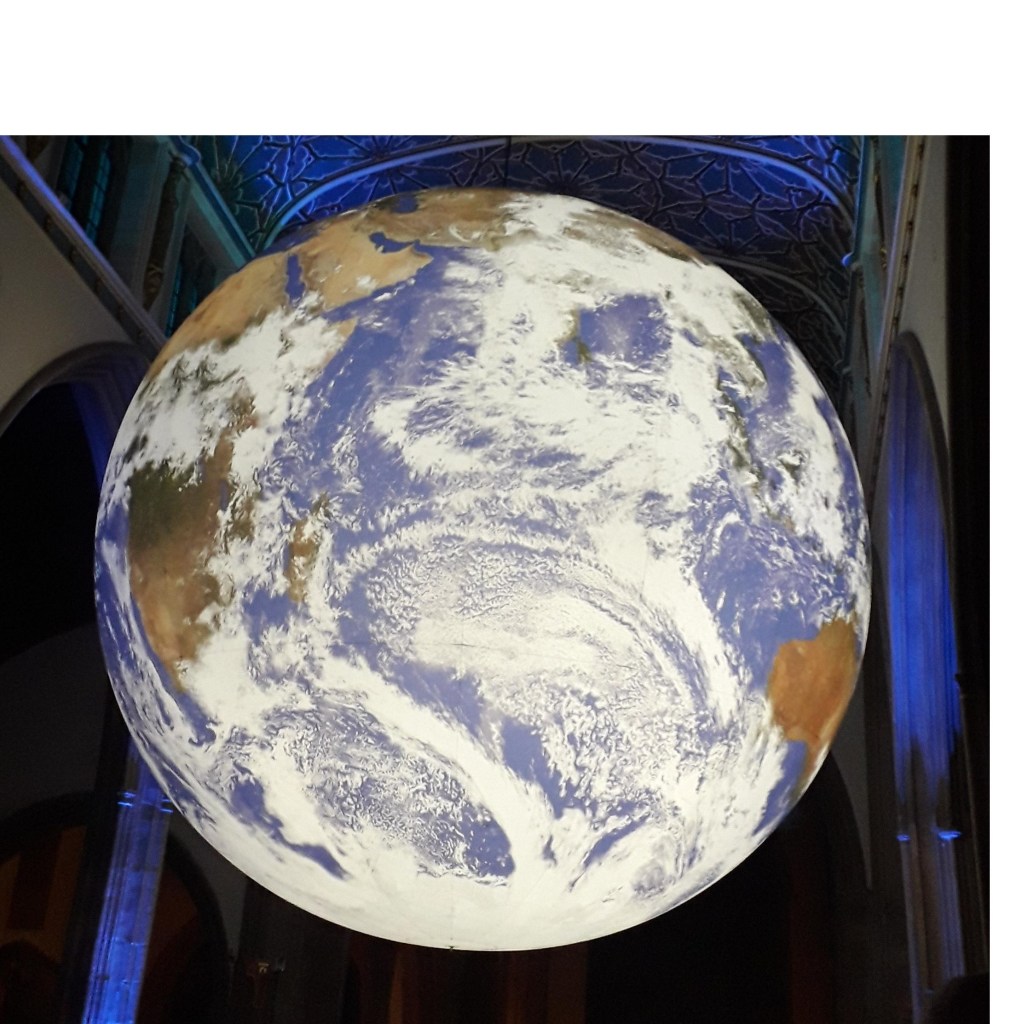
Gaia ~ Artistic representation of The Earth by Luke Jerram photo by Mr.G.
Prayer for the United Nations Organization.
God of compassion, walk alongside all of your global stewards who work to create a more just and peaceful world. Equip the United Nations community with a sense of urgency and humility that lets your will be done. Each day you give bread enough for all, grant us also the wisdom to ensure that everyone has enough. Teach the world’s leaders to forgive, to extend welcome across borders. Show the world a new path beyond greed, oppression, and division. We pray for a world united. We pray for the power to save succeeding generations from war. We pray for a glory that reaffirms the dignity and worth of every person. We pray that your grace might ensure life in larger freedom forever, for all of your children.
Our weekly study group has been looking at the meaning of the Eucharist, in particular at the Last Supper, its spiritual and biblical roots in the Jewish Passover in the Book of Genesis.
As we delved into these links, we read the details in St. Luke’s Gospel, Chapter 22 and about the preparations Jesus had made for the Passover meal. We are told that Jesus sent Peter and John to get the meal ready. In answer to their question as to where they might eat it, Jesus told them : When you have entered the city, a man carrying a jar of water will meet you’ follow him into the house he enters” and there they were to meet the master of the house who would show them where the meal was to happen. In our discussion we needed the signal Jesus had given them ~ a man with a water jar. We never hear of him again but as he was at the right place at the right time we can assume that he was known to Jesus and an arrangement had been made both with him and with the master of the house. Without giving much thought to it we have been in the company of two others with a role in the Gospel story and clearly, friends of Jesus. We thought of how often this happens in the New Testament; people are encountered who simply appear and disappear, given but a sentence or two, yet were signs of a Gospel friendship that was extended to so many. As we discussed; Pete, one of our group took the moment further and later he sent me the following poem.
Did you know?
Did you know, O man with the jug, when you lifted water to your shoulder, that heaven was in your step, and the Teacher’s eyes were upon you? Did you sense the whisper of eternity in the clay’s cool weight? Did you feel the river of life passing through your humble task?
Did you know, O master of the house, that your upper room would cradle God? That bread would be broken, wine poured as covenant and blood? Did your heart stir as they entered, those weary men, so calm yet trembling, while the Lord of all took the servant’s towel?
Did you know, O silent room, how still the air would grow, how words eternal would hang like oil lamps in your wooden beams? “This is my body… this is my blood.” Did the walls remember the sound? Did they shiver again when the Spirit came like wind?
Three mysteries in one night: a man with a jug, a host with a home, a room with an open door. None named, none praised, yet through them the world was readied for grace poured out like water, for bread shared among friends, for love that would not die.
O Lord, teach us to be like them: to carry what is needed, to open what we have, to hold what is holy, and to let it all be Yours. Amen






 Mr G's Ponderings