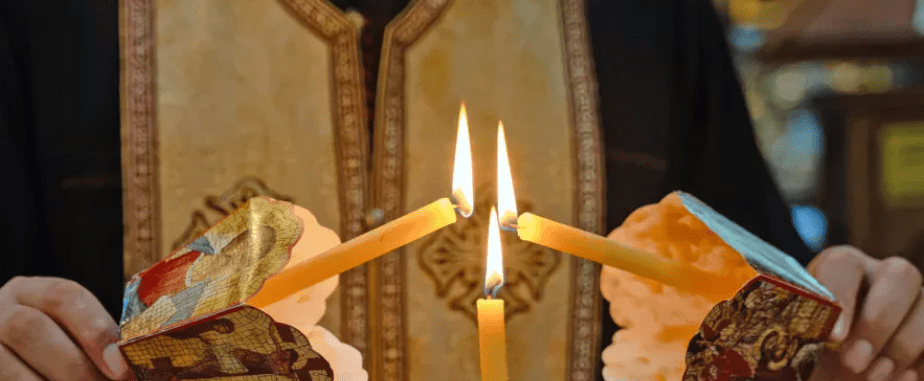
Thoughts during The Week of Prayer for Christian Unity
Last week at a funeral, I met a relative of the girl who had died. It was a Christian funeral but he was a Muslim relative. He was amongst members of the family who came from France but he had been brought up in Algeria.
Despite the language and faith differences we managed to have quite a chat! Inevitably we touched on our differing faiths but soon found level ground when we talked about Abraham, known biblically as the ‘father of the nations’. The Muslim faith together with the Christian and the Jewish faiths all have Abraham in common. We can all trace our roots back to him which is why we sometimes refer to being Abrahamic in origin.
I always enjoy these chance encounters because, if we concentrate on what we hold in common, they are often very enriching. God, Prayer and worship are the bedrock of all our religions.
Later, I thought about the many conversations and dealings I have had with those of other faiths. For example, I support a small charity named, Abraham’s Children in Crisis, which touches the lives of a group of children and young people living in the West Bank of Israel. Most are Muslim but there are no barriers and some are Jewish.
They are supported in their education and medical care by Christians here in Britain.
I know their names; what they look like; how they are struggling and how they support each other. I thought of them often during these troubled times. In a small way I try to share their fragile lives.
Some time ago now I was at a wedding which was a double one – in that it was held first in London at the Cyprian Orthodox Cathedral because the husband was an Orthodox Christian. We then travelled to Kolkata for a Hindu ceremony because Rumi was of the Hindu Faith. Both ceremonies were fascinating and very moving. I was enriched by the experience . One of my special Internet blog friends is KK who is also an Hindu so I feel a sense of closeness to him because of Rumi’s wedding.
Another Rumi has a special place in my life because I am deeply inspired by his poetry. He is the famous 13th century Persian poet and Sufi mystic.Within Christianity I have discovered and engaged with many differing believers in Jesus Christ, whom we claim as our Lord and King.
My own journey of faith began with its roots partly in Roman Catholicism. I was then sent to a Methodist Sunday School and I am now a strong adherent to the Anglican practice of the Christian Faith. Who knows where I’ll end up!
I am pondering these thoughts because this week, followers of Jesus Christ are keeping Christian Unity Week.
Many things have happened throughout our history to divide us and even within particular denominations there is much brokenness and need for repentance but there is, at heart, a God who loves us and cares for us as His children.
It sometimes feels that what gets in the way of Unity – the sense that we are united as all God’s children- is because every church or group seem to think that they alone have the truth.(Bit like some world political leaders just now!)
How false is that!
I think that’s why I love and respect what the former Chief Rabbi, Jonathan Sacks, says that only in heaven is there Truth. On earth there are truths. God is the only real truth and all over the globe people are seeking to answer that profound question of Pilate to Jesus at his trial – what is truth?
Truth on earth, Rabbi Sacks says, is not, nor can it aspire to be, the whole truth. It is limited, not comprehensive; particular, not universal. What propositions conflict is not necessarily because one is true and the other false He suggests that the difference is because we are coming at something from different angles but both are only part of the truth
I believe that we can only look to God for the real answer and anyone who claims to hold THE truth exclusive of others, is bound to be mistaken. We can only learn truth if we listen to others and share our insights with each other and, of course, listen to God together in prayer.
There is so much to learn and be excited by the story of people’s journey of faith and the joy and encouragement that brings to my own journey. We all have so much to share with each other and so much to discover about God.
There is much in Judaism I admire and there is much in Islam that I respect. My Hindu hairdresser in the North taught me a lot about prayer in the family. I love the joyful and convincing hymn-singing and biblical insights of the Methodists. I like the ritual and devotion of the Roman Catholic Church. I love the ceremonies of High Anglicanism; the intellectual honesty of Anglican theology; the exuberant praise worship of our evangelical brethren.
I draw strength from Celtic insights into the sacredness of places and people; I enjoy the simple rhythm of Taizé; I find enrichment in ancient prayer forms like the Labyrinth; I adore the Orthodox Liturgy.
I am reduced to silence by the witness of monastic places like Bec in Normandy, where prayer is the breath of the place;
I like the simplicity of worship in a quiet rural church and my heart soars during Anglican Cathedral Evensong. I am loving being spiritually fed by Pope Leo!
I find talking and listening to other believers fascinating.
And God is in all that and in much, much more. He is bigger than all our concepts of Him or He would not be God.
Wide Vision goes with deep exploration. God is always teaching us something new.
Evelyn Underhill spoke of all our differing expressions of faith as ‘Chapels in the Cathedral of the Holy Spirit’. I like that.
We are all part of the Universal People of God. What gives any church real authenticity is if, in the words of Michael Ramsey, we are filled with the grace-giving presence of Jesus Christ. Grace-filled churches have no need of labels. They simply reflect God and so try to live in close friendship with GOD, the giver of Grace and Truth.
[Mr G. 2oth January 2026]
 Mr G's Ponderings