Tag: Jesus Christ

From Bloodline to Loveline

Lessons from Queen Elizabeth

[Based on a sermon by Piers Northam and adapted and added to by Mr G.]

This week we, in the United Kingdom and the British Commonwealth, have commemorated the Anniversary of the Birth of Queen Elizabeth II (our longest reigning Monarch) who would have celebrated her Centenary on April 21st.
She died in 2022.

At the time of her death, our present King – Charles III – wrote:

‘The death of my beloved Mother, Her Majesty The Queen, is a moment of the greatest sadness for me and all members of my family.  We mourn profoundly the passing of a cherished Sovereign and a much-loved Mother.  I know her loss will be deeply felt throughout the country, the Realms and the Commonwealth, and by countless people around the world.’

In his message we can note a  holding together of the two things: the personal and the shared.  The Royal Family were mourning  a mother, grandmother, great-grandmother; and we as a Nation were mourning the death of our Sovereign – who for many of us at the time  was the only one we’ve ever known – but one with whom so many of us feel a strong, personal connection. 

At the Platinum Jubilee, just before her death, the then Prince Charles began his speech ‘Your Majesty… Mummy…’ to huge applause.   For Queen Elizabeth inhabited both those roles and in so doing, she became the person who drew us together as a worldwide family – through national ties, but also through ties across the Commonwealth and beyond.  She inspired love and that drew people of all races, colours, creeds and classes together.  This was her gift and, in her way, she made possible a drawing together of people.

She not only brought people together but also, through her historic ancestry was a link with many previous generations. She had clearly defined links to Queen Victoria and further back to Margaret of Scotland – the sister of Henry VIII.  Her bloodline was well established. 
It brought with it a right to rule but this right was tied with both responsibility and accountability.
No one, with power to govern, either elected or inherited, can avoid accountability which defines how they act and how that action is carried out in service for others.
This is very important in our present day when some world leaders are wielding power for their own ends and with no real sense of care for others.
Queen Elizabeth did not rely on right or might. What defined her was not bloodline, but rather, loveline.

For Queen Elizabeth the Loveline had its roots in God and in an Almighty Love which has a global outreach – and one that extends beyond humanity to all of Creation.

Queen Elizabeth gladly accepted that God’s love is for each and every one of us, his beloved children who, through Jesus are drawn into a global and eternal family of love.
She expressed this in terms of a belonging together as a community under God, remembering that community is about holding our world in a common unity. Her Majesty, in her Christmas broadcasts, clearly proclaimed her belief in the importance of community:  In 2001 she said this:

‘I believe that strong and open communities matter both in good times as well as in bad.  Certainly they provide a way of helping one another.  Communities also give us an important sense of belonging which is a compelling need in all of us.  We all enjoy moments of great happiness and suffer times of profound sadness; the happiness is heightened, the sadness softened when it is shared.  But there is more than that.  A sense of belonging to a group, which has in common the same desire for a fair and ordered society, helps to overcome differences and misunderstanding by reducing prejudice, ignorance and fear.  We all have something to learn from one another, whatever our faith… whatever our background, whether we be young or old.’

But her understanding went further than that, as she said in 2007:

Jesus of Nazareth reached out and made friends with people whom others ignored or despised.  It was in this way that he proclaimed his belief that, in the end, we are all brothers and sisters in one human family.

Our humanity alongside our responsibility for the Care of all Creation is rooted and grounded in Love which flows from the Love of God.

For Queen Elizabeth this became an essential part of her loveline which she expressed in two ways.  
One is that she had a deep interest and love for people.  At an individual level, so many have talked of how when they met her, she paid them her full attention; really listening to them; entirely focused on them during their exchange.  There is that sense that in so doing, she honoured their identity, openly and without judgement.

The other theme is the way that at a national and international level, she was able to draw us together; to point to something bigger than our own private concerns.  Her ability to forge a connection with us; to show her love and care and concern for us in that  long life of service – service to the Nation, the Commonwealth and the wider global community;– helped us to feel that vital sense of connection to each other; helped us to see beyond ourselves and give us a sense of belonging.
In our deeply fragmented world both internationally and locally, we need to take those words, which are the essence of who Elizabeth was, and cherish them deeply in our own hearts.

All this sprang from her profound faith and trust in God.

This must be something we seek for our own lives and what we should expect and demand from others. Not least from those in leadership who act in ungodly ways whilst pretending to believe they have some kind of Divine right to behave as they do! Not least those who have the temerity to believe they might have some claim to a Godliness which couldn’t be further from the truth.

Reflection on the Saints, their actions, prayers and faith has always been an helpful way of shaping our own lives and souls. Queen Elizabeth lived a saintly life (indeed, for me she is a worthy candidate for for Canonization!) and as we seek a way out of the present morass of our world, we would do well to ponder on her example, values and faith.

Here’s how we may set about doing it:

  • by following her example;
  • by trusting in the goodness of God
    and his ability to do great things;
  • by looking beyond ourselves to others;
  • by seeking to draw all people into family;
  • by honouring each of God’s beloved children
    who are our brothers and sisters;

So, here’s a blessing prayer which was a favourite one of  Queen Elizabeth’s.

{Piers Northam &Mr G 22nd April 2026}

Parenting by God

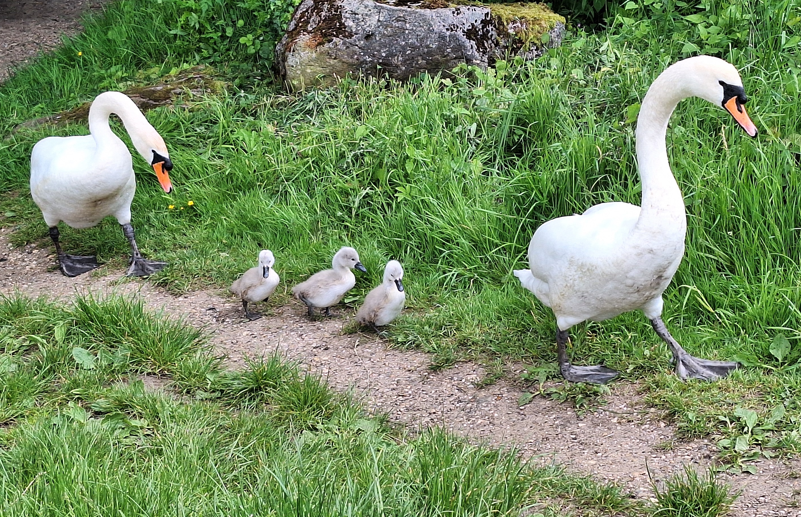
Cygnets watched over by parent swans. Hatfield Forest, Essex. Photo by Mr G

A Reflection about Mothering Sunday by Piers Northam.

There is a Neopolitan saying about cockroaches
Ogni scarrafone è bell’ a mamma soja
which translates as ‘every little cockroach is beautiful to its own mother…’
It feels relevant, because the cockroach’s mother looks on her offspring with a eyes filled with love – and that set me thinking about how we are each looked on by God.

As we journey through Lent, I think it’s an important thing to ponder on for ourselves: how does God see us? 
I mean really see us? 
I suspect that answers to this question will vary, but they might include the fact that he loves us; that he might also be a bit disappointed in what he sees us getting up to; that he’s forgiving and always willing us to turn back to him; that he’s also forward-looking and sees the potential in us: sees the best that we can be; and that he sees the beauty that we might think is either not there or well-hidden under our crusty, cockroachy exteriors – and so he gazes on us with love and affection – with the gaze of a loving parent.

On Mothering Sunday, that notion of the relationship between parent and child – by which I mean the very best version of that relationship – might have a lot to teach us: it’s bound up in notions of nurturing and feeding us; protecting us; teaching and equipping us for life; perhaps a bit of necessary discipline from time to time, but above all that sense of wanting the best for us; loving us: and that unspoken bond and shared identity… 
The Bible Readings for Mothering Sunday, from Exodus and from St John’s Gospel, have some other interesting things to say about parenthood: 

First there’s the story of Moses’ mother.  It’s perhaps useful to remind ourselves of the background to this story: the Hebrews were enslaved to the Egyptians, but they had grown hugely in number and the Pharaoh feared being overrun by them so, in order to keep down the population, he commanded that all Hebrew male children be thrown into the Nile and killed – they were living in dark times.
When Moses was born and his mother could no longer hide him, she made a basket for him, sealed it with pitch to make it watertight and hid him amongst the reeds.  Here is a mother who can no longer protect her child, so she entrusts him to God, leaving him somewhere she prays he will be safe.  And then, of course, Pharaoh’s daughter comes along and finds him – she acts instinctively; taking pity on this defenceless baby.  She is aware that he is probably Hebrew – an alien that her society looks down on – but what she sees is a fellow human being: a child in need of care and nurturing whom she goes on to bring up as her own. 
And then we see the two women working together to raise Moses: his biological mother hired as a wet-nurse to feed him and raise him for a period.  Later, she hands him over to Pharaoh’s daughter because she realises that by doing so he will survive and thrive and be safe and well looked after.  In her we see sacrifice and trust in God; putting her child’s needs before her own; nurturing him and wanting the best opportunities for him in life.  And in Pharaoh’s daughter, we see compassion and generosity; she looks beyond the views of her society, to see a defenceless child and she responds to his need, bringing him up as her own.  Both these women think of Moses first and both act in his best interests.

The other little thread here, that is picked up in the Gospel reading, is that motherhood for Pharaoh’s daughter goes beyond blood-ties.  Moses is her child by adoption, yet he is treated as her own.  And this is what we see at the Cross when Jesus entrusts Mary and John to each other.  The beloved disciple takes Mary into his household and treats her as his own – as she does him.  In entrusting them to each other, Jesus is asking them to form this interdependent, loving relationship.

It is these relationships that are at the very heart of our Christian faith.  Jesus tells us that we are children of his Heavenly Father, who is also our Father – we’re reminded of it every time we pray that great prayer he taught us.  And so, by extension, we are to be family to each other – with all that that might entail.  As with Pharaoh’s daughter, we are to see beyond the blood-ties of our own families and beyond the borders of race and nationality and to regard each other as beloved brothers and sisters.

But on Mothering Sunday, I think we could push things a stage further.  We’ve all heard of sibling rivalry and there’s never a guarantee that we’ll get on with our brothers and sisters.  But if we focus on the way that the best parents look on their children, we might find a stronger imperative.

In the 16th century, long before it was subsumed into the Mothers’ Day peddled by the card companies, this Sunday in Lent was a day when churchgoers returned to their ‘Mother Church’ – often the local cathedral or big church, or perhaps the church where they were baptised.  In later times, domestic staff who lived away from home, were given the day off to return to their families – and usually to their mothers – and this is where some of the customs that we keep today came from.  But that notion of ‘Mother Church’ is an important one, for if we take it seriously, then it tells us something about how the church should be – not a church that fences us out with rules and regulations about who’s in and who’s out, but one that loves and nurtures us.  One that, like Pharaoh’s daughter, simply recognises our common humanity – whether we’re Hebrew or Egyptian, black or white, rich or poor, gay or straight or any of the shades and variations in between.  Because if we look beyond our cockroachy exteriors, we’re all simply children of God and the Church needs to recognise this and gaze upon us with abundant love – irrespective of who we are or what we look like.

Now I know that for some, the phrase ‘Mother Church’ will evoke notions of an Institution that knows best; perhaps even one that lays down the law and tells you what to think; or one that is too slow to show true love and acceptance to all.  And that’s not what the best parenting is all about is it?  What I would love to be able to say of the Church of England is that it isn’t entirely like that – and actually, at grass-roots level, I don’t think it is.  For me, Anglicanism – in its best form – aims to brings us to maturity: helping us to learn that we are loved by our Father in Heaven so that we grow in confidence; teaching and equipping us; encouraging us to think for ourselves and to learn so that we can grow into adults – or at least mildly sensible teenagers – who have enough nous and confidence to go out into the world and treat our fellow men and women lovingly. 
That’s what the best parents do, don’t they?  They bring up their children confident in the knowledge that they are loved and therefore able to be loving to others; equipped to be good and valuable members of society. 

Now I referred to ‘Mother Church’ a moment ago as an Institution, but of course the really important thing is that the church isn’t an institution at all.  It’s you and me – we are the Church.
So it seems to me that our calling is not just to treat each other as brothers and sisters, with whom we might bicker around the dinner table, but actually to look at each other with the loving eyes of a parent – with all that that entails. 

Of course that’s a lot more challenging isn’t it?  We’ve got to be like the cockroach’s mother, seeing past the carapace to the lovely little cockroach inside.  We’ve got to want the very best for each other – and not just the ones who are like us – Jesus, with his words to John and Mary, blew the whole thing wider from up there on the cross.  We need to be like this to the whole of humanity.

I was chatting with a friend in the week who I haven’t seen for quite a while and we were talking about the rather depressing state of the world right now and she said, ‘wouldn’t it all be so much better if we could simply treat each other with kindness?’
I think she’s absolutely right – and I think St Paul would agree:

‘clothe yourselves with compassion, kindness, humility, meekness, and patience. 
Bear with one another […] forgive each other. 
And above all, clothe yourselves with love.’[1]

The other day I was telling someone, who didn’t know it, that wonderful story of the Prodigal Son – it’s one of my all-time favourites: I never cease to be moved by that moment when the father, who’s been sitting all day at the front step gazing down the road, sees his son returning home.  What does he do?  He hitches up his skirts and goes running, full pelt down the road to meet him and sweep him up in a loving embrace.  That bursting-at-the-seams joy at seeing his lost child come home, gets me every time.  And that needs to be us.

We need to be out on the front step, looking down the road to see which one of our children might be coming home; we need to be rooting around in the bulrushes looking for those whom we can protect and clothe and give a home to; we need to be feeding and nurturing those who are with us and – in the manner of all good parents, giving them the confidence that they are loved and valued; we need to be inviting and gathering those around us to the table to break bread with our brother, Jesus.

It’s not much to ask is it?


[1] Colossians 3:13-14

Other readings referred to – Exodus 2:1-10 ; John 19:25b-27
Luke 15: 11-32

Piers Northam.
15th March 2026 (Mothering Sunday)

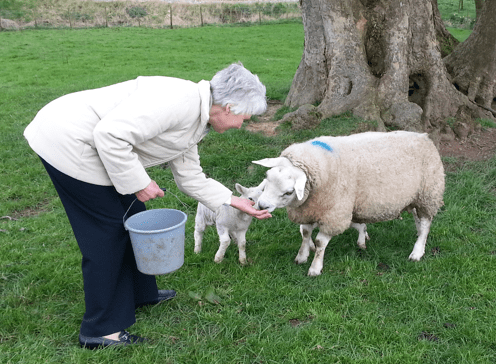
Barbara Butler feeding lambs & sheep.
Whitechapel, Lancashire.
[photo: Mr G]

Seeking the Truth and Grace of God together

Photo from Churches Together in Britain and Ireland

Thoughts during The Week of Prayer for Christian Unity

Last week at a funeral, I met a relative of the girl who had died. It was a Christian funeral but he was a Muslim relative. He was amongst members of the family who came from France but he had been brought up in Algeria.
Despite the language and faith differences we managed to have quite a chat! Inevitably we touched on our differing faiths but soon found level ground when we talked about Abraham, known biblically as the ‘father of the nations’. The Muslim faith together with the Christian and the Jewish faiths all have Abraham in common. We can all trace our roots back to him which is why we sometimes refer to being Abrahamic in origin.
I always enjoy these chance encounters because, if we concentrate on what we hold in common, they are often very enriching. God, Prayer and worship are the bedrock of all our religions.

Later, I thought about the many conversations and dealings I have had with those of other faiths. For example, I support a small charity named, Abraham’s Children in Crisis, which touches the lives of a group of children and young people living in the West Bank of Israel. Most are Muslim but there are no barriers and some are Jewish.
They are supported in their education and medical care by Christians here in Britain.
I know their names; what they look like; how they are struggling and how they support each other. I thought of them often during these troubled times. In a small way I try to share their fragile lives.

Some time ago now I was at a wedding which was a double one – in that it was held first in London at the Cyprian Orthodox Cathedral because the husband was an Orthodox Christian. We then travelled to Kolkata for a Hindu ceremony because Rumi was of the Hindu Faith. Both ceremonies were fascinating and very moving. I was enriched by the experience . One of my special Internet blog friends is KK who is also an Hindu so I feel a sense of closeness to him because of Rumi’s wedding.
Another Rumi has a special place in my life because I am deeply inspired by his poetry. He is the famous 13th century Persian poet and Sufi mystic.Within Christianity I have discovered and engaged with many differing believers in Jesus Christ, whom we claim as our Lord and King.
My own journey of faith began with its roots partly in Roman Catholicism. I was then sent to a Methodist Sunday School and I am now a strong adherent to the Anglican practice of the Christian Faith. Who knows where I’ll end up!

I am pondering these thoughts because this week, followers of Jesus Christ are keeping Christian Unity Week.
Many things have happened throughout our history to divide us and even within particular denominations there is much brokenness and need for repentance but there is, at heart, a God who loves us and cares for us as His children.

It sometimes feels that what gets in the way of Unity – the sense that we are united as all God’s children- is because every church or group seem to think that they alone have the truth.(Bit like some world political leaders just now!)
How false is that!
I think that’s why I love and respect what the former Chief Rabbi, Jonathan Sacks, says that only in heaven is there Truth. On earth there are truths. God is the only real truth and all over the globe people are seeking to answer that profound question of Pilate to Jesus at his trial – what is truth?
Truth on earth, Rabbi Sacks says, is not, nor can it aspire to be, the whole truth. It is limited, not comprehensive; particular, not universal. What propositions conflict is not necessarily because one is true and the other false He suggests that the difference is because we are coming at something from different angles but both are only part of the truth
I believe that we can only look to God for the real answer and anyone who claims to hold THE truth exclusive of others, is bound to be mistaken.  We can only learn truth if we listen to others and share our insights with each other and, of course, listen to God together in prayer.
There is so much to learn and be excited by the story of people’s journey of faith and the joy and encouragement that brings to my own journey. We all have so much to share with each other and so much to discover about God.

There is much in Judaism I admire and there is much in Islam that I respect.  My Hindu hairdresser in the North taught me a lot about prayer in the family.  I love the joyful and convincing hymn-singing and biblical insights of the Methodists.  I like the ritual and devotion of the Roman Catholic Church.  I love the ceremonies of High Anglicanism; the intellectual honesty of Anglican theology; the exuberant praise worship of our evangelical brethren. 
I draw strength from Celtic insights into the sacredness of places and people; I enjoy the simple rhythm of Taizé; I find enrichment in ancient prayer forms like the Labyrinth; I adore the Orthodox Liturgy. 
I am reduced to silence by the witness of monastic places like Bec  in Normandy, where prayer is the breath of the place;
I like the simplicity of worship in a quiet rural church and my heart soars during Anglican Cathedral Evensong. I am loving being spiritually fed by Pope Leo!
I find talking and listening to other believers fascinating. 

And God is in all that and in much, much more.  He is bigger than all our concepts of Him or He would not be God. 
Wide Vision goes with deep exploration. God is always teaching us something new. 
Evelyn Underhill spoke of all our differing expressions of faith as ‘Chapels in the Cathedral of the Holy Spirit’. I like that.

We are all part of the Universal People of God. What gives any church real authenticity is if, in the words of Michael Ramsey, we are filled with the grace-giving presence of Jesus Christ.  Grace-filled churches have no need of labels.  They simply reflect God and so try to live in close friendship with GOD, the  giver of Grace and Truth. 

[Mr G. 2oth January 2026]

Immediately ~ (εὐθύς),

St Mark’s day is normally celebrated on April 25th, except in years when Easter Week takes precedent.
In 2025, therefore, it is kept on April 29th.

One of the key words in the Gospel occurs 42 times in St Mark’s Gospel – the word is  euthus” (εὐθύς), which is translated as ‘immediately’, or ‘straightway’. The use of this word gives the Gospel account a sense of urgency. There is an emphasis on the active and dynamic ministry of Jesus.
My poem ‘euthus’ below is inspired by the word and its meaning.

Euthus – immediately!

Straightway,
he takes up the pen,
dips it in the ink:
words flow onto parchment
at once.

Getting it down immediately
as readers wait:
impatient to hear this story of faith.

We long for phrases
that awaken and challenge the heart;
ideas that lift souls
in search of meaning;
feet, itching for travel,
on our pilgrimage to God,
are now hope-filled.

Eagerly,
we follow way-markers,
constructed not with stones
but with the pen.

Our souls need feeding
and our minds are thirsty for truth.
The parchment lays itself open to the pen,
which breathlessly recounts the story:
the wonderful Good News
that enlivens us.

Straightway,
words take shape:
‘The beginning of the Good News
of Jesus Christ, the Son of God……..’

Mr G
St Mark’s Day, 2025