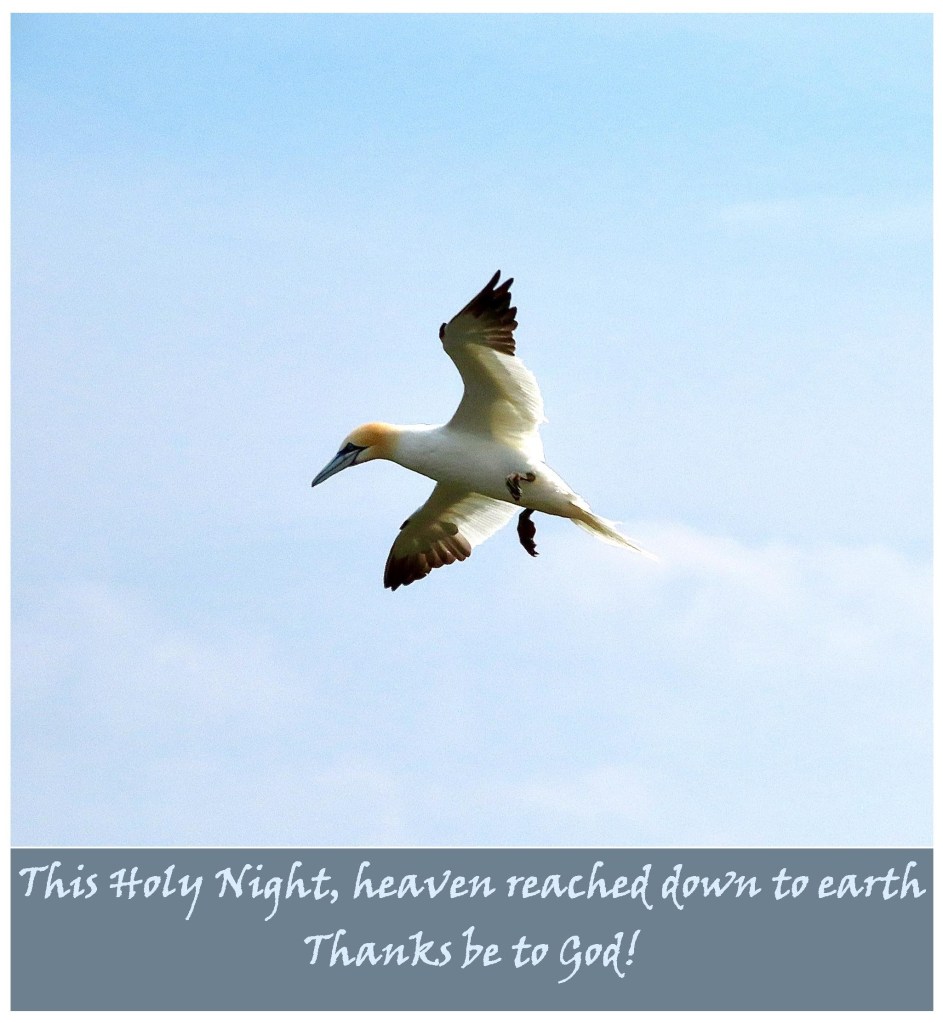
My friend Joyce’s latest photo Tweet takes, as its theme, the soaring flight over the earth which symbolizes the coming of the Christ-Child in the birth of Jesus to Mary and Joseph. Joyce chooses the caption which takes up this theme ; –
This Holy Night heaven reached down to earth.
The stooping down of God to embrace earth and all creation with His saving Love has an echo in those moments in a faith journey where we encounter heaven opening and sense God’s presence so keenly that it takes our breath away and for a time we feel drawn into God’s embrace. These are our thin moments when the membrane that separates earth from heaven is so thin that we could be in either place. As indeed we are, and far more than we realize. God is very near but unless we are still, it is easy to miss Him. A bit like the Whisky Priest in Graham Greene’s novel, The Power and the Glory who “missed happiness by seconds at the appointed place.”
All but a few shepherds and animals missed God’s coming at the appointed place of Bethlehem in the stillness of the Night.. As the writer of the Book of Wisdom in the Old Testament put it in the beautiful words in Chapter 18:
When all things were in quiet silence and the night was in the midst of her swift course, Down from the heavens, from your Royal throne, leapt your all-powerful Word.
Being attentive to God’s coming to us in our lives means watching and hoping with real expectancy that He will indeed Come. And whilst we might not always meet Him at the appointed place, that is not the final moment or place. God is always waiting and creating new thin places of meeting, each Christmas being an absolute certainty of that truth.
For reasons we hardly can fathom, He has this ‘thing’ about touching us with the love and joy pouring constantly from His heart. In Jesus He shows us just what that means.
So with the 17th century Poet, Richard Crawshaw in his poem, In the Holy Nativity of God, let us gratefully say :
Welcome, all wonders in one sight! Eternity shut in a span; Summer in winter, day in night’ Heaven in earth and God in man. Great little one, whose all-embracing birth Lifts earth to heaven Stoops heaven to earth.
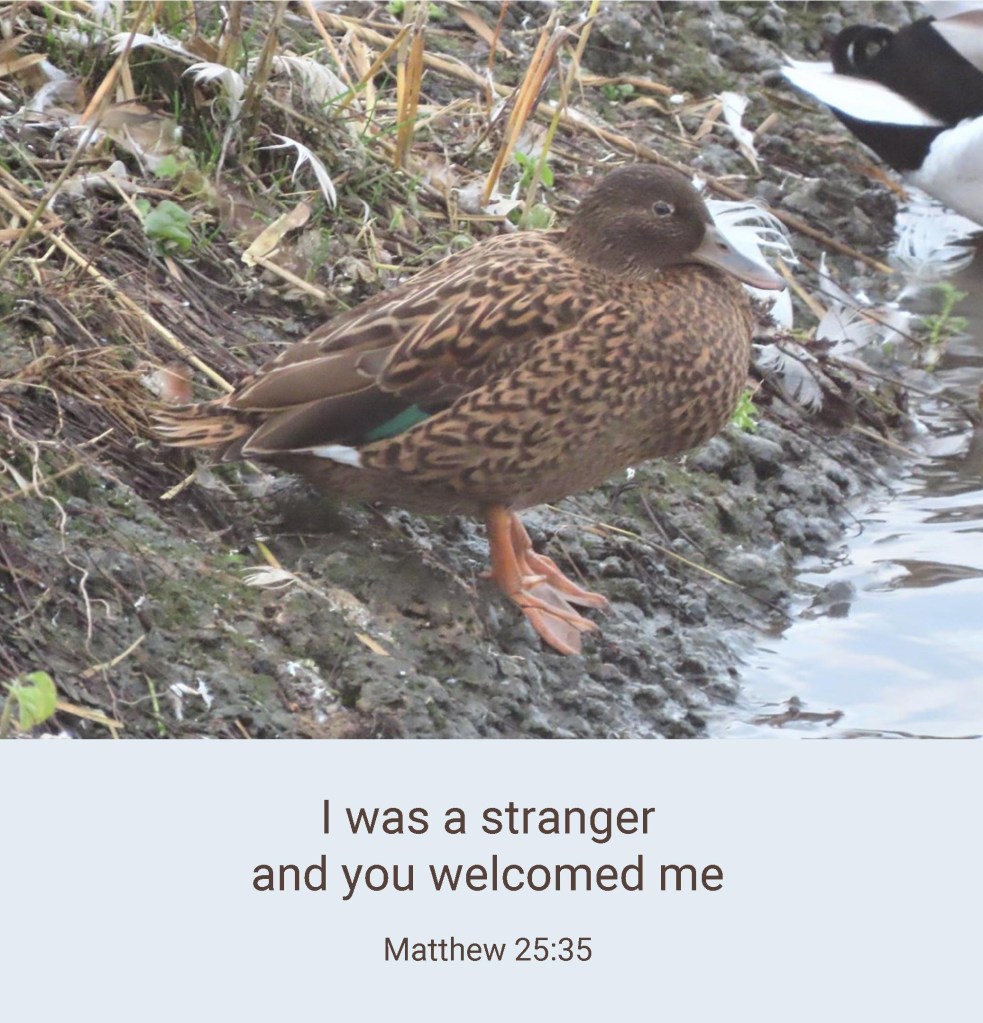
Joyce sent this picture tweet recently. She commented: In spite of being a stranger, this lone Laysan Teal seems to have been accepted by the other waterfowl at Welney nature reserve. It got me thinking about hospitality.
There is an ancient rune or poem about Celtic Hospitality which begins:
I saw a stranger yestere’en: I put food in the eating place, Drink in the drinking place, Music in the listening place.
All this because the guest brings a blessing from God because, as the poem ends:
Often, often, often Goes the Christ in the stranger’s guise.
The idea of seeing Christ Jesus in others, especially in strangers and visitors has its root in early church practice. It was particularly central to the teaching of St. Benedict. St. Benedict wrote a rule for living, for his monks, which has become enshrined in the practice of Benedictine communities and the wider Christian Church ever since. Amongst the things he put into his rule, St. Benedict said this:
All visitors who call are to be welcomed as if they were Christ, for he will one day say: I was a stranger and you took me in (Mt 25).
Benedict then set down how guests should be received and how they should be treated. His teaching has its roots in ancient practice which was as much part of Judaism as it was Christianity. Both are doubtless mindful of what the epistle to the Hebrews calls entertaining angels unawares – without knowing it. (Hb 13:1). There is an echo here in the Old Testament story of Abraham’s hospitality to the three angels at the oak of Mamre in Genesis 18.
Seeing Christ in each other is something which ought to make a huge difference to how we treat each other. St. Benedict in his rule cautions about self-centredness and offers hospitality towards others as an antidote to this.
One of the stories about how we should treat others as if they were Christ is Luke 7: 36-50.It begins with a Pharisee called Simon who seemingly offered hospitality to Jesus. His motives however, were suspect and we quickly see that he had no intention of treating Jesus as the honoured guest. In contrast a woman, who had the notoriety locally of being a sinner, entered the house bearing an alabaster jar, out of which she poured ointment and began to wash Jesus’ feet. It was an act of profound love and honour, though the gathering greeted what she did in the kind of shock-horror which is the hallmark of certain kinds of so-called newspapers today! Surely if he were a prophet, they began to murmur, he would know what kind of woman was touching him! Whatever her sin, theirs was all the greater because they had failed in hospitality. Jewish Law was extremely strict in how the stranger and visitor are to be received. From the time of Abraham onwards, great importance was attached to hospitality. It is described as a sacred obligation. In biblical times, certain customs are attached to it such as providing water for washing the feet, greeting a guest with a kiss on both cheeks, offering olive oil mixed with spices to anoint the hair, all these demonstrated hospitality – loving strangers – in a practical way: which is why Benedict was careful to highlight hospitality in his Rule. Jesus saw Simon’s hospitality as a complete sham and the self-righteous outpouring from his lips condemns him as a bigot whose religious practice is equally bogus. By contrast the woman, says Jesus, has done much more than follow Jewish custom. What she did came straight from her heart. She had, said Jesus, shown great love. She demonstrated true hospitality and Jesus saw beyond what others saw in her. He saw The Spirit at work in her heart.
The final part of this story moves our attention away from the Pharisees towards the woman whom Jesus forgives, grants peace and makes whole. Apart from being shown a lesson in true hospitality we are also reminded that Jesus has an inclusive view of humanity by which all who turn to God are accepted, blessed and made whole. God who makes us in his image and in Jesus Christ restores that image within us, excludes no one from his Gospel net of love. By implication, neither must we. Equally, there is a warning here – if we fail to embrace others with loving hospitality then we condemn ourselves. If we fail to see Christ in others then we are failing in our witness to His Good News of eternal love and salvation. Our welcome of others must be authentic and real and lead to true loving openness as a Christian community. As Benedict reminds us, at the heart of Christian hospitality is the recognition that all are of infinite value to God; all are precious and all are worthy of being treated lovingly.
Sometimes Christianity can appear harsh, judgemental and unloving. It can seem to be exclusive, unyielding and so righteous that it is off-putting. Sometimes we can erect barriers which keep people out if they don’t fit into our own view of how things should be. The trouble with barriers, of course, is that they not only keep people out – they imprison people within. By the way he treats the woman who anointed his feet Jesus makes it quite plain that God’s saving love is available to all and none are excluded. It opens our lives and hearts to a deeper love and joy and acceptance of and by God that should be a great comfort to us.
It certainly seemed to be to the Laysan Teal. Thank you Joyce for sharing.
St John the Baptist, detail. Banner attributed to G F Bodley. Parish of St John the Baptist, Epping. [photograph Mr. G]
A traditional theme on the Third Sunday of Advent is that of St. John the Baptist. His part in the Christmas story began at the Visitation of The Blessed Virgin Mary to Elizabeth. When Mary greeted Elizabeth, St Luke records that the babe in her womb (John) leapt for joy. After a time of preparation in the wilderness, possibly among the desert people known as the Essenes, John obeyed the will of God and left the desert to fulfill his part in the story of Jesus. Calling the people to repentance he prepared them for the Christ, who is Jesus. His own followers were to leave him when Jesus began his ministry of loving salvation . His own story was to end in his death at the hands of King Herod. His legacy was that he would for all eternity be known as the ‘forerunner’, the one who pointed people to Jesus and who fulfilled the prophecy of who Jesus is and what he does. The ‘last’ of the prophets he was the proto-disciple, the herald of the Good News. Orthodox Christians give him a much warmer title. He is thefriend of the Bridegroom. It is to this deep and joyful friendship that we are called. Like John we are encouraged to point away from self and towards God. The more people turn their lives to God and away from self-centredness, the better our world will be. John the Baptist gives us the words to live by: I must decrease and He (Jesus) must increase.
My friend, Joyce, has produced a book of Reflections for Advent to Epiphany. This is her reflection for December 9th.
He himself was not the light, but he came to testify to the light.
John the Baptist, not the Light, but pointing to the Light. Pointing away from himself, to the one to come.
John the Baptist, a faithful witness, showing the way, in spite of the cost.
John the Baptist, a wild man for Christ, pushing the boundaries beyond convention.
John the Baptist, searching for the truth, speaking the truth to power, dying for the truth.
God our Father, thank you for the faithful witness of your servant John. Help us to reflect your light, so that we too, may bear faithful witness to you.
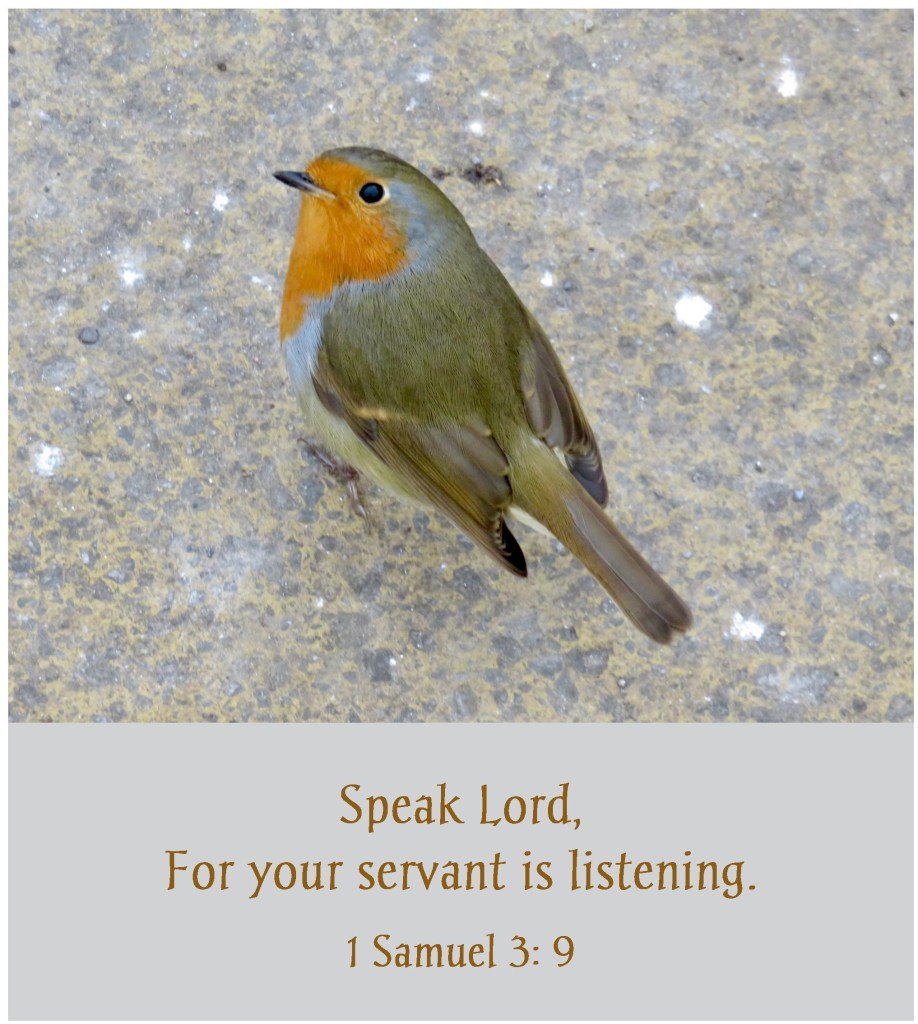
My friend Joyce has sent a new Picture Tweet. This is what she says
Dear Friends,
Amidst all the different noises at this time of year, I often find it difficult to hear God’s voice, but this little robin showed me what it was like to just be still and listen for a few minutes before he flew away.
With my love and prayers, Joyce.
Here’s a short reflection from Simon Tugwell OP
Be Still and know that I am God enter into the chamber of your heart.
There is the Kingdom of God. in the utter stillness within. From that depth comes human joy; human love; human activity. Relax into the assurance of His love, His care.

 Mr G's Ponderings