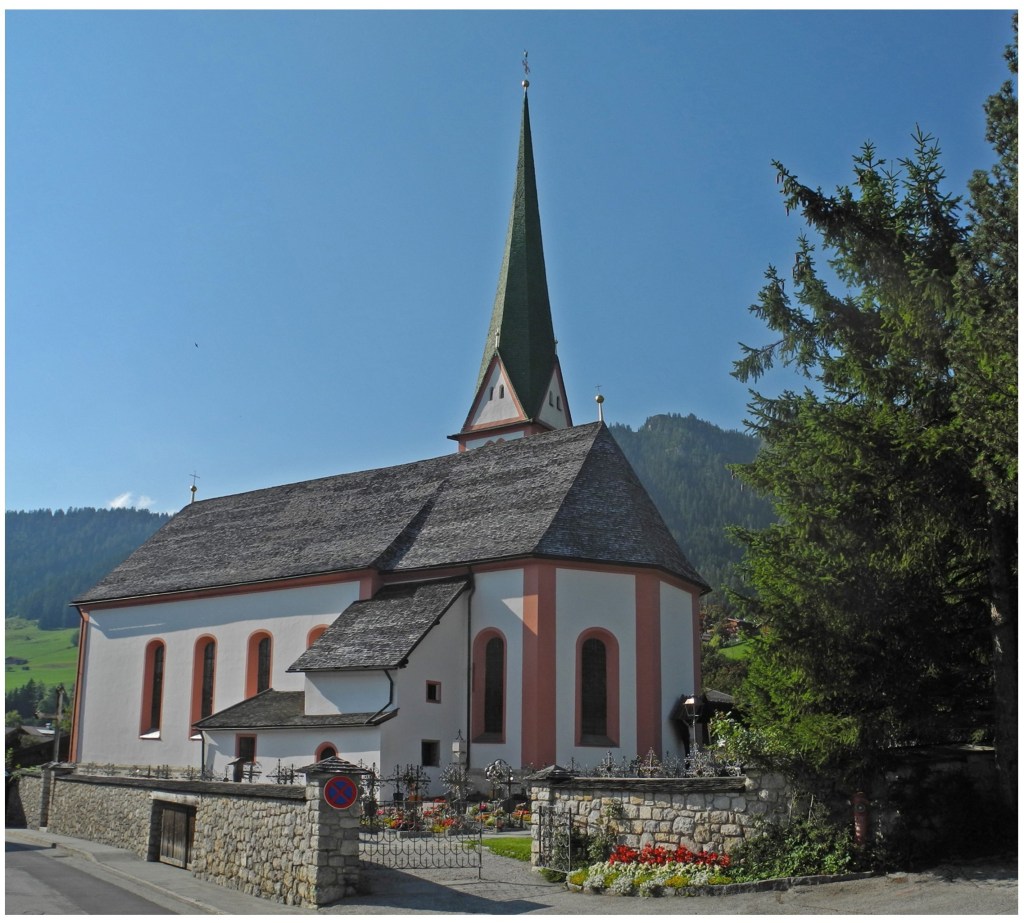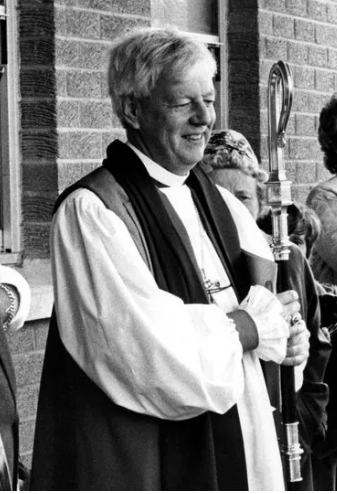
When Bishop David Jenkins was Bishop of Durham, he often spent his summer holiday leading tours to Christian places. On one such occasion he found himself at a place in Western Austria, the mountain village of Alfbach. He visited the church and, to his surprise he found that it was dedicated to St. Oswald of Northumbria. His own Cathedral in Durham was the place where some physical remains of St. Oswald rested alongside Saint Cuthbert. David Jenkins fell to wondering why this Austrian Church had this dedication to a saint in faraway Northumberland. He found a tourist leaflet which said that in the 7th and 8th centuries Christianity was brought to the region by Irish and Northumbrian monks. The bishop’s journey to the village had been in an air-conditioned coach but it had still been a difficult journey along narrow mountain roads. How much more difficult must it have been for those monks who had travelled through darkest Europe to bring the Gospel to that place. The bishop could only imagine what it must have been like and what hardships they endured.
More importantly, why did they bother? The Bishop asked himself that question and this is the answer he came up with: They had discovered in Jesus, that God loved them so they fell in love with God. As a result they wanted to share that love with others.
That was what took them through Europe at a time when the flame of Christianity was burning dim—and their mission—to spread the Good News of God’s love renewed the faith of Europe and took the Gospel to new places.
In an age when, for the majority of people, the Christian light burns dimly —God continues to love us so much that we too might fall back in love with Him—and when we do, like those monks, we will want to tell others. A way of describing mission. That’s a good thought for Lent.
They come; those Viking spirits on the lapping ancestral waves of memory and myth. They conquer hearts for the day, proclaiming a time for turning. Torchlight gives way to flame, which turns to fire, transforming heat with real warmth, licking upwards, giving light. flickering sign of a turning world looking forward now to lengthening days as Lent, the Springtime of the year, draws us forward with new expectation.
[Mr G]
This poem is inspired by the annual festival of Up Helly Aa, held at Lerwick on Shetland , each year on the final Tuesday of January. It marks the end of the Yule, or Christmas, season which was kept, under the old Julian Calendar at this period of the year. According to an article in Wikipedia, Up Helly Aa means, literally Holy Day. The Festival draws from the link between the Shetland Islands and Norway of which it used to be a part. So it centres on a replica of a Viking Longship. It is ‘crewed’ by locals dressed as Vikings knows as Guizer Jarls (pr. Yarl) with a head Guizer presumably as warrior captain. Each Guizer is dressed in a figure from Norse legend. This year for the very first time, these include women and girls, though a few have slipped in many years ago disguised by costume! After a day of festivity, as night falls, the replica Longship is dragged through the streets of the town in a procession led by torchbearers. The Longboat is circled by the torchbearers who then sing a traditional song associated with the Festival. They then cast their burning torches into the ship which lights up the night with fire. Once the ship is just embers, another song is sung and then it’s party time as the people sing and dance the night away.
The following day is a holiday or ‘hangover’ day!
The Festival marks a transition from Winter Festival towards the season of Lent. In Christian terms this is also a turning point as we begin to prepare for the Passion, death and Resurrection of Jesus at Eostre, Easter. Lent itself is Old English for Spring. It is a time of growth as the earth gives birth to new growth. This growth is both spiritual as well as physical. It carries new hope and new expectation for each of us and for our world. And don’t we need it!
[There are a number of informative and entertaining sites about Up Helly Aa on the web. The photo is from one of the official sources]
In the past, the days before Lent were used to eat up all the food in the house which were traditionally ‘banned’ during the period of Fasting. It was the period of ‘Carnival’ (Carnivale) which is still popular in parts of Southern Europe. One of the most popular being in Venice with its parades and fancy dress and general merriment. ‘Carnivale’ means, literally, ‘farewell to meat’ – a reminder that in Lent meat was not eaten. The Monday before Ash Wednesday is known as Collop Monday because on this day, any meat remaining in the house was fried into collops (like a medallion) and eaten. A traditional recipe involves bacon collops with eggs. Then on the day before Lent, Shrove Tuesday, the remaining eggs were used to produce pancakes (a tradition still extremely popular). Like meat, eggs were forbidden in Lent. Shrove Tuesday has all sorts of customs attached to it as a result.
When I lived in the countryside in a place called Whitechapel in North Lancashire, the children were given a half day holiday to go round the village calling at the farms and homes. They asked politely, please, a pancake!’ I think in the past they received just that but eventually people opted for easier, and more healthy, food. They were each given an orange. No doubt a lot of juice was made that day!
Shrove Tuesday was also the day when people confessed their sins and made themselves ready for the Lenten Fast. The word ‘Shrove’ comes from ‘shriven’ meaning ‘to confess and receive God’s absolution/ forgiveness’.
Nowadays some of the festivity continues but the meaning behind it is lost. Lent is no longer a time for absolute fasting though many ‘give up’ things like chocolate or alcohol. (Sometimes the motive for this abstinence is to do with losing weight for the summer!). Fasting is a good spiritual discipline for all sorts of reasons. It is meant to train the body so that the soul is free to communicate more closely with God; it is a reminder of our Jesus’s desert time when, after fasting he was tempted by the devil and resisted—and we are called to resist the temptations that beset us. Going without food of any kind and perhaps eating more simply at all times helps us to identify with so many in the world who are suffering from malnutrition—people we can help if we give the money saved by avoiding luxury foods to Third World charities and, increasingly, local Food Banks.
More than anything, fasting is also about giving up earthly things in order to concentrate on heavenly ones. A proper Fast is accompanied by a deeper praying. In our modern world we could give up things other than food—such as watching less television—and using the time saved to read a spiritual book. A negative should always be accompanied by a positive. Lent can be a time to ‘take on’ something as well as ‘give up.’ Lent is a positive time. Lent is not a time of gloom but as the word itself means—a spring time for spiritual growth. An exciting time of opportunity to spend more time with God.
For all of us, whether we are religious or not, there is a lot of value of giving something up that would improve our inner being. I remember that, some years ago, the Vicar on the Radio Programme, The Archers, suggested that people should give up gossiping about others. Negative and disparaging comments don’t really affect those about whom they are made unless they hear them. They do, however, destroy the character of the people who participate in such gossip.
Here’s a story.
A certain monk couldn’t wait to tell his abbot the rumour he had heard in the market place. “Wait a minute”, said the abbot, “what you plan to tell us – is it true?” “I don’t think it is.” “Is it useful?” “No, it isn’t” “Is it funny?” “No.” “Then why should we be hearing it?”
The Vicar of Ambridge finished his sermon on a positive note. He encouraged his parishioners, and, by extension, us, to do random acts of kindness. We live in a world which many think is cruel and unkind but there are so many acts of goodness happening all the time. They don’t get reported in the media but we all know that they happen and I dare say most, if not all, of us do them. Our world would be a much better place if our random actsof kindness become even more frequent.
Icon of the Transfiguration written by Sister Irène of the Convent at Bec-Hellouin, Normandy. Photograph arranged by Piers Northam.
The Gospel used by the Church of England on the Sunday before Lent is that of the Transfiguration. (Luke 9: 28-36) An unusual choice perhaps but it has a message to tell us as we enter, once again, the Lenten season.
One of the most treasured things I have is an Icon of the Transfiguration (see above). It was painted/written by Sister Irène of the Convent at Bec-Hellouin, in Normandy. Sister Irène wrote (or painted) two versions. One is in the Chapel of the Transfiguration in the Parish Church of St. John the Baptist, Epping. It was commissioned specially for the new Chapel. The second is in the library in my home. It was written in memory of parents.
Over the centuries there have been many attempts by artists and Icon writers to capture the moment when Jesus is Transfigured – bathed in glory –on the Mountain. Quite naturally the primary subject matter of these paintings & icons is Jesus bathed in beatific and glorious light. It is to this that our eyes are drawn but also we take note of the other five figures, not least the favoured disciples, Peter, James & John, usually at the foot of the painting, often in a state of enraptured prayer. In Sister Irène’s Icon there is a sense of awesomeness and of being overcome by the dazzling beauty of it all.
We are led by the Gospel writers to see this scene with the eyes of those disciples and certainly through their witness. Whilst the effect on the disciples is present in Sister Irène’s Icon there is something else that attracts me to it and it is something unusual. It concerns the figure of Elijah. Traditionally the two representatives of the Old Testament, Moses and Elijah are shown as revered, wise and elderly men. Moses represents the theme of deliverance which threads its way through the Old Testament and, Elijah the prophetic strand which points to a deliverer usually called a Messiah who will free the people of Israel from whatever yoke holds them back from true love and service of God. Sometimes this is the behaviour of their leaders – those Kings who did wicked, even demonic, things about whom we hear so much in the Scriptures – or it is about correcting and judging of sin which led to the people being variously exiled or driven back into slavery until they mended their ways. By placing these two figures on either side of the figure of Jesus at the moment of his glorification we get a Triptych but always with the two figures pointing away from self towards the Christ in the middle. This is because Jesus fulfils the hope and promise of deliverance – of freedom – of transformation of a community who, wayward and rebellious, nevertheless are claimed by God as his own.
So in the Icon both Moses and Elijah are pointing their hand towards Jesus. See, they are saying, this is one whom God has sent to free you and love you into his Kingdom. Because Jesus is Transfigured then we, looking at him and making him the centre of our lives, can be Transformed too.
Sister Irène gives us a clue, I believe, not in the transformation of the disciples – that is yet to come when they understand better what has happened on this Mountain – not in them, but in Elijah. He is almost always, as I say, painted as an old and venerable man whose wisdom came through a life that was often harsh, incredibly lonely and more often misunderstood but who, through experiencing God closely, becomes the great Prophet, calling people back to a life with God. In this Icon, however, Elijah is painted as a young man. At Bec we were shown a number of possible representations but it was this which excited me most. A young Elijah symbolised for me something essential about the Transfiguration – that it is about being Transformed by the glory and love of God in such a way that we are utterly changed.
Elijah as a young man is on the face of it a physical thing but spiritually it can be seen as a Transformation from within. The more we see the glory and love of God as something that frees us, forgives us, redeems us and opens for us a new way of life, so our soul fizzes with new energy, new life – a life energized by God. This opens us to new possibilities, new adventures of faith and a renewed way of being true disciples.
Luke’s version of the Transfiguration tells us that while Jesus was praying, the appearance of his face changed. And it was this change that I see startlingly portrayed in Elijah and with that a realization that this is at the heart of our relationship with Jesus. We are called to be people of change- people who are renewed by our encounter and subsequent life with, in and through Jesus Christ. People who are unafraid to grow, indeed who long to grow and become more deeply involved the Christian adventure. This change comes about when we turn our lives around towards the beauty of God, which as St. Paul tells us shines in our hearts and gives the light of the knowledge of the glory of God, in the face of Jesus Christ.
This is the message of the Transfiguration and it is personalized by that rather beautiful phrase, shines in our hearts. God penetrates our hearts with light – with knowledge that in Jesus we can all be changed, transformed. We can be renewed, rejuvenated, made youthful again, because in the trials of life in this world with its pressures and relentless claims on our energy, especially at this time, this affects our spiritual centre which gets a bit askew. We become weary, dispirited, disorientated Which, of course, is why Lent is such a Godsend.
It is a time to refresh our souls, to learn afresh about the mighty acts of God in Jesus Christ, about disciplining our lives through prayer and fasting and centring ourselves on God again. It’s about encouraging new growth in the Spirit. And new hope. No wonder a writer of the Orthodox Church calls this a season of the springtime of the soul. The spiritual writer Thomas Hopko quotes a phrase from the Orthodox Lenten Liturgy which begins : The Lenten spring shines forth,The flower of repentance He goes on to say: The Church welcomes the Lenten spring with a spirit of exultation. She greets the time of repentance with the expectancy and enthusiasm of a child entering a new and exciting experience. The tone …is one of brightness and light.
Lent is not about doom and gloom and grovelling – it is a time of rebirth renewal. It is an enthusiastic turning of our lives back to God and therefore a time of rejoicing. We are bidden to put a new spring in our step and let the glory and love of God, shining not only from the face but also the heart of Jesus, burn away from our lives all that is not of God and replace it with a re-centring on God which is what repentance really means.
So as we approach the Lenten Journey we are given a glimpse of glory. Lent is a time of real Transformation and of being glorified as we are held in the beautiful glorious, totally stupendous Vision of Jesus on the Holy Mountain and so becoming filled with a longing to be there with Him. We are invited to be transformed through a response to God’s Glory which begins with thankfulness. Thanksgiving is such an important part of our response to what God is doing for us in Jesus Christ, in our community and personal life. We give thanks in small and big ways.
It would be a good thing to use Lent as a time when we repent of negativity and concentrate instead on the positive things which are happening, from deeper care and kindness towards each other to the many opportunities we have to think and pray about what matters in our lives. Not least, the many and varied signs in which God loves us. The call to return to God is a big sign of God’s love but so is the call to make life better for others through what might be called random acts of kindness. When the story of this pandemic is told, it will include so much about how, with God holding us, we have not only transformed our neighbourhoods through such acts of kindness, but also discovered the transfiguration of what is important in our being human, true humanity shot through with God’s glory. Add to that the inspiration of service from carers, NHS workers, doctors and amazing people like Captain Sir Tom. Ordinary people who by simply showing goodness, determination, care and kindness. People like you!
The message of the Icon of the Transfiguration is to show us what ordinary lives, blessed by God, can be and how we can all be transformed, transfigured, when we live close to God in Jesus Christ.