Tarn Hows photographed at the eve of Candlemass/Imbolc by Gill Henwood.
The photo speaks its own message. Very still, chilly breeze, birds singing for Imbolc/Candlemas ….But fallen giant conifer trees from the storms are on slopes exposed and waterlogged ground. After the storms, the birds sing of hope, for Spring, new life, another season to grow. Bittersweet calm, but the low sun rising is warming the cold wet land and her creatures. [Gill]
February tiptoes across a winter landscape, luring us away, from cold depression of dark, dank January.
Weak, shy strengthening Sun, practices dazzling us with brightness; whispering promises of hope about Spring beyond.
Ah! What trembling beauty lays a carpet of expectant joy!
The festival day of St Brigid (also known as Brigit, Bride, Brighid, amongst others) is an important day in Ireland because with St Patrick and St Columba, she is regarded as one of the Patron Saints of that fair isle!
She was born in the mid 6th century (about 451) and died in 525AD. Her father was a pagan chieftain at Leinster and her mother was a Christian. It is said that her mother was born in Portugal and her arrival in Ireland was as a result of Irish pirates who kidnapped her to work as a slave. There is a similarity here with the story of how Patrick came to Ireland.
She was probably influenced in developing her Christian faith from her mother but it is also said of her that she was influenced by the preaching of St Patrick. Despite strong opposition from her father she became a nun and soon established a reputation for compassionate care of the sick and those in need. She became head (Abbess) of her convent at Kildare which, following an Irish tradition was known as a double monastery in that both women and men shared a common vocation and life together. Brigid was head of both. When the Irish Christian influence spread to Northumbria, this practice was introduced there by the Saintly Abbess Hilda first at Hartlepool and then at Whitby.
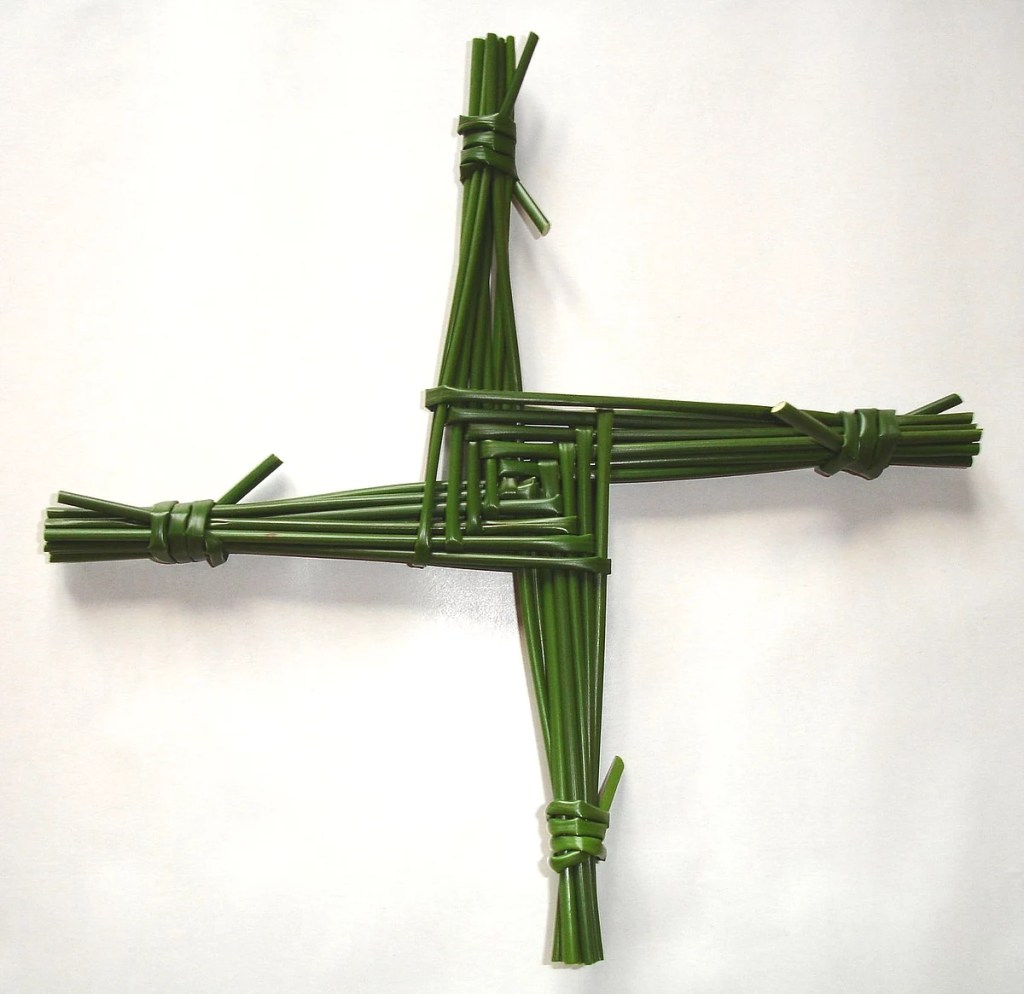
As with many of the early saints, legends and stories became linked to them and Brigid was no exception. One particular story is certainly true and it provided the Church in Ireland with a link between Christmas and Easter. It comes in the form of what is now called St. Brigid’s Cross, a picture of which heads this article.
It’s a rather lovely story. A pagan chieftain from the neighbourhood of Kildare lay dying. Christians in his household sent for Brigid to talk to him about Christ. When she arrived the chieftain was raving. As it was impossible to instruct this delirious man, hopes for his conversion seemed doubtful. Brigid sat down at his bedside and began consoling him. As was customary, the dirt floor was strewn with rushes both for warmth and cleanliness. Brigid stooped down and started to weave them into a cross, fastening the points together. The sick man asked what she was doing. She began to explain the cross, and as she talked his delirium quieted and he questioned her with growing interest. Through her weaving, he became a Christian and was baptized just before he died. Since then the cross of rushes has been venerated in Ireland. There are, of course, several versions. This one can be found on the website for St. Brigid’s School in Glasnevin in Dublin and gives a rich description of her background and life.
Christianity is often a faith of paradoxes and none more so than the connection of birth with death. At Candlemass, February 2nd, we complete our Christmas celebration of Christ the Light and then begin our journey towards Holy Week and Jesus’s death on the Cross. Yet there is nothing strange in this. Christ’s victory over the human heart and the darkness which so often besets our lives begins in the Christmas event but needs Calvary to complete it. There Christ’s love shone from the Cross as it had from the Manger and in the light of that love we can claim our place in God’s heart. Brigid’s cross, woven from simple straw became a sign of healing and of life. The straw of the Manger and the Wood of the Cross woven together are symbols of this healing and salvation linked to God’s Saving Love.
Another story connected with St. Brigid is without doubt highly popular in Ireland. It may be viewed as Ireland’s own version of Jesus’s miracle at Cana,
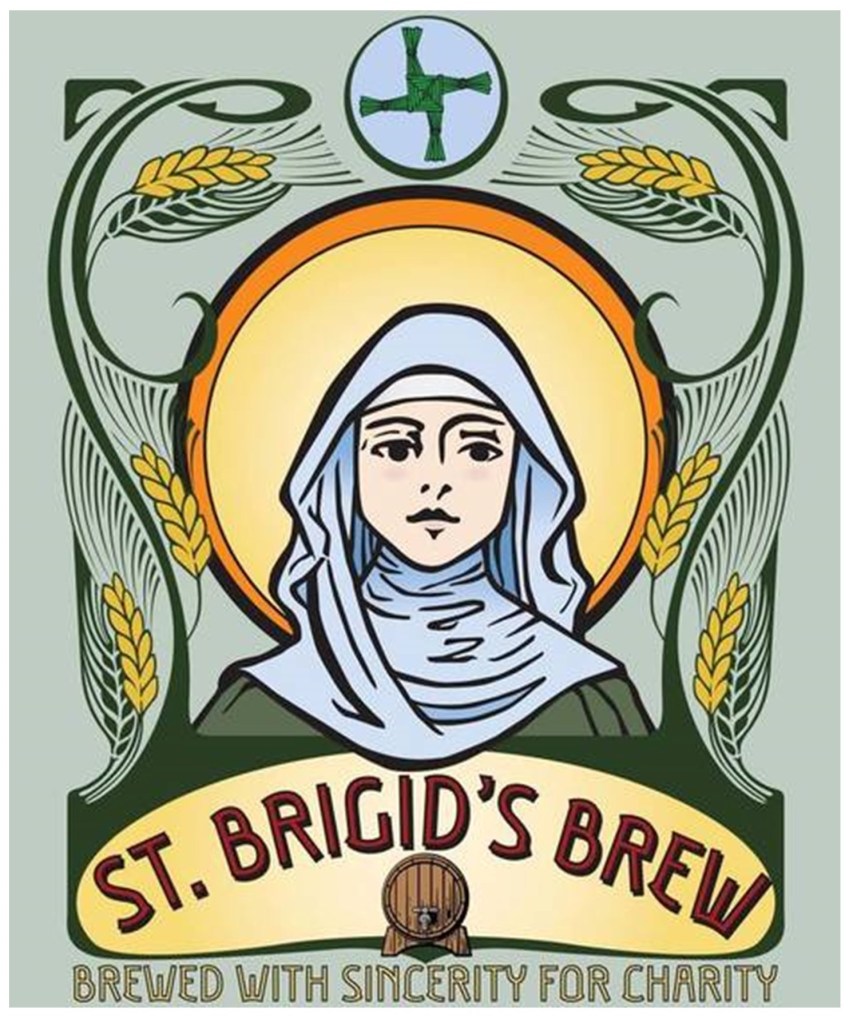
One day, while working in a leper colony, Brigid discovered to her horror that they had run out of beer. It’s important to understand that in those times, centuries ago, beer was consumed on a daily basis as a source of hydration and nourishment. Back in those times many of the water sources close to villages and towns were often polluted to the point where consumption would likely result in illness or, worse still, death. Alcohol offered an (almost) germ free alternative. So, to be faced with a beer drought was nothing short of disastrous. Brigid knew exactly what to do. She asked God for help and He answered her prayer. The bathwater was miraculously turned into beer and not just any beer, but a genuinely brilliant beer that was enjoyed by one and all!
Obviously this secured her reputation, not least because she was fond of beer herself! Lest it be thought she acted as much out of self-interest as well as those in need, she is thought to have written a prayer/ poem about giving God his Divine Share! The version we have here is from the 10th Century and some doubt that she wrote it but it’s always unwise to doubt a Saint, especially a lady one!
St. Brigid’s Prayer
(Poem attributed to St. Brigid herself)
I’d like to give a lake of beer to God. I’d love the heavenly Host to be tippling there For all eternity. I’d love the men of Heaven to live with me, To dance and sing. If they wanted, I’d put at their disposal Vats of suffering. White cups of love I’d give them With a heart and a half; Sweet pitchers of mercy I’d offer To everyone. I’d make Heaven a cheerful spot Because the happy heart is true. I’d make all contented for their own sake. I’d like Jesus to love me too. I’d like the people of heaven to gather From all the parishes around. I’d give a special welcome to the women, The three Marys of great renown. I’d sit with the men, the women and God There by the lake of beer. We’d be drinking good health forever And every drop would be a prayer.
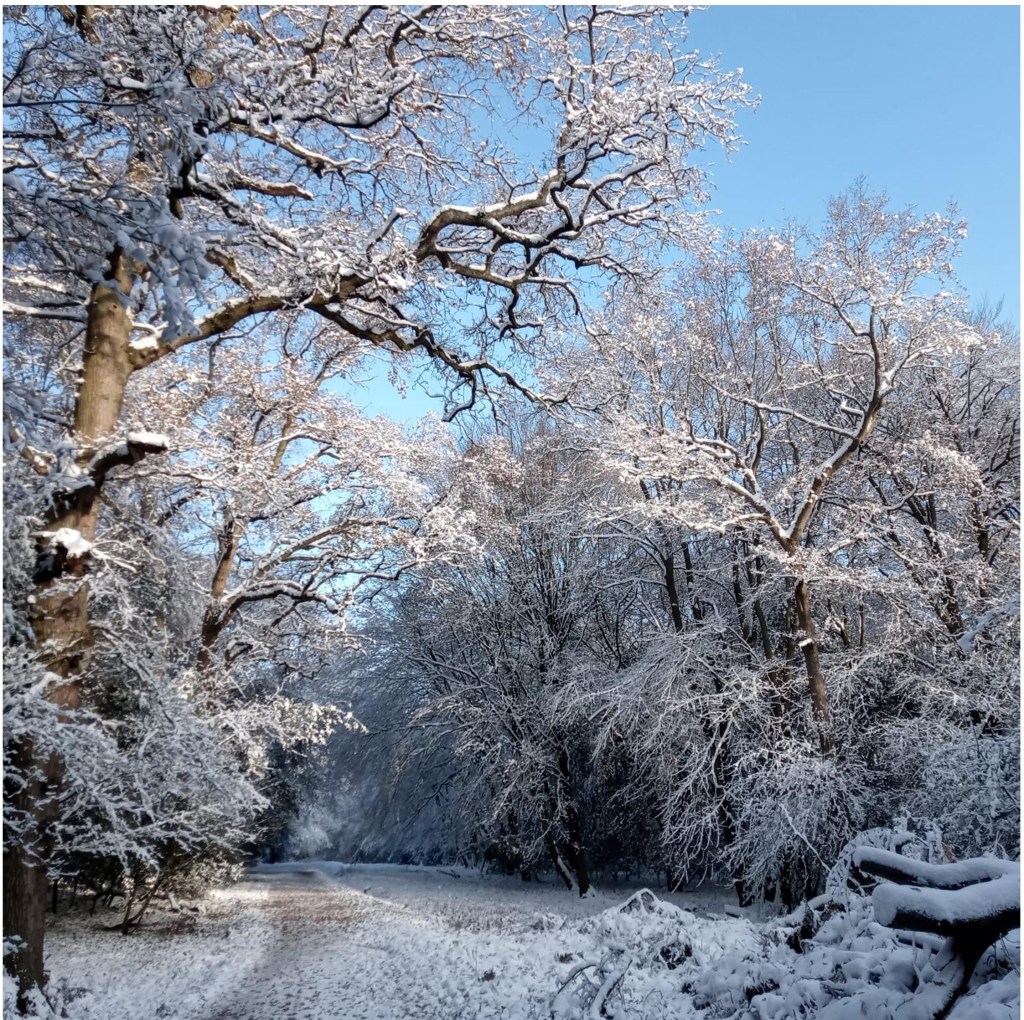
Winter Scene, Epping Forest. Photo by my friend, Shanne Woodhouse.
SOUL-WARMING
This headline, in the Guardian newspaper last week, caught my eye. It appeared on a day which was markedly cold and at a time of year when the weather in the UK included floods, ice, snow, bitter winds and all those elements which would encourage humans to join the animal kingdom in hibernation. (if only!)
It was also a time when yet more headlines drew our attention to a time when the darkness of humanity seems to be at its deepest. The Middle East is a tinder box of conflict; Ukrainian people are struggling against an evil foe, and bitterness in politics all over the Globe add to our woes. Even the Planet is angry with us. Earthquakes, Tsunamis, Volcanic eruptions, famine would, in earlier Biblical times have been attributed to an angry God (or earlier, gods).
So, the headline, ‘Soul-Warming’, grabbed my attention. The sub text gave a clue. ‘the mystery man who chops wood to keep his neighbours from freezing.’
The article told a story by an American journalist, David Wallis, about a Woodsman in upstate New York who, in the midst of a harsh winter, went about quietly easing the suffering of others. The man had once been involved as a director, writer and producer of films and TV programmes but has now given that up to help his struggling neighbours, especially the elderly trying to cope with freezing weather conditions. He believes firmly that heat in winter is a human right but in a part of America where many are wealthy there are equally those who are poor and really suffering.
So, the woodsman has been quietly doing something about this over the past few years. His mother was suffering from Cancer and later Covid, so he moved to look after her. He stocked a stand outside her home with bundles of wood which people could buy to fuel their fires. The proceeds were donated to local charities. Over time, the Woodsman noticed that bundles of wood vanished. He was sad that people were stealing. After a conversation with a friend, he thought of putting up a sign outside inviting people who needed wood but couldn’t afford it, to let him know and he would deliver some.
This led to a free firewood programme. Alongside two local Librarians, who knew about people living in reduced circumstances, he joined forces with them in supplying wood to people in need. He drew upon financial support from those in his former career as things developed. For him, it all really began to take off when one of the librarians called for his help. There had been a power cut and an old couple had burned their last stick of wood, could he help? Within hours, the Woodsman came to the rescue and went to their home. When he arrived, he found them huddled under a blanket with the fire long gone out. They were freezing cold. He brought wood and lit a fire for them. He continued to keep them supplied until power was restored. The journalist, David Wallis, called it a Soul-Warming action.
After that beginning, things just grew. The number of those he helped each winter were, he thought, a sign of increasing economic struggle. He not only supplies wood for them but also acts as one who listens and cares. He says that what he is doing is a ‘cheap form of therapy’ ~ for himself. “I’m sort of a quiet guy. Giving away wood does draw me out, pushes me out. When you interact with people, and I listen a lot, you do learn their stories. And I’m moved by every one of them.”
He meets real, genuine people, who are not only suffering from poverty but also need people to touch their lives and souls. Some are ill and need compassion and care. Often, they just need someone to talk to. Life hits them hard, trips them up, and they need someone who treats them not as a case to be helped but as a human being who needs a friend. In his own quiet pragmatic and determined way he is being just such a friend.
We often think of a Soul Friend, as a kind of Spiritual Director, and of Saints who show us holiness. Yet the Woodsman is being a Soul Friend to the people he helps. There is both a physical and spiritual friendship and it is often hard to see where one ends and the other begins. St Aelred of Rievaulx speaking of Martha & Mary drew on the distinction between Mary who sat at Jesus’s feet and listened to him and Martha who rushed around preparing a meal for him. Aelred made the point that both needed each other. Who would listen to Jesus if Mary didn’t sit with him and how would he be fed if Martha didn’t do it. It seems to me that that the Woodsman in this story did both.
As he said, anyone can do something – right?
In times such as now, I need stories like this because they warm my soul too.
The Daily Reflections on Scripture Readings by the Church of England over the past 2 days have been based on the Book of Genesis, Chapter One. This inspired me to think of it as a Love Poem from God.
Father God,
Your poem spoke creation into being telling us of our origins, our companions, the light and darkness of our existence, the moments of our being; your gift, which is the earth.
You appoint us custodians of all that you have made and go on making, stamping your image on us and all that we receive; showing us how good it is.
Help us to hear your poem and fulfill its meaning of who and where and what we are, of all that you have given us to cherish ~ a poem spoken out of pure love.


 Mr G's Ponderings