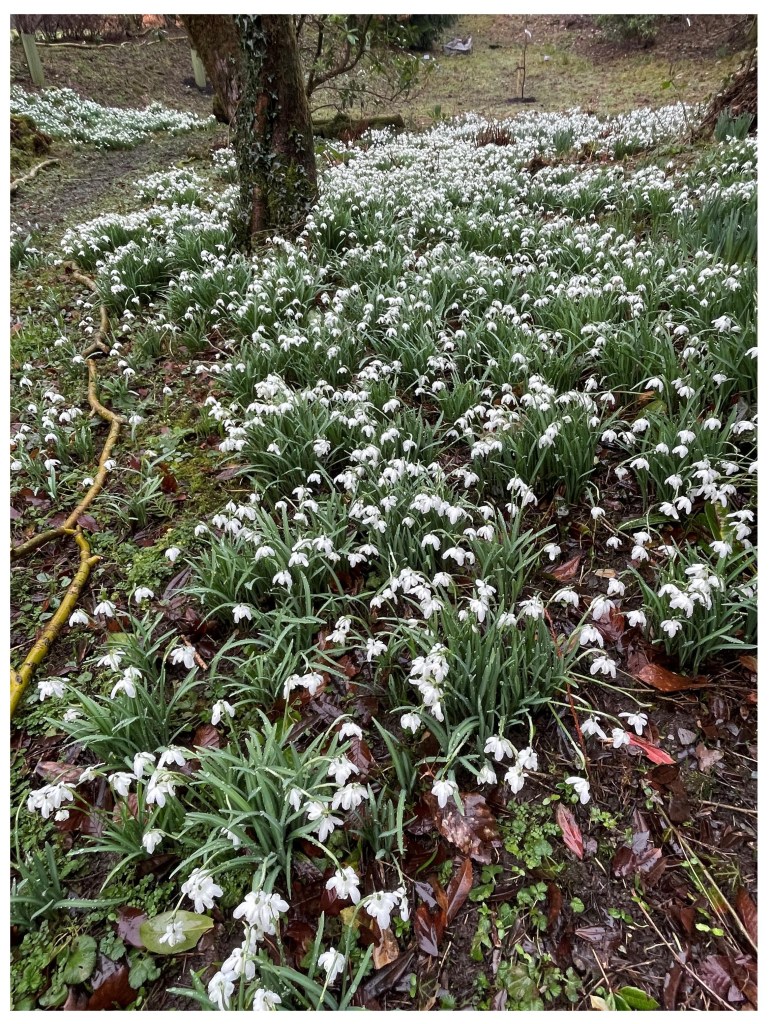
Snowdrop carpet photographed by my friend, Gill Henwood
Lakeland carpet thoughts :
Seven years on… the old snowdrops have drifted for a hundred years or more. Now cleared of overgrowth (though brambles will keep growing due to the seeds in the ground), they are a dancing carpet – here in the gentle February rain.
The sticks mark an edge so we don’t tread on the shoots…
In the dell meadow beyond, we’ve planted a black walnut tree and a hornbeam, both native. The grass is full of old wood anemones running through it (creeping a little further each year, now they have some light).
Joy in wet mid February!
Gill.
February tiptoes across a winter landscape, dressed in white array, luring us away from cold depression of dark, dank January, with dazzling brightness; promising the hope of Spring beyond.
Ah! What trembling beauty lays a carpet of expectant joy!
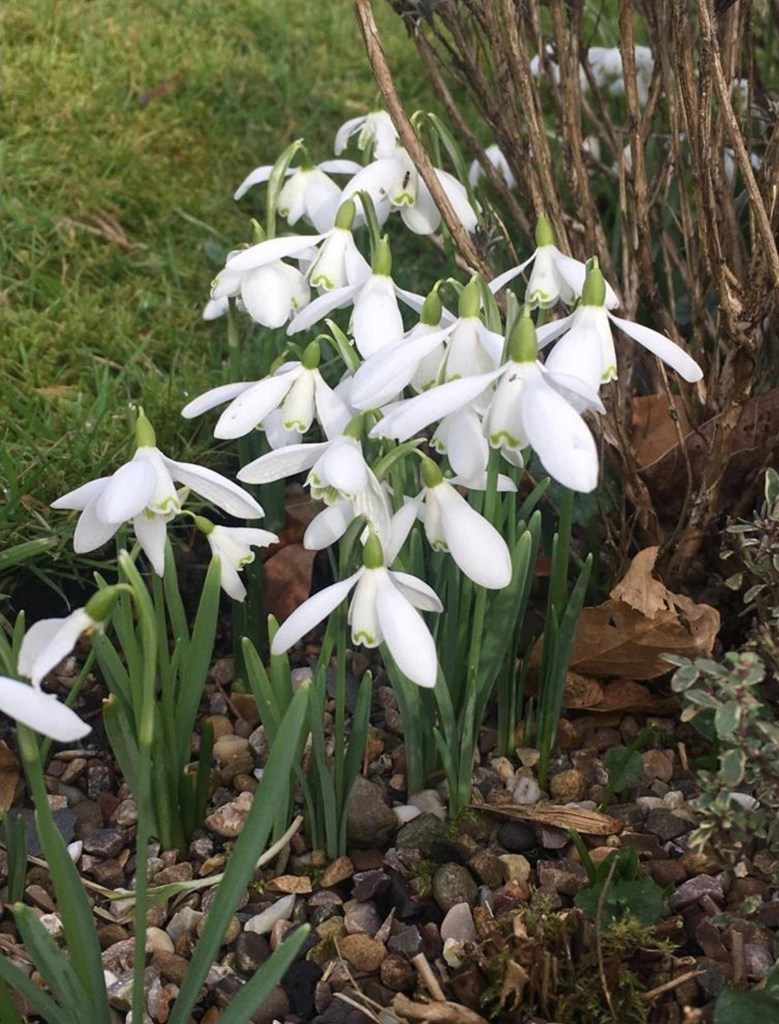
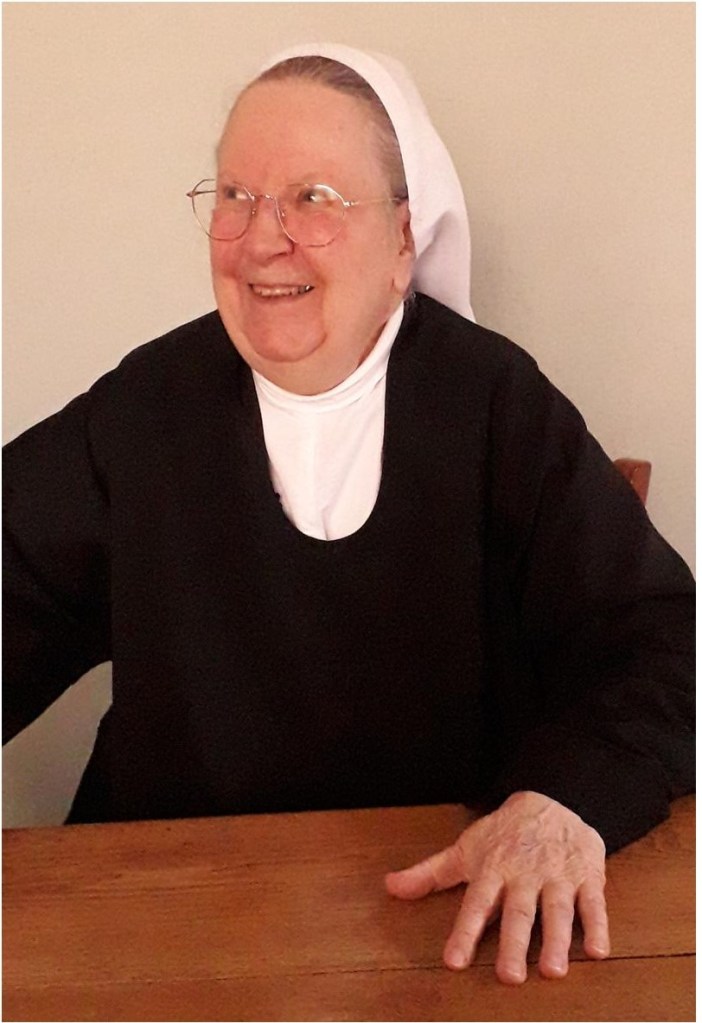
Photo from the Convent at Le Bec taken by the Sisters.
At the Weekend, I posted a blog item about Sister Irène-Marie, a beautiful nun and iconographer. She was a member of the community at the Monastère Sainte Françoise Romaine, Le Bec Hellouine, Normandy. You can read more about her if you scroll back two blog entries.
Her funeral is today, Thursday 9th, at the Convent and I just wanted to mark the entry into heaven of a dear friend. So I have written the following poem.
Dear Sister Irène-Marie, bearer of Peace, held in the love of Mary, you brought a singular joy into our lives. We met you and sensed your nearness to God. We were enraptured by your sacramental eyes which mirrored the Divine.
Extending monastic hospitium , you encircled us with welcome, embracing our need with thoughtfulness and gentle love, which was kept warm within the folds of your habit.
Your listening expressed concern for a broken world from which you could draw a reservoir of experience. No hidden cell housed you. The lives of others glazed your windows and held open the door from which rays of love shone.
Most of all, you ‘wrote’ visible signs of God’s Presence in Jesus and the Saints. You dipped your brush and pen in the palette and inkwell of God. From the depth of your prayerful iconography you led us into the heart of faith which has led you now into the bosom of your Saviour, for as you said, that is what you, (and we,) “are here for.”
Thank you for opening and sharing the images of your faith with us. By you we have been truly blessed.
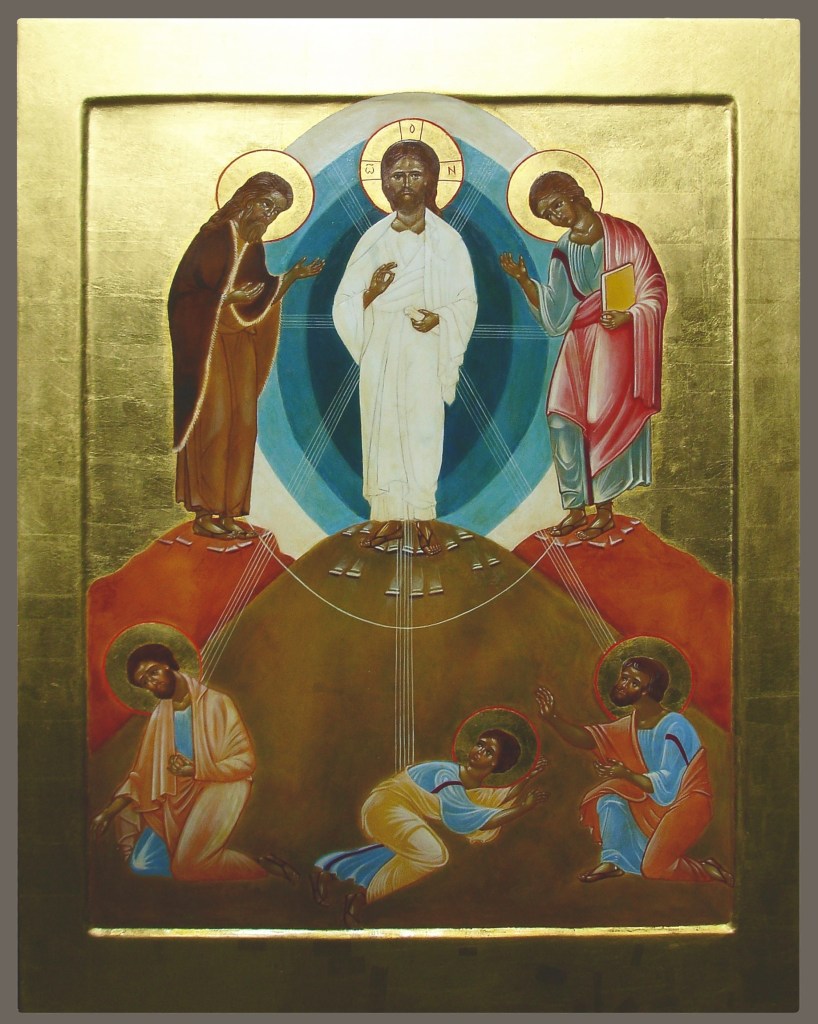
Icon of the Transfiguration. written by Sr. Irene of Le-Bec, in the Chapel of the Transfiguration, Parish Church of St John the Baptist, Epping, Essex.
Sr Irène
‘Pray to your Father who is in secret’. Matthew 6:6
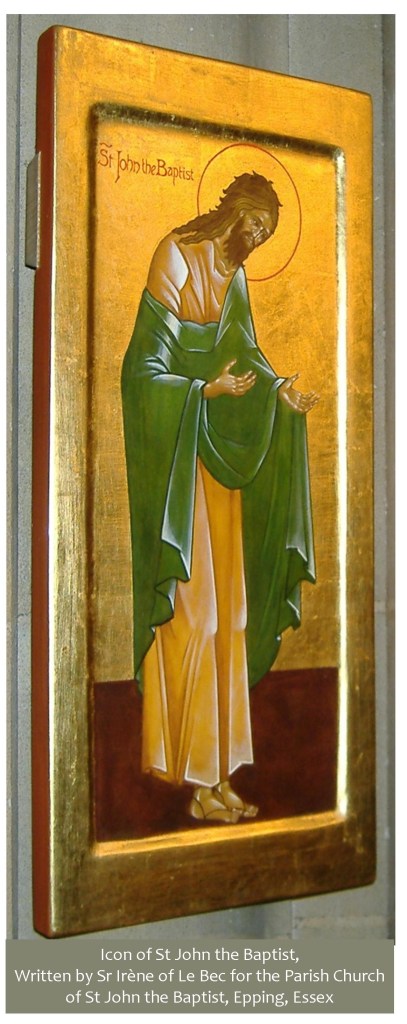
A number of years ago I was searching for an iconographer to write an icon of St. John the Baptist for a church dedicated to him in Epping, Essex.
On a visit to Bec-Hellouin in Normandy I arrived at a Convent which sold what appeared to be original icons. When I enquired about them, I was immediately introduced to Sr. Irène. By the end of our visit she was commissioned to write the icon for us. Not, however, without a small consultation! In the original icon, the figure of John was part of a triptych with our Lord and the Blessed Virgin Mary. He occupied the right hand panel. Because of where he would be positioned, with his hands facing the Blessed Sacrament, I needed him on the left! Sister Irène had to consult in prayer with St Tikhon, the original writer before it was agreed! She was to write three other icons for me. Two are of the Transfiguration and one of St. John.
Tonight we have just heard that Sister Irène died at Candlemass. I was so glad that I had been able to see her again last August.
These notes are from Sr Marie-Patrick of the Community at Bec.
Of Burgundian origin, and an elder sister to three boys, Chantal Boillot – Sister Irène Marie – entered the monastery at the age of 38, after caring for her elderly parents. She joined a novitiate which was then numerous (9!) and which shook her up a bit… She made profession as an Oblate nun on the feast of St. Benedict, July 11, 1979, and was soon sent to our little foundation at Mesnil saint Loup, near Troyes. As life in Troyes proved difficult, she was transferred to our other foundation in Abu Gosh in the Holy Land, on 1 February 1984. She stayed there for a good eight years but was called back to Le Bec at the end of 1992, a decision that was painful for her and that she never explained.
Back at Le Bec, she was able to deploy her talents as an iconographer, and even organised a few training sessions in this art. Very cultured and quite original, her interventions were sometimes unexpected, always enriching, but you didn’t want to be in a hurry!
In recent years, she bravely faced serious health difficulties, with cancer spreading despite numerous operations. Heavy treatment – which exhausted her – proved necessary. Recently, the nurse who came early to take a blood test found her struggling for breath and called the paramedics. Taken to Evreux, to the department that was treating her for her cancer, she was quickly transferred to cardiology: her heart problem – which had remained in the background until then – had worsened! Under oxygen and perfusion, she did not know when she would have a heart operation; and on her last visit, Mother Prioress admired her confident state of peaceful abandonment: “That’s what we’re here for, isn’t it? Sister Irene said to her with simplicity, leaving us with an exemplary testimony of a profound life of faith of which she spoke little. Her condition deteriorated rapidly despite the care of the clinic staff – whom we thank warmly – and she passed away at the age of the prophetess Anna, at the end of the first Vespers of February 2, (Candlemass), entering into that eternal Light to which she aspired with all her being.
If I were to try and sum her up, I would say that she was a person of deep holiness with a careful eye on the world. A writer of Icons which she infused with prayer and which she treated with utmost reverence. A woman of determination who served her Lord with dogged determination, not least through her long illness and sometimes in times of spiritual trial. All this and more framed in a gentle face with twinkly eyes and a genuine smile. We have a new and caring friend in heaven.
This photo of Tarn Hows on a misty morning, was taken by my friend, Gill Henwood. She gave it the title ‘Through a glass darkly,’ which is a quotation from verse 12 of what is probably St. Paul’s most well known writing – 1 Corinthians Chapter 13.
For now we see through a glass, darkly; but then face to face. (that is the King James Version. The more recent NRSV has, see in a mirror, dimly, which, to my mind is poetically is weaker.)
As I contemplated the feast day of the ‘Conversion of St. Paul,’ I found the title Gill chose, and the fascinating and rather evocative scene, kept coming back to me. I wrote this poem and tried the let the photo speak to the event I am trying to address.
It is a very amazing photo and it deserves to highlight a very amazing event.
The Conversion of Saint Paul
Brooding mist blurs edges of perception. Colours muted. A whisper of wind kisses the water, rippling on the shore of the soul. Visibility impaired, a cloak of quietness drawn across the mind. Stilling all movement. Intentions passionately held, melt into deep darkness. Yet this is not the cause of fearfulness nor of despair. Out of the shadows, of seeing “through a glass darkly” there is a pinprick of growing light which slowly, perceptively, burns away the haze as new vision takes shape.
A Voice, crisp, gently directive, unfettered by illusion, beckons, touching eyes to see a wonder, “face to face.” The waypath is irrevocably changed.


 Mr G's Ponderings