Tag: Northumbria

St. Aidan, meeting God in others.

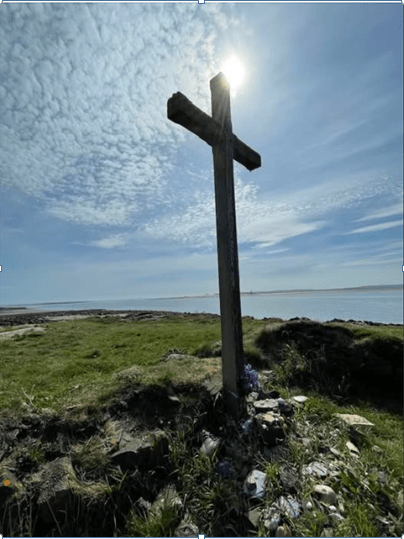
Lindisfarne : The Cross on Cuddy’s Isle .

Piers Northam ponders on the mission of St. Aidan

St Aidan of Lindisfarne, whom the church remembers today, modelled humility. He was active in Northumbria in the 7th Century.  Aidan was of Irish descent and was a monk at the monastery on Iona.  Oswald, who became king of Northumbria in 634, wanted to bring Christianity to his people and the Venerable Bede tells us that he contacted the monastic community on Iona and they sent a bishop called Corman to bring the good news to Oswald’s people.  But Corman didn’t go down well – he was haughty and harsh, and thought the Northumbrians were too stubborn and stupid to be converted.  On his return to Iona, Aidan criticized the way that he had gone about things: “Shouldn’t you have been a little gentler and more patient brother?” Aidan is reported to have asked and, before he knew it, he was being sent off to have a go himself. 

So what was it that differed in Aidan’s approach?  Well, first, he was aware that if he was going to bring a lasting Christian faith to this part of the country he was going to have to have a long-term strategy.  So his first move was to set up his little monastery on the island of Lindisfarne and in it a school that took in local Northumbrian boys.  In doing so, he was valuing the people of Northumbria rather than assuming that they were stupid and stubborn.  He was noticing, valuing and nurturing their potential, because they were to be the very foundation of this local church. 

His next move was to begin to learn the language of the local people so that he could go out into the lanes and farms talking to people and telling them the Gospel stories in a language they could understand.  You have to remember that Aidan would have spoken Old Irish and the Northumbrians Old English – two languages that had no linguistic ties – so this was no mean feat. Thankfully, King Oswald came to his rescue being bilingual. If you think about it, that’s the exact opposite of a colonial approach, where you take your own culture and impose it on another society and culture – again, Aidan saw the value in what was there and approached the task with humility.

In those times, people were in the habit of carrying knives – and not just to cut their meat up – allegiances were fiercely local; foreigners and outsiders generally mistrusted and Aidan, of course, was one such outsider.  Yet Aidan and his followers refused to tuck a knife in their belt – a risky strategy, but a courageous one, for it showed that they were essentially defenceless and meant that they were reliant on people to help them – trusting them to do so.  And, of course, we see the parallels between that and the gospel account of Jesus sending the disciples out in pairs. Whereas Corman, Aidan’s predecessor had ridden around the farms and villages of the area on horseback, gathering people together, preaching to them and then aiming at mass conversions, Aidan’s methods were far more humble: he literally walked thousands of miles, tramping the lanes and pathways, and getting into conversation with those he met.  His was a patient approach: aiming to kindle a curiosity in his listeners so that in time they were drawn into the way of Christ and would ask to be baptised.  His methods did not hinge on mass conversions which had little to back them up, but rather on personal, long-lasting relationships that led to a real desire to learn more about Christ.  He was not talking down to people from the back of a horse, rather, he was encountering them face-to-face – eye-to-eye – on a level: treating them as equals – all valued, beloved and precious to God.

Needless to say, Aidan’s approach found far greater success than Corman’s and Christianity took hold and became deeply rooted in the North East of England.  His humility and the way that he approached and valued people was effective in spreading the Good News of Jesus Christ.

[Extract from a sermon by Piers Northam, preached on St. Aidan’s Day, Sunday 31st August 2025]
Why did they bother?

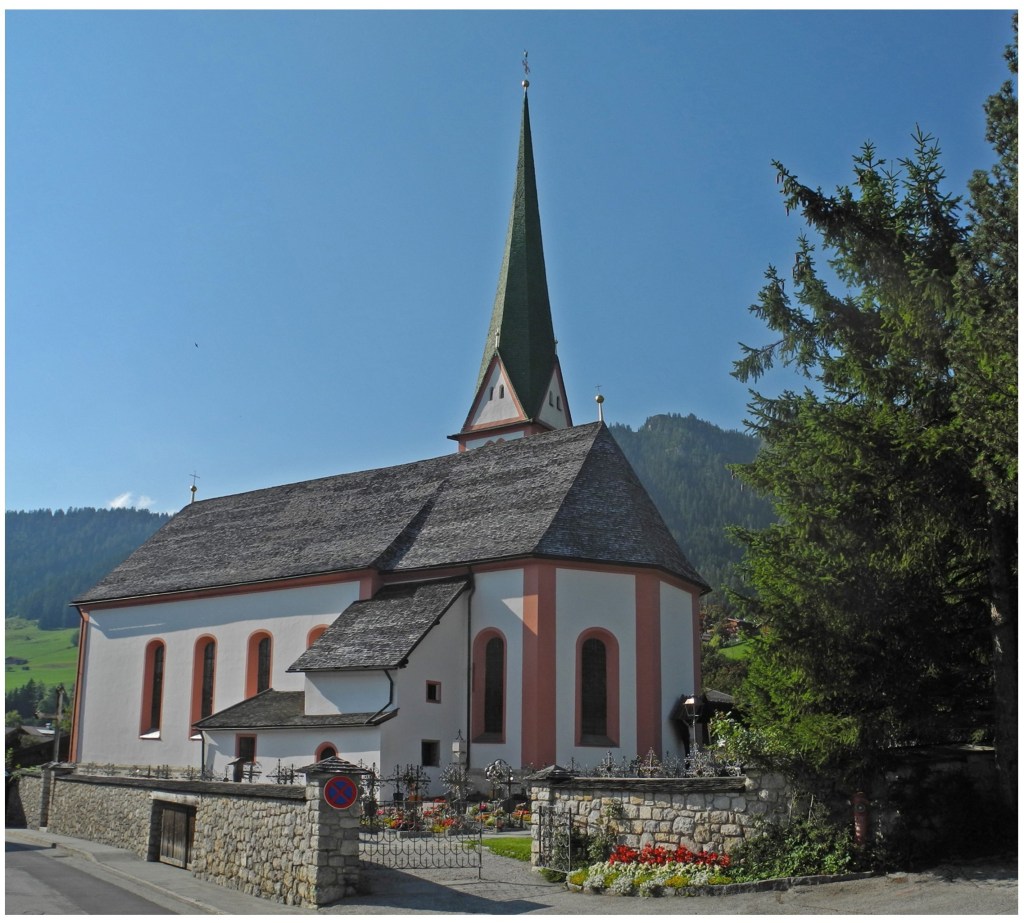
St Oswald’s Church, Alfbach, Austria
This image is licensed under the Creative Commons Attribution-Share Alike 4.0 International license.

Photo by SchiDD/2018-WLM

 When Bishop David Jenkins was Bishop of Durham, he often spent his summer holiday leading tours to Christian places.
On one such occasion he found himself at a place in Western Austria, the mountain village of Alfbach.
He visited the church and, to his surprise he found that it was dedicated to St. Oswald of Northumbria. His own Cathedral in Durham was the place where some physical remains of St. Oswald rested alongside Saint Cuthbert. David Jenkins fell to wondering why this Austrian Church had this dedication to a saint in faraway Northumberland.
He found a tourist leaflet which said that in the 7th and 8th centuries Christianity was brought to the region by Irish and Northumbrian monks.
The bishop’s journey to the village had been in an air-conditioned coach but it had still been a difficult journey along narrow mountain  roads. How much more difficult must it have been for those monks who had travelled through darkest Europe to bring the Gospel to that place. The bishop could only imagine what it must have been like and what hardships they endured.

More importantly, why did they bother?
The Bishop asked himself that question and this is the answer he came up with:
They had discovered in Jesus, that God loved them so they fell in love with God.
As a result they wanted to share that love with others.

That was what took them through Europe at a time when the flame of Christianity was burning dim—and their mission—to spread the Good News of God’s love renewed the faith of Europe and took the Gospel to new places.

In an age when, for the majority of people, the Christian light burns dimly —God continues to  love us so much that we too might fall back in love with Him—and when we do, like those monks, we will want to tell others.
A way of describing mission. That’s a good thought for Lent.

[Mr G]

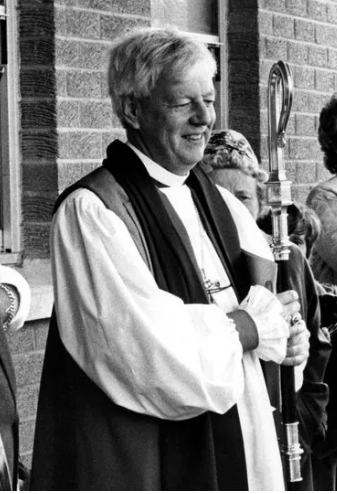
David Jenkins when Bishop Of Durham

St Aidan of Lindisfarne – Apostle from the North

Feast day, 31st August.

St Aidan window | Leonard Evetts
Holy Island Church

In 635AD a monk from Iona arrived at the court of King Oswald at Bamburgh in Northumberland. The King had recently won back his kingdom from the pagan Penda and he vowed that his people should become, as he was, Christian. When his father was defeated by Penda, Oswald with his brother and sister were sent, for safety, to live with the monks on Iona – the island consecrated by the prayer of St Columba. There Oswald learned Christianity and it was to Iona that the newly crowned king sent for a missioner to begin the work of proclaiming the Gospel. The first monk to arrive failed to make any headway with the people and it is thought he was too harsh on them. It probably didn’t help his case when he called them ignorant, unteachable and barbaric!

The saintly monk Aidan gently told him that he had tried to feed the people with ‘meat’ when first they needed the ‘milk’ of the Gospel. Not surprisingly, the Abbot told Aidan if he could do any better, he should go to Lindisfarne and see what he could do. Thus he was sent to re-start the mission and his gentle approach to evangelism soon paid off.

As a Celtic monk, he preferred the isolation of an island – although one which was accessible to the mainland for his missionary work and also near the King with whom he intended to work in partnership.   Ideally suited (and you can so easily detect the hand of God in this) was the island known as Lindisfarne or today, because of Aidan, Holy island.

Aidan’s approach to mission and evangelism was neither hard-line nor hard-sell.  He was a Celt and the Celtic approach was to quietly but certainly overlay pagan beliefs with Christian ones but not by denouncing the pagan.  To pagan belief, the Celts introduced a richer interpretation.  For example, the pagan worship of the Sun was easily transferrable to worship of the SON, Jesus Christ.  Without threatening but through gentle loving, the seed of Christianity was carefully and firmly sown and it paid off.

Aidan also went ‘local’.  He set up a monastic school which trained  youths for mission, having first steeped them in prayer and Bible study.  Twelve boys (like 12 disciples) were the first to arrive and they laid the foundation for a monastic school which was to gain huge renown.  The boys, when trained, were sent out as ‘Apostles’ to England.  Cedd, for example, took the Gospel to Essex (having first proclaimed Jesus Christ in North Yorkshire). Chad, his brother, proclaimed the Gospel in the Midlands. Aidan himself was tireless in his Missionary journeys.  The mission succeeded and was blessed by God, because it combined the deep zeal of Celtic spirituality to travel to foreign parts for the sake of the Gospel with a deep understanding of what the Gospel is.  It used local people to spread the Word.  Though Lindisfarne began as a Celtic foundation (and was staffed in part from Iona and Ireland) it was also an Anglo-Saxon (native) mission.  That’s why it took root.  It may sometimes be true that a prophet isn’t often heard in his or her own country but there is another truth which is that if you are convinced by Jesus Christ and build up your relationship with Him, then you will witness to people in your own locality.

Aidan was a clever, wise and astute purveyor of the Gospel and he made it his business to get to know the people he preached to.  At first he even took King Oswald along to interpret what he said until he learned the native tongue.  And he was gentle and loving.  In all this he has much to teach Christians about mission today.  He is the Apostle from the North but he became the Apostle of England.  Ripples of Gospel love started from Lindisfarne and quickly spread by God’s grace.