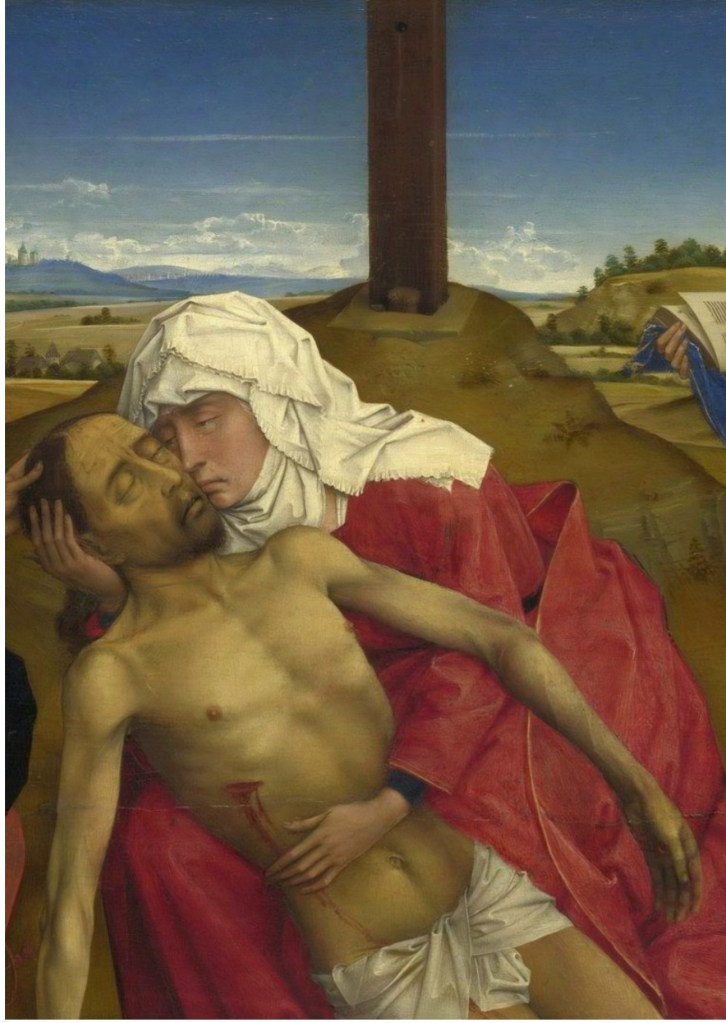
Their eyes never leave you, together confronting the agony as you are pinioned to the cross and crucified.
Three long hours.
Their presence is unwavering, their gaze unflinching, though a sword pierces their own anguished hearts.
Among them, the one who endured the agonies of bringing you into the world: who cradled the infant you. Now you are held in her gaze, her eyes fixed on you as she stands close by. Soon she will cradle your stiffening, lifeless body.
Where others have faltered and fled, these are the ones who remain, their presence, all that is left to give: a wilful resistance, a faithful standing by, a harrowing witness.
Here, at the foot of the cross, is true strength, true devotion: a love that is unsparing and never turns away…
Sometimes in our relationships we can lose touch with people. We might be so busy that we neglect friends, relatives, colleagues, even neighbours. It’s never intentional and when we do find time to catch up, it’s often as if we last spent time with each other yesterday. Even so, real friendships need to be worked at or we simply drift apart and our life loses a little bit of meaning or even love.
Of course, we do have to show that our friendship matters and that we really do mean to do something about it! Here’s a conversation I imagined.
Conversation.
We must catch up sometime soon! It’s been too long. There’s so much to talk about.
It’s amazing how time has flown
I don’t know where it’s all gone. It’s not intentional. Just so many things getting in the way.
Tell me about it! There just aren’t enough hours in the day.
But I’m determined to catch up, so I’ll ring you soon.
It would be good to get a date in the diary otherwise it will never happen.
I’ll email you with some dates when I get home.
Good plan.
Must go but it’s been lovely to chat.
Yes, hasn’t it. I look forward to hearing from you again soon.
Are there any dates you can’t do?
Oh no, I’m always around, but then, being God, I always will be.
Our weekly study group has been looking at the meaning of the Eucharist, in particular at the Last Supper, its spiritual and biblical roots in the Jewish Passover in the Book of Genesis.
As we delved into these links, we read the details in St. Luke’s Gospel, Chapter 22 and about the preparations Jesus had made for the Passover meal. We are told that Jesus sent Peter and John to get the meal ready. In answer to their question as to where they might eat it, Jesus told them : When you have entered the city, a man carrying a jar of water will meet you’ follow him into the house he enters” and there they were to meet the master of the house who would show them where the meal was to happen. In our discussion we needed the signal Jesus had given them ~ a man with a water jar. We never hear of him again but as he was at the right place at the right time we can assume that he was known to Jesus and an arrangement had been made both with him and with the master of the house. Without giving much thought to it we have been in the company of two others with a role in the Gospel story and clearly, friends of Jesus. We thought of how often this happens in the New Testament; people are encountered who simply appear and disappear, given but a sentence or two, yet were signs of a Gospel friendship that was extended to so many. As we discussed; Pete, one of our group took the moment further and later he sent me the following poem.
Did you know?
Did you know, O man with the jug, when you lifted water to your shoulder, that heaven was in your step, and the Teacher’s eyes were upon you? Did you sense the whisper of eternity in the clay’s cool weight? Did you feel the river of life passing through your humble task?
Did you know, O master of the house, that your upper room would cradle God? That bread would be broken, wine poured as covenant and blood? Did your heart stir as they entered, those weary men, so calm yet trembling, while the Lord of all took the servant’s towel?
Did you know, O silent room, how still the air would grow, how words eternal would hang like oil lamps in your wooden beams? “This is my body… this is my blood.” Did the walls remember the sound? Did they shiver again when the Spirit came like wind?
Three mysteries in one night: a man with a jug, a host with a home, a room with an open door. None named, none praised, yet through them the world was readied for grace poured out like water, for bread shared among friends, for love that would not die.
O Lord, teach us to be like them: to carry what is needed, to open what we have, to hold what is holy, and to let it all be Yours. Amen
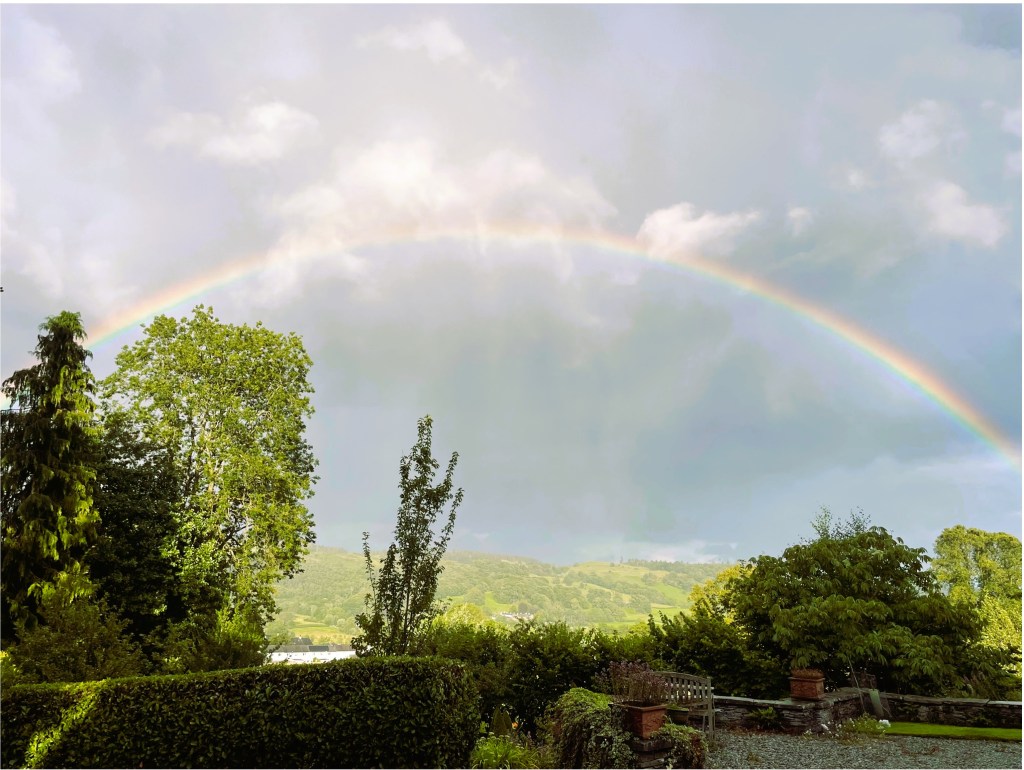
Rainbow after the rain. Storm Floris passes over the Lake District and leaves a rainbow behind.Photo by Gill Henwood.
My friend Gill Henwood has been reflecting on Midsummer life in the Lake District, Cumbria. She sent me her reflection in the form of a poem with a P.S. about Nature at work. When she sent it, we were all awaiting the August Summer Storm christened by the weather people as Floris. The North of England, the whole of Scotland and the Western Isles as far as Orkney are bearing the brunt of it, but already things are improving in Cumbria. Gill invites us to ponder on the beauty, stillness and calm, which can so often follow a storm. This is not just true of Nature but also in our own lives too. Sometimes we are buffeted about by what life throws at us but God is always near, ready to throw his rainbow cloak of love in a great arc over us. We do, however, like Elijah in 1 Kings 19, be still to hear and know God is there for you. Here’s Gill’s poem:
AFTER THE RAIN. Gill Henwood
The winds are soughing In the beech tree canopy. Sound ripples away As the waves on a beach.
Lichens reach into the air Dewdrops and sun A rich garden Growing on the stump.
Badgers have clawed Bark for grubs, Dragonflies shimmer Past, in the sun shafts.
Life is renewed The seasons turn again After rain, the sun. After storms, the calm.
And throughout, the still small voice.
1 Kings 19:11-13
P.S. The dragonfly, emerald and gold, dazzled me. S/he flew on but, having stopped, I looked. Noticed. A miniature garden on the decaying tree stump. Was s/he a fleeting messenger? “Remember, it’s Lammas…”. The farmer was baling the hay last night at 10pm, headlights on the tractor, collecting the bales before overnight rain. First fruits, in the sheep-dwelt fells: the grass harvest for winter feed. And for all the local creatures of hedges, dry stone walls, woods and tarns: plentiful seeds, berries, nuts, leaves. A harvest festival is quietly underway.
[Lughnasad is the Celtic name for Lammas, time of the ‘first fruits’ of harvest. (Newgrange website) Lammas is the Christian Festival on August 1st when we give thanks for Harvest that is coming and offer to God the gifts of the Land.]

 Mr G's Ponderings