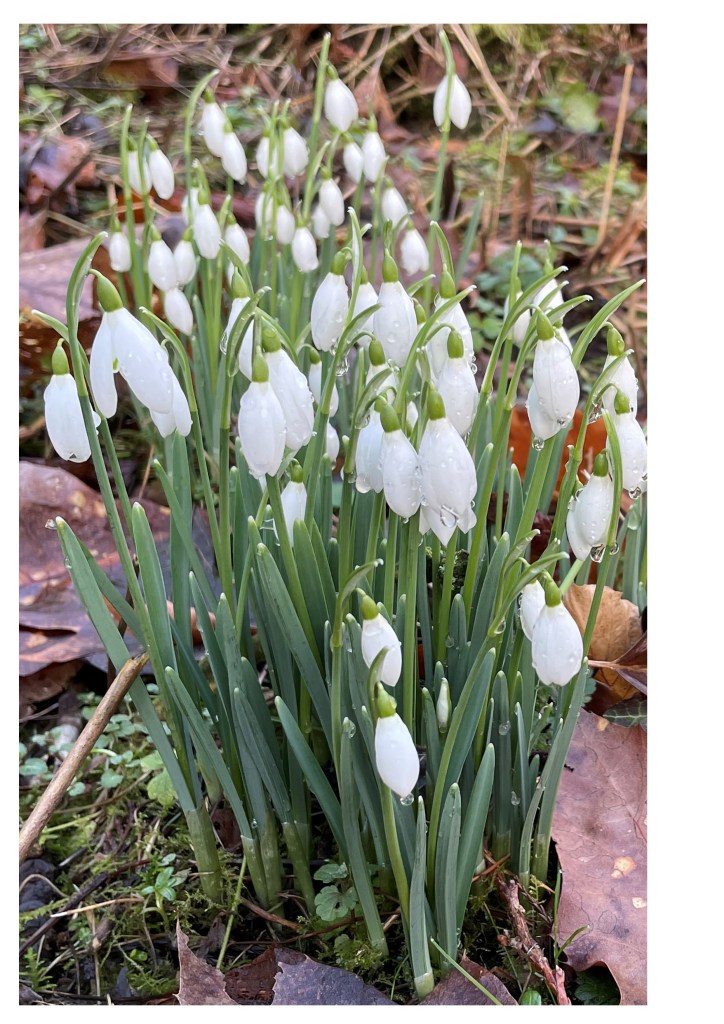
Snowdrops photographed by Gill Henwood in her Lake District garden.
February tiptoes across a winter landscape, dressed in white array, luring us away from cold depression of dark, dank January, with dazzling brightness; promising the hope of Spring beyond.
Ah! What trembling beauty lays a carpet of expectant joy!
Hawkshead Church in early morning mist. Photo by Gill Henwood.
This photo was taken by my friend, Gill Henwood and is of Hawkshead Church emerging from the morning mist. This mist speaks to me of ‘revealing’, of something that will become clearer as the mist rises; of a beauty present but not yet fully defined.
Today is the time the Christian Church remembers the Conversion of St. Paul, the moment when all that clouded his mind and darkened his thoughts, were lifted by an encounter with the Risen Christ. We are told of it in the Book of Acts, chapter 9 verses 1 to 19.
Paul or as he was then known, Saul, a zealous Jewish Rabbi, had made it his mission to persecute Christians, those Jews who had chosen to follow the teaching of the Apostles about Jesus. He was responsible for the death and imprisonment of many and was thus thwarting the work of proclaiming the Good News of Jesus.
Something had to be done to stop him and it was the Risen Christ who did so. As Paul travelled along the road to Damascus, the Risen Christ appeared and light flashed around him. Paul was blinded by the light and fell to the ground. It was as if a dark mist enveloped him and in the darkness Jesus challenged him, Why are you persecuting me?’ Paul asked who he was and the revelation came to him that it was Jesus. Paul’s heart was converted but though his eyes were opened, he could still not see. First, his spiritual blindness had to be lifted; something Jesus arranged and then Paul became the great champion of Christianity he was destined by God to be.
For me there is something autobiographical in Paul’s famous passage in his first letter to the Corinthians, chapter 13. Having written his classic definition of ‘love’, He made the point that only love will carry us through to the heart of God and that is both our faith and hope. He referred back to his own lack of understanding of the power of God’s love (verse 8 following) and reminds us that on our spiritual journey we move, often haltingly, to a deeper knowledge of love, as God shares His divine love with us. At first our perception of God’s love is as if we are looking through a mirror dimly’ or as the King James Version puts it, through a glass darkly, but then, as God continues to reveal his Love to us, we shall one day meet Him as Love face to face.
Gill’s photograph of Hawkshead Church suggests to me another illustration of this. Our experience of God’s love for us, may seem at times to be as if we are looking through the mist of understanding. It contains all that will be revealed but we must let God work in our souls as he did in Paul’s. Then, slowly but surely, the mist will lift and the glorious vision will open our eyes and our hearts to a deep and abiding love. In the photo we already see the promise coming clearer. The scene contains all that needs to be revealed. So that is for us. If we open ourselves to the possibility of God lifting from us all that prevents His love to flourish, then it will become a reality.
The Conversion of Saint Paul
Brooding mist blurs edges of perception. Colours muted. A whisper of wind kisses the air rippling through the soul. Visibility impaired, a cloak of quietness drawn across the mind. Stilling all movement. Intentions passionately held, melt into deep darkness. Yet this is not the cause of fearfulness nor of despair. Out of the shadows, of seeing “through a glass darkly” there is a pinprick of growing light which slowly, perceptively, burns away the haze as new vision takes shape.
A Voice, crisp, gently directive, unfettered by illusion, beckons, touching eyes to see a wonder, “face to face.” The waypath is irrevocably changed.
Lakeland hills appearing like a desert. photo by Gill Henwood.
A Voice from the Desert ~ St. Antony of Egypt. (f.d. 17th January)
There are significant dates in our lives, which can lead to a change of direction and a new way of living.This was very true of St. Antony of Egypt, also known as ‘the great’. Antony was born in Egypt in 250AD, the son of a prosperous farmer. His family were Christian and he grew up hearing the Gospel read each Sunday in his local church. His parents died and Antony gained a rich inheritance which he shared with his sister.
The significant day in his life was when he was 20. He went to church one Sunday morning and he heard the Gospel including the words: Go, sell all you have, and give to the poor; and come, follow me. Antony heard God calling to him through those words and he left the church, made provision for his sister and then sold all his goods and gave the money to the poor. He then left home and, after a time of spiritual preparation, he eventually set up a simple hut in the Desert of Egypt where, for the rest of his long life, he lived in solitude and prayer. He became one of the founders of the monastic life.
We might think that Antony was rather extreme in his interpretation of the Gospel. After all, how many times have we heard those words and not acted upon them in that way. Yet Antony knew that he had heard God’s voice. For him this was a clear sign of his vocation and he had the courage to respond. He lived a life dedicated to prayer, fasting, daily recitation of the psalms and to combating those forces in the world that are against God, including personal temptations and the battle for true holiness. Others were attracted to his way of life and communities began to be formed of people who sought a pure prayerful life. Antony became a spiritual guide to many, including streams of Christians living in towns and cities and who came to him for guidance. Some of that guidance was collected as ‘words’ which remain available to us today in collections of sayings’ of the Desert Fathers and Mothers.
Antony died in 356, over 100 years old. By the time he died he had learned the most important thing that every Christian must learn—he learned how to love God and to respond through this love to the immense and unconditional love that God had for him, as God has for all of us.
Few of us today are likely to be called to live in a deserted place, though those who have found time to do so, even for a short while, know just how valuable and precious that time is for communing with God without distraction. Some, of course, are called, like Antony, to live as members of Religious Communities as monks and nuns. But all of us are called to dedicate our lives to God and to serve him in whatever way is right for us. We can’t get away with saying something like, “it’s all right for Antony and the other desert dwellers.. They had a spiritual greatness that few of us can even get near.” Actually they wouldn’t claim to be specially great. But they did recognize the greatness of God and they wanted to respond to this in some way. Saints are important for us simply because they are ordinary Christians like us but who knew the Gospel to be extraordinary. It changes lives. If it doesn’t then we wouldn’t be Christians at all. Because it changed Antony’s life, the Church became more Godly and the world more lovely. That can be just as true for us today. Listen and let God tell you how.
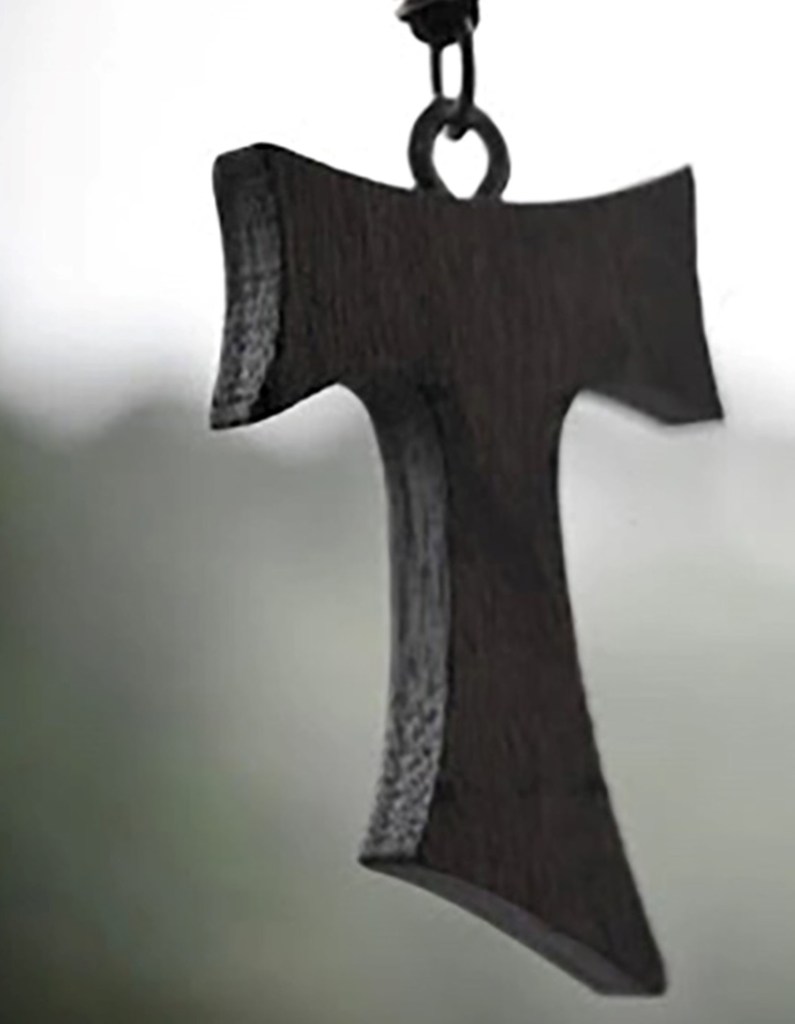
Tau Cross. Symbol of St. Antony of Egypt.
St Antony, You had everything. Then one day you heard the voice of God. “Antony, go sell all you possess and have nothing.” So you did, and then you had everything.
Star I saw the star at its rising * flaming the dying night sky with light. New Day, empty still of events that will define it, and give it a shape which will date it. Perhaps promises fulfilled, adjusted, stillborn? Expectations tinged with hope colouring the blackness, pushing dreams into memories. half remembered, half forgotten. half heeded, half not.
Shall we become whatever this Morning Star** will make of us? bursting over the horizon of our hearts, golden rays offering us a different kind of day.
[Mr G] Epiphany 2025
*a reference to St Matthew’s Gospel, 2:2 to words attributed to the Three Magi
** Morning Star Is usually associated in astronomy with the Planet Venus. In the Book of Revelation 22: 16, the risen Jesus acclaimed himself as the Bright Morning Star. It is with this meaning that the words appear in my poem
The photo is of the Bede Memorial in the Galilee Chapel of Durham Cathedral. It is in Latin and English and is a quotation from the Book of Revelation: “Christ is the morning star who when the night of this world is past, brings to his saints, the promise of the light of life and open everlasting day.



 Mr G's Ponderings