Tag: Resurrection

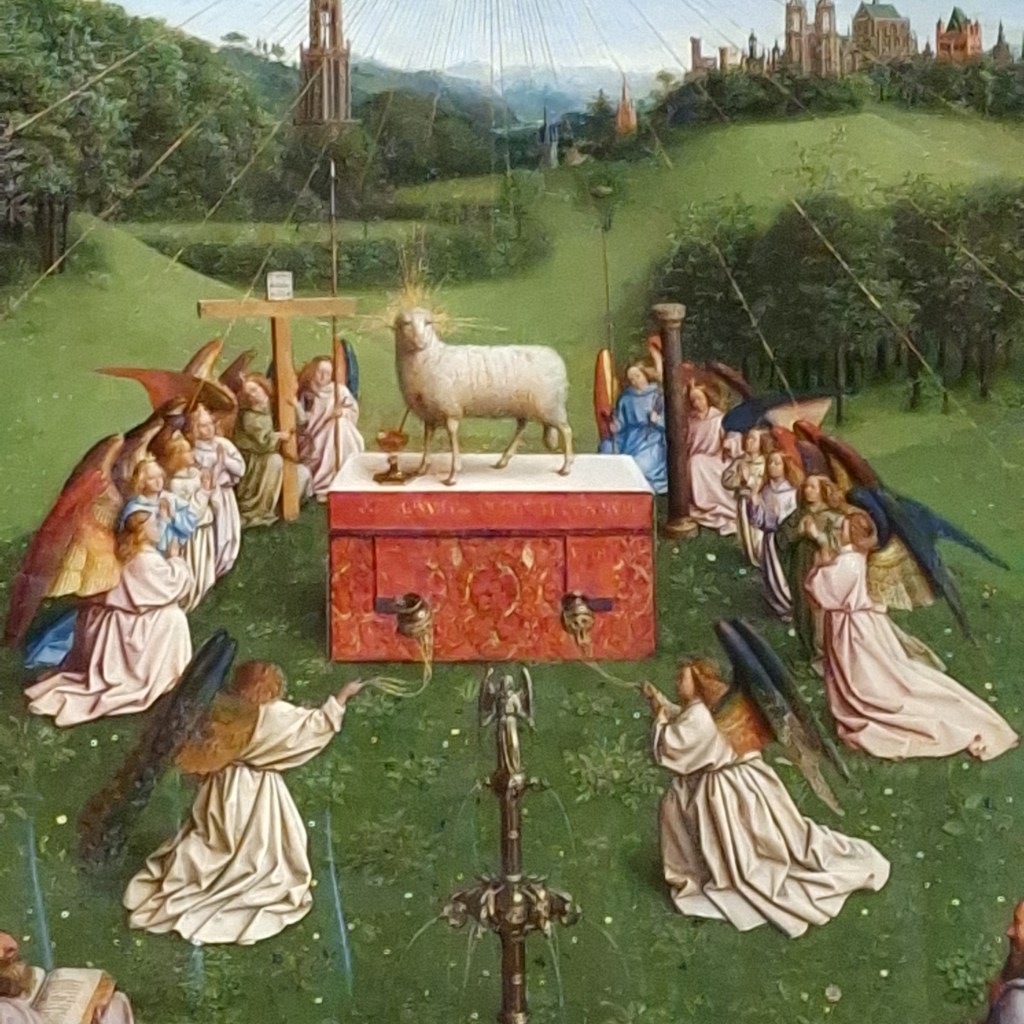
All Hail the Lamb

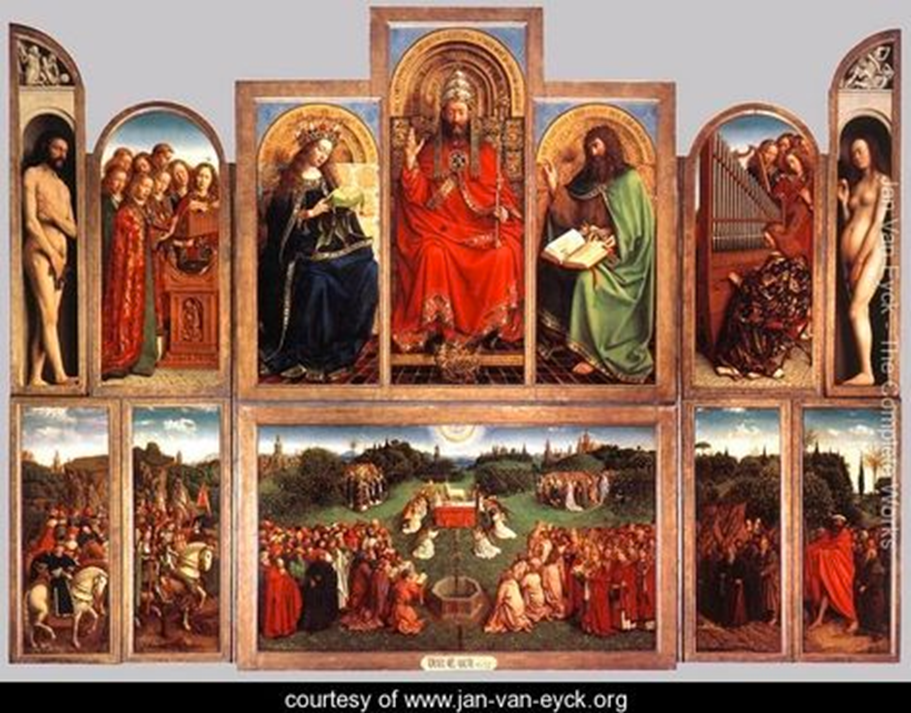
detail from : Adoration of the mystic lamb, from the altar-piece of Ghent Cathedral
Belgium. [photographed by Mr G.

The Ghent Altarpiece

In the early 15 century two Flemish brothers, Hubert and Jan van Eyck produced one of the great masterpieces of western art: the Ghent altarpiece known as The Adoration of the Mystic Lamb.  It is a multi-panel painting that can be displayed both open and closed, revealing different scenes and levels of detail. When closed, the altarpiece primarily displays the Annunciation, while opening it reveals the intricate and vibrant “Adoration of the Mystic Lamb” scene. 

Although of outstanding artistic and religious significance it is surrounded by controversy and speculation, not only from art historians but theologians as well.  It is currently undergoing a time of restoration and research which is scheduled to be completed in 2026.

In total the altar piece is constructed from 18 separate panels.  Its main panel depicts the Lamb of God on an altar set in an expansive landscape surrounded by figures in various groups. These include  Old Testament  judges, Knights of Christ, holy pilgrims and holy hermits; saints of both the Old and New Testaments. Above this lower central panel there is a depiction of God, with Mary to the left and John the Baptist to the right.  In turn, they are flanked by the figures of Adam and Eve.
The Altarpiece was completed in 1432 and it is a truly great work of art; one of the most influential paintings ever painted.
The panels depict biblical scenes as well as a portrait of Joos Vijd who commissioned it and his wife Elisabeth Borluut.

At the heart of the painting is the Mystic Lamb, seen on the central altar.  It symbolizes  Jesus Christ and the sacrifice he made for humanity.  From a wound on its chest, blood pours into a chalice which represents Christ’s sacrifice and its commemoration in the Eucharist.
Around the altar, in various groups are gathered those who gaze on the Lamb in  adoration. The Virgin Mary and St. John the Baptist are contrasted with the figures of Adam and Eve with a depiction of God in the panel above that of the Lamb.

The painting has had quite a difficult life and has been described as the most stolen piece of art in history. It has also been hidden when iconoclasts and others would have preferred to destroy it.
On the morning of 11 April 1934, Ghent woke up to news of a disaster. Two panels of the Altarpiece, ‘The Just Judges’ and ‘John the Baptist’ had been stolen from St Bavo’s Cathedral! This daring theft has grown to become one of the most fascinating art robberies of the 20th century. It remains unsolved. The panel of John the Baptist was returned later anonymously but that of the ‘Just Judges’ remains at large! There is a hope that it will be found in due course, meanwhile a copy takes its place.
As if that wasn’t enough the painting was stolen by the Nazi’s in 1940. Hitler wanted to establish a museum of culture in his home town of Linz. Whilst plans for the building were completed, the painting, along with many others, was kept safely in a salt mine in Austria, which also guaranteed its preservation.
When the Allied troops were getting near, there was a plan to dynamite the salt mine but such a disaster for the art heritage of the world was averted by the residents who lived near the mine.

Today, the Altarpiece has its own chapel in the Cathedral where it can be viewed freely. It is an amazing work of art but it is much more.
For the believer, there is a strong sense of being led into adoration not just of the painting itself but of the resurrection it signifies.~The Lamb is one of the powerful symbols of Easter not only because lambs are themselves signs of new life at this time of year, but also because in Christian art, the Lamb depicts Christ Jesus, risen from the dead and glorified.
As I sat before the painting, in contemplation, the only response I could make was to be still and pray, giving thanks for all that God in the Risen Jesus has given to me – and the unstoppable and unconditional love through which He saves and redeems me and you.
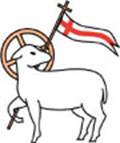
In Christian symbolism, the lamb represents Jesus, “the lamb of God” (agnus Dei). (Jn 1:29, Rev 5:12) Standing with a banner, the lamb represents the risen Christ triumphant over death. Standing with a cross and a gash in its side, it symbolizes the passion of Christ. Seated on a throne or a book, the lamb represents the judgment of Christ. Because the lamb is humble, gentle, and innocent, lambs are often engraved on the tombstones of children.

Paschal triumph, Easter joy,
Only sin can this destroy;
From sin’s death do thou set free,
Souls re-born, dear Lord, in thee.
Hymns of glory, songs of praise,
Father, unto thee we raise.
Risen Lord, all praise to thee,
Ever with the Spirit be.

{final verse of the hymn : At the Lamb’s High Feast we sing}

[Mr G] Easter Friday 2025

Pope Francis speaks to us before Jesus takes him to heaven

John Dugdale, Christ the liberator. Morton St NYC

Pope Francis’ Easter Message 2025

Christ is risen, alleluia!

Dear brothers and sisters, Happy Easter!

Today at last, the singing of the “alleluia” is heard once more in the Church, passing from mouth to mouth, from heart to heart, and this makes the people of God throughout the world shed tears of joy.
From the empty tomb in Jerusalem, we hear unexpected good news: Jesus, who was crucified, “is not here, he has risen” (Lk 24:5). Jesus is not in the tomb, he is alive!
Love has triumphed over hatred, light over darkness and truth over falsehood. Forgiveness has triumphed over revenge. Evil has not disappeared from history; it will remain until the end, but it no longer has the upper hand; it no longer has power over those who accept the grace of this day.

Sisters and brothers, especially those of you experiencing pain and sorrow, your silent cry has been heard and your tears have been counted; not one of them has been lost! In the passion and death of Jesus, God has taken upon himself all the evil in this world and in his infinite mercy has defeated it. He has uprooted the diabolical pride that poisons the human heart and wreaks violence and corruption on every side. The Lamb of God is victorious! That is why, today, we can joyfully cry out: “Christ, my hope, has risen!” (Easter Sequence).
The resurrection of Jesus is indeed the basis of our hope. For in the light of this event, hope is no longer an illusion. Thanks to Christ — crucified and risen from the dead — hope does not disappoint!  + Spes non confundit! (cf. Rom 5:5). That hope is not an evasion, but a challenge; it does not delude, but empowers us.
All those who put their hope in God place their feeble hands in his strong and mighty hand; they let themselves be raised up and set out on a journey. Together with the risen Jesus, they become pilgrims of hope, witnesses of the victory of love and of the disarmed power of Life.
Christ is risen! These words capture the whole meaning of our existence, for we were not made for death but for life. Easter is the celebration of life! God created us for life and wants the human family to rise again! In his eyes, every life is precious! The life of a child in the mother’s womb, as well as the lives of the elderly and the sick, who in more and more countries are looked upon as people to be discarded.

What a great thirst for death, for killing, we witness each day in the many conflicts raging in different parts of our world! How much violence we see, often even within families, directed at women and children! How much contempt is stirred up at times towards the vulnerable, the marginalized, and migrants!
On this day, I would like all of us to hope anew and to revive our trust in others, including those who are different than ourselves, or who come from distant lands, bringing unfamiliar customs, ways of life and ideas! For all of us are children of God!

I would like us to renew our hope that peace is possible! From the Holy Sepulchre, the Church of the Resurrection, where this year Easter is being celebrated by Catholics and Orthodox on the same day, may the light of peace radiate throughout the Holy Land and the entire world. I express my closeness to the sufferings of Christians in Palestine and Israel, and to all the Israeli people and the Palestinian people. The growing climate of anti-Semitism throughout the world is worrisome. Yet at the same time, I think of the people of Gaza, and its Christian community in particular, where the terrible conflict continues to cause death and destruction and to create a dramatic and deplorable humanitarian situation. I appeal to the warring parties: call a ceasefire, release the hostages and come to the aid of a starving people that aspires to a future of peace!

Let us pray for the Christian communities in Lebanon and in Syria, presently experiencing a delicate transition in its history. They aspire to stability and to participation in the life of their respective nations. I urge the whole Church to keep the Christians of the beloved Middle East in its thoughts and prayers.
I also think in particular of the people of Yemen, who are experiencing one of the world’s most serious and prolonged humanitarian crises because of war, and I invite all to find solutions through a constructive dialogue.

May the risen Christ grant Ukraine, devastated by war, his Easter gift of peace, and encourage all parties involved to pursue efforts aimed at achieving a just and lasting peace.

On this festive day, let us remember the South Caucasus and pray that a final peace agreement between Armenia and Azerbaijan will soon be signed and implemented, and lead to long-awaited reconciliation in the region.
May the light of Easter inspire efforts to promote harmony in the western Balkans and sustain political leaders in their efforts to allay tensions and crises, and, together with their partner countries in the region, to reject dangerous and destabilizing actions.
May the risen Christ, our hope, grant peace and consolation to the African peoples who are victims of violence and conflict, especially in the Democratic Republic of the Congo, in Sudan and South Sudan. May he sustain those suffering from the tensions in the Sahel, the Horn of Africa and the Great Lakes region, as well as those Christians who in many places are not able freely to profess their faith.

There can be no peace without freedom of religion, freedom of thought, freedom of expression and respect for the views of others.
Nor is peace possible without true disarmament! The requirement that every people provide for its own defence must not turn into a race to rearmament. The light of Easter impels us to break down the barriers that create division and are fraught with grave political and economic consequences. It impels us to care for one another, to increase our mutual solidarity, and to work for the integral development of each human person.

During this time, let us not fail to assist the people of Myanmar, plagued by long years of armed conflict, who, with courage and patience, are dealing with the aftermath of the devastating earthquake in Sagaing, which caused the death of thousands and great suffering for the many survivors, including orphans and the elderly. We pray for the victims and their loved ones, and we heartily thank all the generous volunteers carrying out the relief operations. The announcement of a ceasefire by various actors in the country is a sign of hope for the whole of Myanmar.

I appeal to all those in positions of political responsibility in our world not to yield to the logic of fear which only leads to isolation from others, but rather to use the resources available to help the needy, to fight hunger and to encourage initiatives that promote development. These are the “weapons” of peace: weapons that build the future, instead of sowing seeds of death!
May the principle of humanity never fail to be the hallmark of our daily actions. In the face of the cruelty of conflicts that involve defenceless civilians and attack schools, hospitals and humanitarian workers, we cannot allow ourselves to forget that it is not targets that are struck, but persons, each possessed of a soul and human dignity.
In this Jubilee year, may Easter also be a fitting occasion for the liberation of prisoners of war and political prisoners!

Dear brothers and sisters,

In the Lord’s Paschal Mystery, death and life contended in a stupendous struggle, but the Lord now lives forever (cf. Easter Sequence). He fills us with the certainty that we too are called to share in the life that knows no end, when the clash of arms and the rumble of death will be heard no more. Let us entrust ourselves to him, for he alone can make all things new (cf. Rev. 21:5)!

Happy Easter to everyone!


Copyright © Dicastero per la Comunicazione – Libreria Editrice Vaticana

 + Spes non confundit! (cf. Rom 5:5).

Hope does not disappoint us, because God’s love has been poured into our hearts through the Holy Spirit that has been given to us.  (NRSV)

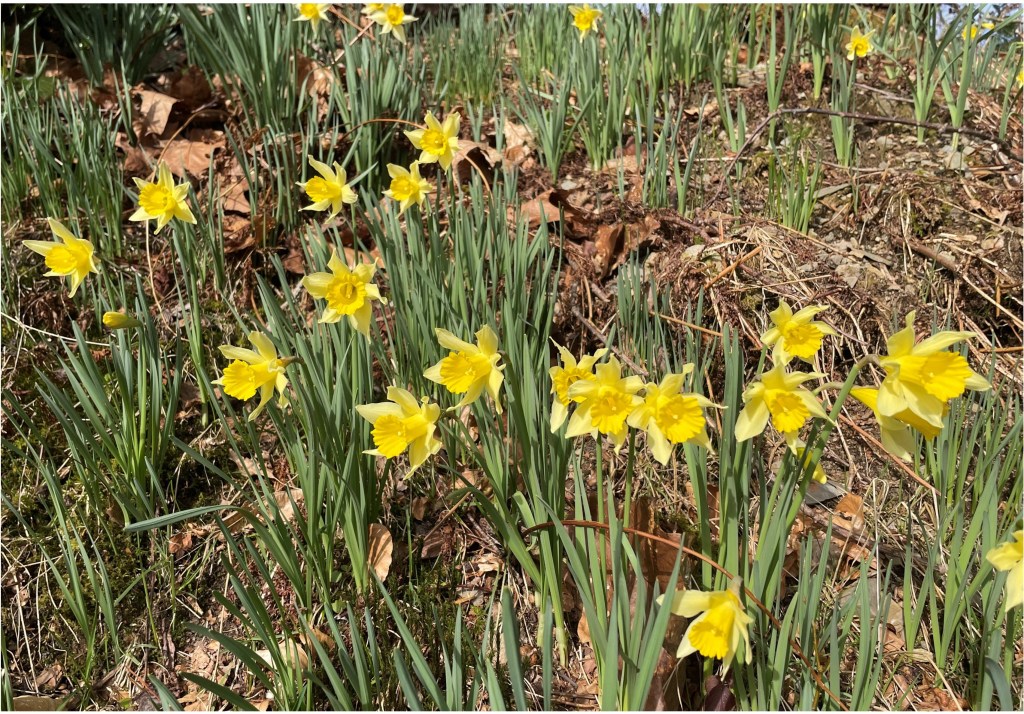
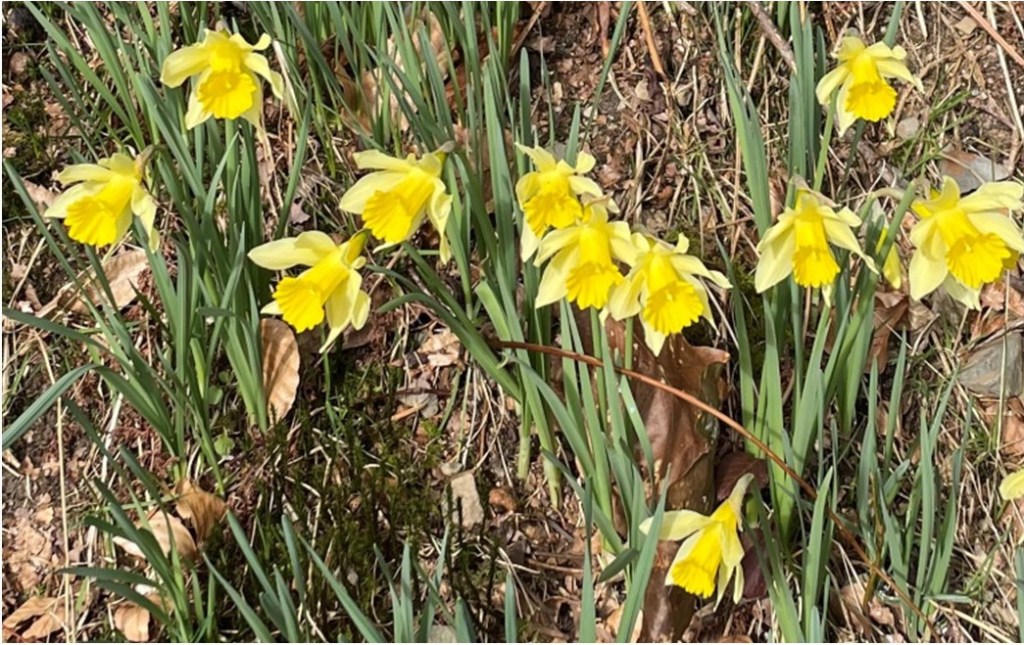
Dancing with daffodils

Wild daffodils in the Lake District photographed by my friend Gill Henwood

In this coming week, we who live in the earth’s Northern Hemisphere, move from the season of Winter to that of Spring.
The Spring equinox is often known as the ‘Astronomical’ Spring to differentiate it from the ‘Meteorological’ Spring which is used by weather forecasters and is always on March 1st. The season of Spring generally falls on either March 20th or 21st (19th in a Leap Year) This year it is on March 20th.
Nature, however, prefers to set its own time and has already begun showing growth from the earth; songs from the birds and a gentle ‘greening’ of the leaves as trees create a dusting of new life.

It has been suggested that it was these words which inspired her brother, William, to write his own poem in praise of daffodils. The sentiments and imagery expressed by Dorothy are certainly traceable in his poem.
William became famous and eventually Poet Laureate whilst Dorothy was all but forgotten at the time but there are some who would suggest that his daffodil poem might constitute plagiarism!
What can be certainly said is that between them they helped to make the Daffodil become a joyful sign of Spring and of Resurrection. [Mr G]

photo GH

I wandered lonely as a cloud
That floats on high o’er vales and hills,
When all at once I saw a crowd,
A host, of golden daffodils;
Beside the lake, beneath the trees,
Fluttering and dancing in the breeze.

Continuous as the stars that shine
And twinkle on the milky way,
They stretched in never-ending line
Along the margin of a bay:
Ten thousand saw I at a glance,
Tossing their heads in sprightly dance.

The waves beside them danced; but they
Out-did the sparkling waves in glee:
A poet could not but be gay,
In such a jocund company:
I gazed—and gazed—but little thought
What wealth the show to me had brought:

For oft, when on my couch I lie
In vacant or in pensive mood,
They flash upon that inward eye
Which is the bliss of solitude;
And then my heart with pleasure fills,
And dances with the daffodils.

[William Wordsworth]

Hope rises from the ashes

The old earthquake damaged Cathedral at Christchurch, New Zealand
and below The vista looking east, of the temporary cardboard Cathedral [G H]

Thoughts in Holy Week
from the Revd Dr Gill Henwood

My phone chose a Christchurch photo this morning for me. Herewith the damaged cathedral (Photo taken 2020) and the temporary one made with cardboard roof struts I believe.

The white chairs installation (see below) is for the 185 who died in the earthquake- all different chairs, all unique people. Freshly repainted and evocative, in the cleared wasteland around the temporary cathedral.

Loss, hope, death, resurrection, darkness, bright sunlight and blue sky. Juxtaposed. Past. And now….

Nearby was a war memorial for NZ troops in the world wars. Next to it was a smaller memorial for people lost in 1919 by the Spanish Flu epi/pandemic.
Today, all these losses resonate in Europe and also globally, keenly, acutely, in the present. 

As we approach Jerusalem in Holy Week once more, may God give strength to all who are suffering and bereaved in our world now – through natural disasters, war and pandemic – to endure and trust that in Love there is a better way. We are ‘keening’ (mourning and lamenting) worldwide, drawn into the reality of suffering and death in the timeless journey of Holy Week.

May each one – in time, with others, together – find hope and, as the Light of Christ comes in the darkness of Easter Eve. May each glimpse even the possibility of solace and, one day, the renewing recreating joy of resurrection.

Gill Henwood