Tag: St aidan

A Ray of Light in darkness

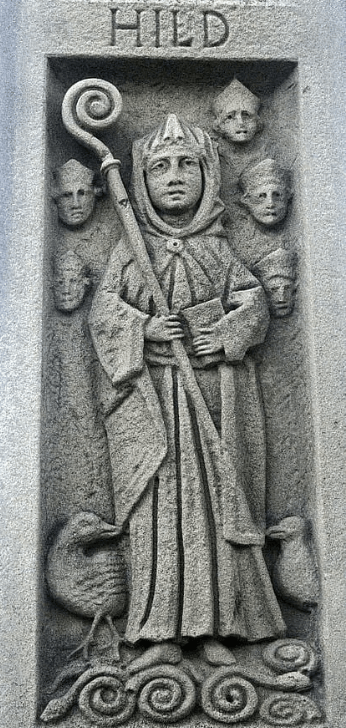
St Hild, detail from a monument to Hilda of Whitby.

This week, the church keeps the feast of St. Hilda (or to give her the Anglo-Saxon name, Hild). 

She was born into the Northumbrian royal family and for the first 33 years of her life led a very different life to the one God was to lead her.
For that call God used the voice of St.Aidan of Lindisfarne. He was the monk from Iona who brought the Gospel to the North East of England and in his monastery on Holy Island he trained up Anglo-Saxon boys to become Missionaries to many parts of England as well as the Scottish borders.
Part of Aidan’s mission plan was to establish religious power houses, monasteries from which further missions could be launched.
These religious houses were built on Prayer and cemented by the Gospel of Jesus Christ as well as translated into Christian Service.

One day, in obedience to God’s plan, Aidan summoned Hild to meet him on the banks of the river Coquet south of Bamburgh.
Here he told her God’s plan for her. She was to establish a religious house, first at Wearmouth and then on the Headland at Hartlepool. From there she was to go on to established her most famous foundation at Whitby (Or Strines at it was then known).
It was to be a ‘double’ monastery in that two monasteries were built side by side, one for men and the other for women.
Hild was to be the Abbess of both.
As Abbess she ruled over both monasteries and was, in effect, the head.

This may surprise some but Aidan belonged to the Church of the West which we call Celtic but which was really Irish. In Ireland women had equality of status with men and particularly in the Church.
Aidan saw no reason why this equality should not be established in England too.
It was only later when the Church of Rome grew in strength that this practice was challenged.

The Venerable Bede, to whom we owe much of the story of Christianity in Britain, and who, if pressed was more generous in his comments about Roman practice, recognized Hild’s specialness and greatness.
He wrote of her:

“All who knew abbess Hilda, the servant of Christ, called her Mother because of her wonderful devotion and grace; she never ceased to give thanks to her Maker or to instruct the flock committed to her care.
Not only was Hilda an outstanding example of holy life to all who were in her monastery, but she also provided an opportunity for salvation and repentance to many who lived far away, and who heard the happy story of her industry and virtue.”

Under her guidance the Abbey at Whitby grew in stature, capturing her devotion to Christ and the gift of holiness showered upon her by God.
Her advice and prayer was sought after by ordinary folk as well as those of royal birth. She compelled all who were under her instruction to devote so much time to the study of the holy Scriptures and so much time to doing good works that many came to have an enriched and deep faith.
She was also, because of God’s Providence, the right person in the right place at the right time.
It was at her abbey at Whitby that the Church met for an important Synod in 664AD. It brought together Roman and Irish Christians who had differing views on issues such as the date of Easter, the way Baptism was administered, who could ordain and other matters. Hilda favoured the Celtic/Irish view of things but the Roman view prevailed.
This caused a big rift in the Church and it fell to Hilda, along with her friend St. Cuthbert, to try and reconcile the various factions.
To the degree that she was quite successful shows her, not only, to be a person of generous spirit but also one who had a gift of diplomacy.
Hilda, who had sided with the Irish, kept her cool, and she set about healing the divisions which split the Church.  With quiet diplomacy, authority and fortitude, she brought the wounded church to some kind of healing from which it was to move forward.
Perhaps because of this she has been described as a ray of light in darkness.

One of the qualities which disciples of Christ are encouraged to seek and use are the gifts that God gives us.
We are all called to support and encourage each other to grow in discipleship by discovering and offering our gifts to God and his people.

An example that we all have gifts but need others to encourage us to find and use them, comes from something Hild did.
It concerns a cowherd called Caedmon, who though not a monks, worked at the monastery and shared its life.
One day he was heard singing. His voice was angelic.
Hild heard of it and sent for him. She encouraged him to write songs that were formed from verses of the Bible.
Soon Caedmon was singing the Scriptures and so edified others. He was encouraged by Hild to use his God-given talents. He became a monk and he was England’s first poet.
Little of his work remains today – just six lines – but his prolific outpouring was well chronicled.
Hild brought out the image of Jesus Christ in people because she lived in God’s brightness.

Today, she Is offered to us as a beacon in our own darkened world and, at times, church. When we are up against it in both world and church, Hild reminds us of a deeper truth and of a greater world. A world where Angels dance and sing; a world where those who die are loved by the Lord into eternal life; a world where we have a joyful witness to carry out. Hilda served this world but her heart was always in another world. Her soul belonged to God and it was in God’s presence that she continually lived. The novelist T H White once wrote that :   There is another world and it is in this one.
By which is meant that we are surrounded by the world of God which constantly embraces us and holds us in love.
We don’t have to search for this world by looking up but by feeling it around us. We touch it in prayer; we hear its voice in Scripture; we are fed by it in Worship and we celebrate it in each other.
That is what gave Hild the impetus to serve God and to touch hearts and lives with his Love.
She also shows us a very important truth, often forgotten, that in the eyes of God we are all equal and we are all part of his inclusive love.
We are tasked to discover what that means in a world which acts differently, where lies are easily told and truth is discarded and which uses words rather than actions – e.g. what can we least get away with in global gatherings; A world where refugees are used as pawns and for political ends, a world which defames people of colour and people of differing gender, and a world which still treats women abominably.

I wonder what Hild would do in our world?
I expect she would have sharp words and strong opinions but she would carry these in love, in prayer and in care to God, with repentance for our shortcomings but with a depth of hope in her heart that, despite everything, God’s world will continue to break through and make everything new.

But I suspect she would want each of us to join in making real the vision of a world ruled by Love, Care and kindness.
A world she discovered for herself is found in God alone.
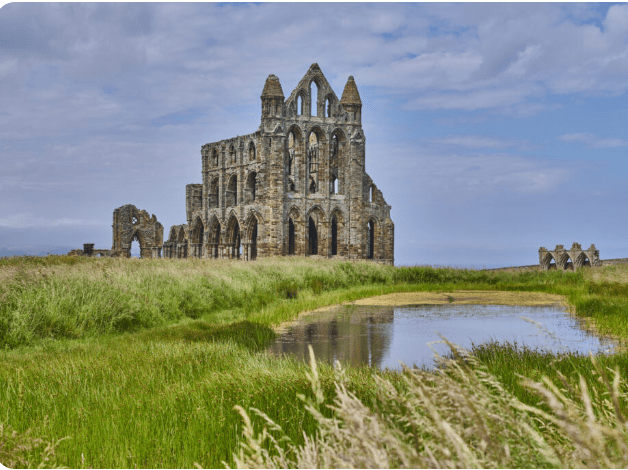
The Abbey ruins today at Whitby.
There is an Anglican religious community nearby.
There is a lively and faithful parish church in Whitby and
other Christian congregations.

[] [] [] The Statue of Hild pictured above includes coiled ammonite fossils
at St Hilda’s feet – a reference to a legend in which she turned snakes
which plagued Whitby, into stone.
The image was made available by Wilson44691, uploaded by Arienne King
and published on 20th April 2019. The Copyright holder has made the image available and licensed
in the ‘Public Domain’ and specifically made it available for copying purposes.
[Mr.G]
Learning of God from Island Saints

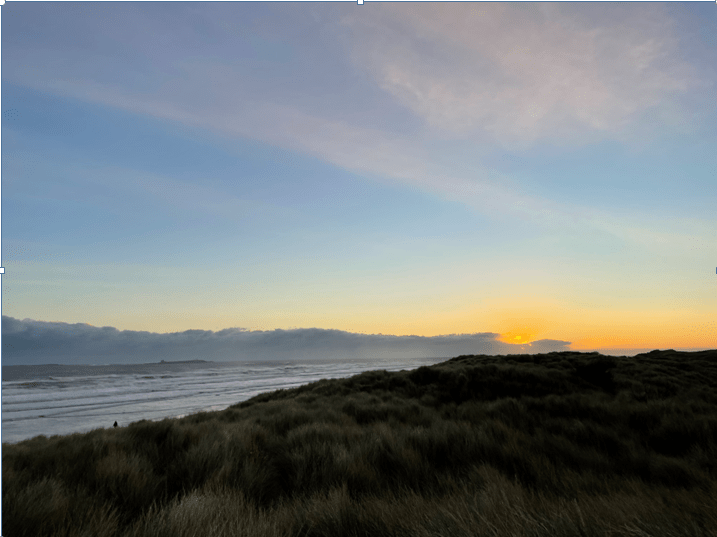
Sunrise from Lindisfarne over the Farne Islands, St Cedd’s day, October 26th 2025. Photo by Gill Henwood.

October 26th is St. Cedd’s Day:

The little that is known about Saint Cedd comes to us mainly from the writing of Saint Bede in his Ecclesiastical History Of The English People.
Cedd was born in the kingdom of Northumbria and brought up on the island of Lindisfarne by Saint Aidan. He was one of four brothers: Chad (originally Ceadda), Cynibil and Caelin being his siblings. The first datable reference to Cedd by Bede makes clear that he was a priest by the year 653. It is likely that Cedd was oldest of the brothers and was acknowledged the head of the family. While he was alive, he seems to have taken the lead, while Chad was his chosen successor.
Cedd was sent out from Lindisfarne to take the Gospel to Essex, landing after a sea journey at Bradwell where, today, there is still a Chapel built on the foundation of Cedd’s monastery.

As well as this mission, Cedd also established a monastery at Lastingham in the Cleveland Hills. From here he established a mission in North Yorkshire. When he died of the Plague, his brother Chad took over. Today, at Lastingham, the crypt chapel is said to date back to Cedd’s time.

Learning of God from Island Saints.

I come to this Holy place
where, when the tide turns,
silence and conversation
meld into stillness.
God is here.
His sanctuary, enclosed by the sea,
welcomes those who are seeking after meaning.

What am I looking for, here on Lindisfarne,  
where the spirit of Aidan
gathered together those chosen by God,
on whom the Saint poured out his soul,
his faith, into their waiting hearts?

I sense and seek the company
of those who first prayed here
through the storms of the sea, the blowing of the winds
sweeping over the Headland Heugh,
in the strange light of pale day
and the fading shadows of eventide.
In silence and in prayer; through learning and in listening;
by becoming steeped in God’s word;
twelve young monks, were inspired to mission the good,
Gospel news, of Jesus Christ.

Cedd and Chad, Cynibil, Caelin and companions
allowed Jesus to be etched upon their hearts,
discovering a love which must be shared.
How else would others inhale God’s blessing
and love in their own lives
and cause a world’s darkness to be bathed and transformed
by the dazzling  light of God’s Spirit?

And I, kneeling somewhere between the waves and shore
of my inner being, must hear anew this call
to open the Gospel pages illuminated by God within my soul,
that through me also
God may mission to others His amazing and saving Love.

Mr. G.
St Cedd’s Day 2025.

Dawn over Lindisfarne, taken from Bamburgh by Gill Henwood. St Cedd’ s Day 2025

Sit Awhile

Photo: Emmanuel Head. This striking structure, built between 1801 and 1810 by Trinity House, is one of the earliest daymarks built in Britain (possibly the earliest one). A daymark is a navigational aid for shipping, and this one stands 35 feet high. A good place to sit awhile. Photo taken by Gill Henwood.

My friend Gill Henwood recently stayed on Lindisfarne (Holy Island), Northumbria. Near the ruins of the Benedictine Monastery, is a cliff top walk along what is known as The Heugh (pronounced ‘Hee-uff’). It is believed that this rock was utilized by the Celtic/Anglo-Saxon monks, as part of the early monastery, built in 635AD when King Oswald, newly reclaiming his father’s kingdom, sent to Iona for a monk to begin the work of bringing the Northumbrian people to the Christian faith. St Aidan set up his monastery on Lindisfarne which becomes an island twice a day. It was near enough to Bamburgh, the King’s castle to allow Aidan free access to the King and yet quiet enough for the young Anglo-Saxon novices to learn the Gospel of Jesus, the prayers, the sacramental life and the lessons of mission.
Because Lindisfarne becomes an Island twice a day, it can welcome tourists and visitors but also it can flow into silence. Both purposes are valid but it is good that sometimes, being still allows the voice of God to enter our hearts, where we are converted by Love for a life of love.

We are invited to Sit Awhile and allow the multi-faceted island re-create us from within.
Gill’s poem below takes its inspiration from this.

Sit Awhile

A place to sit awhile
to listen…

sea splashing as the tide retreats
oystercatchers piping as they fly on the wind
swans overhead in their pair…

to see…
seal heads bob up in the surf
cormorant fishing in the seaweed
ships on the horizon far off
the low silhouette of the Farne Islands.

But nobody here
‘til the causeway opens
and the coaches arrive.

I feel…
wind ruffling my hair
the breeze brushing my cheek
a Presence balming my soul
the Spirit enlivening all.

Lastly …
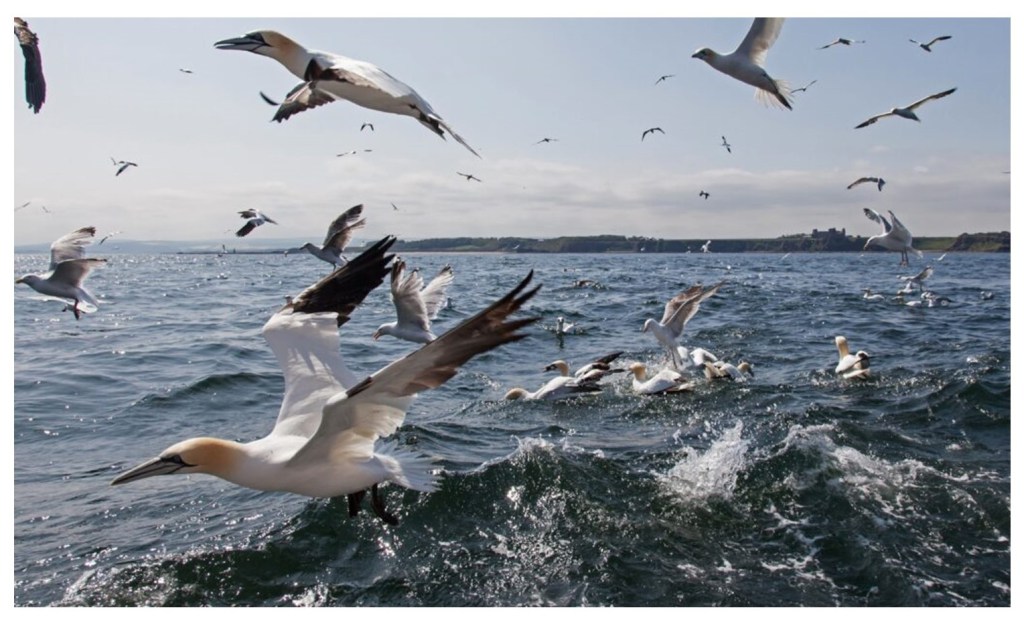
the gannets skimming the waves.
Stunningly beautiful.

Holy Island,
indeed.

Gill Henwood
October 2023

Northumbrian Gannets

Special places, Special people

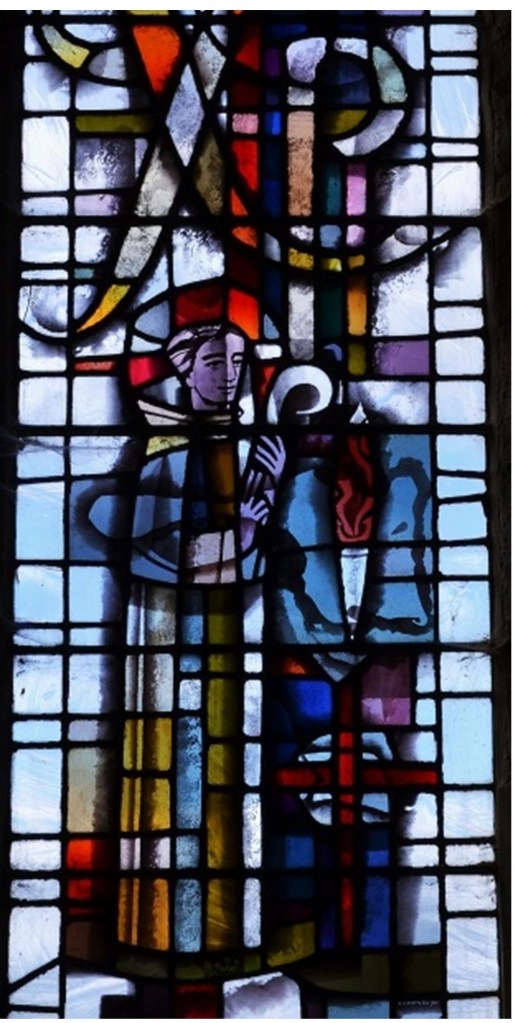
St Aidan window on Holy Island Church (St Mary the Virgin) detail.

In many journeys of faith there are special places that have spoken to us vividly about God.
The Celtic Christians called these the ‘thin places’ where the membrane which separates our world
from the world of heaven is so thin that it is easy for heaven’s spirit to burst through,
catching us up in a breathtaking experience of God’s nearness.
For me one very special ‘thin’ place will always be the Holy Island of Lindisfarne,
off the Northumbrian coast  between Bamburgh and Berwick-upon-Tweed.

It was to this island that St. Aidan came in 635AD.

He nearly didn’t come at all!
When King Oswald won back his Kingdom from the pagan king of Mercia,

he immediately sent to Iona for a monk to teach his people Christianity.
Oswald had spent many years in exile on Iona and there embraced the Christian faith.

His desire was that his people would also find a love for Christ.

The Abbot of Iona sent a monk who soon fell foul of the local people whom he branded as barbarians
and un-teachable. Returning to Iona he told his brethren what he thought and a gentle monk admonished him.
“I think, brother, that you gave them the meat of the gospel when what they needed first was milk.”

 Wise words but as so often happens, those who criticise (however gently) must be prepared to serve!  
Aidan was sent to Northumbria! There he set up his base in the place which, twice a day became an island—Lindisfarne.

Here he built a monastery and founded a school in which he taught 12 boys amongst whom
was the future St Chad, and his brother, St. Cedd as well as their two other brothers.

From this island a great mission began which was to take the Christian Gospel throughout the North and the Midlands and to Essex.

Because, initially, Aidan couldn’t speak the language, King Oswald went with him on his missionary journeys
to act as interpreter. One of the earliest examples of the co-operation between Church and State.

Lindisfarne remained a Christian centre until Viking raids led to the withdrawal of the monks.
Today it is once again a centre both of pilgrimage and prayer.

The local Church set up a Christian house for pilgrims known as Marygate House and it was here, in 1974 that I first came across Aidan and the spirit of the Celtic saints.
I have returned many times since and more than once I have experienced the sense of God’s nearness and presence. It truly is a ‘thin’ place.

Some, reading this will know exactly what I mean and will have their own ‘thin’ or special places (associated often with special holy Christians).
They are places where faith comes alive in a unique and special way. Such experiences carry us through the more mundane parts of our Christian journey.

What marks such places is that they are, in the words of the poet T.S.Eliot, places ‘where prayer has been valid’ – where prayer has consecrated them to God.

It strikes me that we should not have to travel far to find such places.

It is often the sincere prayer of ordinary Christians which makes a place holy.

One of my personal criteria when I visit, or worship in, a church is whether I can find God easily there.

A place where God can be found is a holy place, a thin place. It certainly needn’t be a church nor a place of special pilgrimage.

One of the holy and thin places I discovered is a slight bend in the rough hewn road which leads down from the Parish Church on Holy Island
to the shore which is opposite the crossing to Cuddy’s isles.

One day, when the island was clothed in a mist, I walked down this road and quite suddenly and totally unexpected, I found I had a companion.
I knew that it was St. Aidan whose simple presence touched me.

I knew at that moment I was on holy ground. I was at the thin place which is extraordinarily the meeting point between earth and heaven.
I can’t (and don’t want to) explain it in any other way.

Yet, whilst people like St. Aidan seem to be extra-holy, he would probably argue that he did nothing that all Christians can do,
which is to allow God to love them until they are on fire with God’s love.
That can be true for all of us and where it is then we become the ‘thin’ place where others can find God.

Photo: Gill Henwood

Aidan

You came on the flow tide
blown in, full of hope and zeal.
You carried the milk of the Gospel
but in your satchel, the firm, solid Good News waited to be heard.

The waves revealed the pilgrim way to Lindisfarne,
for its first journeying companion of Christ.

Those waves, a sign of what your Lord achieved through you:
first, lapping the hearts of those aspiring to know God,
then rushing in, hurrying to swamp the land with love:
a sea boiling with joy and hope and message.

Milk, then meat.
Quiet ripples, then mighty waters of God’s love and grace.

You were sent, Apostle to the North.
You came: a gentle breeze inspiring others,
awakening in them the wind of the Spirit.
Because of you, they stormed the Gospel message,
opening others to grace and truth,

to joy and love.

Mr G. | St Aidan’s Day, 2020