Tag: St Chad

Learning of God from Island Saints

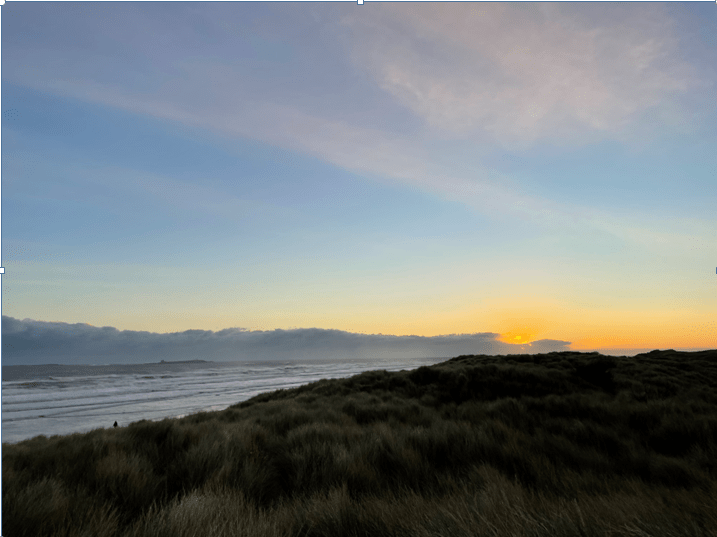
Sunrise from Lindisfarne over the Farne Islands, St Cedd’s day, October 26th 2025. Photo by Gill Henwood.

October 26th is St. Cedd’s Day:

The little that is known about Saint Cedd comes to us mainly from the writing of Saint Bede in his Ecclesiastical History Of The English People.
Cedd was born in the kingdom of Northumbria and brought up on the island of Lindisfarne by Saint Aidan. He was one of four brothers: Chad (originally Ceadda), Cynibil and Caelin being his siblings. The first datable reference to Cedd by Bede makes clear that he was a priest by the year 653. It is likely that Cedd was oldest of the brothers and was acknowledged the head of the family. While he was alive, he seems to have taken the lead, while Chad was his chosen successor.
Cedd was sent out from Lindisfarne to take the Gospel to Essex, landing after a sea journey at Bradwell where, today, there is still a Chapel built on the foundation of Cedd’s monastery.

As well as this mission, Cedd also established a monastery at Lastingham in the Cleveland Hills. From here he established a mission in North Yorkshire. When he died of the Plague, his brother Chad took over. Today, at Lastingham, the crypt chapel is said to date back to Cedd’s time.

Learning of God from Island Saints.

I come to this Holy place
where, when the tide turns,
silence and conversation
meld into stillness.
God is here.
His sanctuary, enclosed by the sea,
welcomes those who are seeking after meaning.

What am I looking for, here on Lindisfarne,  
where the spirit of Aidan
gathered together those chosen by God,
on whom the Saint poured out his soul,
his faith, into their waiting hearts?

I sense and seek the company
of those who first prayed here
through the storms of the sea, the blowing of the winds
sweeping over the Headland Heugh,
in the strange light of pale day
and the fading shadows of eventide.
In silence and in prayer; through learning and in listening;
by becoming steeped in God’s word;
twelve young monks, were inspired to mission the good,
Gospel news, of Jesus Christ.

Cedd and Chad, Cynibil, Caelin and companions
allowed Jesus to be etched upon their hearts,
discovering a love which must be shared.
How else would others inhale God’s blessing
and love in their own lives
and cause a world’s darkness to be bathed and transformed
by the dazzling  light of God’s Spirit?

And I, kneeling somewhere between the waves and shore
of my inner being, must hear anew this call
to open the Gospel pages illuminated by God within my soul,
that through me also
God may mission to others His amazing and saving Love.

Mr. G.
St Cedd’s Day 2025.

Dawn over Lindisfarne, taken from Bamburgh by Gill Henwood. St Cedd’ s Day 2025
St Chad

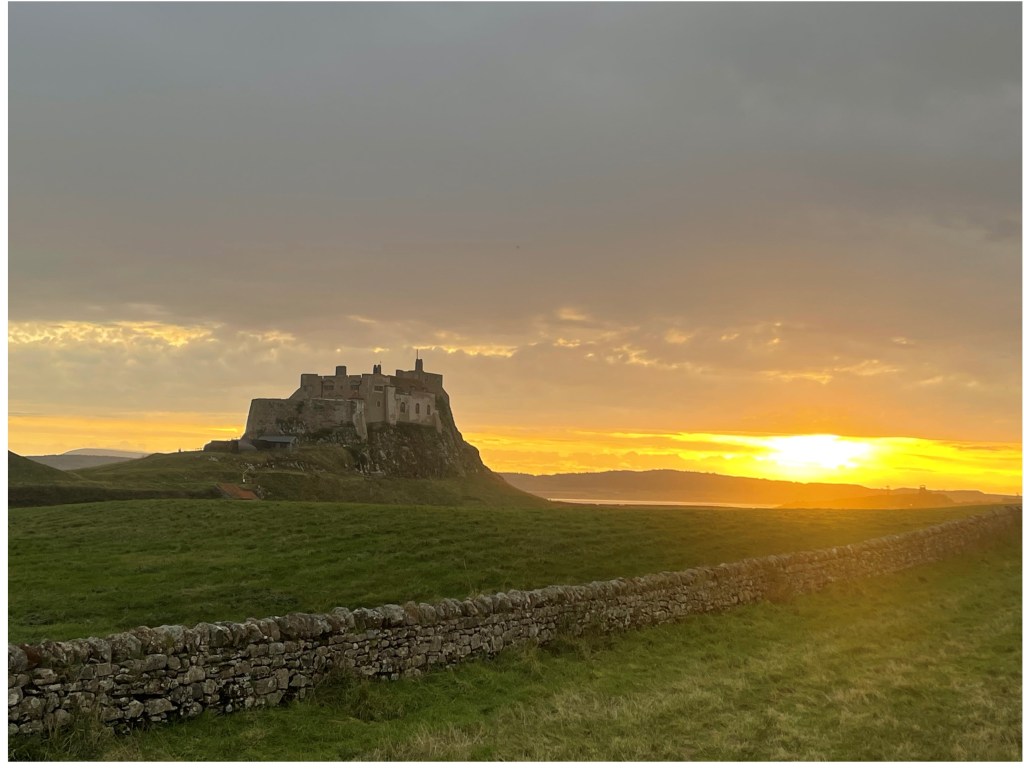
Lindisfarne, Evening Sun. Photograph by Gill Henwood.

St Cædda (St Chad) is commemorated on March 2nd.
When St Oswald sent to Iona for a monk to open up his people to the love of God in Jesus Christ, the community ultimately sent Aidan (the first monk they sent turned out to be rather disappointing!)  Aidan established his monastery on Lindisfarne, in Northumberland, known today as Holy Island. It was made holy, consecrated to God, by the mission St Aidan began. He first trained up 12 Anglo-Saxon boys in the faith, in prayer and in the ways of God. Of these, four were brothers. Two we know of because of their missionary work and because the Venerable Bede wrote of them. St Chad, after a time in the North-East of England, took the Gospel to the Midlands, establishing a church in Mercia at what is now Lichfield. His brother Cedd took the Gospel to Essex and then Lastingham in North Yorkshire. When Cedd died, Chad continued his work there.

Today Chad’s mission and ministry lives on in Lichfield Cathedral and Diocese, in the Roman Catholic Cathedral in Birmingham, in parishes and schools dedicated to him and in the College which bears his name in the University of Durham.

I couldn’t find a poem about him, so I wrote this one in honour of his saint’s day today.

Cædda (St Chad)

He found his place of Resurrection
deep in the Mercian woods,
near the church he founded.
Here, angels sang prayers of preparation,
bringing joyful messages from on high.
He heard his Lord, quietly whispering to him.
“Cædda, it is time.
You must come home now.”

It had been a great adventure,
beginning on that far off day when,
with Cedd and Cynbil and Caelin,
he crossed the Northumbrian water
following the calling Cross,
the hymns of birds and seals,
and the lapping mantra of waves,
to a place of welcome and warmth
and the great man who waited for them.

There were twelve in the end,
a band of brothers learning to get on together.
Celtic words taught to Anglo-Saxon minds,
merging with the language of Love.
Excitement and joy,
as slowly, but wonderfully,
they heard the words of God
swirling across the headland:
eddying Gospel syllables
bringing holiness to Cædda’s soul.

It was there, on that far shore,
that he found the dawn of his Resurrection.

[Mr G.]
St Chad’s Day March 2nd 2024

St Chad’s Birthday in Heaven.

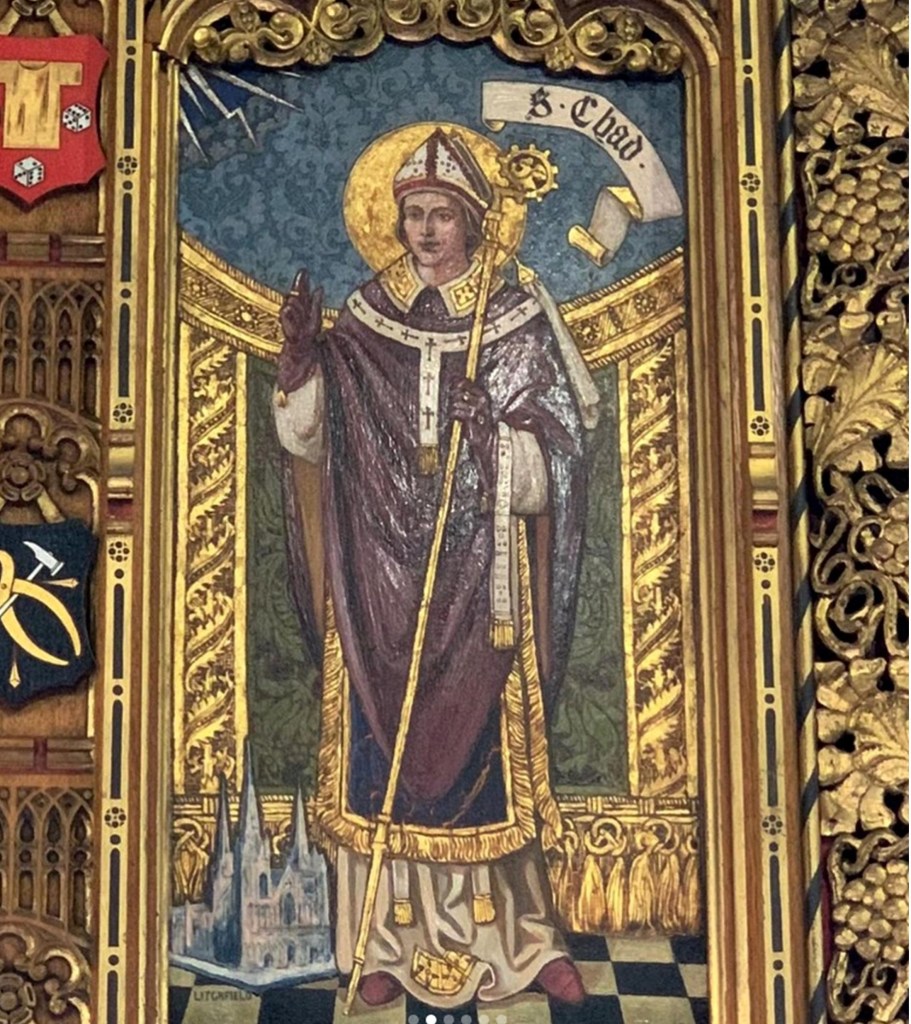
Detail from the Altar Reredos, St Chad’s College Chapel, University of Durham

Today, March 2nd, the Church keeps the feast day of St. Chad. In a rich and eventful life there is too much to mention, so I thought I would say something about his birthday into heaven.

Appointed  the first Bishop of Lichfield, in what was then the Kingdom of Mercia, Chad established his church and monastery there. Chad also sought solitude, in the custom of the Celts and Anglo-Saxons, by building a house away from the church to which he could retire quietly to pray and study whenever his missionary duties permitted. In Celtic style he also trained up others to carry out the work of mission, as he himself had been trained by St. Aidan on Lindisfarne.  One of those he trained was Winfrid who succeeded him as Bishop. him as Bishop. Chad was to be bishop for only three more years for in 672 the Plague struck again.

The Venerable Bede  in his Ecclesiastical History of the English Nation, records the event:

When he had ruled the church of the province with great success for two and a half years, heaven sent a plague which, bringing bodily death, bore away the living stones of the Church to the Temple in heaven.”

The date of his death was March 2nd 672.

It was accompanied by a premonition 7 days before it happened. A monk working outside Chad’s oratory heard a joyful melody of persons singing sweetly which descended from heaven into the bishop’s cell, accompanied by a great light. Half an hour later the sound ceased and Chad called the brother asking him to bring his companions. When they entered the oratory he urged them to preserve peace, be faithful in prayer and observe the discipline of the monastic life. He asked them to pray for him as he approached death and he begged them to remember their own deaths which would come at an uncertain hour – they must be vigilant, prayerful and given to good works,
The brother who had first heard the singing asked Chad from where it had come.“They were angelic spirits” replied Chad “who came to call me to my heavenly reward, Which I have always longed after.”
Shortly after he fell into the throes of his final illness which grew steadily worse until 7 days later, having received the eucharistic sacrament, he died – or as Bede puts it:
“his soul being delivered from the prison of the body, the angels, as may justly be believed, attending him, he departed to the joys of heaven.”

Bede then comments that “it was no wonder that he joyfully beheld the day of his death, or rather the day of our Lord, which he had always carefully expected till it came; for notwithstanding his many merits of continence, humility, teaching, prayer, voluntary poverty, and other virtues, he was so full of the fear (Love) of God, so mindful of his last end in all his actions…”

He died as he had lived, deeply within the love of God.
He combined the Celtic love of mission  with a firm conviction that nothing is accomplished without prayer.
His life was one of active Proclamation of the Gospel but whenever he could he would retire to the solitude of communion with God – a lesson he had well learned at Lindisfarne.
Whilst his call was to the Market Place of the world his heart was always travelling towards heaven.

[Mr G]