Tag: St John of the Cross

God’s calling card

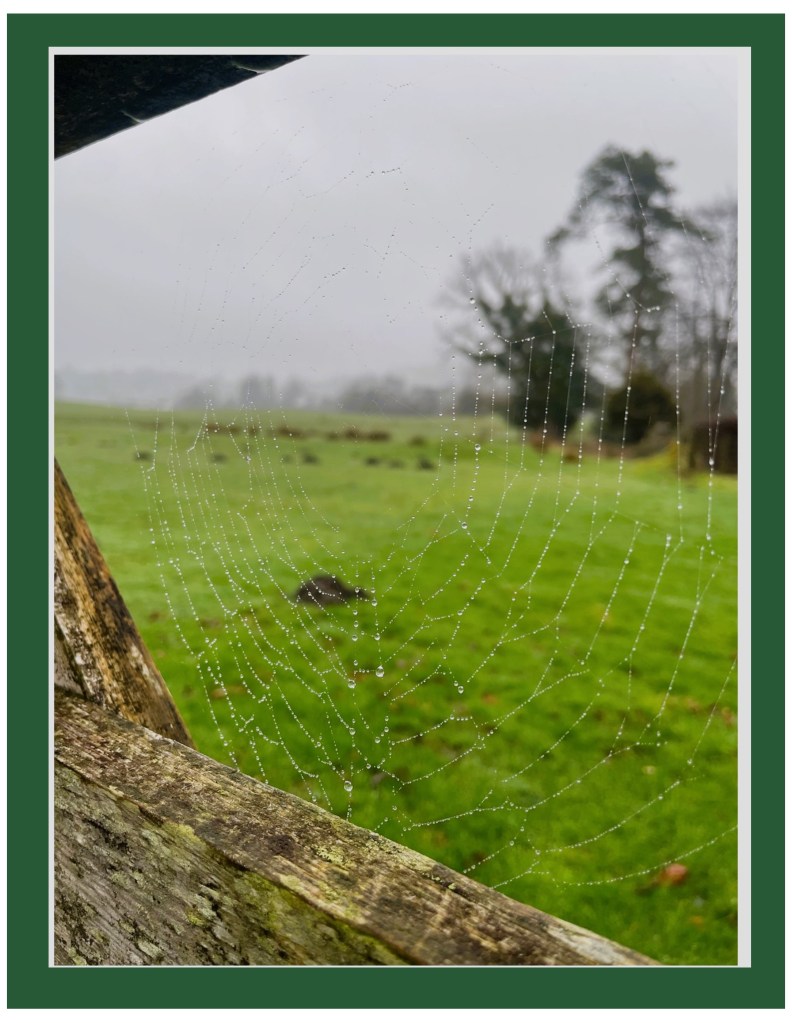
Dewdrops on spider’s web. photograph by Gill Henwood

My friend Gill has recently sent me this photograph of dewdrops on a cobweb near her home in the Lake District.
My thoughts centred on the fragility and ephemeral nature of the scene.  A word often associated with spiders’ webs is ‘gossamer’ – a fine filmy substance consisting of cobwebs spun by spiders; light, thin, delicate, almost insubstantial. Certainly short-lived. But another way of seeing it is that of a thin place, a tissue paper kind of boundary between two worlds.

‘Thin Place’ is an idea many of us use to describe places where God seems spiritually and, in a way, physically present to us.
Obvious thin places are religious shrines, like that at Santiago de Compostella where pilgrims walk from many places in Europe to the Northern area of Spain, to a journey end at the Shrine of St. James the Great there. When I made the pilgrimage there  a few years ago, I was deeply moved by the experience of God I had and I knew then what a thin place truly is.
There are many such places, such as Iona, the Holy Island of Lindisfarne and legions of other places. Every religion has such holy places which have been sanctified by God and by prayers of the pilgrims.
Not all are huge centres like Lisieux in Northern France or Lourdes where many go to pray for healing. Some are almost backwaters like Little Gidding near Huntingdon, Cambridgeshire. It is a quiet oasis and not that easy to find. However,  those who visit, certainly can say of it, words which the great poet T.S.Eliot coined in the Quartet Poem to which he gave it’s name. It is a place where Prayer has been valid. It is valid still. It is truly a thin place where it feels very easy to meet God.

Though all that is true, Gill’s photo reminds me that not all thin places are permanent nor beyond the immediate moment, spectacular. God sanctifies all our meetings with him, it’s just that we don’t often recognize it. (at least, I don’t !) I have to keep remind myself of something St. Teresa of Avila said – God walks among the pots and pans. Her soul friend, St John of the Cross, puts that rather more beautifully, when he says, “God passes through the thicket of the world, and wherever His glance falls He turns all things to beauty.”

In the spider’s web decorated with dewdrops we can be aware of that.
It becomes a way in which God reveals his presence and it is a personal revelation so everything could be experienced as  a thin place. Whether it be cleaning the dishes in the kitchen or catching our breath at some lovely sight in the world. Being touched by God, becoming aware of the spiritual in the midst of the ordinariness of life, can be a breath-giving moment. Such an experience can be seen as an act of love on God’s part. In such ways, he presents his ‘calling card’ to us
In the war torn areas of our world it may not seem like that but even there,maybe especially there, in kindnesses and moments when people are touched by love, care and by prayer,  almost unawares, certainly not always invited, God comes to call.

[Mr G]

Famous last words

St Non’s Well where St David is said to have been baptized near St. David’s. Photo Mr G

Not far from St. David’s Cathedral in Wales, there is a lovely scenic walk along the coastal headlands to a place where St. David is reputed to have been born in the 6th century.
It is said that David’s mother, Saint Non, gave birth to David in a house on the site of an ancient chapel and nearby there is a small well bubbling up from the ground and forming a little pool before cascading away. Today it is known as  St. Non’s Well  because tradition says that it first sprung up at the time David was born. The water is said to have healing and miraculous powers. It is regarded as one of the most sacred Wells in Wales. It certainly feels a holy place – one of those spots where you sense that God’s grace has been specially dispensed. Visitors to the well strew garlands of flowers and herbs in the pool of water and some, like me, fill water bottles with the crystal clear spring water. Cupping one’s hand and letting the water trickle through the fingers is a delicious sensation.

David himself was very fond of water – the only liquid he drank, except the wine of the Eucharist. He and his followers were known as the Aquati because of this.  Perhaps, too, David’s affinity with water stems from the legend which surrounds his birth. He is said to have been born in the midst of a terrific thunderstorm!

St. Non, David’s mother, was the daughter of a local chieftain and she is said to have been made pregnant (perhaps even by force) by Prince Sant of the royal house of Ceredigion. Some say he was King. Whatever the circumstance of the pregnancy, Sant seems to have tried to make amends by renouncing his kingdom after David’s birth and following the life of a hermit.

David himself eventually became a monk and a scholar. He is said to have founded 12 monasteries and certainly many came to him to learn the Christian faith. Of those, quite a few went on missionary journeys to Cornwall and to Brittany. There they established the faith and proclaimed the Gospel. David continued to live in Wales but his reputation for holiness and scholarship, as a spiritual warrior,  spread throughout Europe.

He and his monks lived a simple life of prayer, worship and study. They ate frugally on a diet of vegetables with water. Not all his monks approved of this and it is said that a group of them were so fed up that they tried to poison him! Hagiography is not always noted for its accuracy!

It was as death approached that David prepared himself for his final words to his monks and nuns. According to his chief biographer, Rhgyfarch, himself a son of a later Bishop of St. David’s, David gathered his loved ones to his side and spoke these words:

The little things which David taught included prayer, being present for the breaking of bread at the Eucharist; reading scripture; speaking only when necessary and helping the poor. He believed also that we should have a deep respect for others. Learning to listen to each other with real love is a way towards greater understanding but it also leads to godliness. We are encouraged to be lowly, possessing a humility which never expresses itself arrogantly and which steers us away from pride. He also set great store on hospitality – always being ‘at home’ for others and for God – having time for both.
There are so many big, dark things happening in our world today and we might wonder what doing some little things can make such a difference. You would be amazed – in fact do be amazed!

It is the little things we do in Christ’s name which matter most. Mother Teresa of Calcutta expressed much the same thing when she said that she and her sisters didn’t do great things but rather little things with a great love. St. David would have approved of that.
Mother Teresa points us to one particular thing we can do more than anything else and it is suggested by the lovely Saint John of the Cross.

That will change everything in a world of great sorrow and need.

[Mr G]

All is beauty

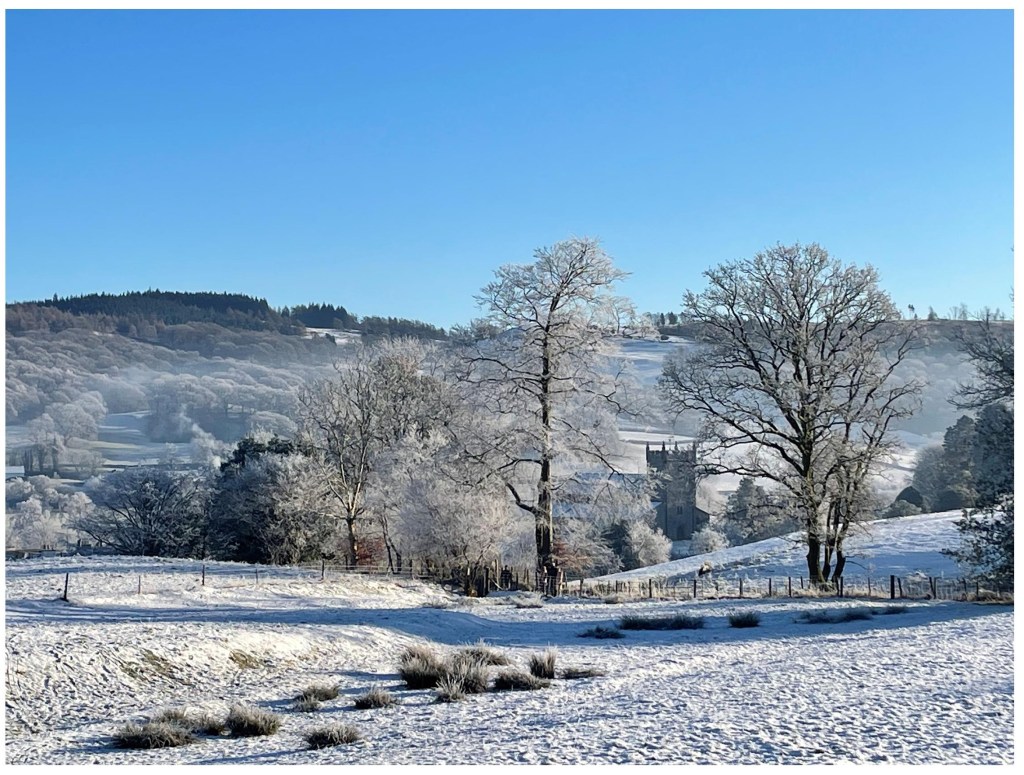
The photograph of Hawkshead is by my friend, Gill Henwood.
The quotation is by St John of the Cross whose feast day is December 14th.

John of the Cross was regarded as one of the greatest Spanish mystics of the sixteenth century.
His writings still nourish modern Christians in their hunger for a true experience in the spiritual life.
He was born in 1542 and became a Carmelite friar at the age of twenty-one. Four years later he met Teresa of Avila in one of those God-moment meetings were two souls are fused together by the love of God, for the greater good of Christianity.
Teresa was occupied in reforming the Carmelite Order, instilling renewed vision and discipline and founding many new Convents of Prayer throughout Spain. John of the Cross joined her in this work. He served as a spiritual guide to the nuns and to Teresa herself. He was one who encouraged her to write her teaching on Prayer. His prominence in the reform movement made him a target for those who preferred the more comfortable old ways and twice he was abducted and imprisoned. After Teresa died, he was again targeted, this time by his own superiors in the Reformed Carmelites. Their harshness contributed to his death in 1591.
Nothing, however, took him away from his love of God and he gladly accepted the hardships because he saw them as sharing in the sufferings of Jesus on the Cross. Hence his name.

Like Teresa, he experienced the presence of Christ in “intellectual visions.” His reflection upon these experiences issued, first of all, in poetry of extraordinary power and beauty. At the urging of his disciples, he selected a number of his poems and produced prose commentaries on them, which have become classics of mystical theology. This includes one of his most famous writings on The Dark Night of the Soul.

John united the vocation of a theologian with the experience of a mystic, and his writings are the good example of theology as the fruit of prayer.

The most lovely thing that was ever said about him was by St Teresa.  “I cannot be in the presence of John without being lifted up into the presence of God.”

John said, himself, about God:

How gently and lovingly
You wake in my heart,
where in secret You dwell alone;
and in your sweet breathing,
filled with good and glory
how tenderly You dwell in my heart
with love
.

from, The Living Flame of Love by St. John of the Cross

and here is something for us to ponder over and pray about, applying it to ourself.

God is more pleased by one work, however small, done secretly, without desire that it be known,
than a thousand done with the desire that people know of them.
Those who work for God with purest love not only care nothing about whether others see their works,
but do not even seek that God himself know of them.
Such persons would not cease to render God the same services, with the same joy and purity of love,
even if God were never to know of these.”

― John of the Cross, The Collected Works of Saint John of the Cross

[Mr G]

Love remains

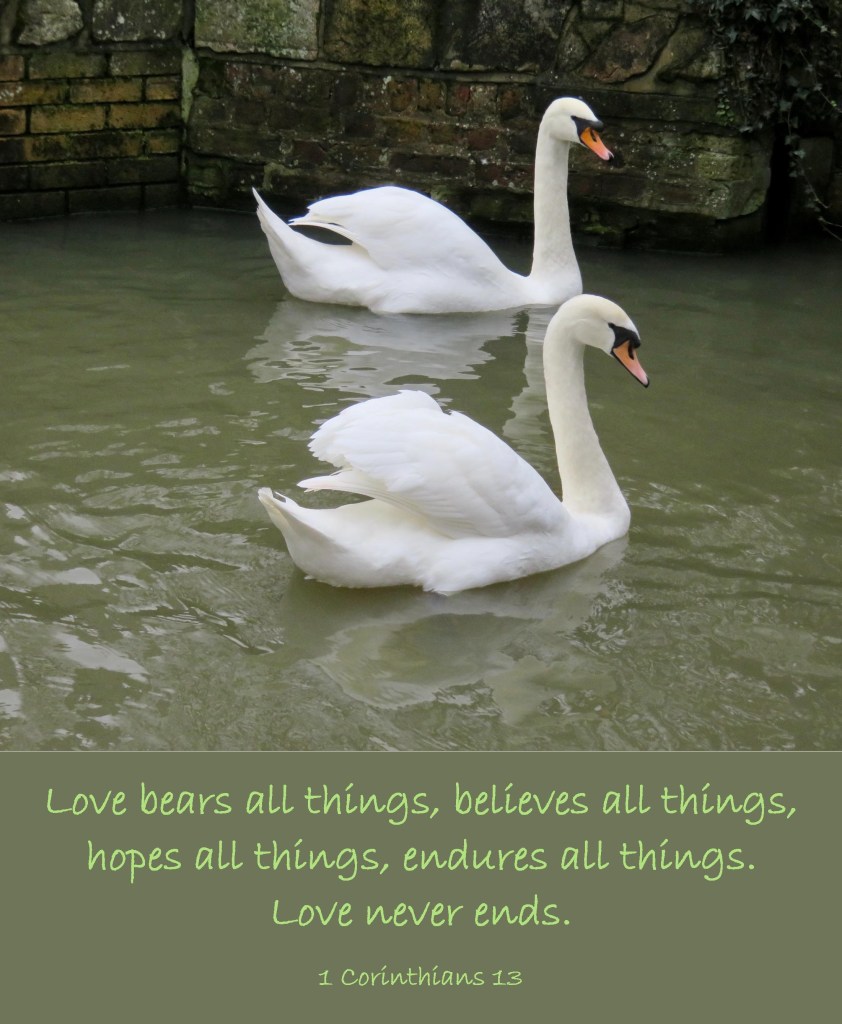
Photo Tweet from Joyce Smith

My friend, Joyce, has sent me this photo of two companionable swans, making gentle progress in the canal waters. They are contendedly together as love flows between them. The Caption from St Paul’s first letter to the Corinthians is well known but perhaps less pondered because of that.
Joyce says that :
In these dark times, these words of love bring light and hope.
That light and hope comes to us through God.

During Lent we Christians are invited by God to understand more deeply that the Victory of Christ on the cross is really life-changing and that this change comes about not because of something we do but of realizing that God has done, and goes on doing, something so powerful in our lives through Christ on the Cross.
He has  loved us totally and completely and through that Love he has drawn us into himself so that, as Paul tells the Galatians (2:20)

It is no longer I who live, but it is Christ who lives in me.

In order to die to self and live for, and in, Christ we are, says Jesus, to take up our Cross and follow him.
He is not asking for heroics. He is not asking us to search for some impossible burden to carry, some suffering to undergo.
He is asking us to commit ourselves to carry the sign of God’s love in our lives. It is the power of that love to transform that makes the real difference
For that to happen, the Love of Christ must rule our hearts, our lives – come what may.

Many years ago, a young Russian priest was imprisoned at the beginning of the Russian Revolution.
Years later he was released from prison. He was a broken man.
His friends asked him, “What is left of you?”
“Nothing” he replied, “nothing is left. They have burnt out everything. Only love remains.”

That priest had discovered the one thing that changes every human situation and disarms every human conflict – sacrificial love.
Only Love remains – that is what is necessary for Christ to change the world – and he does it through us. When we abide in God’s love, totally, then, as we walk around the area where we live, it will become a changed and different place. Our approach to others will be different, generous, kind and joyful.

The darkness of our present situation in the world can easily lead to despair and a sense of futility but we are called to be, increasingly, signs of God’s amazing, long suffering and transforming love. We are called, in fact, to carry that love into all the world’s dark places and into hearts that have turned away from love.
On the Cross the victory of Jesus was the triumph of love over all that is not love. It was a cosmic battle to proclaim God’s power over demonic and destructive forces which threaten to swamp the world with evil, hatred, self absorbtion and oppression.
Against this darkness and evil we are to love and go on loving for, as the great mystic, St John of the Cross, put it so powerfully:

“Where there is no love, pour love in, and you will draw love out.” 

[Mr G]

Cartoon by Charlie Mackesy who speaks profoundly through humour

Thank you Joyce for your inspirational photo & text