Today, the Christian church keeps the festival day of St. John the Baptist.
There is another feast day later in the year when we mark his beheading at the hands of King Herod. Today, however, it is a joyful day, possibly helped by the fact that in the Northern Hemisphere it is Mid-Summer!
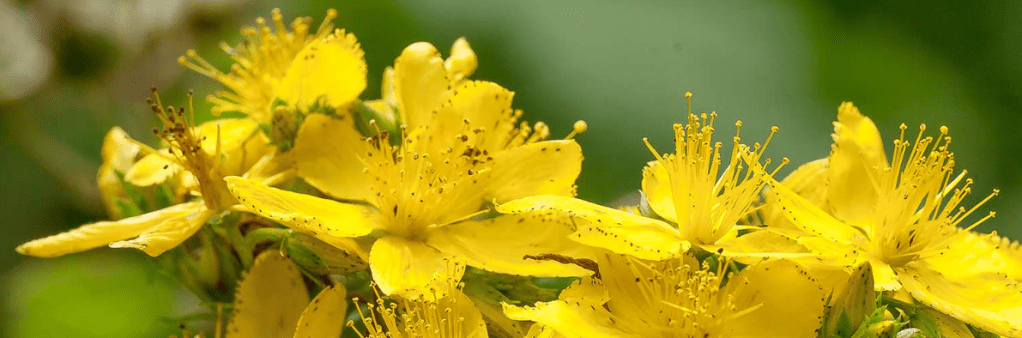
One of the things that marks this as a special time for all sorts of people is that it is also associated with a special flower, The Hypericum, or to give it its posh name, Hypericum perforatum. A native of Europe but now flowering in many other places worldwide (except for Siberia and other cold extremes),it is a bright flower marking bright summer. The dominant colour is vivid yellow, its petals often decorated with black dots. It generally has five petals with five smaller leaf-like sepals below them.
Hypericum is made up of two words from Greek – Hyper meaning above and eikon meaning picture. This may well date back to a custom, in earlier times, of hanging the flower over an Icon (sacred picture) in the home.
This really introduces us the other name for this plant which is St John’s Wort.There is a direct association with St John the Baptist in the flower itself. It has been suggested that the five petals form a halo, a symbol of saintliness. The red juice which is released when the stem is crushed, represents the blood of the martyred saint.
St John’s Wort is also known for its healing properties and in various forms is a wort or salve (0intment). In earlier times it was used, therefore to ward off evil spirits; safeguard against sickness, protect against the bad things in life. This made the plant special in the nature of healing and it is still offered as an alternative medicine. It is however toxic to some animals and even humans so should be used carefully and advisedly.
Its power and that of St John the Baptist, is, however feted in an anonymous 14th Century Old English poem:
St Johns wort doth charm all the witches away.
If gathered at midnight on the Saints holy day.
And devils and witches have no power to harm
Those that do gather the plant for a charm.
Rub the lintels and post with that red juicy flower
No thunder nor tempest will then have the power.
The ministry of healing, offered by John the Baptist to the people who heard his message was a more powerful salve. He was known in the Gospel as the Forerunner the one who prepared the way of Salvation through God’s Son, Jesus.This Salvation is God’s healing of a broken and unloving world and Jesus his beloved Son His Salve, is the ointment of God’s Saving Love.
John the Baptist led the way to Jesus through his baptism of Repentance, a Baptism which Jesus enhanced through his own life and ministry, death and resurrection. It is possible to say that it is in Baptism that we receive the Healing of God, the Salve which invites us to partake of the Salve of eternal life.
Another title by which St John the Baptist is known is that of Friend of the Bridegroom.
He knew Jesus through a life lived in friendship with God. Friendship brings its own healing and when we are in friendship with God we are touched by the salve or Wort of his love and friendship for us.
Often when we visit friends we take them flowers. Receiving flowers can brighten and change the direction of our day and even our life. Giving them is even better! The love behind them is better still.
St John the Baptist offers us not St John’s Wort but the love and friendship of the giver, the Lord, our SALVE-ation, who loved us a into being created us to be bright with His image.
[Mr G. Nativity of St John the Baptist. 2025]
 Mr G's Ponderings