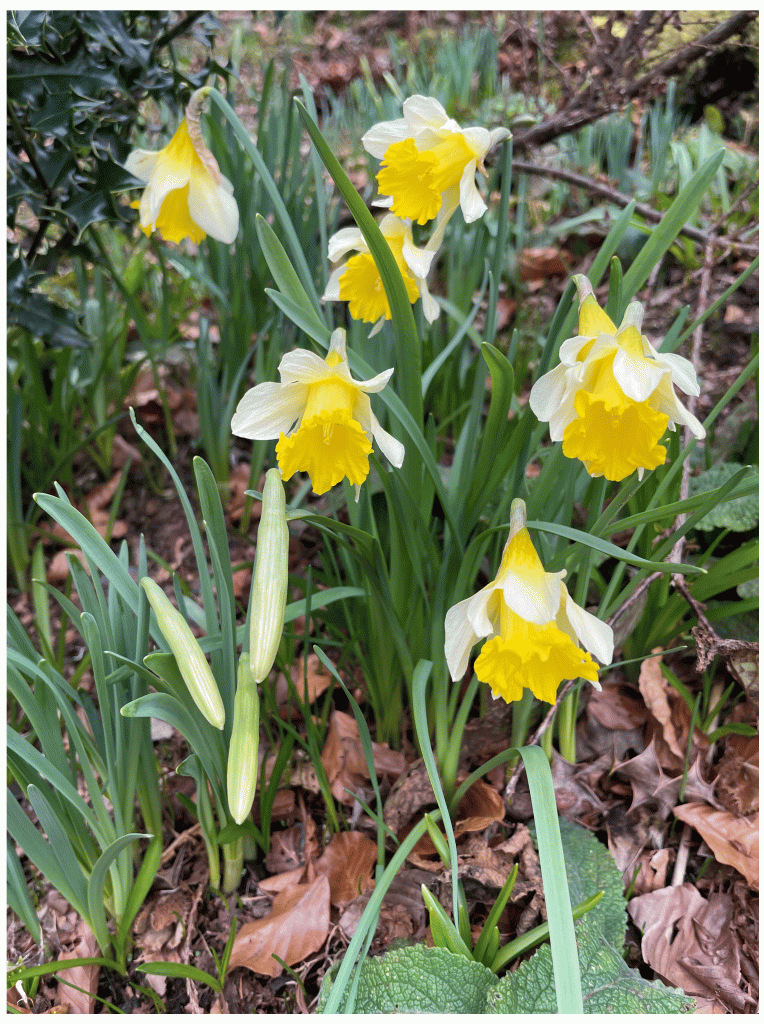
One of the emblems of Saint David ~Daffodils. Photographed by Gill Henwood in their natural habit.
Today, March 1st, we celebrate St. David’s day, though perhaps not as boisterously as some Welsh people may do! I once had a memorable visit to St. Davids in Wales, an highlight of which was a cliff-top walk which led to St. Non’s Well. (St. Non was David’s mother). The well is reputedly where David was baptized and today it is still flowing gently and pilgrims strew flowers on its waters. David himself was very fond of water – the only liquid he drank, except the wine of the Eucharist. He and his followers were known by the Latin word Aquati meaning ‘water drinkers’,because of this.
Through living simply with God and teaching of the Love of Jesus, David lay down a pattern of life for his own disciples to follow. On his deathbed he reminded his monks of this in his final words to them (and therefore, to us): “Brothers and sisters, be joyful Keep the faith and do the little things that you saw and heard from me.”
The little things which David taught included prayer, being present for the breaking of bread at the Eucharist; reading scripture; speaking only when necessary and helping the poor. He believed also that we should have a deep respect for others; that we should always be lowly, possessing a humility which never expresses itself arrogantly and which steers us away from pride. He also set great store on hospitality – always being ‘at home’ for others and for God – having time for both. These ‘little’ things are the bedrock on which faith is built. Neglect of them leads to spiritual deprivation. Attention to them leads to faith expressed joyfully. It is the little things we do in Christ’s name which matter most.
Mother Teresa of Calcutta expressed much the same thing when she said that she and her sisters didn’t do great things but rather little things with a great love. St. David would have approved of that.
During this season of Lent we might try to improve our understanding of faith and pay more attention to the little things which build it up. The obvious faith-building things of prayer, bible and worship combined with a concern for the poor need our attention as much as anything else. We also should pay more attention to others especially when there is disagreement and difference of opinion between people and groups. Learning to listen to each other with real love is a way towards greater understanding but it also leads to godliness. Allowing our hearts to be open to others is real hospitality, especially because, quite often, whenever we open ourselves to others, God can also slip into our hearts and feel ‘at home’ with us.
This is certainly much more to be desired than trying to impose our opinion and views upon others!
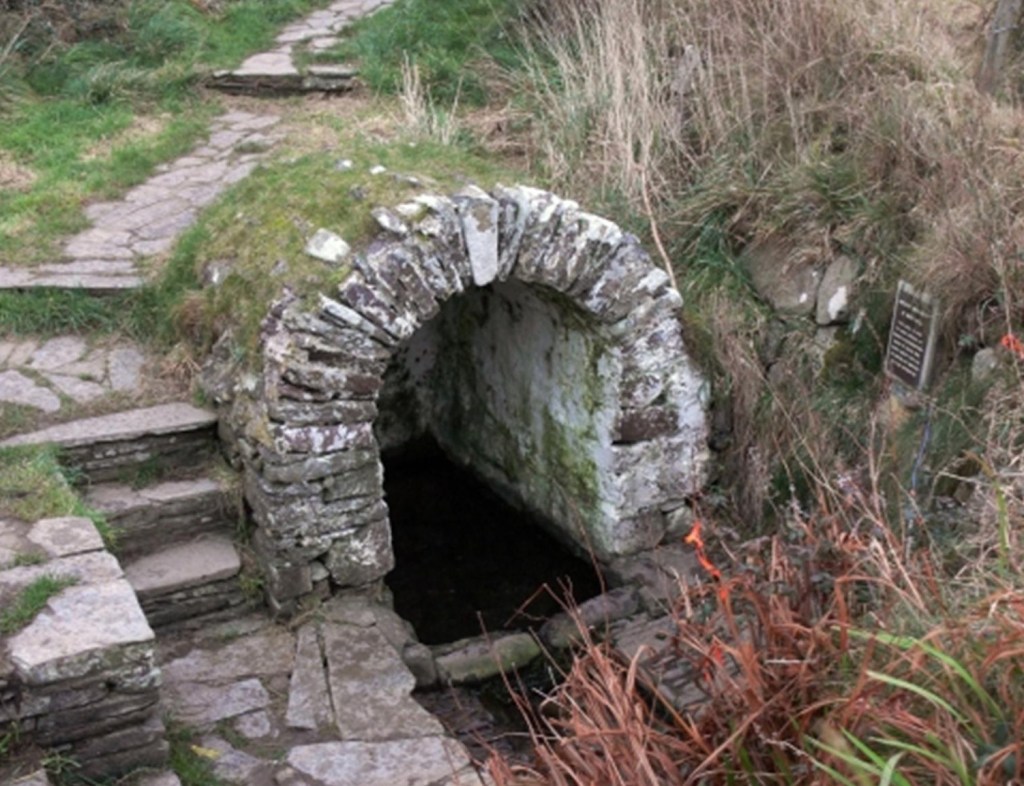
St Non’s Well where St David is said to have been baptized near St. David’s. Photo Mr G
‘Gwnewch y pethau bychai’ – do the little things.These are the famous last words of St. DAVID (Dewi Sant). We remember them especially today, the 1st March) which is his feast day.
Not far from St. David’s Cathedral in Wales, there is a lovely scenic walk along the coastal headlands to a place where St. David is reputed to have been born in the 6th century. It is said that David’s mother, Saint Non, gave birth to David in a house on the site of an ancient chapel and nearby there is a small well bubbling up from the ground and forming a little pool before cascading away. Today it is known as St. Non’s Well because tradition says that it first sprung up at the time David was born. The water is said to have healing and miraculous powers. It is regarded as one of the most sacred Wells in Wales. It certainly feels a holy place – one of those spots where you sense that God’s grace has been specially dispensed. Visitors to the well strew garlands of flowers and herbs in the pool of water and some, like me, fill water bottles with the crystal clear spring water. Cupping one’s hand and letting the water trickle through the fingers is a delicious sensation.
David himself was very fond of water – the only liquid he drank, except the wine of the Eucharist. He and his followers were known as the Aquati because of this. Perhaps, too, David’s affinity with water stems from the legend which surrounds his birth. He is said to have been born in the midst of a terrific thunderstorm!
St. Non, David’s mother, was the daughter of a local chieftain and she is said to have been made pregnant (perhaps even by force) by Prince Sant of the royal house of Ceredigion. Some say he was King. Whatever the circumstance of the pregnancy, Sant seems to have tried to make amends by renouncing his kingdom after David’s birth and following the life of a hermit.
David himself eventually became a monk and a scholar. He is said to have founded 12 monasteries and certainly many came to him to learn the Christian faith. Of those, quite a few went on missionary journeys to Cornwall and to Brittany. There they established the faith and proclaimed the Gospel. David continued to live in Wales but his reputation for holiness and scholarship, as a spiritual warrior, spread throughout Europe.
He and his monks lived a simple life of prayer, worship and study. They ate frugally on a diet of vegetables with water. Not all his monks approved of this and it is said that a group of them were so fed up that they tried to poison him! Hagiography is not always noted for its accuracy!
It was as death approached that David prepared himself for his final words to his monks and nuns. According to his chief biographer, Rhgyfarch, himself a son of a later Bishop of St. David’s, David gathered his loved ones to his side and spoke these words:
Be joyful and keep the faith and do the little things that you saw and heard from me.
The little things which David taught included prayer, being present for the breaking of bread at the Eucharist; reading scripture; speaking only when necessary and helping the poor. He believed also that we should have a deep respect for others. Learning to listen to each other with real love is a way towards greater understanding but it also leads to godliness. We are encouraged to be lowly, possessing a humility which never expresses itself arrogantly and which steers us away from pride. He also set great store on hospitality – always being ‘at home’ for others and for God – having time for both. There are so many big, dark things happening in our world today and we might wonder what doing some little things can make such a difference. You would be amazed – in fact do be amazed!
It is the little things we do in Christ’s name which matter most. Mother Teresa of Calcutta expressed much the same thing when she said that she and her sisters didn’t do great things but rather little things with a great love. St. David would have approved of that. Mother Teresa points us to one particular thing we can do more than anything else and it is suggested by the lovely Saint John of the Cross.
Where there is no love, put love in, and then you will draw love out!
That will change everything in a world of great sorrow and need.
these stunning Daffodils are the work of my artist friend, Kay Gibbons. They remind us that the Daffodil is the National Flower of Wales and an emblem of St David (Dewi) , Patron Saint of Wales
Today, March 1st, the Church celebrates St. David’s day though perhaps not as boisterously as some Welsh may do! He is, after all the Patron Saint of Wales. I once had a memorable visit to St. David’s, the highlight of which was a cliff-top walk which led to St. Non’s Well (St. Non was David’s mother). The well is reputedly where David was baptized and today it is still flowing gently and pilgrims strew flowers on its waters.
David himself was very fond of water – the only liquid he drank, except the wine of the Eucharist. He and his followers were known as the Aquati because of this. Perhaps, too, David’s affinity with water stems from the legend which surrounds his birth. He is said to have been born in the midst of a terrific thunderstorm! St. Non, David’s mother, was the daughter of a local chieftain and she is said to have been made pregnant (perhaps even by force) by Prince Sant of the royal house of Ceredigion. Some say he was King. Whatever the circumstance of the pregnancy, Sant seems to have tried to make amends by renouncing his kingdom after David’s birth and following the life of a hermit.
As a Christian leader David has been described as an athlete of the spiritual life who pressed himself to the limits of human endurance. However, what he expected of himself he did not demand of others whom he treated with deep compassion, especially the poor and the sick. On his deathbed, his monks gathered around him and he spoke his final words to them and it is these which mark him out as a man of holiness whose heart was touched by God. This is what he said: Brothers and Sisters, be happy and keep your faith and your belief, and do the little things that you have heard and seen me do.”
The little things which characterized David’s own approach to life were (a) to respect others and have a deep care for the poor; (b) to live in lowliness, which can be read as meekness and humility and thus live a life of simplicity, never expressing oneself arrogantly and (c) be at home to others. This is about practicing the deeply held monastic ideal of hospitality in which Christ is recognized in everyone. Not a bad thing our world today, where so many are ill-treated, isolated and ignored. Loneliness is one of the great diseases of our time and hospitality which recognizes people’s worth as carriers of the image of Christ ,would do much to relieve this. These little things are undergirded and fed by prayer and by being present for the breaking of bread at the Eucharist; and reading scripture; He also set great store on hospitality. One of David’s early biographers with a personal knowledge of him said that he was constantly feeding a multitude of orphans, wards, widows, needy, sick, feeble and pilgrims.
Drawing on the example David set, a modern writer on Welsh Spirituality, Patrick Thomas wrote:
“In any community apparently insignificant acts of habitual kindness and self-forgetfulness which display a fundamental respect and love for others can generate stability, unity and wholeness. On the other hand, acts of unkindness or contempt, however superficially trivial, can quickly lead to the disintegration of a society as feuds develop and are fuelled by an unwillingness to forgive.”
Insignificant acts of kindness which takes us outside ourselves is at the heart of what David meant when he spoke of doing the little things. These ‘little’ things are the bedrock on which faith is built. Neglect of them leads to spiritual deprivation. Attention to them leads to faith expressed joyfully. It is the little things we do in Christ’s name which matter most. Mother Teresa of Calcutta expressed much the same thing when she said that she and her sisters didn’t do great things but rather little things with a great love. St. David would have approved of that.
Encouraged by St David we might practice a truth that whenever we open the door to our hearts and show genuine love, acceptance and joy towards others, we can be sure of one thing – God will slip into our lives and make himself ‘at home’ with us.
St Non’s Well where David is said to have been baptized Photo Mr G
There is no barrier between two worlds in the Church. The Church militant on earth Is one with the Church triumphant in heaven, And the saints are in this Church which is two in one. They come to worship with us, our small congregation, The saints our oldest ancestors Who built Wales on the foundation Of the Crib, the Cross and the Empty Tomb. And they go out as before to travel their old ways And to evangelize Wales.
I have seen Dewi going from shire to shire like the gypsy of God, With the gospel and the altar in his caravan; He came to us in the colleges and schools To show us the purpose of learning. He went down into the pit with the coal miners And shone his lamp on the coal face. He put on the goggles of the steel worker, and the short grey overall And showed the Christian being purified like metal in the furnace. He brought the factory people into his disreputable Church.
He carried the Church everywhere Like a body with life and mind and will, And he did small things and great.
He brought the Church into our homes, Put the holy vessels on the kitchen table With bread from the pantry and wine from the cellar, And he stood behind the table like a tramp So as not to hide from us the wonder of the sacrifice. And after the Communion we had a talk round the fire And he spoke to us of God’s natural order, The person, the family, the nation and the society of nations And the cross which prevents us from making any of them into a god. He said that God had made our nation


 Mr G's Ponderings