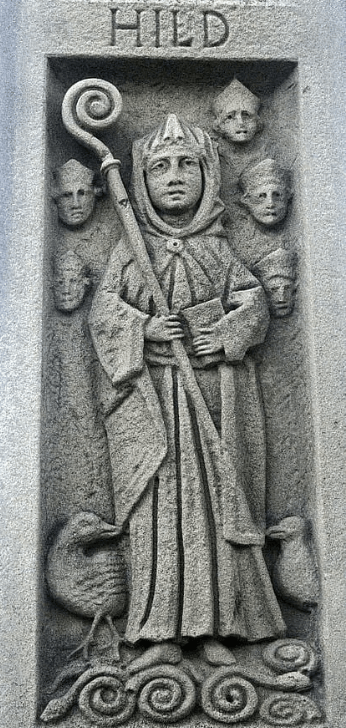
This week, the church keeps the feast of St. Hilda (or to give her the Anglo-Saxon name, Hild).
She was born into the Northumbrian royal family and for the first 33 years of her life led a very different life to the one God was to lead her.
For that call God used the voice of St.Aidan of Lindisfarne. He was the monk from Iona who brought the Gospel to the North East of England and in his monastery on Holy Island he trained up Anglo-Saxon boys to become Missionaries to many parts of England as well as the Scottish borders.
Part of Aidan’s mission plan was to establish religious power houses, monasteries from which further missions could be launched.
These religious houses were built on Prayer and cemented by the Gospel of Jesus Christ as well as translated into Christian Service.
One day, in obedience to God’s plan, Aidan summoned Hild to meet him on the banks of the river Coquet south of Bamburgh.
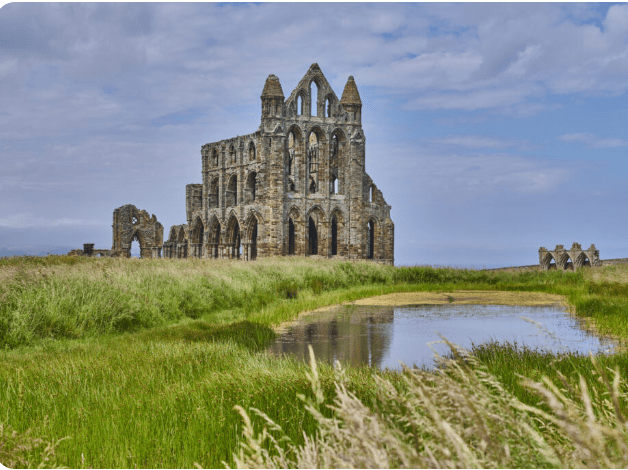
Here he told her God’s plan for her. She was to establish a religious house, first at Wearmouth and then on the Headland at Hartlepool. From there she was to go on to established her most famous foundation at Whitby (Or Strines at it was then known).
It was to be a ‘double’ monastery in that two monasteries were built side by side, one for men and the other for women.
Hild was to be the Abbess of both.
As Abbess she ruled over both monasteries and was, in effect, the head.
This may surprise some but Aidan belonged to the Church of the West which we call Celtic but which was really Irish. In Ireland women had equality of status with men and particularly in the Church.
Aidan saw no reason why this equality should not be established in England too.
It was only later when the Church of Rome grew in strength that this practice was challenged.
The Venerable Bede, to whom we owe much of the story of Christianity in Britain, and who, if pressed was more generous in his comments about Roman practice, recognized Hild’s specialness and greatness.
He wrote of her:
“All who knew abbess Hilda, the servant of Christ, called her Mother because of her wonderful devotion and grace; she never ceased to give thanks to her Maker or to instruct the flock committed to her care.
Not only was Hilda an outstanding example of holy life to all who were in her monastery, but she also provided an opportunity for salvation and repentance to many who lived far away, and who heard the happy story of her industry and virtue.”
Under her guidance the Abbey at Whitby grew in stature, capturing her devotion to Christ and the gift of holiness showered upon her by God.
Her advice and prayer was sought after by ordinary folk as well as those of royal birth. She compelled all who were under her instruction to devote so much time to the study of the holy Scriptures and so much time to doing good works that many came to have an enriched and deep faith.
She was also, because of God’s Providence, the right person in the right place at the right time.
It was at her abbey at Whitby that the Church met for an important Synod in 664AD. It brought together Roman and Irish Christians who had differing views on issues such as the date of Easter, the way Baptism was administered, who could ordain and other matters. Hilda favoured the Celtic/Irish view of things but the Roman view prevailed.
This caused a big rift in the Church and it fell to Hilda, along with her friend St. Cuthbert, to try and reconcile the various factions.
To the degree that she was quite successful shows her, not only, to be a person of generous spirit but also one who had a gift of diplomacy.
Hilda, who had sided with the Irish, kept her cool, and she set about healing the divisions which split the Church. With quiet diplomacy, authority and fortitude, she brought the wounded church to some kind of healing from which it was to move forward.
Perhaps because of this she has been described as a ray of light in darkness.
One of the qualities which disciples of Christ are encouraged to seek and use are the gifts that God gives us.
We are all called to support and encourage each other to grow in discipleship by discovering and offering our gifts to God and his people.
An example that we all have gifts but need others to encourage us to find and use them, comes from something Hild did.
It concerns a cowherd called Caedmon, who though not a monks, worked at the monastery and shared its life.
One day he was heard singing. His voice was angelic.
Hild heard of it and sent for him. She encouraged him to write songs that were formed from verses of the Bible.
Soon Caedmon was singing the Scriptures and so edified others. He was encouraged by Hild to use his God-given talents. He became a monk and he was England’s first poet.
Little of his work remains today – just six lines – but his prolific outpouring was well chronicled.
Hild brought out the image of Jesus Christ in people because she lived in God’s brightness.
Today, she Is offered to us as a beacon in our own darkened world and, at times, church. When we are up against it in both world and church, Hild reminds us of a deeper truth and of a greater world. A world where Angels dance and sing; a world where those who die are loved by the Lord into eternal life; a world where we have a joyful witness to carry out. Hilda served this world but her heart was always in another world. Her soul belonged to God and it was in God’s presence that she continually lived. The novelist T H White once wrote that : There is another world and it is in this one.
By which is meant that we are surrounded by the world of God which constantly embraces us and holds us in love.
We don’t have to search for this world by looking up but by feeling it around us. We touch it in prayer; we hear its voice in Scripture; we are fed by it in Worship and we celebrate it in each other.
That is what gave Hild the impetus to serve God and to touch hearts and lives with his Love.
She also shows us a very important truth, often forgotten, that in the eyes of God we are all equal and we are all part of his inclusive love.
We are tasked to discover what that means in a world which acts differently, where lies are easily told and truth is discarded and which uses words rather than actions – e.g. what can we least get away with in global gatherings; A world where refugees are used as pawns and for political ends, a world which defames people of colour and people of differing gender, and a world which still treats women abominably.
I wonder what Hild would do in our world?
I expect she would have sharp words and strong opinions but she would carry these in love, in prayer and in care to God, with repentance for our shortcomings but with a depth of hope in her heart that, despite everything, God’s world will continue to break through and make everything new.
But I suspect she would want each of us to join in making real the vision of a world ruled by Love, Care and kindness.
A world she discovered for herself is found in God alone.
There is an Anglican religious community nearby.
There is a lively and faithful parish church in Whitby and
other Christian congregations.
[] [] [] The Statue of Hild pictured above includes coiled ammonite fossils
at St Hilda’s feet – a reference to a legend in which she turned snakes
which plagued Whitby, into stone.
The image was made available by Wilson44691, uploaded by Arienne King
and published on 20th April 2019. The Copyright holder has made the image available and licensed
in the ‘Public Domain’ and specifically made it available for copying purposes.
[Mr.G]
 Mr G's Ponderings