Tag: Venerable Bede

A Ray of Light in darkness

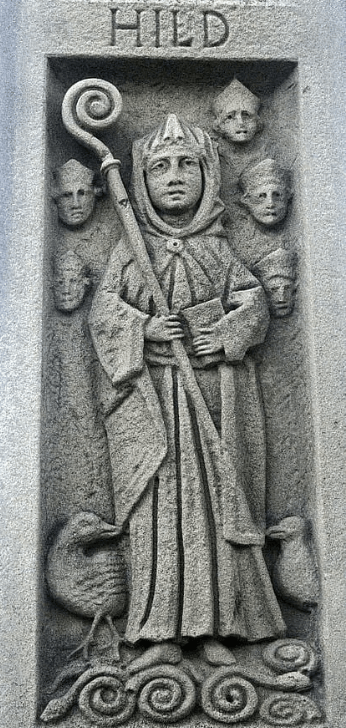
St Hild, detail from a monument to Hilda of Whitby.

This week, the church keeps the feast of St. Hilda (or to give her the Anglo-Saxon name, Hild). 

She was born into the Northumbrian royal family and for the first 33 years of her life led a very different life to the one God was to lead her.
For that call God used the voice of St.Aidan of Lindisfarne. He was the monk from Iona who brought the Gospel to the North East of England and in his monastery on Holy Island he trained up Anglo-Saxon boys to become Missionaries to many parts of England as well as the Scottish borders.
Part of Aidan’s mission plan was to establish religious power houses, monasteries from which further missions could be launched.
These religious houses were built on Prayer and cemented by the Gospel of Jesus Christ as well as translated into Christian Service.

One day, in obedience to God’s plan, Aidan summoned Hild to meet him on the banks of the river Coquet south of Bamburgh.
Here he told her God’s plan for her. She was to establish a religious house, first at Wearmouth and then on the Headland at Hartlepool. From there she was to go on to established her most famous foundation at Whitby (Or Strines at it was then known).
It was to be a ‘double’ monastery in that two monasteries were built side by side, one for men and the other for women.
Hild was to be the Abbess of both.
As Abbess she ruled over both monasteries and was, in effect, the head.

This may surprise some but Aidan belonged to the Church of the West which we call Celtic but which was really Irish. In Ireland women had equality of status with men and particularly in the Church.
Aidan saw no reason why this equality should not be established in England too.
It was only later when the Church of Rome grew in strength that this practice was challenged.

The Venerable Bede, to whom we owe much of the story of Christianity in Britain, and who, if pressed was more generous in his comments about Roman practice, recognized Hild’s specialness and greatness.
He wrote of her:

“All who knew abbess Hilda, the servant of Christ, called her Mother because of her wonderful devotion and grace; she never ceased to give thanks to her Maker or to instruct the flock committed to her care.
Not only was Hilda an outstanding example of holy life to all who were in her monastery, but she also provided an opportunity for salvation and repentance to many who lived far away, and who heard the happy story of her industry and virtue.”

Under her guidance the Abbey at Whitby grew in stature, capturing her devotion to Christ and the gift of holiness showered upon her by God.
Her advice and prayer was sought after by ordinary folk as well as those of royal birth. She compelled all who were under her instruction to devote so much time to the study of the holy Scriptures and so much time to doing good works that many came to have an enriched and deep faith.
She was also, because of God’s Providence, the right person in the right place at the right time.
It was at her abbey at Whitby that the Church met for an important Synod in 664AD. It brought together Roman and Irish Christians who had differing views on issues such as the date of Easter, the way Baptism was administered, who could ordain and other matters. Hilda favoured the Celtic/Irish view of things but the Roman view prevailed.
This caused a big rift in the Church and it fell to Hilda, along with her friend St. Cuthbert, to try and reconcile the various factions.
To the degree that she was quite successful shows her, not only, to be a person of generous spirit but also one who had a gift of diplomacy.
Hilda, who had sided with the Irish, kept her cool, and she set about healing the divisions which split the Church.  With quiet diplomacy, authority and fortitude, she brought the wounded church to some kind of healing from which it was to move forward.
Perhaps because of this she has been described as a ray of light in darkness.

One of the qualities which disciples of Christ are encouraged to seek and use are the gifts that God gives us.
We are all called to support and encourage each other to grow in discipleship by discovering and offering our gifts to God and his people.

An example that we all have gifts but need others to encourage us to find and use them, comes from something Hild did.
It concerns a cowherd called Caedmon, who though not a monks, worked at the monastery and shared its life.
One day he was heard singing. His voice was angelic.
Hild heard of it and sent for him. She encouraged him to write songs that were formed from verses of the Bible.
Soon Caedmon was singing the Scriptures and so edified others. He was encouraged by Hild to use his God-given talents. He became a monk and he was England’s first poet.
Little of his work remains today – just six lines – but his prolific outpouring was well chronicled.
Hild brought out the image of Jesus Christ in people because she lived in God’s brightness.

Today, she Is offered to us as a beacon in our own darkened world and, at times, church. When we are up against it in both world and church, Hild reminds us of a deeper truth and of a greater world. A world where Angels dance and sing; a world where those who die are loved by the Lord into eternal life; a world where we have a joyful witness to carry out. Hilda served this world but her heart was always in another world. Her soul belonged to God and it was in God’s presence that she continually lived. The novelist T H White once wrote that :   There is another world and it is in this one.
By which is meant that we are surrounded by the world of God which constantly embraces us and holds us in love.
We don’t have to search for this world by looking up but by feeling it around us. We touch it in prayer; we hear its voice in Scripture; we are fed by it in Worship and we celebrate it in each other.
That is what gave Hild the impetus to serve God and to touch hearts and lives with his Love.
She also shows us a very important truth, often forgotten, that in the eyes of God we are all equal and we are all part of his inclusive love.
We are tasked to discover what that means in a world which acts differently, where lies are easily told and truth is discarded and which uses words rather than actions – e.g. what can we least get away with in global gatherings; A world where refugees are used as pawns and for political ends, a world which defames people of colour and people of differing gender, and a world which still treats women abominably.

I wonder what Hild would do in our world?
I expect she would have sharp words and strong opinions but she would carry these in love, in prayer and in care to God, with repentance for our shortcomings but with a depth of hope in her heart that, despite everything, God’s world will continue to break through and make everything new.

But I suspect she would want each of us to join in making real the vision of a world ruled by Love, Care and kindness.
A world she discovered for herself is found in God alone.

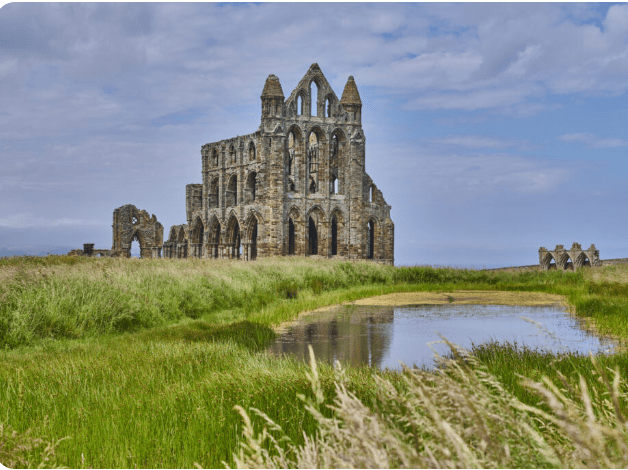
The Abbey ruins today at Whitby.
There is an Anglican religious community nearby.
There is a lively and faithful parish church in Whitby and
other Christian congregations.

[] [] [] The Statue of Hild pictured above includes coiled ammonite fossils
at St Hilda’s feet – a reference to a legend in which she turned snakes
which plagued Whitby, into stone.
The image was made available by Wilson44691, uploaded by Arienne King
and published on 20th April 2019. The Copyright holder has made the image available and licensed
in the ‘Public Domain’ and specifically made it available for copying purposes.
[Mr.G]

Star

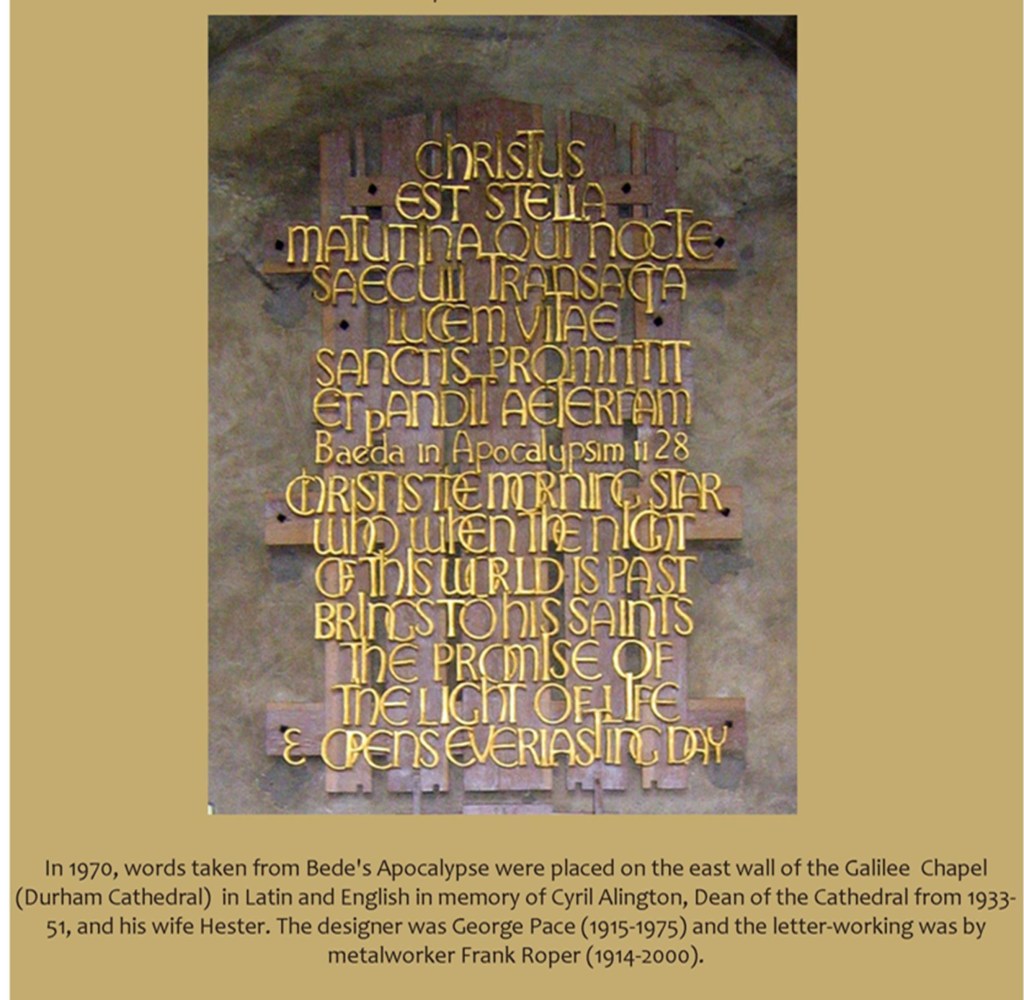
Memorial to the Venerable Bede, Durham Cathedral.

[Mr G]
Epiphany 2025

*a reference to St Matthew’s Gospel, 2:2
 to words attributed to the Three Magi

** Morning Star Is usually associated in astronomy with the Planet Venus.
In the Book of Revelation 22: 16, the risen Jesus acclaimed himself as the Bright Morning Star.  
It is with this meaning that the words appear in my poem

The photo is of the Bede Memorial in the Galilee Chapel of Durham Cathedral. It is in Latin and English
and is a quotation from the Book of Revelation:
“Christ is the morning star who when the night of this world is past,
brings to his saints, the promise of the light of life and open everlasting day.

Venerated by Angels

Durham Cathedral is one of my very special places for very personal reasons.
This great Northern building is especially precious to many because, without doubt, a visit can enfold you with a feeling that this is a very holy place. That may very well be because it houses the shrine of the great Northern Saint, Cuthbert and also the bones of another Northern Saint, the Venerable Bede.

Bede is most renowned for his Ecclesiastical History of the English People, a chronicle of our early history as a nation and as a church and for which he is rightly recognized as the ‘father of English History’

It is all the more remarkable because Bede never left the North East of England. When he was 7, in what is described as a free-will offering  to the church, his parents placed him in the care of the Anglo-Saxon monastery at Wearmouth near what is now Sunderland. This was in  about the year 680AD and a year later he moved to the new sister monastery at Jarrow where he stayed until his death. Here he learned and taught the scriptures and shared faith and prayer with others.

At the age of about fifty nine he said: “I have spent all my life in this monastery [of Jarrow], applying myself entirely to the study of the Scriptures; and amid the observance of the discipline of the Rule and the daily task of singing the Divine Office in the church, it has been my delight to learn or to teach or to write.”

Apart from the Ecclesiastical History, Bede also wrote the lives of various Northern Saints including Cuthbert but he was also a renowned Biblical Scholar. He wrote commentaries on many biblical books including the first Latin commentary on the Acts of the Apostles, which is still available today and which has a contemporary feel to it.

He led a quiet, devoted and happy life in which he simply obeyed God and followed what God asked of him. In that life he left a mighty legacy of learning but also the foundation of all our knowledge about the British lands, its people, its church and its faith. It was a life deeply rooted in prayer.

St.  Alcuin related that Bede used to say: “I well know that angels visit the congregations of brethren at the canonical hours. What if they should not find me there among my brethren? Will they not say, ‘Where is Bede? Why comes he not with his brethren to the prescribed hours?”

Hehas become known as Bede the Venerable  and there is a little story as to how he got this title. Late in life he is said to have become almost blind. One day some jesters came to him and said that there were some people in the church waiting to hear the word of God. In fact there was no-one there except the jesters. So, ever anxious for the salvation of others, the saint went to the church and preached, not knowing that it was empty. When he had ended his sermon, he prayed, and, instead of a human response, he received one from the angels: “Amen, very Venerable Bede”.

I do not know how much truth is in this story but it has a certain holy authenticity about it!

When Bede was dying he was working on a translation of the Gospel of John.
Bishop Joseph Barber of Durham in his famous Leaders of the Northern Church describes the scene:

A man past the middle of life lay on his deathbed, surrounded by his disciples. They were sorrowing, says a bystander who relates the incident, at the thought that they should see his face no more in this life. A youth was taking down some words from the master’s lips. ‘One chapter still remains,’ said the lad, ‘of the book which thou hast dictated; and yet it seems troublesome to thee to ask more of thee.’ ‘It is not troublesome,’ said the dying man, ‘get out thy pen and prepare, and write quickly.’ So the hours went on. At intervals he conversed with his scholars; then again he dictated. At length his amanuensis turned to him; ‘Beloved master, one sentence only remains to be written.’ ‘Good,’ he replied,’ write it.’ After a short pause the boy told him that it was written. ‘Good,’ said he, ‘it is finished; thou hast said truly.’ And in a few moments more he gave up his soul to God, with his last breath chanting the doxology, familiar to him, as to us.

Glory be to the Father and to the Son and to the Holy Ghost.

I like to think that his friends the angels awaited to take him into the joy of eternal life.

The prayer below says so much about him. It is based on one Bede wrote.

Lord God almighty,
open wide the door of my heart
and enlighten me with the grace of the Holy Spirit,
that I may seek what is pleasing to your will.
Guide my thoughts and my heart,
and lead my life in the way of your commandments,
that I may always seek to fulfil them,
and that I might be found worthy of  the eternal joys of the heavenly life;
through  Jesus Christ our Lord.
Amen.

[Mr. G]

St Chad’s Birthday in Heaven.

Detail from the Altar Reredos, St Chad’s College Chapel, University of Durham

Today, March 2nd, the Church keeps the feast day of St. Chad. In a rich and eventful life there is too much to mention, so I thought I would say something about his birthday into heaven.

Appointed  the first Bishop of Lichfield, in what was then the Kingdom of Mercia, Chad established his church and monastery there. Chad also sought solitude, in the custom of the Celts and Anglo-Saxons, by building a house away from the church to which he could retire quietly to pray and study whenever his missionary duties permitted. In Celtic style he also trained up others to carry out the work of mission, as he himself had been trained by St. Aidan on Lindisfarne.  One of those he trained was Winfrid who succeeded him as Bishop. him as Bishop. Chad was to be bishop for only three more years for in 672 the Plague struck again.

The Venerable Bede  in his Ecclesiastical History of the English Nation, records the event:

When he had ruled the church of the province with great success for two and a half years, heaven sent a plague which, bringing bodily death, bore away the living stones of the Church to the Temple in heaven.”

The date of his death was March 2nd 672.

It was accompanied by a premonition 7 days before it happened. A monk working outside Chad’s oratory heard a joyful melody of persons singing sweetly which descended from heaven into the bishop’s cell, accompanied by a great light. Half an hour later the sound ceased and Chad called the brother asking him to bring his companions. When they entered the oratory he urged them to preserve peace, be faithful in prayer and observe the discipline of the monastic life. He asked them to pray for him as he approached death and he begged them to remember their own deaths which would come at an uncertain hour – they must be vigilant, prayerful and given to good works,
The brother who had first heard the singing asked Chad from where it had come.“They were angelic spirits” replied Chad “who came to call me to my heavenly reward, Which I have always longed after.”
Shortly after he fell into the throes of his final illness which grew steadily worse until 7 days later, having received the eucharistic sacrament, he died – or as Bede puts it:
“his soul being delivered from the prison of the body, the angels, as may justly be believed, attending him, he departed to the joys of heaven.”

Bede then comments that “it was no wonder that he joyfully beheld the day of his death, or rather the day of our Lord, which he had always carefully expected till it came; for notwithstanding his many merits of continence, humility, teaching, prayer, voluntary poverty, and other virtues, he was so full of the fear (Love) of God, so mindful of his last end in all his actions…”

He died as he had lived, deeply within the love of God.
He combined the Celtic love of mission  with a firm conviction that nothing is accomplished without prayer.
His life was one of active Proclamation of the Gospel but whenever he could he would retire to the solitude of communion with God – a lesson he had well learned at Lindisfarne.
Whilst his call was to the Market Place of the world his heart was always travelling towards heaven.

[Mr G]