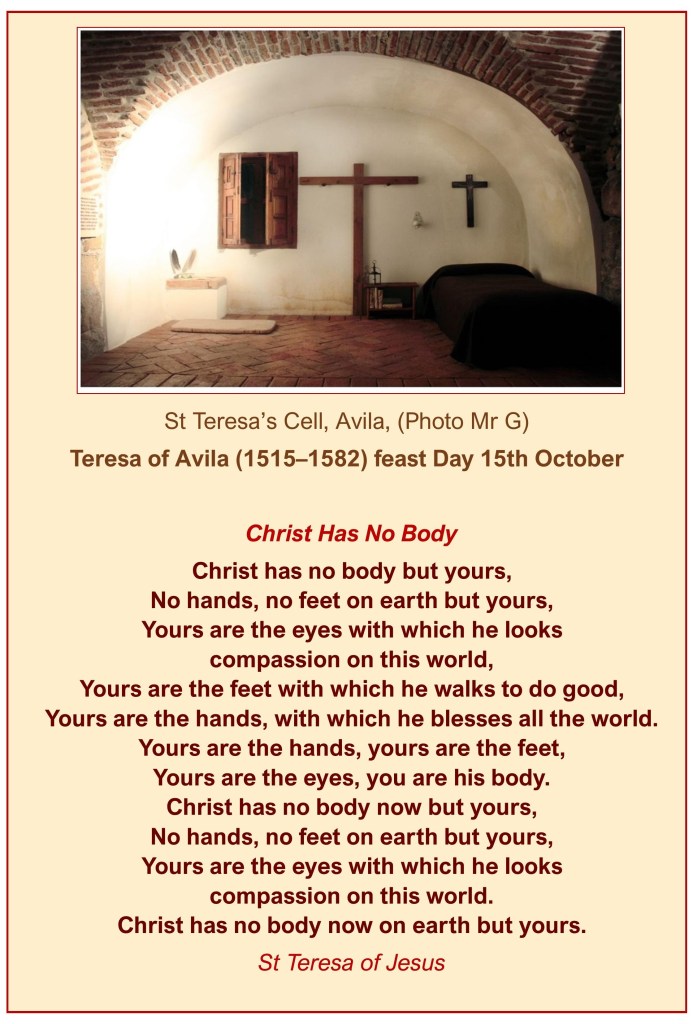
St. Teresa of Avila believed that God could be found in everyday and rather ordinary activities as well as in
the silence of prayer said in church or some special place.
Though she herself had experienced deep mystical experiences she was down-to-earth and practical.
When it was reported to her that a sister was having an extreme religious experience which threatened to overwhelm her, Teresa advised that she should eat marmalade. (she knew the value of sugar as a way of bringing things under control.)
She was born in the 16th century in 1515 and her feast day is today October 15th. At an early age she was fired up by the lives of the saints and she was particularly taken by the martyrs and their complete self-offering to God.
When she was about 12 she decided that she would leave home and travel to where there were enemies of Christ who would, she confidently believed, behead her! Then she would immediately enter heaven! She took her younger brother Rodrigo with her but fortunately for them, they were apprehended by an uncle before they had reached the outskirts of the town. He noted that the ever-practical Teresa had remembered to pack the sandwiches!
Though she failed to receive the martyrs crown, she responded to the call from God which was to be total and life-long. Entering a Carmelite convent at the age of 21, she was to be dogged by ill health for many years, even to the point of death. It was then that she experienced a mystical visitation from God which left her heart trembling after which she was “left completely afire with a great love for God.” She knew then that her soul would “never be content with anything less than God.”
At this time in Spain, convent life was one of luxury. Nuns even had their own personal maids! Teresa received a call from God to restore a sense of sacrifice and simplicity to the Carmelite order. With thirteen other nuns, she left the security of her convent and for the rest of her life she founded a different sort of convent. Throughout Spain she introduced reforms, some of which she had to argue for in front of prelates and even a Pope but she was not afraid of anything that she saw as standing in the way of God. Simple convents for a simple Godly way of life was her aim. The nuns went barefoot (discalced) as they trod gently but purposefully towards God and His Kingdom.
Teresa herself rushed all over Spain founding convents, and earning the nickname of ‘God’s Gadabout’. Yet in the midst of all this activity was a soul stilled into prayer. She remained close to God in the silence of true prayer.
Her spiritual guides insisted that she wrote down her thoughts about prayer and they are, to this day, among the great spiritual classics. They reflect her holiness, wisdom and sense of humour. Through them she has become a favourite teacher of prayer to many, many people. Her teaching was recognized by the Church when shortly after her death she was made a saint (no less than a ‘Doctor’ of the Church) who was truly a ‘teacher of the faith’
A good part of that teaching is that God is close to us in the midst of ordinarinessof life. As we go about our business prayerfully, we walk with Jesus through whom we walk in the joy of heaven on earth.
We find God in the everyday, and if we train ourselves to recognize that, we shall meet Him in the events of our lives and in the people we meet. This is about finding Heaven in Ordinary.
Teresa reminds us also, that God was within us as well as beside us, and here she takes up our Lord’s own teaching that the Kingdom of God is within us. We encounter Him in the silent depths of our hearts.
“You know that God is everywhere,” she says, “which is a great truth; wherever God dwells there is heaven, and you may feel sure that all which is glorious is near His Majesty.” Always practical and pragmatic, she insisted that is where we are close to God or as she liked to put it, “God walks among the pots and pans.”
~~~~~~~~~~~~~~~~~~~~~~~~~~~~~~~~~~~~~~~~~~~~~~~~~~~~~~
Let nothing disturb you,
Let nothing frighten you,
All things pass away:
God never changes,
Patience obtains all things.
Whoever has God finds they lack nothing.
God alone suffices.
The prayer by Teresa found in her prayer book after her death.
[Mr G. 15th October 2026}


I celebrated the mass and preached
LikeLike