Fairfield Horseshoe, Lake District, with the Helvellyn range to the left. Photograph by Gill Henwood
God’s Spirit Poured Out
Then afterwards I will pour out my spirit on all flesh; your sons and your daughters shall prophesy, your old men shall dream dreams, and your young men shall see visions. Even on the male and female slaves, in those days, I will pour out my spirit.
Today’s daily meditation from the Church of England (14th Feb) was by Tom Clammer, who gave his thoughts on the Book Of Joel, Chapter 2 verses 28 – 32 .
Tom Clammer led his readers to make a connection between the prophecy of the Old Testament prophets, like Joel and what, in hindsight they are prophesying about, or rather whom. Tom invited his readers to make the link between prophecy and fulfilment by making the connection with the Passion, death and resurrection of Jesus. Tom Clammer makes this point:
“What happens between Ash Wednesday and the feast of Pentecost is, of course, the Passion, death and resurrection of Jesus. When we read of portents in the heavens and on the earth’, when we think about darkness and blood, we are not only sitting firmly in the tradition of the Old Testament prophets; we are also in the story of Good Friday.”
He then makes a further link between the darkness experienced by Jesus which enfolds him in his suffering and death. This, he says, is the cost to Love, the cost to our salvation, the price Jesus pays. In paying it, Jesus makes the utterly self-emptying offering, is indeed amazing grace, and the gift to us is the closeness and intimacy of the Holy Spirit.
In the pouring out of God’s Spirit in the Crucified’s action we are reminded that it is the connection made between us and Christ Crucified; between Jesus and the world of the prophets, we are caught up in what Tom Clammer calls an extraordinary act of love. As ever in our involvement with God, we are not spectators but fully involved.
In the context of the passage from Joel, that involvement calls us to become dreamers of dreams and sharers of visions. For this, we must, Tom Clammer insists, pray. At the end of today’s Reflection he makes both a plea and an injunction: to pray once again for the Holy Spirit of God to make us receptive to the dreams and visions that might inspire us for the living of our Christian faith today.
And here lies the challenge for me and I think for many. So many of us are infected with a ‘deep negativity’ which enforces a downward drag of the Spirit of God within us. Very little in the news from ‘the affairs of men’ (and it’s mostly men who are leading us downwards!), give us much to hope for, in the world, in nations and also in churches.
Yesterday I met a neighbour in my road and we passed the time of day. In our own ways we have a deep love of God. As we talked, her two children, aged 6 and 8, politely waited. I said that I felt that my post-war generation had failed in building a fair, just and hope-filled society. I looked at her children and added that I fear for them and all young people throughout the world. What sort of society, world, climate or alternative kingdoms such as that of the animals, are to be our legacy to those growing up today? What hope can we give to them and what vision?
This is the challenge that came to me when I continued to think of today’s reflection from Joel.
Old men, like me, are being called again to dream dreams, and our young are being led to see visions and all, whoever they are, must become people from whom the Spirit of God pours. That can only be so if we move away from negativity to an enrichment of a life which, despite those who are despots and dictators would wish it otherwise.
There is a Proverb in Chapter 29 of the King James Version of the Bible, which reads: Where there is no vision, the people perish. That was quoted to me many years ago now, and I have never forgotten it (though, sadly, I haven’t always practiced it!)
We cannot do this alone because as a well-known prayer puts it, we have no power of ourselves to help ourselves. So we must turn back to God. His joyous, glorious vision is always reflected in creation, in a world teeming with real life and growth. God’s love is waiting always to pour over and through us. In that love our visions and dreams begin and blossom.
My friend Gill’s latest photo gives me both inspiration and hope in all this, because as a biblical poet once said in a Psalm (21) I will lift up mine eyes unto the hills, from whence cometh my help. My help cometh from the LORD, which made heaven and earth.
[Mr G. 14th February 2025]
[][][] The Revd Canon Dr Tom Clammer trained for the priesthood at Westcott House, Cambridge, before serving his Title in the City of Gloucester. After curacy Tom was incumbent of seven rural villages in the Diocese of Gloucester, before becoming Canon Precentor of Salisbury Cathedral. He retired from the cathedral in 2019, and now combines a ministry of spiritual direction and writing with teaching posts at Cuddesdon and Sarum College.
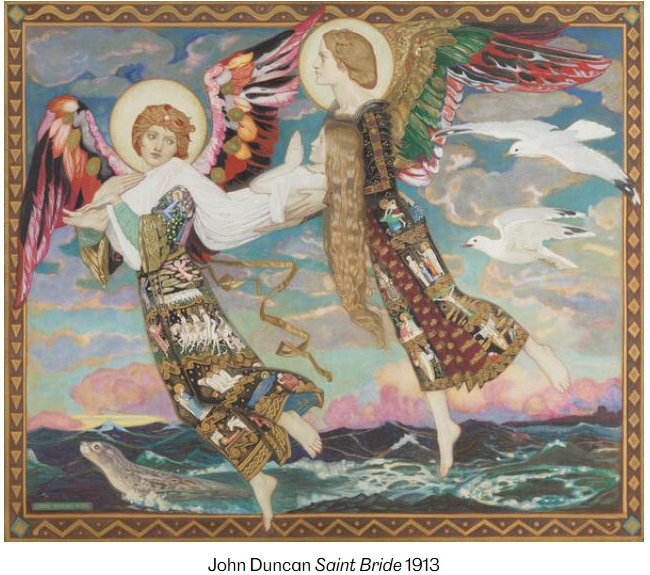
St Brigid and the Manger. Last Saturday, February 1st, we remembered St. Brigid (sometimes spelt, Brigit). Along with St. Patrick, she was Apostle to Ireland and is credited with him as one who proclaimed the Good News of Jesus Christ to the Irish people. At that time the links between Ireland and what is now the southern part of Scotland were very strong. So Brigid(t) enjoys a special place in the hearts of both nations. Her abbey was at Kildare in Ireland and, as in some parts of the Irish Christian tradition, it was a double monastery of both women and men. This practice was later transferred to Northumbria via the mission from Iona.
Many stories, traditions, myth and legends grew up around St Brigid, including one that suggests she was ordained Bishop to serve her Irish congregations. There is more evidence than not about this and if true, Brigid would have the honour of possibly being the first Woman Bishop in the Christian Church! That’s a thought for another time but one legend about her was brought to my attention by my dear friend, Heather Upfield, with whom I enjoyed a lovely friendship when we were both in Edinburgh. Her love of what we now call the Celtic spiritual tradition did much to feed and inspire my own love of it. Earlier this week I received this note from her:
“In the Scottish tradition, St Bride was carried by angels from Iona to Bethlehem on Christmas Eve to be midwife to Mary at the Nativity. She then remained with the Holy Family till Mary and Joseph took the baby Jesus to the Temple. In the Candlemass mythology, she walked ahead of them carrying lighted candles, with a crown of lit candles on her head.”
The painting above by John Duncan, painted in 1913, which is in the National Gallery of Scotland, is inspired by this story. The two angels are carrying the saint between them to Bethlehem.
Wanting to know more, who better to turn to than my friend, Heather? I happened to find an article, by her, on St Brigid which was published in 2017. Here is the part of that which refers to this story.
“In the mythology, St Bride is carried from the Isle of Iona, in the Inner Hebrides, to Bethlehem on Christmas Eve, to be mid-wife to Mary at the birth of Jesus. In the Ghaidlíg, she was known as‘Ban-Chuideachaidh Muire’ ‘knee woman of Mary’, as in the Hebrides, women gave birth on one knee. Not only is she present at the birth of Jesus, but she also takes on the role of the Foster mother of Jesus – ‘Muime Chroisd’. In the Hebridean tradition, a Foster mother was considered more important than a natural mother. They took the view that any woman could become a mother – and be good or indifferent or bad. But the Foster mother took on the rearing of a child who was not her own, and this gave her greater status. In the eyes of the Hebrideans, therefore, St Bride is more important than St Mary and it is she who is considered the true Mary of the Gaels. A Hebridean prayer during labour was ‘Bride, Bride, Come in. Thy welcome is truly made. Give thou relief to the woman and give thou the conception to the Trinity’. Following the Nativity, the Church celebrates Candlemas forty days after Christmas. St Bride is closely connected to this Festival. When Mary and Joseph carried the infant Jesus to the Temple, St Bride walked ahead of them. She wore a crown of candles and held a lighted candle in each hand. The flames stayed completely still and were not moved by the wind. In some traditions, Candlemas is known as Feast Day of St Bride of the Candles, and she herself is known as St Bride of Brightness. The legend of the flames also corresponds with what we know of Oimelc (or Imbolc) as a Fire Festival.”
A certain caution must be exercised and possibly a suspension of belief in this story. It is part of a folklore which belongs to a people who understand the importance of myth as containing a kernel of truth rather than made-up fiction. Chronologically, of course, it can’t be an historical truth but there is more than one sort of truth, especially where angels are involved! Sometimes we have to move from the human realm to the heavenly to discover a new way of discovering the heart of God. Poetry, art, storytelling and music belong to this realm. Often words fail us in their bareness and logic but spring to life in a new way if we use our communication skills differently.
So the myth of St Brigid’s visit to Bethlehem and the echo of a Candlemass ceremony which is ascribed to St. Lucy in Scandinavia , are wonderful stories about new birth, tenderness, care and light. Bride’s visit to Bethlehem is also a delightful and fun story. Anything that brings a smile to our lives right now can only be good!
Thank you, Heather, for bringing this source of joy to my heart.
[If you wish to know more about the painting by John Duncan, go to the website of the National Gallery of Scotland. Search for John Duncan and click on to the the very informative podcast]
Joshua and I, Ahuz*, are doorkeepers of the Temple. We greet people and try to make them welcome. There are visitors and strangers and, of course, we have our regulars. Like that old man over by the corner of sacrifice. We don’t know where he lives but it must be nearby. He’s always here as soon as the doors are open.
Then there’s Anna who seems to live in the Temple, in a dark, quiet place. We know her because she has good connections. She comes from the tribe of Asher and she’s the daughter of Phanuel and she’s a prophet, they say.
We’ve found out that the old man is called Simeon. He has a stillness about him which suggests that he’s a man of prayer. He behaves as if he loves God, which is more than most who come here! Others are more like politicians, self-seekers, people who believe not in God but in their own religious importance.
Old Simeon has just noticed me and he smiles and bows towards me, making me feel human, wanted, needed. Out of the corner of my eye, I spot the daughter of Phanuel who comes and grasps my cold hands and rubs them warm. It’s a kind gesture of gratitude for letting her wait.
I don’t really know what they are both waiting for but there is always an expectation about them. I once asked the old man, Simeon, “What are you doing here? What are you waiting for?” “Salvation”, he said quietly, “and a peaceful death.”
‘Salvation’, isn’t a word we hear in the Temple these days! That’s what Joshua said, when I told him. “I reckon they’re on a fool’s errand.” “Maybe”, I tell him, “but I’m not so sure. There’s a holiness about him and Anna, too. There’s wisdom as well, without any trace of self-boasting. They know things we don’t.” Joshua laughed. “I’ve told you, they’re wasting precious time. They haven’t much left.”
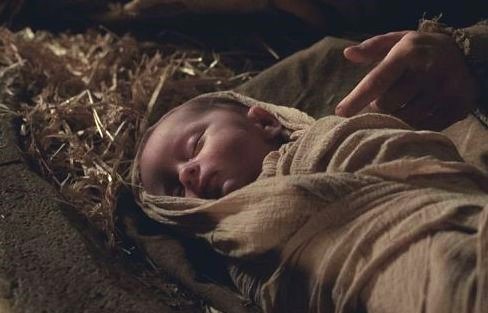
Then, it happened. A young woman and a caring man came into the Temple, carrying a little vulnerable baby. Purification. It’s like a thanksgiving after childbirth and an act of dedication. So they made their offering to God and then Simeon shuffled to stand next to them. Anna drew near as well. Interesting! Is this what they were waiting for? Odd, though. How could a baby bring Salvation and hope?
Simeon took the child into his arms and praised God. I quietly moved towards them, just as the old man began to speak. “…let me go in peace…I have seen your Salvation…” Love shone in his eyes and in Anna, too. I couldn’t make sense of it. How could a mere child be God’s fulfilment? Simeon spoke again of the child, who would be God’s light not only to us, the Jewish people, but also to Gentiles – non-Jews. You could see that the young couple were as perplexed as I was, but there was more. It was like a prophecy, about a future event, something about conflict the child would cause, some choosing for him, others against him. He would see into every heart; speaking of which, the young lady would also have her heart pierced as if by a sword. It would, without doubt, be a sword of pain and sadness but she seemed to smile a little as if she knew something we didn’t. Why didn’t Simeon’s word worry her? Nothing would break up her serenity. It was as if she already seemed to live with God.
Then Anna took the child from Simeon’s hands and held him close, cherishing the one of whom the prophets had spoken. They called him ‘The Messiah’ but this child was called, Jesus. Where they the same? Was he the one for whom, in the depths of all our hearts we too have been waiting?
For a moment, as we all stood facing the child, the Temple was filled with silence, but it was such a stillness that it felt as though it trembled with the very breath of God.
Salvation had come to the Temple that day. I, Ahuv*, found it in that little child and, like myriads who came to recognize him, I was changed and loved and saved!
[Mr G. Candlemass 2025]
*Ahuv translates as “being loved” or “beloved.” The word ahuv comes from the Hebrew root aleph-hei-vet, which means, “to love.”




 Mr G's Ponderings