A Call to service.
At the beginning of the Coronation Service Samuel Strachan, a boy of His Majesty’s Chapel Royal, addressed The King:
“Your Majesty, as children of the kingdom of God we welcome you in the name of the King of kings.
King Charles replied:
“In his name and after his example I come not to be served but to serve.”
Right at the beginning of the Coronation; a service rich in music, symbolism, pageantry, and historic significance, the heart of what was happening was stated clearly.
King Charles had come with Queen Camilla to Westminster Abbey to be consecrated to a particular kind of life; a life of Service.
The Archbishop of Canterbury at the beginning of his sermon said:
We are here today to crown a king and we crown a king to serve.
The word and the meaning dominated the proceedings.
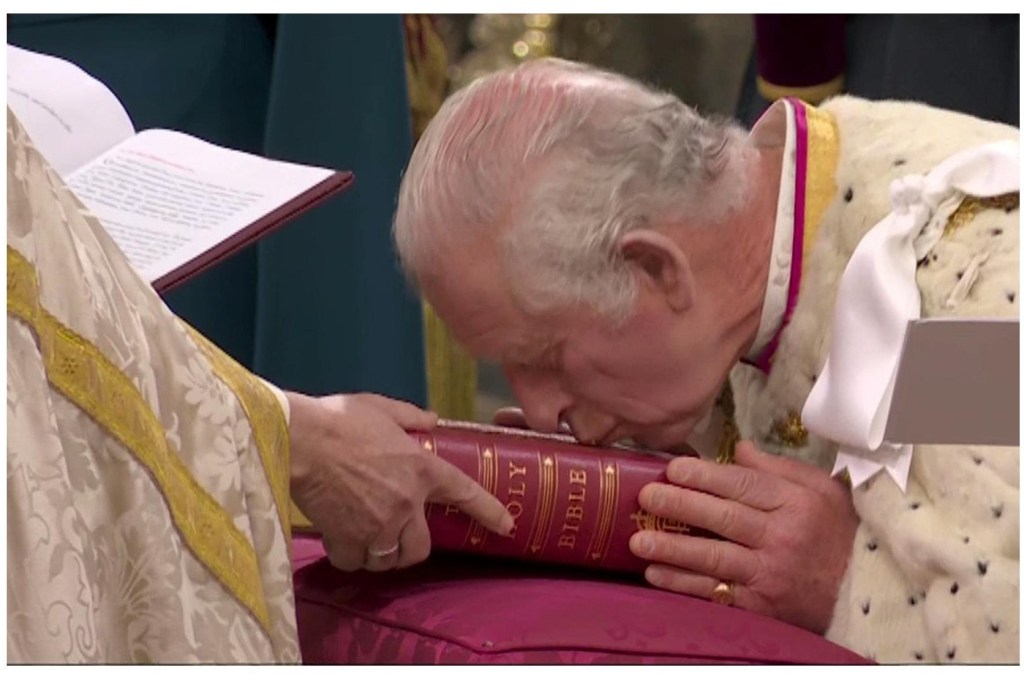
King Charles, himself, placed himself under obedience to serve and he referred to the Gospel message of Jesus who made it quite clear that He came not to be served but to serve.
Charles prayed:
GOD of compassion and mercy whose Son was sent not to be served but to serve, give grace that I may find in thy service perfect freedom and in that freedom knowledge of thy truth. Grant that I may be a blessing to all thy children, of every faith and belief, that together we may discover the ways of gentleness and be led into the paths of peace; through Jesus Christ our Lord. Amen.
King Charles thus pledged his life as King to the King of Kings by imitation.
He saw and proclaimed it his duty to serve in a way which is Love in Action and which reaches out to the vulnerable in our society and builds up communities where all share this duty of service. With our King we are all called to dedicate our lives for the service of others.
This is what was behind the invitation of the Archbishop for the Nation to get behind our new Sovereign in an allegiance to share with him in a life of service.
As the Archbishop was to say later, we are bound together with our King to work for the Righteous Salvation of all.
This was a work which was a pledge between God and the King and between King and the People.
For this work King Charles is consecrated, set apart, not from the people but for us.
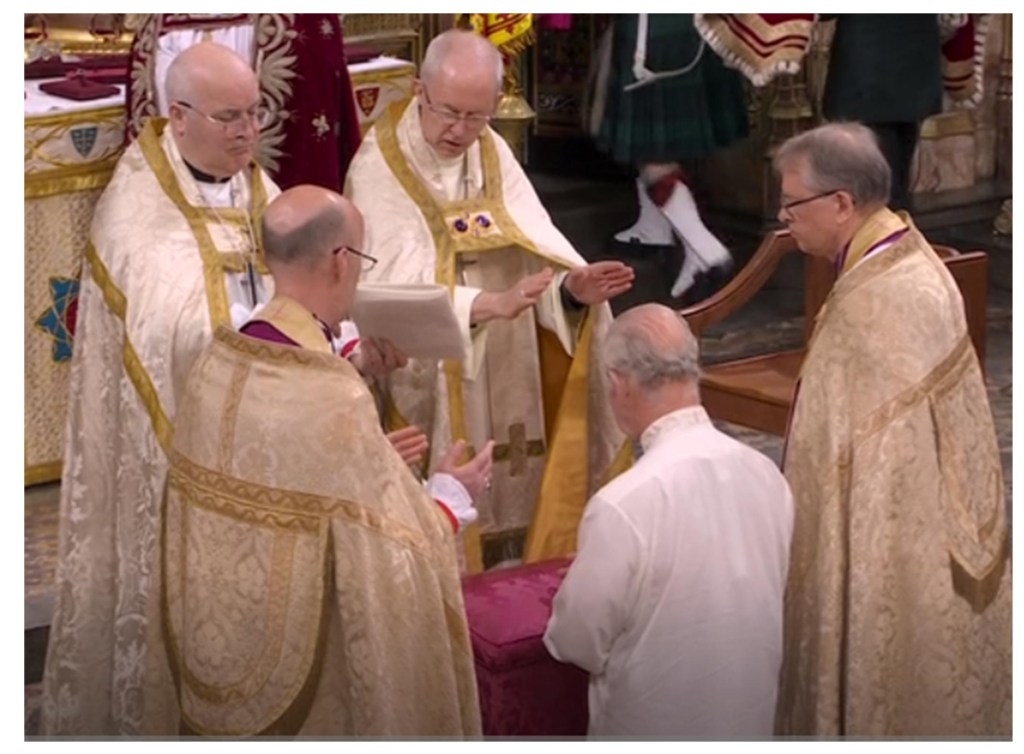
Coronation is an act of Ordination in much the same way that the Ministry of the Church is set apart to serve God and people.
The Crowning and anointing are sacred acts of being Chosen by God and set apart as all those who ministered to the King in that service to others.
Whilst there are differences in how that is done by the King, the Queen, the working members of the Royal Family, and all those who are ordained in some way, Archbishops, Bishops, Priests, Licensed ministers, all who have submitted to God through Baptism, the call to serve is the same.
The context for this is to be found in the marvellous reading from 1 Peter 2:1-10
This is an example of what the Moderator of the Church of Scotland said, of Scripture, Wisdom, Royal Law and one of the
Lively Oracles of God.
In this passage from 1 Peter Chapter 2: 1-10 is the text for all of us to be set apart as servants of the King of Kings.
In the context of the Ministry and Service of Jesus whom the writer of 1 Peter calls the Living Stone, who has been chosen and precious in God’s sight, we too are to be living stones who are also chosen and are precious to God.
When I read this, I think of all those times when I walked over the hills of the North! On rocky and not always distinct paths, I would come across Cairns, mounds of stones which were way marks, showing the uncertain traveller which way to go. They were a godsend and there is a custom that, if possible, you are to add a stone or pebble to the cairn. That way you will help to guide others.

I believe that when 1 Peter asks us to become Living Stones we are being encouraged to add our lives to the waymarks which lead people through this world to heaven.
We become these way marks through a life dedicated to God, consecrated to prayer, opening our hearts to the Lively Oracles of Scripture, learning from others who have laid waymarks for our own personal journey – those who have nurtured and encouraged our faith. Things which have built us up to be, as 1 Peter puts it, spiritual houses.
But the epistle goes further.
We are Consecrated, set apart, as a Royal Priesthood, which is another way of saying that, through our life as people Baptized by God, we have a particular calling to represent and serve God in the world.
We know that there is a cost to this Priestly ministry but also that Jesus has paid this cost.
In the Coronation Service we were reminded what this cost entailed.
In our Lord’s Coronation, he bore a heavy weight for us. His throne is the Cross. His Crown was made of thorns; His robe was seeped, in blood, his marks of Kingship were the wounds he bore on his body.
A very different Coronation indeed but through it we became people whom the writer of 1 Peter puts it:
A chosen race,
A royal priesthood, a holy nation and most of all:
God’s own people.
How marvellous is that!
Here is the Pledge and Promise of God to us.
Here lies the bedrock of our life of service.
Here is the spring of absolute joy, of hope, of love.
Here is the source of our energy to transform the world, starting with the people and places with whom and with which we are most nearly connected.
We are called and set apart by God for an amazing mission,
To proclaim the mighty acts of him (God) who called you out of darkness into his marvellous light.
We can do this because we are God’s people.
We are filled with God’s mercy and his love and because we receive God’s Grace, the outpouring of His very Being into us.
During the Eucharist, the Archbishop prayed
that by the anointing of God’s grace, Charles may be the Defender of Faith and the:
Protector of thy people; that, with him, we may learn the ways of service, compassion, and love; and that the good work thou hast begun in him
this day may be brought to completion in the day of Jesus Christ.
Note that –with Him,
In the verses which follow our reading from 1 Peter,(2:11f) there is an exhortation to behave in such a way towards others that through us they may see God at work and so glorify Him with us.
The alternative Collect for Easter 5 sums up both the ministry of King Charles and ours, and puts it in the context of our Lord Jesus Christ.
Risen Christ.
Your wounds declare your love for the world
and the wonder of your Risen Life.
Give us compassion and courage to risk ourselves
for those we serve, to the Glory of God the Father.
Amen
[Mr G]