Lunar Incantations

Kay Gibbons exhibition Bampton. Photo Mr G

LUNAR INCANTATIONS
An artist’s response to lunar imagery in T S Eliot’s  poetry.

Last week, I went with my friend Julia to an art exhibition in Bampton, West Oxfordshire. It was arranged by the West Ox Arts as part of the Oxfordshire Arts Week.
The reason for our visit was that our mutual friend Kay Gibbons was one of the exhibitors and we wanted to support her. It was also an opportunity to look at high quality art by talented exhibitors in a beautiful and open surroundings.

Kay is a multidisciplinary artist, working often, though not exclusively in sculptured glass.
Her current exhibition is  called LUNAR INCANTATIONS, an artist’s response to lunar imagery in the poetry of T S Eliot.
(we have already posted some of this work on my blog).
Here is what Kay has written about this.

“How wonderful it is to be weaving word and image together in my Art weeks exhibition on display
at the West Ox Arts Gallery in Bampton where I am exhibiting with other talented artists from Oxfordshire .
My artistic journey has been one of ‘ebb and flow’ responding to and being determined by the directional pull of circumstance and opportunity. Similarly with the moon as it journeys through its different phases .

During lockdown I became reacquainted with the poetry of T S Eliot .It inspired me to create small watercolour paintings and drawings often incorporating calligraphy . With Artweeks looming I was inspired to bring together my love of creativity with Eliot’s poetry and of the moon to explore the Lunar imagery in T S Eliots poem Rhapsody on a Windy Night .
I have interpreted this using glass and also calligraphy .
My exhibition is innovative, colourful and lively.

With this we agree and my friend Julia has written a comment:

Glorious drive across the Chilterns at the weekend to meet my Instagram hero @kaygibbons_art.glass.sculpture and her wonderful exhibition at @westoxartsgallery on opening day. I was inspired by Kay’s freedom and humour which plays out through her abstracts and her evocative interpretation of a TS Elliot poem in leaded and copper foiled pieces, and exquisite water colour and pen work. Thank you Kay for the laughs and hugs and reigniting my love for colour, transparency, and stained glass “

Needless to say, we were both tempted to buy a piece of art.

In love with this little glass abstract which is coming home to me at the end of the exhibition.
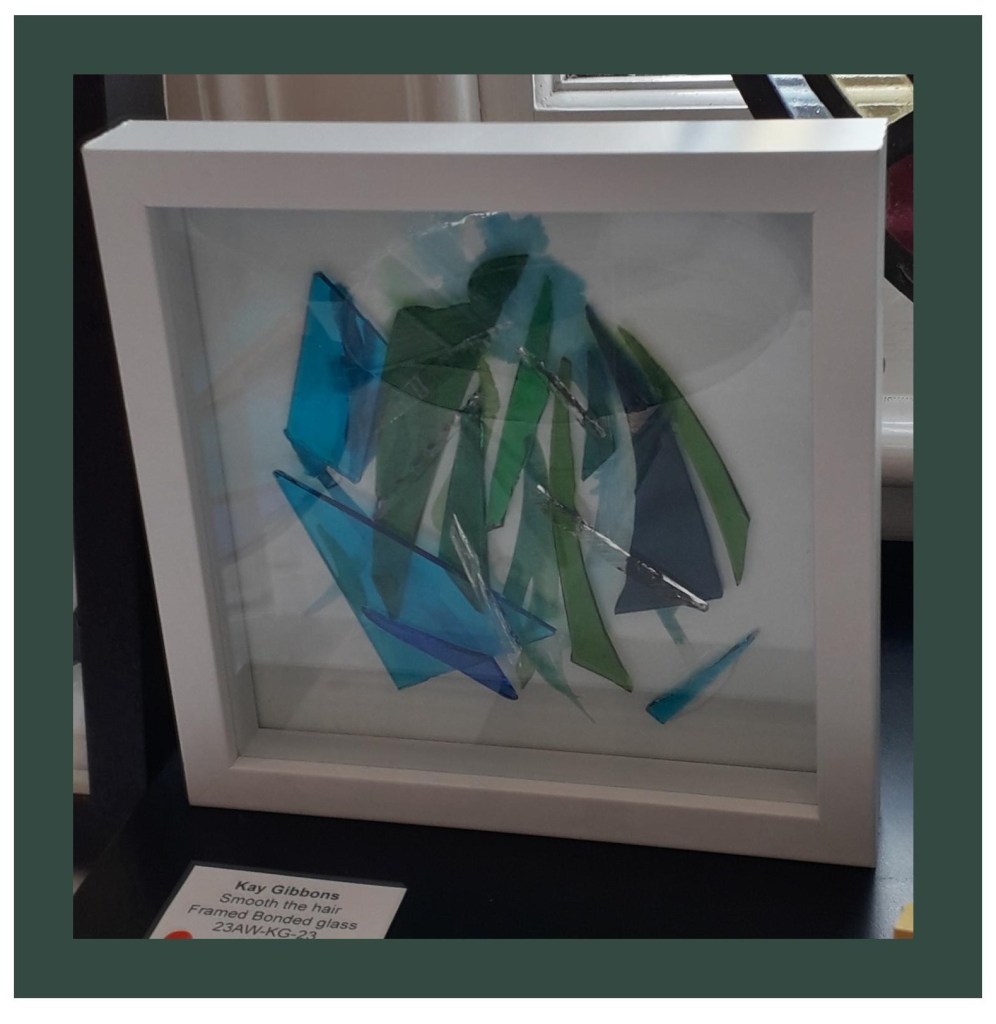
photo: Mr G

Mine is a present for someone so I am keeping it under wraps for now.!

Kay’s art has shone a light into the soul of the world with her combination of visual and the poetic. T. S. Eliot deserves illustration and a new way of entering into his depth of meaning. Equally, to watch an artist develop and explore life through shape and colour and faith is exciting. It shines a light into my soul as it does in any who encounter and sit with her work.
So much in life is depressing and frightening, not least because of power struggles which ultimately destroy everything in their wake. So we need a way to lift the Spirit and point us away from destruction to creativity and love. Art, Music, creative writing, photography, caring for the natural world are, in themselves incantations, cries to a better way. Incantation is word derived from Latin and means to ‘enchant’, perhaps even to cast a spell. It is associated with magic but poetry has its own meaning of what that means. Often to say something is magic is to point to a new experience of brilliance.  Allowing a creative act to work on your own creative spirit can easily be experienced as something magical, amazing, beautiful and, if we let it, life enhancing.It turns us from despair to hope.

Kay understands the way in which art speaks to the soul, to the heart of our being. For me, of course, this is about taking me right to the heart of God.
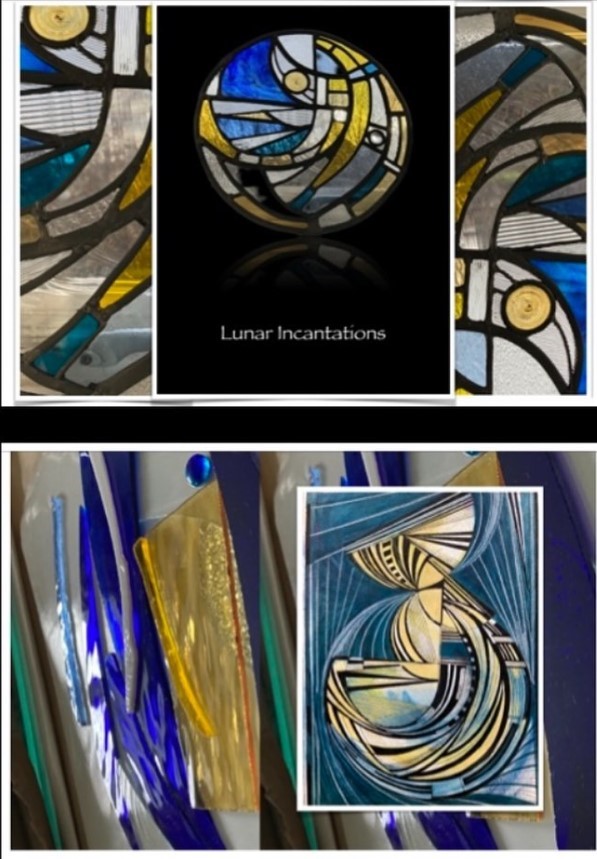
Photo: Kay Gibbons

“The joy of art is that we all see different stories in the one canvas – the one piece of glass, the one mural and so it goes .”

Exhibiting at WestOxArts GalleryBampton 29 April-3 June
as part of Oxfordshire Artweeks.

Not many will be able to go but you can discover more of Kay’s work on Instagram.
kaygibbons_art.glass.sculpture

[Mr.G.]
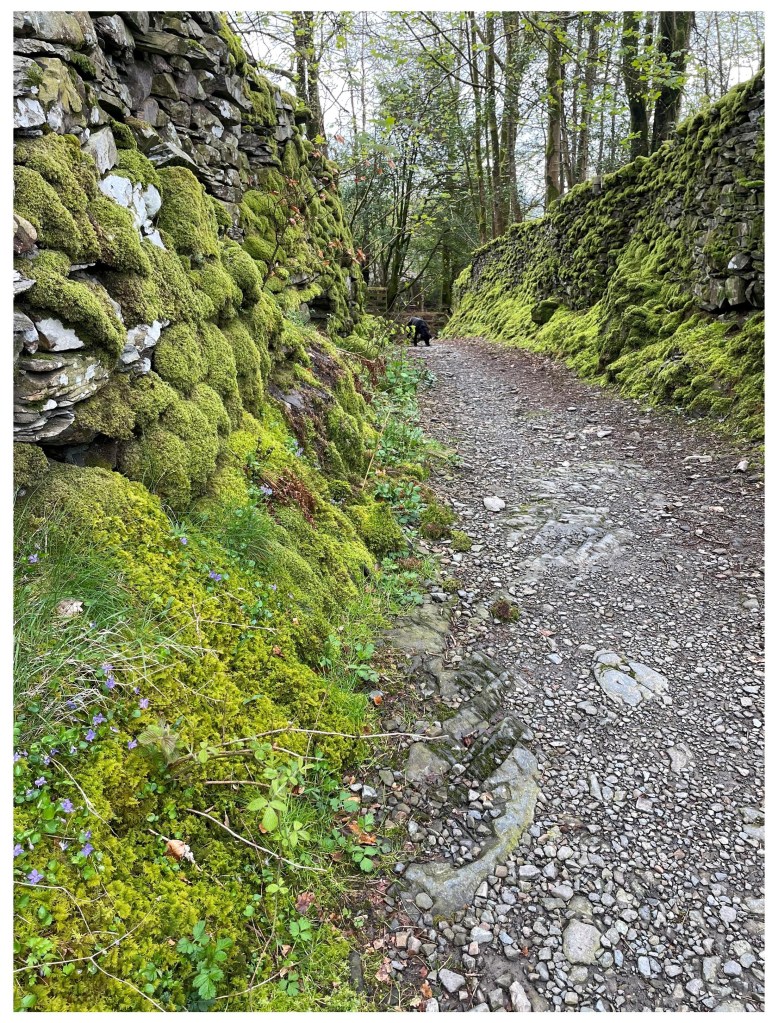
By the Hollow Way

This is a photo taken by my friend Gill Henwood of a Sunken Lane’ in the Lake District.

Gill tells me that this one has dry stone slate walls and floor with mossy banks and ivy. She says that “further up are greater stitchwort, and a huge bramble thicket that promises bramble jelly in the autumn! Happy nesting birds  are all around, singing.”

Another name for a Sunken Lane is Holloway or hollow way, which comes from the Old English  “hola weg”.  It’s a road or track that is significantly lower than the land on either side. Such ways can be found all over the world and they are generally ancient routes for the carriage of trade, travelling and sometimes battle roads along which troops moved. Some date back to Roman times and beyond.
Many are overgrown with nettles and briars and most are disused except by local people or country walkers.

Today they can offer a unique and integral look of the English landscape, providing a glimpse into a time and way of life long gone. They give us information about those times, about the way of life then, or geological information and how the paths have evolved into habitats for wildlife. They also bring pleasure and interest to the walker.

Spiritually, they can offer a physical and contemplative meditation about pilgrimage to God and the Heavenly Kingdom as well as a visible lesson of what the Bible teaches us about walking the ‘narrow way’. Whilst they can offer a warning about keeping on the straight and narrow, they also show us the beauty and joy of doing so.  There is so much to enrich our lives if we don’t rush headlong by, getting caught up in frantic pace and demands which often come to nothing. It was St John of the Cross who said:

“God passes through the thicket of the world, and wherever His glance falls He turns all things to beauty.”

Walk, breathe, pause, notice, pray, become!

[Mr G]

Hear, my child, and accept my words,
   that the years of your life may be many.
I have taught you the way of wisdom;
   I have led you in the paths of uprightness.
When you walk, your step will not be hampered;
   and if you run, you will not stumble.
Keep hold of instruction; do not let go;
   guard her, for she is your life.
Do not enter the path of the wicked,
   and do not walk in the way of evildoers.
Avoid it; do not go on it;
   turn away from it and pass on.
For they cannot sleep unless they have done wrong;
   they are robbed of sleep unless they have made someone stumble.
For they eat the bread of wickedness
   and drink the wine of violence.
But the path of the righteous is like the light of dawn,
   which shines brighter and brighter until full day.

Proverbs 4:10-18

Daughter of the Wind

Wood Anemone photographed by Gill Henwood in the Lake District.

Wood Anemone…. A little story.

According to the poem at the beginning of the Book of Genesis, God completed the creative action on Planet earth after six days of total activity.
Genesis informs us that on the 7th day, God rested.
But rest rarely means inaction, especially for God. There is no way that The Maker of everything can either unmake nor stop the inbuilt process of evolving, developing, deepening, the love which God had poured into all that was made.
You see, in order to ‘make’, God had to use the very essence of being to do this and that same essence, being God, is never absent.
That’s a quick way of saying that God is always God and always making things in his and her own image!
God broods over creation like a father and a mother, holding it in being, trying to save it from harm, and guiding with all encompassing ‘love’. That’s the work chosen by God, Father, Son and Holy Spirit.

But none of that needed to be explained on that first Sunday morning. Later, God would invent and make some very clever people called ‘theologians’ who could mull over everything that God has made and decide whether it is good or not so good. They will helpfully disagree on this which makes it very simple for us to ignore them, or become one of them. (tongue in cheek remark!)
On that first Sunday morning, God wasn’t prepared to get too involved in all that. He was resting. I suppose, being, God it wasn’t the forty-winks kind of rest that we know it to be now. It was a creative rather than restorative rest.

As God the Father rested, God the Son pointed up at the lovely stars and noticed that, appropriately, one of the stars had six points, one for each day of creation. In fact, many people would give it the name of The Creator’s Star.
These 6 ‘pinpricks’ touched the darkness and so it wasn’t as dark as it would be without them. In fact, the light had a bright and luminous beauty which simply shone amazingly.

As God the Father, watched this, God the Holy Spirit allowed inspiration to flow.
Earlier, a joint effort had created things like paper, pens and pencils, paint and ink and paint brushes. So God the Spirit set to work.
Gently, the pencil floated over the paper as God thought what to make of the stars with six points drawn on the  paper.
What  had emerged was a flower, robust but also vulnerable. It would live amongst the trees and in the Spring, it would shine with a brilliant  light.
Ah!, thought God. This little flower will become part of something very special.

God knew that one day it would be necessary for some extremely Good News to be announced and the Son of God would make it.
The plan, still to be unfolded, would involve the Son in a supreme act of love though as with all acts of self-giving, it would come at a price.
So, in using the little flower to be part of the message of hope and joy to lighten a dark world, God knew that it would perhaps not live very long because as we all know, when we light a candle, as it burns to give us light, it dies.
But in the case of the little white flower, there would be no permanent death because death merely continues a journey of life but in another place. Well, almost, because what the flower leaves behind is a root system which means it will come alive on earth again.

God loved the little flower and as the Son held it up, the Spirit breathed on it and it danced. It moved as if in the wind, so God said that it would be known as  ‘wind flower’.
The Spirit then pronounced the Name which would be ‘Anemone’  – Daughter of the wind.

Jesus loved the white colour because it would be the Easter colour of Resurrection and the anemone would live in forests and woodlands because that would remind people of the wood of the Cross. It would therefore suggest to the people who saw it that through the love of God poured out from the Crucifixion, the world would be a brighter, lighter, more joyful place. It would be a world able to celebrate hope and beauty and love again. The little white flower would remind people of this

… and the little Wood Anemone? Having done her job she would rest a little until next year.


[Mr G]

with thanks to Gill for the inspiring photograph.

The Dame of Laughter

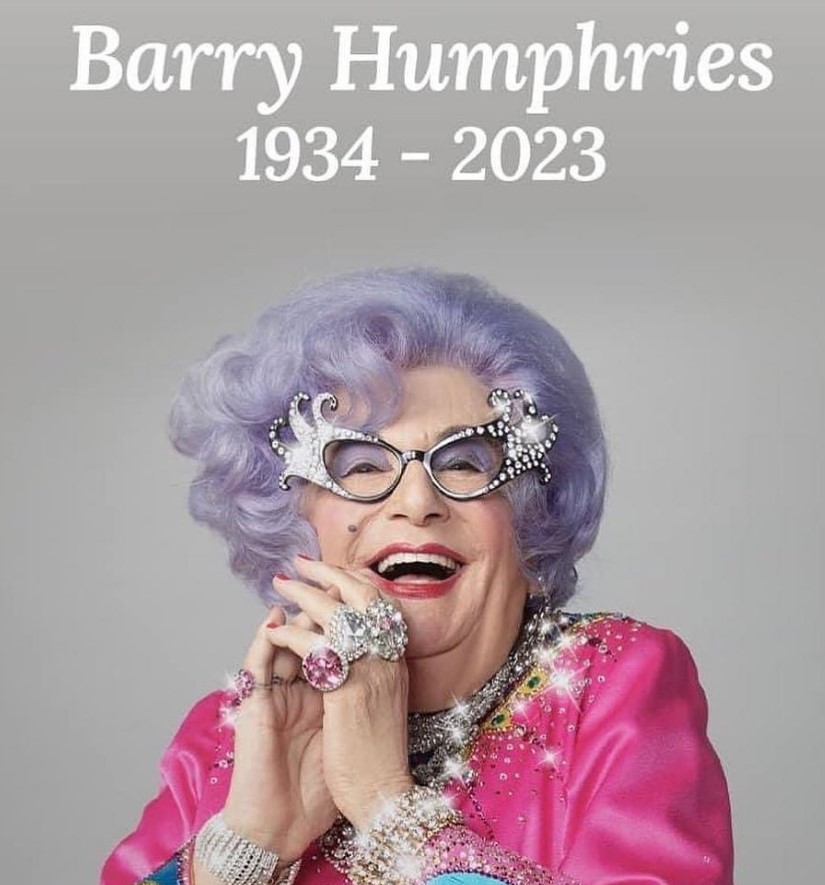
Dame Edna Everage official photo

The death of Barry Humphries leaves many bereft of a special person in their lives, not least in his alter-ego, Dame Edna Everage. Many words are being said about both, as people mourn. Probably the most eloquent obituary is that of Barry Humphries by Dame Edna herself! To hear this read on Radio 3 on Sunday morning was certainly quite a departure from the sound of bells and birds!

What the death reminds us of is the importance of humour and laughter in our lives. As we hear yet more dreadful news from the Sudan it becomes increasingly hard not to despair about what we humans are doing to our planet, to nature and to ourselves. People might well think that there isn’t much to laugh about but even today as snippets of Dame Edna’s contributions to the funny side of life has lifted spirits.
Recently the Jewish people celebrated Purim, which I learned through the writings of the late Rabbi Jonathan Sacks, is the Jewish Festival of ‘happiness’.  In an article he wrote, I also learned a very important truth which drew its strength from the Holocaust.
The Jewish response to trauma is counter-intuitive and extraordinary. You defeat fear by joy. You conquer terror by collective celebration. You prepare a festive meal, invite guests, give gifts to friends and to the needy. While the story is being told, you make an unruly noise as if not only to blot out the memory but to make a joke out of the whole episode. You wear masks. You drink a little too much. You make a Purim spiel.
At the heart of the merrymaking is a challenge. Where a threat is serious there is a refusal to be serious but that leads to a paradox.
The refusal to be serious is a very serious action. As Jonathan Sacks puts it: You are denying your enemies a victory. You are declaring that you will not be intimidated. You face fear with its antidote – Joy! A striking message from the Holocaust is:
They tried to destroy us, We survived. Let’s eat.

Allowing laughter and humour is a way of defeating hate. What you laugh at, you cannot be held captive by.
Psalm  37 expresses  a similar view where we read that  
“the wicked plot against the righteous and gnash their teeth at them;
but the Lord laughs at the wicked, he knows their day is coming.” 
And the righteous can join in the joke.  

Similarly, when an audience laughs at a comedian’s jokes, they are participating  in the story and feel at one with each other. The popularity of performances by what are known as Stand-up Comics is a sign of how much humour has become a shared cultural experience.
For a short while, people are drawn towards each other, become open and perhaps vulnerable. It becomes a truly shared experience.In a brittle, divisive world, humour becomes a collective antidote and therefore a point and time of healing. Perhaps also of hope.

Not much of this may be obvious. The bottom line of having a good time and a bit of fun is itself a perfectly joyful activity but it has natural and love filled consequence.
Those who remember the magazine Reader’s Digest may recall that it had a maxim, Laughter is the best form of medicine.

Dame Edna knew this, I suspect, and whilst her humour played on the ridiculous and poked fun at the pompous, there was a sense of kindness and of gentle holding people in love. Her humour was never cruel even when it was close the bone. A safe haven was created which brought people closer together and which is why good humour, comedy and happiness are generated in a non-threatening way.
For a time there is a community creating the unity of the occasion.

This community, being in unity,  is also at the heart of groups who feel stronger in using humour to face together hatred, war, personal threat and tragedy, as in the response of Jews to the Holocaust, or the Ukrainian people to the evil of Putin.
Solidarity in the face of the world’s pain is also at the heart of the Christian message of hope and love. The foundation of the Christian Church is built on friendship which God, in Jesus, sacrificially showed through loving and sharing love which makes discipleship not a task to perform but a love to be shared. That is what Jesus showed and often it was done through wittiness, joy and sharing food, drink and storytelling. Many of the parables are wonderful, witty stories with punch lines that had people smiling, feeling changed and experiencing ‘penny dropping’ moments, like the show audiences.  Jesus, I suspect, was the master of stand-up!

The result of of all this changes people.
Whether it be at the level of what is known as the feel-good factor and which lasts but a short while or whether it be more permanent, life seems better somehow.
Perhaps this becomes more permanent when we recognize that we can become instruments of change.

Desmond Tutu, in his book ‘God has a Dream’, made the point that changed people are people who can be used to make things better. He wrote:
“All over this magnificent world God calls us to extend His kingdom of shalom – peace and wholeness – of justice, of goodness, of compassion, of caring, of sharing, of laughter, of joy, and of reconciliation. God is transfiguring the world right this very moment through us because God believes in us and because God loves us.”

Did Dame Edna or Barry Humphries seek to do that? I like to think so, or  if not directly, make it possible to make life not just bearable but enriched, cleansed, re-directed.Can laughter do that?

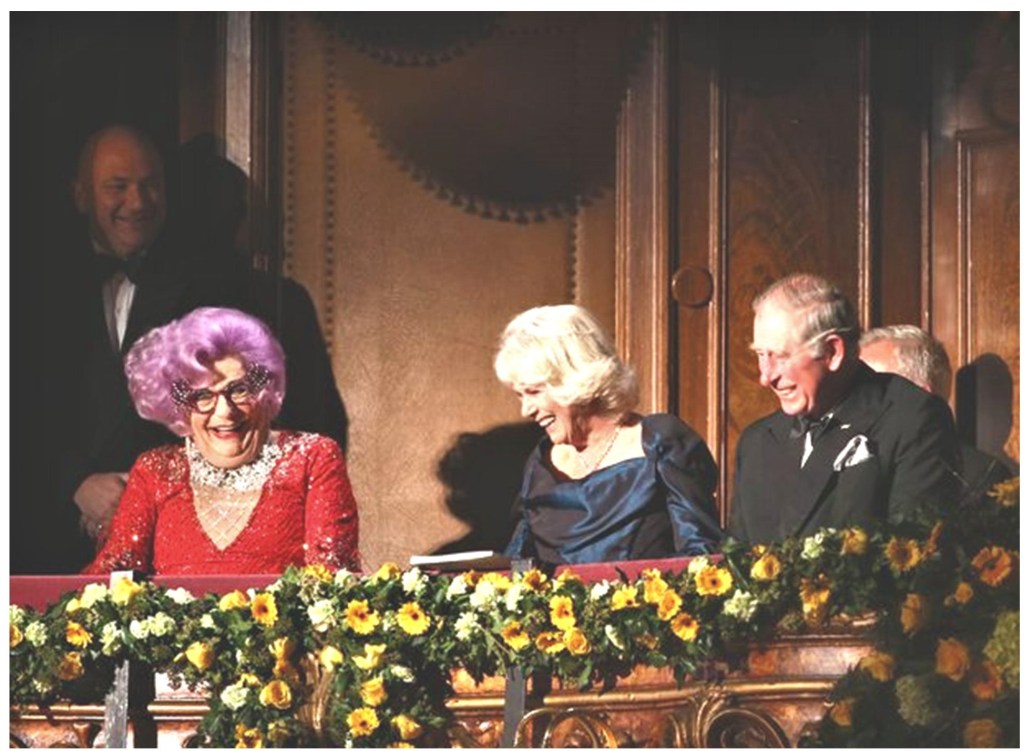
I think it can and I like to think that, as we say goodbye, we might focus on that wonderful sketch where Dame Edna enters the Royal Box where King (then Prince) Charles and dear Camilla are sitting. As ever she makes (creates?) a fuss but before she has time to settle, an usher arrives and pointedly shows her a ticket which suggests she’s in the wrong place. As she gets up, she turns to Camilla and says, “They’ve found me a better seat!”.

I’d like to think that is exactly what God has done now for Dame Edna and, of course for Barry.  I know that there will be laughter.

Here’s a reflective poem by the lovely John O’Donohue,
which says things I have been thinking about, in a very special way.

Like the joy of the sea coming home to shore,
May the relief of laughter rinse through your soul.

As the wind loves to call things to dance,
May your gravity be lightened by grace.

Like the dignity of moonlight restoring the earth,
May your thoughts incline with reverence and respect.

As water takes whatever shape it is in,
So free may you be about who you become.

As silence smiles on the other side of what’s said,
May your sense of irony bring perspective.

As time remains free of all that it frames,
May your mind stay clear of all it names.

May your prayer of listening deepen enough
to hear in the depths the laughter of god.

John O’Donohue
for Equilibrium. A Blessing.

[Mr. G]