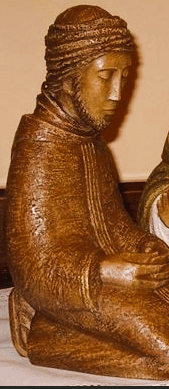
St Joseph could be called the man in the background. His importance at one level is that he provides a link with his ancestor David, thus giving Jesus the lineage back to the establishment of the Royal Kingdom of which Jesus is the heir. In the story of Jesus’s birth, we have to go to St. Matthew for the story of Joseph’s own Annunciation. (Matthew 1: verses 18 to 25) Having learned of Mary’s pregnancy, Joseph’s life was in a turmoil. The law was quite clear that Mary should be punished but Joseph was a compassionate man and he wanted to spare her and her family disgrace. It was then that an angel visited him in a dream and explained about the work of the Holy Spirit in Mary and about both their parts in the Incarnation. Joseph is central to the Christmas story and it is because of him that they must go the Bethlehem for a census. There he provides shelter for Mary to give birth to the Saviour of the World. We next hear about him when Herod seeks to kill Jesus and they take the long journey to Egypt. Later he is told by an angel to return home and the family settle in Nazareth. After this, the only reference to Joseph is in the incident where the boy Jesus remains in the Temple and his parents have to rush back to search for him. We are told that after this Jesus went back home with his parents to Nazareth where he was obedient to his parents. Then, Joseph fades completely from the story though there are references to him when the crowd say of Jesus, Isn’t this the Carpenter’s Son?
Reading the Bible there are many people who appear for some particular reason and then disappear from its pages. Joseph, however, stands not only as one who completes the picture of the Holy Family but who is also a reminder to all of us that God does not always need us to shine on the centre stage. God needs people who are faithfully living out a life of prayer and support with compassion, kindness and loving obedience. People who, like Joseph are attentive to God’s will. He needs people who are content to be in the background and who, by a life of quiet service, allow Jesus to take centre stage in all our lives. Too often the Church is preoccupied with itself and can get so bogged down in its own affairs that it fails to proclaim the Lord we are there to serve. Joseph never does that. He always points away from himself and shows us a vision of God in Christ Jesus. That is God’s call to Christians ~ to us.
Heavenly Father, whose Son grew in wisdom and stature in the home of Joseph the carpenter of Nazareth and on the wood of the cross perfected the work of the world’s salvation: help us to count the wisdom of the world as foolishness, and to walk with Joseph in simplicity and trust; through Jesus Christ our Lord.
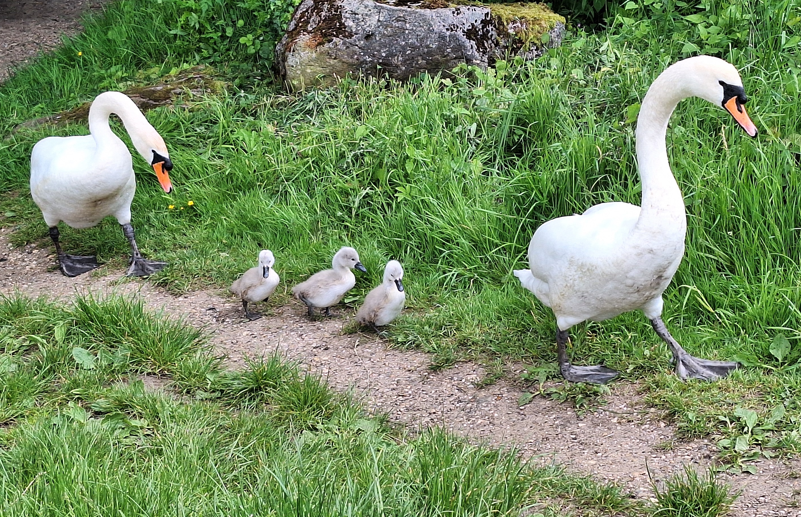
Cygnets watched over by parent swans. Hatfield Forest, Essex. Photo by Mr G
A Reflection about Mothering Sunday by Piers Northam.
There is a Neopolitan saying about cockroaches Ogni scarrafone è bell’ a mamma soja– which translates as ‘every little cockroach is beautiful to its own mother…’ It feels relevant, because the cockroach’s mother looks on her offspring with a eyes filled with love – and that set me thinking about how we are each looked on by God.
As we journey through Lent, I think it’s an important thing to ponder on for ourselves: how does God see us? I mean really see us? I suspect that answers to this question will vary, but they might include the fact that he loves us; that he might also be a bit disappointed in what he sees us getting up to; that he’s forgiving and always willing us to turn back to him; that he’s also forward-looking and sees the potential in us: sees the best that we can be; and that he sees the beauty that we might think is either not there or well-hidden under our crusty, cockroachy exteriors – and so he gazes on us with love and affection – with the gaze of a loving parent.
On Mothering Sunday, that notion of the relationship between parent and child – by which I mean the very best version of that relationship – might have a lot to teach us: it’s bound up in notions of nurturing and feeding us; protecting us; teaching and equipping us for life; perhaps a bit of necessary discipline from time to time, but above all that sense of wanting the best for us; loving us: and that unspoken bond and shared identity… The Bible Readings for Mothering Sunday, from Exodus and from St John’s Gospel, have some other interesting things to say about parenthood:
First there’s the story of Moses’ mother. It’s perhaps useful to remind ourselves of the background to this story: the Hebrews were enslaved to the Egyptians, but they had grown hugely in number and the Pharaoh feared being overrun by them so, in order to keep down the population, he commanded that all Hebrew male children be thrown into the Nile and killed – they were living in dark times. When Moses was born and his mother could no longer hide him, she made a basket for him, sealed it with pitch to make it watertight and hid him amongst the reeds. Here is a mother who can no longer protect her child, so she entrusts him to God, leaving him somewhere she prays he will be safe. And then, of course, Pharaoh’s daughter comes along and finds him – she acts instinctively; taking pity on this defenceless baby. She is aware that he is probably Hebrew – an alien that her society looks down on – but what she sees is a fellow human being: a child in need of care and nurturing whom she goes on to bring up as her own. And then we see the two women working together to raise Moses: his biological mother hired as a wet-nurse to feed him and raise him for a period. Later, she hands him over to Pharaoh’s daughter because she realises that by doing so he will survive and thrive and be safe and well looked after. In her we see sacrifice and trust in God; putting her child’s needs before her own; nurturing him and wanting the best opportunities for him in life. And in Pharaoh’s daughter, we see compassion and generosity; she looks beyond the views of her society, to see a defenceless child and she responds to his need, bringing him up as her own. Both these women think of Moses first and both act in his best interests.
The other little thread here, that is picked up in the Gospel reading, is that motherhood for Pharaoh’s daughter goes beyond blood-ties. Moses is her child by adoption, yet he is treated as her own. And this is what we see at the Cross when Jesus entrusts Mary and John to each other. The beloved disciple takes Mary into his household and treats her as his own – as she does him. In entrusting them to each other, Jesus is asking them to form this interdependent, loving relationship.
It is these relationships that are at the very heart of our Christian faith. Jesus tells us that we are children of his Heavenly Father, who is also our Father – we’re reminded of it every time we pray that great prayer he taught us. And so, by extension, we are to be family to each other – with all that that might entail. As with Pharaoh’s daughter, we are to see beyond the blood-ties of our own families and beyond the borders of race and nationality and to regard each other as beloved brothers and sisters.
But on Mothering Sunday, I think we could push things a stage further. We’ve all heard of sibling rivalry and there’s never a guarantee that we’ll get on with our brothers and sisters. But if we focus on the way that the best parents look on their children, we might find a stronger imperative.
In the 16th century, long before it was subsumed into the Mothers’ Day peddled by the card companies, this Sunday in Lent was a day when churchgoers returned to their ‘Mother Church’ – often the local cathedral or big church, or perhaps the church where they were baptised. In later times, domestic staff who lived away from home, were given the day off to return to their families – and usually to their mothers – and this is where some of the customs that we keep today came from. But that notion of ‘Mother Church’ is an important one, for if we take it seriously, then it tells us something about how the church should be – not a church that fences us out with rules and regulations about who’s in and who’s out, but one that loves and nurtures us. One that, like Pharaoh’s daughter, simply recognises our common humanity – whether we’re Hebrew or Egyptian, black or white, rich or poor, gay or straight or any of the shades and variations in between. Because if we look beyond our cockroachy exteriors, we’re all simply children of God and the Church needs to recognise this and gaze upon us with abundant love – irrespective of who we are or what we look like.
Now I know that for some, the phrase ‘Mother Church’ will evoke notions of an Institution that knows best; perhaps even one that lays down the law and tells you what to think; or one that is too slow to show true love and acceptance to all. And that’s not what the best parenting is all about is it? What I would love to be able to say of the Church of England is that it isn’t entirely like that – and actually, at grass-roots level, I don’t think it is. For me, Anglicanism – in its best form – aims to brings us to maturity: helping us to learn that we are loved by our Father in Heaven so that we grow in confidence; teaching and equipping us; encouraging us to think for ourselves and to learn so that we can grow into adults – or at least mildly sensible teenagers – who have enough nous and confidence to go out into the world and treat our fellow men and women lovingly. That’s what the best parents do, don’t they? They bring up their children confident in the knowledge that they are loved and therefore able to be loving to others; equipped to be good and valuable members of society.
Now I referred to ‘Mother Church’ a moment ago as an Institution, but of course the really important thing is that the church isn’t an institution at all. It’s you and me – we are the Church. So it seems to me that our calling is not just to treat each other as brothers and sisters, with whom we might bicker around the dinner table, but actually to look at each other with the loving eyes of a parent – with all that that entails.
Of course that’s a lot more challenging isn’t it? We’ve got to be like the cockroach’s mother, seeing past the carapace to the lovely little cockroach inside. We’ve got to want the very best for each other – and not just the ones who are like us – Jesus, with his words to John and Mary, blew the whole thing wider from up there on the cross. We need to be like this to the whole of humanity.
I was chatting with a friend in the week who I haven’t seen for quite a while and we were talking about the rather depressing state of the world right now and she said, ‘wouldn’t it all be so much better if we could simply treat each other with kindness?’ I think she’s absolutely right – and I think St Paul would agree:
‘clothe yourselves with compassion, kindness, humility, meekness, and patience. Bear with one another […] forgive each other. And above all, clothe yourselves with love.’[1]
The other day I was telling someone, who didn’t know it, that wonderful story of the Prodigal Son – it’s one of my all-time favourites: I never cease to be moved by that moment when the father, who’s been sitting all day at the front step gazing down the road, sees his son returning home. What does he do? He hitches up his skirts and goes running, full pelt down the road to meet him and sweep him up in a loving embrace. That bursting-at-the-seams joy at seeing his lost child come home, gets me every time. And that needs to be us.
We need to be out on the front step, looking down the road to see which one of our children might be coming home; we need to be rooting around in the bulrushes looking for those whom we can protect and clothe and give a home to; we need to be feeding and nurturing those who are with us and – in the manner of all good parents, giving them the confidence that they are loved and valued; we need to be inviting and gathering those around us to the table to break bread with our brother, Jesus.
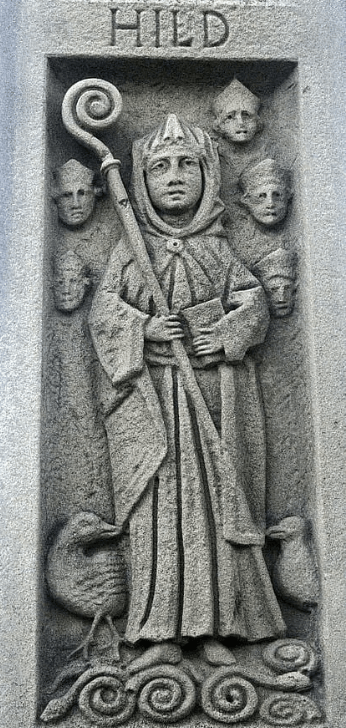
St Hild, detail from a monument to Hilda of Whitby.
This week, the church keeps the feast of St. Hilda (or to give her the Anglo-Saxon name, Hild).
She was born into the Northumbrian royal family and for the first 33 years of her life led a very different life to the one God was to lead her. For that call God used the voice of St.Aidan of Lindisfarne. He was the monk from Iona who brought the Gospel to the North East of England and in his monastery on Holy Island he trained up Anglo-Saxon boys to become Missionaries to many parts of England as well as the Scottish borders. Part of Aidan’s mission plan was to establish religious power houses, monasteries from which further missions could be launched. These religious houses were built on Prayer and cemented by the Gospel of Jesus Christ as well as translated into Christian Service.
One day, in obedience to God’s plan, Aidan summoned Hild to meet him on the banks of the river Coquet south of Bamburgh. Here he told her God’s plan for her. She was to establish a religious house, first at Wearmouth and then on the Headland at Hartlepool. From there she was to go on to established her most famous foundation at Whitby (Or Strines at it was then known). It was to be a ‘double’ monastery in that two monasteries were built side by side, one for men and the other for women. Hild was to be the Abbess of both. As Abbess she ruled over both monasteries and was, in effect, the head.
This may surprise some but Aidan belonged to the Church of the West which we call Celtic but which was really Irish. In Ireland women had equality of status with men and particularly in the Church. Aidan saw no reason why this equality should not be established in England too. It was only later when the Church of Rome grew in strength that this practice was challenged.
The Venerable Bede, to whom we owe much of the story of Christianity in Britain, and who, if pressed was more generous in his comments about Roman practice, recognized Hild’s specialness and greatness. He wrote of her:
“All who knew abbess Hilda, the servant of Christ, called her Mother because of her wonderful devotion and grace; she never ceased to give thanks to her Maker or to instruct the flock committed to her care. Not only was Hilda an outstanding example of holy life to all who were in her monastery, but she also provided an opportunity for salvation and repentance to many who lived far away, and who heard the happy story of her industry and virtue.”
Under her guidance the Abbey at Whitby grew in stature, capturing her devotion to Christ and the gift of holiness showered upon her by God. Her advice and prayer was sought after by ordinary folk as well as those of royal birth. She compelled all who were under her instruction to devote so much time to the study of the holy Scriptures and so much time to doing good works that many came to have an enriched and deep faith. She was also, because of God’s Providence, the right person in the right place at the right time. It was at her abbey at Whitby that the Church met for an important Synod in 664AD. It brought together Roman and Irish Christians who had differing views on issues such as the date of Easter, the way Baptism was administered, who could ordain and other matters. Hilda favoured the Celtic/Irish view of things but the Roman view prevailed. This caused a big rift in the Church and it fell to Hilda, along with her friend St. Cuthbert, to try and reconcile the various factions. To the degree that she was quite successful shows her, not only, to be a person of generous spirit but also one who had a gift of diplomacy. Hilda, who had sided with the Irish, kept her cool, and she set about healing the divisions which split the Church. With quiet diplomacy, authority and fortitude, she brought the wounded church to some kind of healing from which it was to move forward. Perhaps because of this she has been described as a ray of light in darkness.
One of the qualities which disciples of Christ are encouraged to seek and use are the gifts that God gives us. We are all called to support and encourage each other to grow in discipleship by discovering and offering our gifts to God and his people.
An example that we all have gifts but need others to encourage us to find and use them, comes from something Hild did. It concerns a cowherd called Caedmon, who though not a monks, worked at the monastery and shared its life. One day he was heard singing. His voice was angelic. Hild heard of it and sent for him. She encouraged him to write songs that were formed from verses of the Bible. Soon Caedmon was singing the Scriptures and so edified others. He was encouraged by Hild to use his God-given talents. He became a monk and he was England’s first poet. Little of his work remains today – just six lines – but his prolific outpouring was well chronicled. Hild brought out the image of Jesus Christ in people because she lived in God’s brightness.
Today, she Is offered to us as a beacon in our own darkened world and, at times, church. When we are up against it in both world and church, Hild reminds us of a deeper truth and of a greater world. A world where Angels dance and sing; a world where those who die are loved by the Lord into eternal life; a world where we have a joyful witness to carry out. Hilda served this world but her heart was always in another world. Her soul belonged to God and it was in God’s presence that she continually lived. The novelist T H White once wrote that : There is another world and it is in this one. By which is meant that we are surrounded by the world of God which constantly embraces us and holds us in love. We don’t have to search for this world by looking up but by feeling it around us. We touch it in prayer; we hear its voice in Scripture; we are fed by it in Worship and we celebrate it in each other. That is what gave Hild the impetus to serve God and to touch hearts and lives with his Love. She also shows us a very important truth, often forgotten, that in the eyes of God we are all equal and we are all part of his inclusive love. We are tasked to discover what that means in a world which acts differently, where lies are easily told and truth is discarded and which uses words rather than actions – e.g. what can we least get away with in global gatherings; A world where refugees are used as pawns and for political ends, a world which defames people of colour and people of differing gender, and a world which still treats women abominably.
I wonder what Hild would do in our world? I expect she would have sharp words and strong opinions but she would carry these in love, in prayer and in care to God, with repentance for our shortcomings but with a depth of hope in her heart that, despite everything, God’s world will continue to break through and make everything new.
But I suspect she would want each of us to join in making real the vision of a world ruled by Love, Care and kindness. A world she discovered for herself is found in God alone.
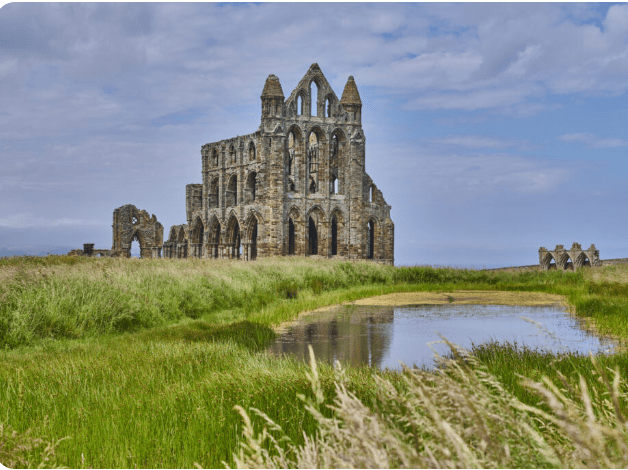
The Abbey ruins today at Whitby. Thereis an Anglican religious community nearby. There is a lively and faithful parish church in Whitby and other Christian congregations.
[] [] [] The Statue of Hild pictured above includes coiled ammonite fossils at St Hilda’s feet – a reference to a legend in which she turned snakes which plagued Whitby, into stone. The image was made available by Wilson44691, uploaded by Arienne King and published on 20th April 2019. The Copyright holder has made the image available and licensed in the ‘Public Domain’ and specifically made it available for copying purposes. [Mr.G]
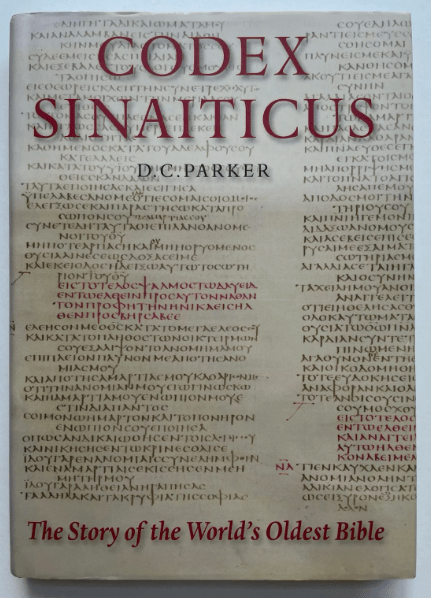
Whenever I visit the British Library in London I try to search out two very special manuscripts ~ The Codex Siniaticus and the Codex Alexandrinus. They are two of the rarest copies of Bible texts in Greek. In the case of Codex Siniaticus it is one of the most important books in the world. It is, arguably, the oldest complete copy of the New Testament that is still in existence, though not all of it is kept in London with a portion still being in Egypt, Russia and Leipzig. However, it has been digitally re-united so a complete copy now exists. From its text (and others which are less complete) all our translations of the New Testament are influenced.
It is also rather beautiful to look at in its handwritten script. To come close to what is the earliest known version of the Gospel of Jesus Christ, lovingly scripted in the 4th century at the monastery of St. Catherine on Mount Sinai, is to come close to the Living Gospel. It is the closest we get to God’s Holy Word spoken by Jesus and the New Testament apostles and evangelists. Yet this is not the only example of the Living Gospel.
I write this on All Hallows Eve or ‘Halloween’ – a night when we try not to think of ghosts and scary things but rather of the Holy Ones of God—the saints whose lives God touched and who became, in the way they lived those lives Living copies of the Good News of Jesus Christ. I think not only of the many saints we commemorate in our Church Calendars but also those whose holiness is known to but a few, though always to God. People who, through the lives and values they have tried to lead and the faith they have proclaimed, been influential and an encouragement to others. Most, if not all, of us who embrace the Christian faith, can think of such people whose nurture of our Christian understanding and practice have laid the foundation of our belief in Jesus Christ and our love for Him. These are the unsung hero’s of our Church. These we remember at All Saints’ tide. But their specialness is not about them being unique. All of us are called to be the Holy Ones of God. We are all called to saintliness and to nurture and grow the faith of others by our example, our prayers and our living out of the Gospel—a Gospel we should know by heart because it is absorbed into our souls. Someone once said that we should remember that we may be the only copy of the Gospel that others may read!
As I keep the Hallowed (sacred) evening on the cusp of All Saints’ Day, I think of those holy ones of God who have made such a difference in my own life with their outflowing of God’s love. They have been the beacons which have illuminated my journey towards God. I am thankful that they were placed in my way to bring God’s heavenly glow to my pilgrimage to heaven. They are also a reminder that, as we can read in the Book of Wisdom (Chapter 3) “The souls of the righteous are in the hands of God.“ That includes all the Saints, and all who, today, are trying to live close to God and who continue to show us the way to God’s Heart.

 Mr G's Ponderings