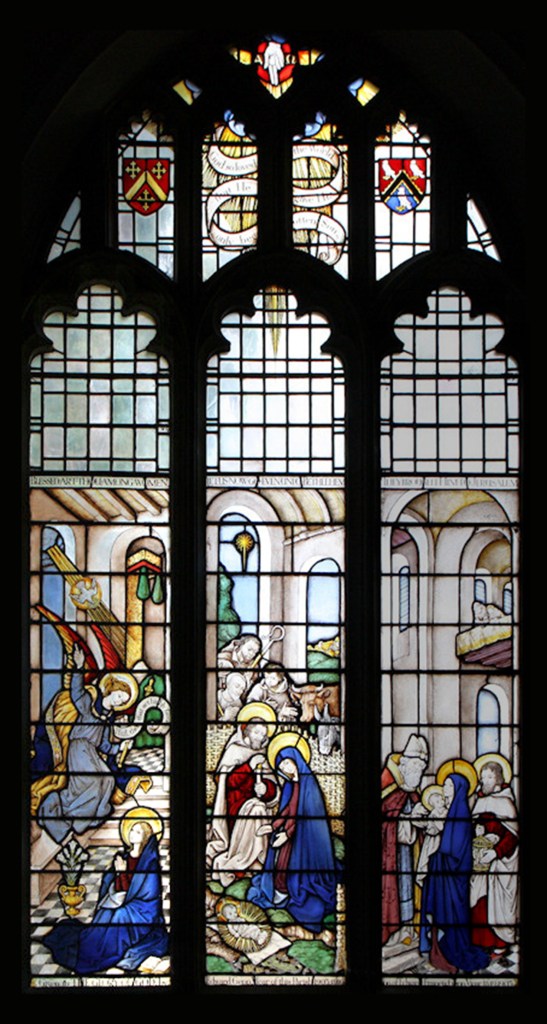
Photo, The East Window in St Mary the Virgin, High Easter, Essex
Summer Evensong in St Mary the Vitgin, High Easter gazing at the East Window.
We gather to open ourselves to God in this House of Prayer, where, alight with early evening sun, Incarnation beckons through refracted glass.
Here, blessed Mary and humble Joseph are transfixed in golden beams streaming towards them from the Christ-child, deeply alive in cradle strewn with straw.
Ox peeps adoringly over shoulder of Ass as the shepherd and his boy look on, crozier, an icon of pastoral love to come, carried proudly. Star above all, shining in majestic glory, a portal through which heaven comes to earth.
I see the telling of this in the left window as Angel Gabriel, deep in converse with God’s chosen One, seeks to draw from her a ‘Yes’ that comes from the heart, And challenges us too.
The triptych of God’s love is completed in the third window , that of Presentation where The child of God touches the waiting Simeon, as the old man tenderly takes, holds, and blesses Him in gentle and awesome thanksgiving, which releases his own soul into God’s arms, slipping into a peace his heart longs for.
Three God moments dance in coloured glass opening our hearts, our souls, our vision, Calling us to glorify, presenting ourselves to receive the light of our Salvation and the grace of God’s Incarnate love.
For this we came.
[Mr G. 23rd July 2026]
I visited High Easter Church on July 19th to take part in Choral Evensong. I was fascinated by the East Window and above is my reflection. Choral Evensong was sung beautifully using the Book of Common Prayer and accompanied by a fine organist. The congregation welcome was kind and warm, and the after service coffee was splendid! Should you ever find yourself in that part of Essex, the postcode is CM1 4QW. It’s a fine church with Saxon roots, roman brick and bits from almost every age. Unusually it has a window dedicated to St. Valentine!
As the Lectionary takes us through Matthew’s Gospel, we come to the Parable of the Good and Bad Seed – or the Wheat and the Tares. The gardening or farming theme continues – I suspect Jesus could well be a fan of Gardener’s World or Farming Today – so last week we had the Parable of the Sower where the Sower sowed seed extravagantly, broadcasting widely, so that it fell on a variety of different types of ground. In today’s story however, Jesus focuses on the contrast between the good and bad seed; or between the wheat and the tares as some translations have it.
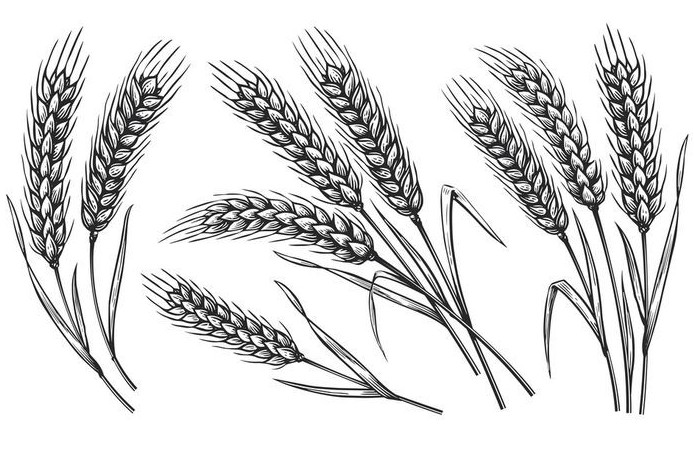
Historically and in biblical texts, a tare is a plant called Poison Darnel (or Lolium temulentum if you’re BBC TV Gardener, Monty Don). The thing about this particular plant is that it grows to look exactly like wheat in its early stages – it’s pretty much indistinguishable – and of course that’s why the Master doesn’t want his servants to pull up the weeds, for in doing so they might pull up the wheat too. And every grain, every seedling is precious to him.
Of course when the disciples later ask for the parable to be unpacked, Jesus explains that the field is the world, the sower is the Son of Man and he refers to the wheat as the children of the kingdom and the tares as the children of the evil one. I have to admit, there’s a part of me that struggles with this, for I think there’s a temptation from this to assume that the world is simply divided into good people and wicked people, with the good ones destined for heaven and the baddies destined for hell. Almost as if there’s no choice or agency in the matter.
But I think it’s a wee bit more complicated than that… For a start the good and the bad are indistinguishable – the tares look just like the wheat: so much so that the workmen in the field would have a hard time telling them apart and might finish by uprooting the wrong ones. What Jesus says is that the moment of sorting and judgement will come later. And anyway, it’s not for us to judge, for there is only One who can judge and who can truly discern what lies in people’s hearts. There’s a warning here – not to think that we can take a glance at someone and simply write them off as being what we might consider to be a bad seed. I think anyone who’s experienced being marginalised at some point in their lives will have a sense of what it’s like to be on the receiving end of that. Yet of course, in these polarised times, that’s what we’re constantly being encouraged to do, isn’t it? To make judgements about others; to decide whether they’re in or out. And if we don’t like the cut of their jib or the way they think or live their lives, then we’re encouraged to consign them to the fire, pronto. But that’s not what the Lord of the Harvest would have us do. No, he says, let them grow together…
And by the same token, it can be all too seductive to simply assume that we’re the good seed – that somehow, we’ve got it right and that we’re just fine and dandy as we are. But again, I think we’re being invited to look deeper than that.
Because as I pondered further on this story, it seemed to me that both the good and the bad seed can sit within each of us. There are times when the fields of our hearts are full of ripening corn; when they are yielding good fruit for the kingdom. But there are other times when the tares grow up and diminish the potential harvest. When the Evil One gets to us and sullies the crop. When we get seduced or distracted, or pulled away from God.
St Augustine, in a sermon on this parable, puts it rather beautifully:
“Listen, dearest grains of Christ; listen, Christ’s precious ears of wheat; listen, Christ’s dearest corn. Take a look at yourselves, go back to your consciences, interrogate your faith, interrogate your love, stir up your consciences. And if you discover that you are good grain, let the thought occur to you, ‘Whoever perseveres to the end will be saved.’
Any of you who, on shaking up their consciences, finds themselves among the weeds must not be afraid to change. The command hasn’t yet been given to cut, it isn’t the harvest yet; don’t be today what you were yesterday, or at least don’t be tomorrow what you are today.” [1]
‘You must not be afraid to change.’ Augustine is encouraging us to take a good look at ourselves and our motivations; to see where our hearts lie, But he also sees in each of us the possibility to change. For tomorrow comes with a new dawn.
There may be times when we realise that the tares are taking over, but the Good News is that nothing is irredeemable with and through Jesus, for our God is the God of new beginnings and new life; of forgiveness and fresh starts; always ready to plant seed afresh in the fields of our hearts. Perhaps that’s also why letting the two grow together is important – because in God’s economy, tares – through the power of Jesus – can become wheat. There is the potential in all of us; none of us is a lost cause to our Father in heaven.
And finally, (because the more you ponder one of Jesus’ stories, the more viewpoints you discover…) we’ve thought about being the seed, but it’s also worth thinking about what sort of sowing we are doing. How – and what – are we planting into other people’s lives? Are we working for the Son of Man and planting seed that will yield a harvest; wheat with the potential to become the bread of life? Or are we coming by night and sowing bitter tares in others’ fields? When we pass judgement about people and spread negativity we’re sowing those tares; when we close our hearts and our minds to people, we’re sowing those tares. We have to be vigilant to ensure that we’re always planting the good seed.
The raising and nurturing of plants is a long game. Last week our preacher talked about how ‘much of God’s work happens beneath the surface. Seeds spend a long time underground before anyone sees signs of life.’ And she went on to say that
‘God is often working beneath the surface long before we can see the results. […] Our role is to cooperate. […] Every act of kindness is tending the seed. Every prayer is watering the seed. Every act of hospitality is nourishing the seed. […] we are cultivating the ground where God is already at work.’ [2]
Jesus calls us to sow good seed in our own lives and the lives of those around us; to beware being seduced by the Evil One into planting bitter tares; and to leave the final judgement to Him.
Amen.
[1] St Augustine – Sermon 73A on the Parable of the Wheat and the Tares
[2] Rachel Griffiths – sermon preached on the Parable of the Sower – St Mary-at-Latton 12 July 2026
Piers Northam teaches Interior Design at the Inchbald School of Design, London. He is priest in The Church Of England and particularly serves at St Mary-at Latton- Harlow.
Easter Bright ~ a poem for Easter by Peter Hellard-Malt.
This morning begins with a quiet frost a carpenter sky, pale and ordinary low expectations drifting in from Nazareth
By mid-morning, scattered light gentle warmth moving among crowds a chance of healing in open places some may notice loaves increasing without explanation
Into the afternoon, conditions turn unsettled authorities gathering like thick cloud pressure dropping over Jerusalem voices rising, thunder without rain
Evening brings a sudden storm darkness at an unusual hour curtains torn by unseen wind one might say the forecast has gone quite wrong
Overnight, a deep stillness he kind that feels like waiting tombs sealed, hope folded away no visibility, not even for seasoned prophets
But at dawn, quite without warning a bright and unreasonable sunrise stone rolled aside like morning mist death giving way as if it were only weather
Outlook for the week light continues, stubborn and uncontained scattered appearances of joy and a general lifting of all things once thought final
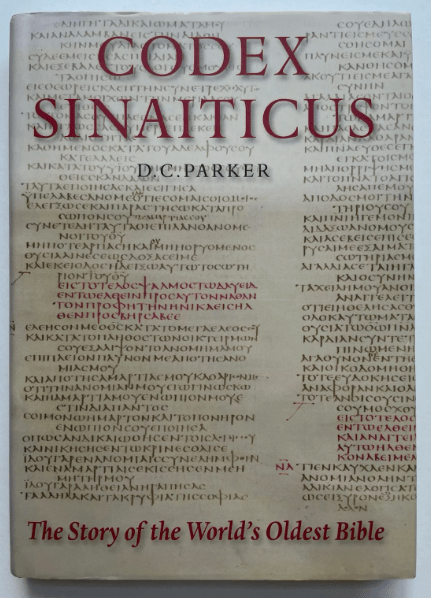
Whenever I visit the British Library in London I try to search out two very special manuscripts ~ The Codex Siniaticus and the Codex Alexandrinus. They are two of the rarest copies of Bible texts in Greek. In the case of Codex Siniaticus it is one of the most important books in the world. It is, arguably, the oldest complete copy of the New Testament that is still in existence, though not all of it is kept in London with a portion still being in Egypt, Russia and Leipzig. However, it has been digitally re-united so a complete copy now exists. From its text (and others which are less complete) all our translations of the New Testament are influenced.
It is also rather beautiful to look at in its handwritten script. To come close to what is the earliest known version of the Gospel of Jesus Christ, lovingly scripted in the 4th century at the monastery of St. Catherine on Mount Sinai, is to come close to the Living Gospel. It is the closest we get to God’s Holy Word spoken by Jesus and the New Testament apostles and evangelists. Yet this is not the only example of the Living Gospel.
I write this on All Hallows Eve or ‘Halloween’ – a night when we try not to think of ghosts and scary things but rather of the Holy Ones of God—the saints whose lives God touched and who became, in the way they lived those lives Living copies of the Good News of Jesus Christ. I think not only of the many saints we commemorate in our Church Calendars but also those whose holiness is known to but a few, though always to God. People who, through the lives and values they have tried to lead and the faith they have proclaimed, been influential and an encouragement to others. Most, if not all, of us who embrace the Christian faith, can think of such people whose nurture of our Christian understanding and practice have laid the foundation of our belief in Jesus Christ and our love for Him. These are the unsung hero’s of our Church. These we remember at All Saints’ tide. But their specialness is not about them being unique. All of us are called to be the Holy Ones of God. We are all called to saintliness and to nurture and grow the faith of others by our example, our prayers and our living out of the Gospel—a Gospel we should know by heart because it is absorbed into our souls. Someone once said that we should remember that we may be the only copy of the Gospel that others may read!
As I keep the Hallowed (sacred) evening on the cusp of All Saints’ Day, I think of those holy ones of God who have made such a difference in my own life with their outflowing of God’s love. They have been the beacons which have illuminated my journey towards God. I am thankful that they were placed in my way to bring God’s heavenly glow to my pilgrimage to heaven. They are also a reminder that, as we can read in the Book of Wisdom (Chapter 3) “The souls of the righteous are in the hands of God.“ That includes all the Saints, and all who, today, are trying to live close to God and who continue to show us the way to God’s Heart.