[photo from Gill Henwood – of the area near the Black Mountains, Bhutan]
Jesus prays in Gethsemane
On the night of his betrayal, Jesus took his disciples to the Garden of Gethsemane, near the Mount of Olives. He asked them to pray for themselves and then went to a place by himself. He prayed to his Father that he might be released from the trial and crucifixion ahead of him. But he also prayed that his Father’s will should prevail. The humanity of Jesus cried out and his anguish caused his sweat to fall like drops of blood. An angel from heaven came to strengthen him. His disciples were fast asleep. Then the Roman soldiers came to the garden to arrest him…. (St Luke’s Gospel Chapter 22: 39-53)
Gethsemane
This is his Passion. Darkness wraps around his very being, not a warming cloak but a shroud. Silence, punctured by friends snoring off the wellbeing of food, minds sloshed with wine. Alone with the shivers of the night, everything in him protests.
Sometimes, when we know our destiny, our minds close. Not this! No! Never! But our hearts are our undoing: our resolve begins; ends there. So he battles with his need to say ‘Yes’, for himself, for others, for us. How else can the world know what it is to be loved?
Kneeling on the damp ground, tense, numb, scared, uncertain, he waits. And the Father waits too as demons and angels whirl, stirring up the black air, a vortex of cosmic battle. Below them, sweat drops as blood. And still the Father waits, listening expectantly, daring to hope…
God wrestling desperately with God with everything – just everything – at stake. This really is the Passion. He sighs, deeply, calm descends. “Yes, let it be.”
The Father wraps his love around him – and so too around us.
Four years ago, my friend Joyce wrote a little story about the Palm Sunday Donkey. It was specifically for the children of Ninefields Church of England School, near Waltham Abbey in Essex. Each child got a printed copy as a gift from Joyce. One or two others of us also got one. With Joyce’s permission, I was able to Blog it as an entry for March 28th 2021. Sadly since then Joyce died unexpectedly and though some will have read the story, it’s worth repeating as I pause in prayer and remember a delightful person who understood more than most, what it means to be child-like.
[Mr G # Palm Sunday 2025]
It promised to be a hot and sunny day as the early morning sunlight played on the little donkey’s face. Benji lazily opened first one eye and then the other, but although the sunshine was warm on his face, he shivered a little and huddled closer to his mother. It was, after all, only yesterday that he had seen the old donkey who lived along the road being cruelly beaten by his master. Benji’s mother gently nuzzled her son’s face and slowly licked one long ear followed by the other. Then, at the sound of their master’s voice, they trotted over to the edge of their field and had a long drink from the bucket of water he had brought for them, before turning to munch the hay which was piled up in the corner.
Even though their master was a kind man, Benji was still very frightened of the world outside his field and the scar on his mother’s back would always remind him of how cruel some people could be even to a donkey who had done nothing wrong. Sometimes, as Benji watched his mother carrying a person down the hill to the big city of Jerusalem, he could almost feel the pain of her scar and he longed to do something to help her. But the trouble was, whenever anybody asked for a ride on Benji, he was so frightened that he would begin to shake all over and no one wanted to ride him when he was like that. And so, in his short life, nobody had ever ridden on Benji’s back. But perhaps, just perhaps, today would be different……….
When Benji and his mother had finished eating, their master returned and, as he gently tickled their ears, he began to speak softly to them:
‘There will be lots of people going down to Jerusalem today to celebrate the Feast of the Passover’ he said ‘and I think that someone will need you to carry him today, Benji, so I’m going to get you both ready and I want you to stand quietly for me by the house.’
Then, using a long length of rope so that the donkeys could still graze from the grass, their master tied them to the trunk of a tree and they began to wait to see who might come by. They hadn’t been waiting long, however, when two men hurried towards the donkeys and, turning to their owner they said:
‘The Lord needs them’‘ That’s just fine’ said their master and as he untied Benji and his mother he whispered in their ears, ‘today will be your special day.’
The two men led the donkeys to the end of a dusty path and as they stood there, waiting, Benji turned his head and from where he was standing he could see right to the bottom of the big hill and all of the city of Jerusalem surrounded by big stone walls and lots of people, who looked as small as ants, hurrying around. Just then Benji’s gaze was arrested by a pile of rubbish outside the walls of the city and he began to tremble. He had often seen donkeys carrying rotting rubbish down to the tip and, sometimes, his mother told him, bad people were hung on crosses and killed there. At that thought, Benji shook even more, but just as he was beginning to feel so weak that he thought he would fall over, he felt a hand on his head and a gentle voice saying:
‘Not today, little donkey, not today; the rubbish tip’s not for today. Don’t be afraid little donkey, today I want you to carry me.’
Benji turned his head and found himself looking into the most understanding man’s face he had ever seen and suddenly his shaking stopped and he felt strangely calm. Yes, he would be able to carry this man because he knew he understood and he gently nuzzled Jesus’ hand. While his friends put their coats on Benji’s back, Jesus gently patted the scar on the older donkey’s back and this time she didn’t wince as she normally did, but she too, gently rubbed her head against him.
When they were ready, Jesus climbed on Benji’s back and began to ride down the hill towards Jerusalem. To his surprise, with this man on his back, Benji suddenly felt quite strong and sure of himself. Somehow, being with Jesus, had taken away his scary feelings and now he really did feel that he could carry him all the way to Jerusalem. And Benji’s mother was just a few paces behind trotting along quite contentedly. They hadn’t gone very far, however, when people started to come to the edge of the road and they began to cheer and wave palm branches as Jesus rode by on the little donkey. People even spread their cloaks and more palm branches on the ground so that Benji had a very soft road to walk on. People then began to shout:
‘Hosanna to the Son of David! Blessed is he who comes in the name of the Lord Hosanna in the highest’
‘Yes, Jesus must be very special’ thought Benji, ‘ but I could have told all these people that from the moment he first spoke to me.’ And as he continued to trot down the road he, too, felt special and so happy.
But as we know, donkeys are very sensitive and after a little while, amidst all the cheering, Benji’s long ears began to pick up some whispers from people at the back of the crowd, people who said they didn’t like Jesus and even that they wanted to kill him. When he heard this, Benji began to shake again, but the man on his back gently patted him and said again; ‘Not today little donkey, not today.’ So, reassured once more, Benji trotted on right through a gate in the wall and into the city of Jerusalem, right up to the temple.
When they arrived there, Jesus jumped off Benji’s back, ‘ thank you, little donkey’ he said, ‘now you go back home with your mother and rest – well done little donkey, well done.’ Benji was so happy, he didn’t want to leave, but after rubbing Jesus’ arm with his muzzle one more, he turned and trotted back up the hill with his mother.
When he got home, he turned his head and looked at the city of Jerusalem once more and he wondered what Jesus was doing now. Then, as his gaze again took in the rubbish tip, a big tear rolled down his face and he heard that gentle voice saying ‘not today, not today, little donkey’ and he wondered what tomorrow might bring……
Lakeland hills appearing like a desert. photo by Gill Henwood.
A Voice from the Desert ~ St. Antony of Egypt. (f.d. 17th January)
There are significant dates in our lives, which can lead to a change of direction and a new way of living.This was very true of St. Antony of Egypt, also known as ‘the great’. Antony was born in Egypt in 250AD, the son of a prosperous farmer. His family were Christian and he grew up hearing the Gospel read each Sunday in his local church. His parents died and Antony gained a rich inheritance which he shared with his sister.
The significant day in his life was when he was 20. He went to church one Sunday morning and he heard the Gospel including the words: Go, sell all you have, and give to the poor; and come, follow me. Antony heard God calling to him through those words and he left the church, made provision for his sister and then sold all his goods and gave the money to the poor. He then left home and, after a time of spiritual preparation, he eventually set up a simple hut in the Desert of Egypt where, for the rest of his long life, he lived in solitude and prayer. He became one of the founders of the monastic life.
We might think that Antony was rather extreme in his interpretation of the Gospel. After all, how many times have we heard those words and not acted upon them in that way. Yet Antony knew that he had heard God’s voice. For him this was a clear sign of his vocation and he had the courage to respond. He lived a life dedicated to prayer, fasting, daily recitation of the psalms and to combating those forces in the world that are against God, including personal temptations and the battle for true holiness. Others were attracted to his way of life and communities began to be formed of people who sought a pure prayerful life. Antony became a spiritual guide to many, including streams of Christians living in towns and cities and who came to him for guidance. Some of that guidance was collected as ‘words’ which remain available to us today in collections of sayings’ of the Desert Fathers and Mothers.
Antony died in 356, over 100 years old. By the time he died he had learned the most important thing that every Christian must learn—he learned how to love God and to respond through this love to the immense and unconditional love that God had for him, as God has for all of us.
Few of us today are likely to be called to live in a deserted place, though those who have found time to do so, even for a short while, know just how valuable and precious that time is for communing with God without distraction. Some, of course, are called, like Antony, to live as members of Religious Communities as monks and nuns. But all of us are called to dedicate our lives to God and to serve him in whatever way is right for us. We can’t get away with saying something like, “it’s all right for Antony and the other desert dwellers.. They had a spiritual greatness that few of us can even get near.” Actually they wouldn’t claim to be specially great. But they did recognize the greatness of God and they wanted to respond to this in some way. Saints are important for us simply because they are ordinary Christians like us but who knew the Gospel to be extraordinary. It changes lives. If it doesn’t then we wouldn’t be Christians at all. Because it changed Antony’s life, the Church became more Godly and the world more lovely. That can be just as true for us today. Listen and let God tell you how.
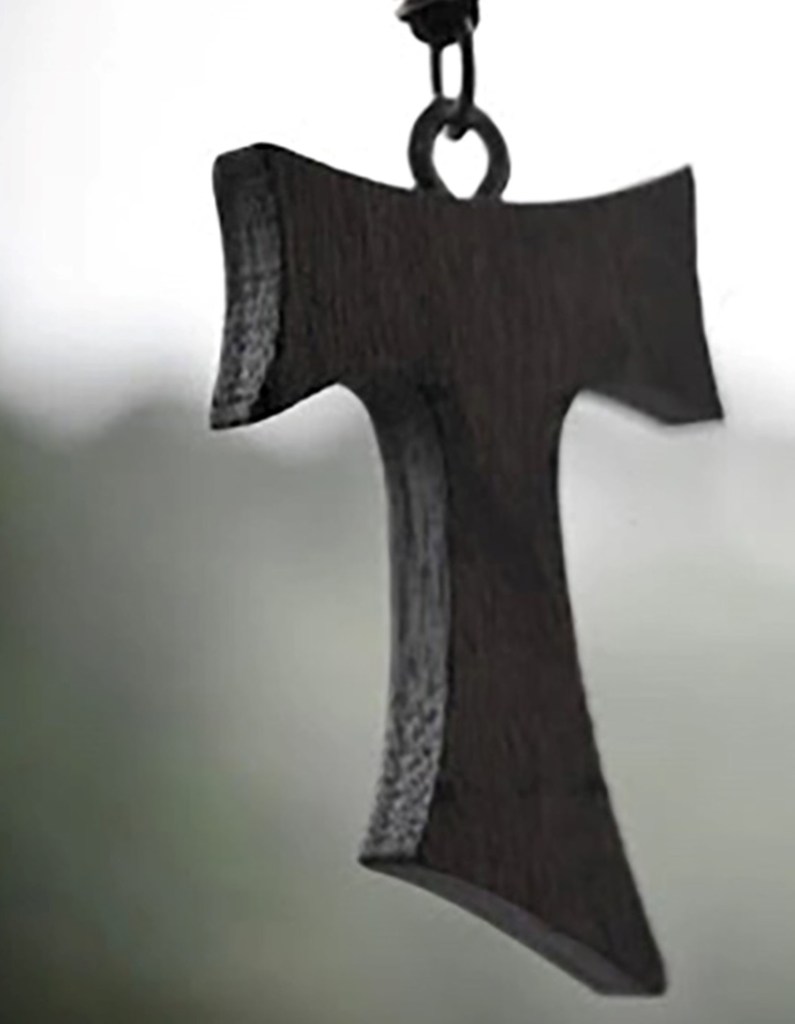
Tau Cross. Symbol of St. Antony of Egypt.
St Antony, You had everything. Then one day you heard the voice of God. “Antony, go sell all you possess and have nothing.” So you did, and then you had everything.
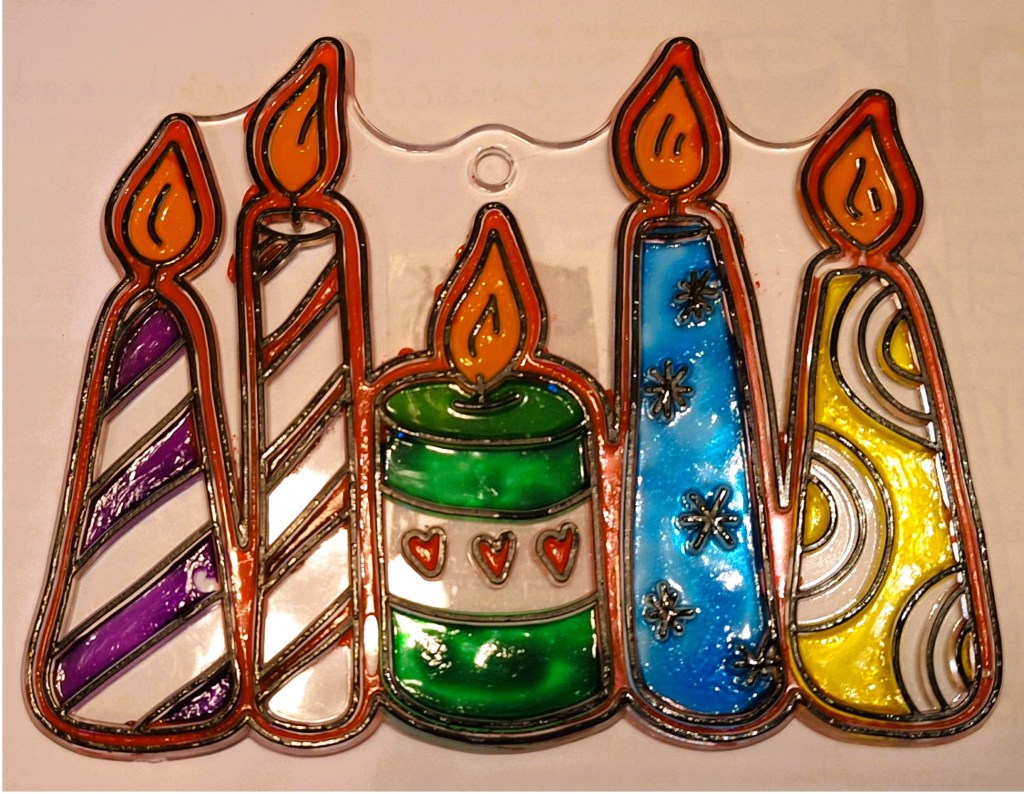
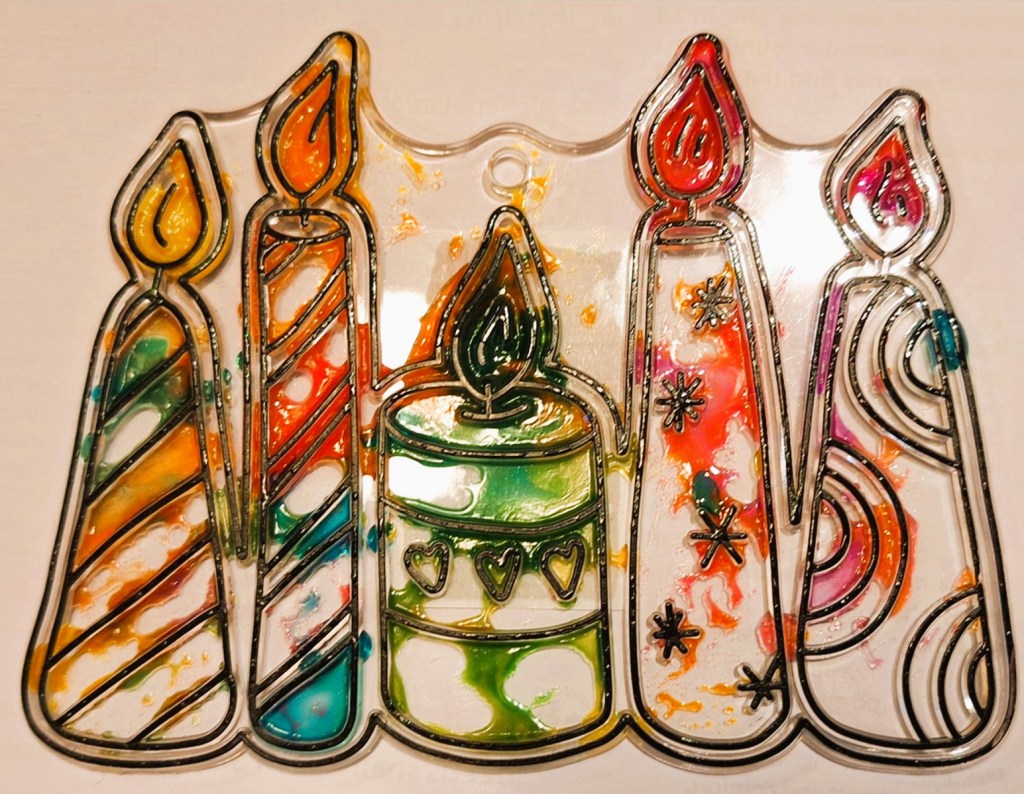
Candles decorated by children at St Mary-at-Latton.(and below) Photos: Mr G
Every so often, astronomers astound us with yet another discovery in space. On December 11th we received news that NASA’s James Webb space telescope has captured an image of what our galaxy was like as it was forming. The telescope, the most powerful ever built, is orbiting in space free from hindrance by the Earth’s atmosphere. This makes its images more pure and more accurate. The particular image that has excited astronomers shows 10 balls of stars of different colours which has led space scientists to liken it to baubles on a Christmas tree. The real significance of the image is that it’s the first time it has been possible to witness the stars assembling to form a galaxy which holds clues of how our own galaxy, the Milky Way came into being. It’s rather good that we have news of our Universe which is positive just when various sections of humanity are trying their hardest to destroy our bit! Much more will be gleaned from this discovery which continues to add to the knowledge we have of our own universe. In many ways the Universe is a mystery but each new discovery adds to our enlightenment. Perhaps in that respect it is mirroring God who created the Universe and even found time to create us! God is a mystery who constantly reveals himself to us especially, Christians believe, through Jesus Christ but also through our gifts, knowledge, skills and talents.
Sometimes God’s revelation is accompanied by some celestial event like a bright star. Writers in the Bible tell us of many constellations. Individual stars are mentioned. In the Book of Job there is a beautiful conversation between God and Job (in chapter 38) where God asks Job where he was when the Lord laid the foundations of the earth. The writer shows the depth of ancient knowledge when he asks whether Job can bind the chains of Pleiades or loose the cords of Orion. The star of Bethlehem referred to in Matthew’s Gospel as the one leading the Magi to the Christ child has also led many scientists into the realms of speculation. As far as the Bible is concerned this is the star which heralds Christ’s birth. The theme of light which is signified by such stars is central to Advent because it speaks to us of the expectation of God coming to light up the world with his new presence in Jesus Christ. This is the Love of God beginning the process of transforming the world with light.
Not surprisingly, when the Church leaders chose December 25th *** for our celebration of Christmas it was the time in the West at least, when the world is at its darkest. It was also the time of the pagan Winter festival and early Christians preferred to overlay pagan religion with new Christian meaning. Sweeping pagan practices away would merely drive them underground. Changing their meaning and adding new depth made for a more permanent and ready acceptance of the, then, new faith. Good missioners always start where people are before helping them into new understanding. It may well be that the pagan solstice was subjected to a pincer movement because December 13th is the feast of St Lucy whose very name means Light (and from which we get the word lucid – to make clear) Lucy was a 4th century Christian who fell foul of an attempt by the Roman Emperor to re-establish worship of the old gods. She was betrothed to a man who expected a decent dowry. Instead of which she gave her possessions to the poor. The angry suitor denounced her to the authorities and she was put to death for her faith in 304AD. Because her martyrdom was in December her festival quickly became associated with Christmas.
Probably, the main reason why Lucy became associated with Light overcoming darkness is because the final act of torture was that her eyes were gouged out, plunging her into complete darkness physically. Yet the physical darkness was itself overcome by the brightness of her faith. She had within her the love and light of Christ and her enemies couldn’t quench that. That encouraged other Christians facing persecution. The light of her faith pointed believers to Jesus, the one true light who was coming into a darkened world with hope and new life. Christ Jesus, who in the final book of the Bible is called the Bright Morning Star, fills all our lives with light. That is both the hope and the witness we must bear in a deeply darkened world.
Maybe we can look to the people of Scandinavia who understand more than most about darkness at the heart of Winter. St Lucie’s day is an important feast not only because of her own overcoming of darkness but because of the physical darkness in Scandinavia at the time of the Winter Solstice ~ the darkest day of the year. In the old Calendar, December 13th, her feast day, was at that time. She became a symbolic example of light conquering darkness. This is why, in Scandinavia, the feast incorporates a celebration of light involving processions in which girls chosen in communities to represent the saint in wearing a crown of candles (possibly battery operated these days!) and accompanied by others including boys known as star boys. This deserves an article of its own but the underlying reason is that St Lucy was light in a dark place and her faithfulness to God was an example from which others could draw strength and inspiration. Never is this more needed than today!
The night treads heavily in places unreached by sun, the shadows brood in the dark places of our world, where human deeds are black. St Lucy comes, bearing lighted candles, heralding the light of God, the Christ-child who comes anew at Christmas. Let us be ready to greet Him with the joyful light of goodness and of peace.
[adapted by Mr G from a traditional song from Sweden)
*** The Orthodox Church follows a different Calendar and keeps Christmas on January 6th



 Mr G's Ponderings