Tag: Christmas

By star and candlelight

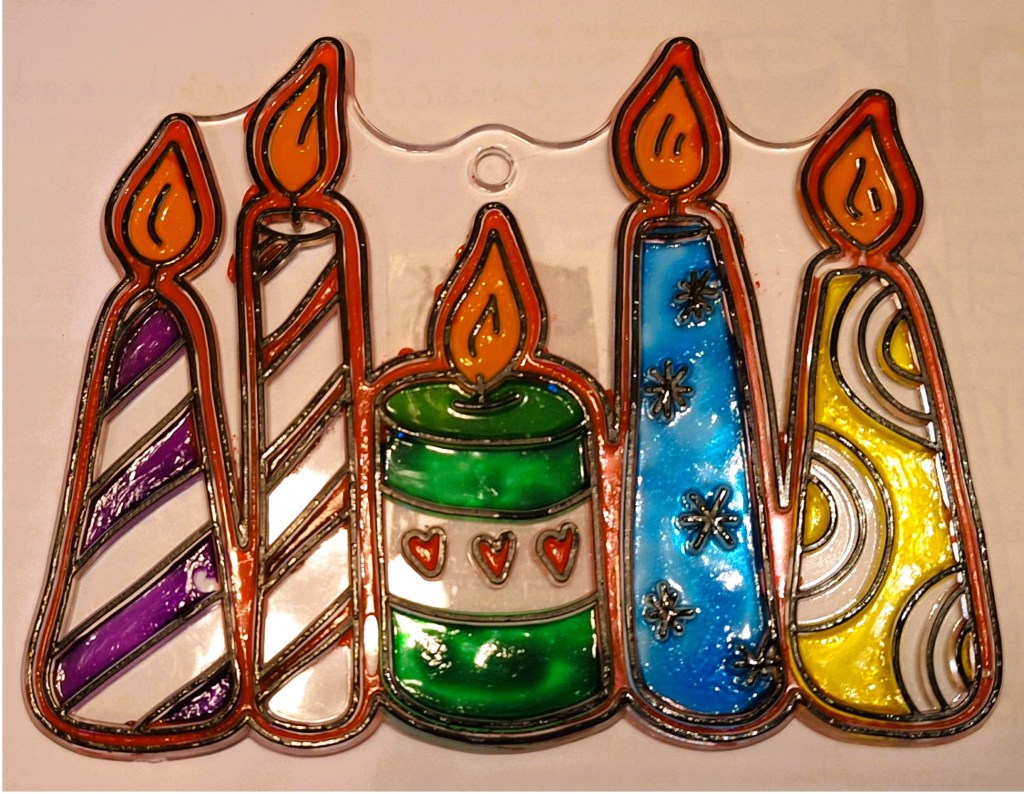
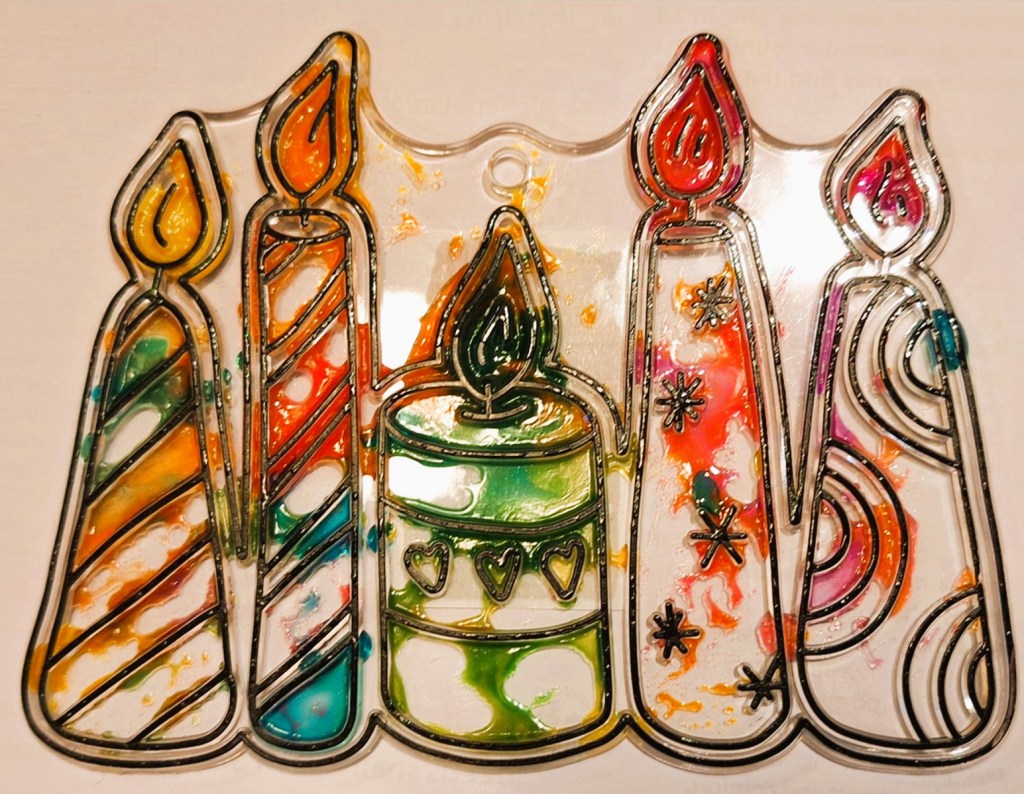
Candles decorated by children at St Mary-at-Latton.(and below) Photos: Mr G

Every so often, astronomers astound us with yet another discovery in space. 
On December 11th we received news that NASA’s James Webb space telescope has captured an image of what our galaxy was like as it was forming. The telescope, the most powerful ever built, is orbiting in space free from hindrance by the Earth’s atmosphere. This makes its images more pure and more accurate.
The particular image that has excited astronomers shows 10 balls of stars of different colours which has led space scientists to liken it to baubles on a Christmas tree.
The real significance of the image is that it’s the first time it has been possible to witness the stars assembling to form a galaxy which holds clues of how our own galaxy, the Milky Way came into being.
It’s rather good that we have news of our Universe which is positive just when various sections of humanity are trying their hardest to destroy our bit!
Much more will be gleaned from this discovery which continues to add to the knowledge we have of our own universe. In many ways the Universe is a mystery but each new discovery adds to our enlightenment.
Perhaps in that respect it is mirroring God who created the Universe and even found time to create us! God is a mystery who constantly reveals himself to us especially, Christians believe, through Jesus Christ but also through our gifts, knowledge, skills and talents.

Sometimes God’s revelation is accompanied by some celestial event like a bright star. 
Writers in the Bible tell us of many constellations. Individual stars are mentioned. In the Book of Job there is a beautiful conversation between God and Job (in chapter 38) where God asks Job where he was when the Lord laid the foundations of the earth. The writer shows the depth of ancient knowledge when he asks whether Job can bind the chains of Pleiades or loose the cords of Orion. 
The star of Bethlehem referred to in Matthew’s Gospel as the one leading the Magi to the Christ child has also led many scientists into the realms of speculation.  As far as the Bible is concerned this is the star which heralds Christ’s birth.
The theme of light which is signified by such stars is central to Advent because it speaks to us of the expectation of God coming to light up the world with his new presence in Jesus Christ.  This is the Love of God beginning the process of transforming the world with light. 

Not surprisingly, when the Church leaders chose December 25th *** for our celebration of Christmas it was the time in the West at least, when the world is at its darkest.  It was also the time of the pagan Winter festival and early Christians preferred to overlay pagan religion with new Christian meaning. Sweeping pagan practices away would merely drive them underground.  Changing their meaning and adding new depth made for a more permanent and ready acceptance of the, then, new faith. Good missioners always start where people are before helping them into new understanding.
It may well be that the pagan solstice was subjected to a pincer movement because December 13th is the feast of St Lucy whose very name means Light (and from which we get the word lucid – to make clear) 
Lucy was a 4th century Christian who fell foul of an attempt by the Roman Emperor to re-establish worship of the old  gods. She was betrothed to a man who expected a decent dowry. Instead of which she gave her possessions to the poor.  The angry suitor denounced her to the authorities and she was put to death for her faith in 304AD.  Because her martyrdom was in December her festival quickly became associated with Christmas. 

Probably, the main reason why Lucy became associated with Light overcoming darkness is because the final act of torture was that her eyes were gouged out, plunging her into complete darkness physically. Yet the physical darkness was itself overcome by the brightness of her faith. She had within her the love and light of Christ and her enemies couldn’t quench that. That encouraged other Christians facing persecution. The light of her faith pointed believers to Jesus, the one true light who was coming into a darkened world with hope and new life.  Christ Jesus, who in the final book of the Bible is called the Bright Morning Star, fills all our lives with light. That is both the hope and the witness we must bear in a deeply darkened world.

Maybe we can look to the people of Scandinavia who understand more than most about darkness at the heart of Winter. St Lucie’s  day is an important feast not only because of her own overcoming of darkness but because of the physical darkness in Scandinavia at the time of the Winter Solstice ~ the darkest day of the year. In the old Calendar, December 13th, her feast day, was at that time. She became a symbolic example of light conquering darkness. This is why, in Scandinavia, the feast incorporates a celebration of light involving processions in which girls chosen in communities to represent the saint in wearing a crown of candles (possibly battery operated these days!) and accompanied by others including boys known as star boys.
This deserves an article of its own but the underlying reason is that St Lucy was light in a dark place and her faithfulness to God was an example from which others could draw strength and inspiration.
Never is this more needed than today!
The night treads heavily
in places unreached by sun,
the shadows brood
in the dark places of our world,
where human deeds are black.
St Lucy comes,
bearing lighted candles,
heralding the light of God,
the Christ-child who comes anew
at Christmas.

Let us be ready to greet Him
with the joyful light of goodness
and of peace.

[adapted by Mr G from a traditional song from Sweden)
*** The Orthodox Church follows a different Calendar and keeps Christmas on January 6th

[Mr G]
Stoops heaven to earth

From Joyce Smith, another photo tweet.

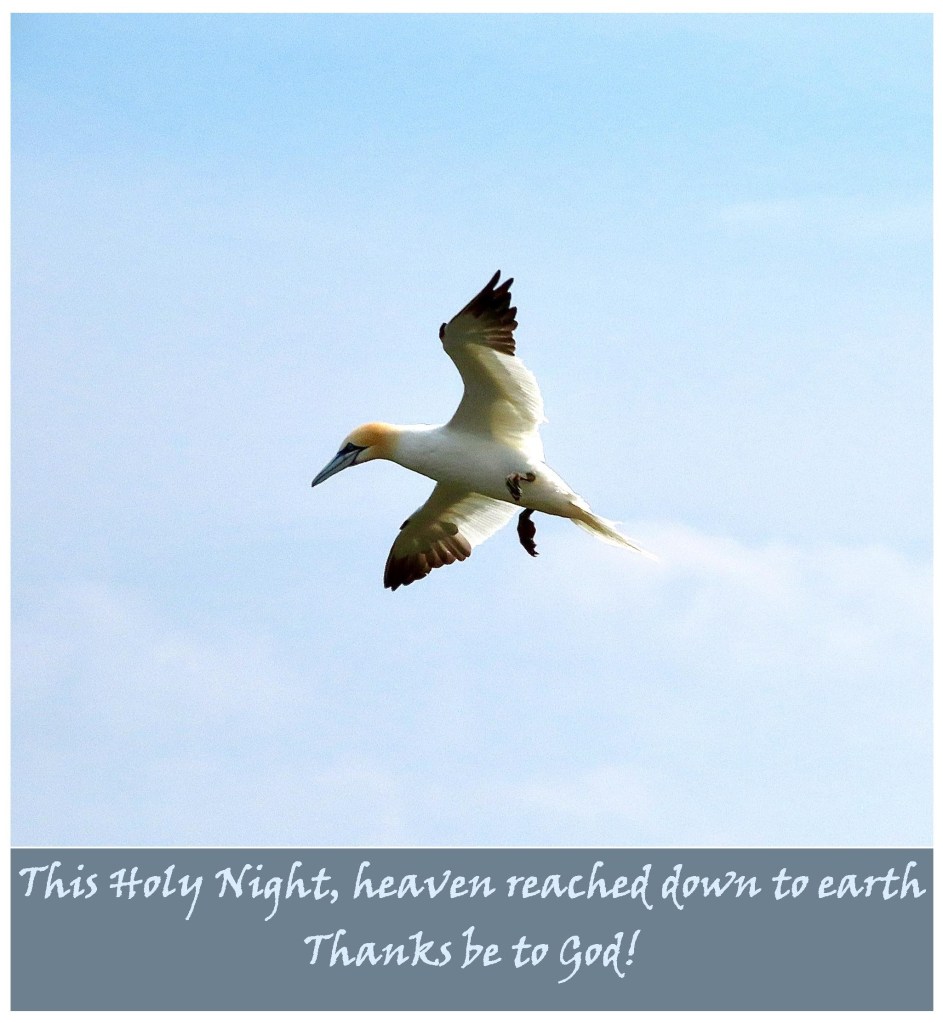
My friend Joyce’s latest photo Tweet takes, as its theme, the soaring flight over the earth which symbolizes the coming of the Christ-Child in the birth of Jesus to Mary and Joseph. 
Joyce chooses the caption which takes up this theme ; –

This Holy Night heaven reached down to earth.

The stooping down of God to embrace earth and all creation with His saving Love has an echo in those moments in a faith journey where we encounter heaven opening and sense God’s presence so keenly that it takes our breath away and for a time we feel drawn into God’s embrace. These are our thin moments when the membrane that separates earth from heaven is so thin that we could be in either place.
As indeed we are, and far more than we realize.  God is very near but unless we are still, it is easy to miss Him. A bit like the Whisky Priest in Graham Greene’s novel, The Power and the Glory who “missed happiness by seconds at the appointed place.”

All but a few shepherds and animals missed God’s coming at the appointed place of Bethlehem in the stillness of the Night.. As the writer of the Book of Wisdom in the Old Testament put it in the beautiful words in Chapter 18:

When all things were in quiet silence
and the night was in the midst of her swift course,
Down from the heavens, from your Royal throne,
leapt your all-powerful Word.     

 Being attentive to God’s coming to us in our lives means watching and hoping with real expectancy that He will indeed Come.
And whilst we might not always meet Him at the appointed place, that is not the final moment or place. God is always waiting and creating new thin places of meeting, each Christmas being an absolute certainty of that truth.

For reasons we hardly can fathom, He has this ‘thing’ about touching us with the love and joy pouring constantly from His heart. In Jesus He shows us just what that means.

So with the 17th century Poet, Richard Crawshaw in his poem, In the Holy Nativity of God, let us gratefully say :

Welcome, all wonders in one sight!
Eternity shut in a span;
Summer in winter, day in night’
Heaven in earth and God in man.
Great little one, whose all-embracing birth
Lifts earth to heaven
Stoops heaven to earth.

[Mr. G]

Great Little One

Great little one whose all-embracing birth
lifts earth to heaven, stoops heaven to earth.

Christmas morning sermon preached at St Mary-at-Latton Harlow by Piers Northam, Licensed Lay Minister.

We’ve just heard the opening of Saint John’s Gospel – to quote the traditional carol service: ‘St John unfolds the mystery of the Incarnation’…  Those words, with their strange, riddle-like poetic language are, on the one hand, familiar – you’ve probably heard that opening phrase many a time:

‘In the beginning was the Word, and the Word was with God, and the Word was God’…

But they’re still quite puzzling.  What do they mean?  Of course one trick to opening it up is simply to substitute ‘Word’ with ‘Jesus’

In the beginning was Jesus, and Jesus was with God, and Jesus was God.

John, at the opening of his Gospel, assumes that we know the story of the birth of Christ so he jumps head-first into the theology of the thing, unpacking what’s going on here at a cosmic level.  No muckin’ about for St John the Evangelist!  And it’s important stuff that he’s setting out for us – about the very nature of Jesus: about who he really is.

There are some other words that I love which are often used at Midnight Mass as the Christ-child is laid into the crib scene and the crib blessed:

Welcome all wonders in one sight!
Eternity shut in a span.
Summer in winter, day in night,
heaven in earth and God in man.


Great little one whose all-embracing birth
lifts earth to heaven, stoops heaven to earth.

These words do a similar job in helping us to understand who Jesus is and what his purpose is in the world:  Eternity – the God of Ages – is shut in a span – the God who created all that exists, is swaddled and wrapped tightly in the confines of a human life; the Ancient of Days is born as an infant child: the Little-one, whose all-embracing birth will stretch arms out across the world; will stand for all people in order to form a bridge; a link between heaven and earth, between God and humankind.  It is a wondrous and mind-boggling thing…

Yet in the midst of all the theology, it’s also good to dwell for a moment on the simplicity of the story of Christmas – and on the facts and circumstances of Jesus’ birth for I feel they have strong resonances for us in 2020, this strangest of years.

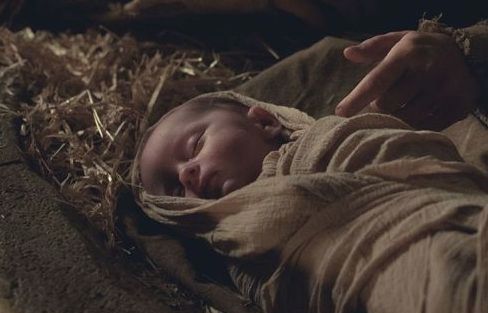
The circumstances aren’t promising, are they?  This is a child born to a couple who are a long way from home; unable to find lodging; forced to hole up in a stable amongst the animals.  (Bedding down in a cowbarn would be scary enough at the best of times – I’d be worried about being trampled if nothing else – but imagine doing that heavily pregnant!)  This is a child born out of wedlock; born into the grubby straw and bedded down in a feeding trough.  This is a child born into a country under foreign political occupation who will, before long, become a refugee simply for who he is: forced to leave his country with his parents and to make the risky journey to Egypt…  I wonder if overladen dinghies and extortionate fees for passage were involved?  It certainly isn’t chocolate-box, is it?  But it has an awful lot in common with millions of people round the world, contending with similar situations today.  For this Emmanuel – God with us – isn’t a God of theories and notions, but one who is willing to get down and dirty in the complexities and anxieties of our lives. 

Andrew Marr the other day asked Archbishop Justin if Christmas had been cancelled this year – and of course much of our celebration of the feast has been curtailed – but Christmas?  No.  For that first Christmas – just as the Easter that would follow some thirty or so years later – stands for all time: proclaiming God’s love for us; God’s desire to build a relationship with us and work with us; to be intertwined in our lives; to walk in our shoes… And in this year of fear and anxiety; of insecurity and loneliness; of sickness and grief, that’s exactly where God has been: walking with us; living in us; working through us.

You see God – in Jesus – puts himself right into the midst of the mess and confusion of human existence.  And in doing so, takes an enormous risk: not forcing himself on us, but entrusting himself to us – making himself completely vulnerable that most fragile of forms; a human baby.  This is a child born in a stable surrounded by ox and ass and sheep – yet their young are born and within minutes they are up and walking; instinctively and quickly developing and able to fend for themselves to a certain extent.  But the child wrapped up in swaddling clothes – as with all human children – is totally defenceless and dependant on his parents to nurture and form him; to feed and clothe him; to protect and cherish him.

God – the very God who created Light and Life – makes himself defenceless and reliant on us…  From the outset, this is a shared endeavour between God and humankind: one where we are not obliged, but where we have to choose to take part – just as the young girl Mary did, when she said ‘Here I am’ to the Angel Gabriel.

For Mary, of course, that ‘Here I am’ was a faith-filled leap in the dark; we, at least, have the benefit of being Easter people who know how this story pans out.  Which isn’t to say – as Beth reminded us last week – that everything will be a bed of roses: ‘Getting a blessing isn’t the same as getting a present’.  But whilst we’re not being asked to give birth on the floor of a stable, crowded out by the hooves of large animals; we are invited to be God-bearers; we’re invited to carry Emmanuel within us; to become places where the Christ-child is given shelter; is cherished and nurtured – where the flame of light that Jesus brings into a dark world can be fanned and fed to glow brighter.

In becoming that fragile child, God creates space for us; giving us room to play our part; to work together with each other and with God.  Like the best of parents, he is encouraging us to grow and mature and fledge to independence and then ‘rise up, with wings, as eagles’.

Christmas tells the story of God choosing to trust us and choosing to need us and choosing to work with us in his longing to save the world.  And, in the midst of all that feels grim at the moment, of God choosing to be there in the thick of it all with us.

So I say, ‘Glory to God in the Highest’ but also ‘Glory!’ to that tiny, earth-bound child whose birth ‘lifts earth to heaven, stoops heaven to earth.’ And I pray that in this Christmas season you will be truly set on fire with love from on high and so find much to rejoice in.

Amen.

Piers Northam
25 December 2020