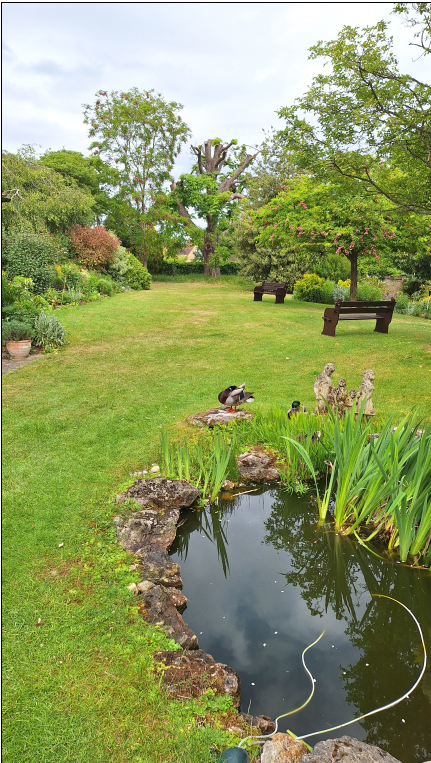
Rosemary’s Quiet Garden at Dunmow, Essex. photo by Mr G.
Quiet Garden
In the Quiet Garden birds sing antiphonally in the monastery of the air.
Ducks murmur gossip across the pond informing prayer[!], as a bee hovers lazily over new mown grass.
Carefully manicured borders teem with joyful colour as plants flower, gratefully supping May-time air fuelling their thirst for new life.
Nearby, a church bell, a single, insistent chime, repeating, marking the moment; calling to prayer. Insects of varying kind respond, their plainchant lifting our souls.
Nature speaks to nature nurturing all Creation within, where God waits to draw us into the Divine heart.
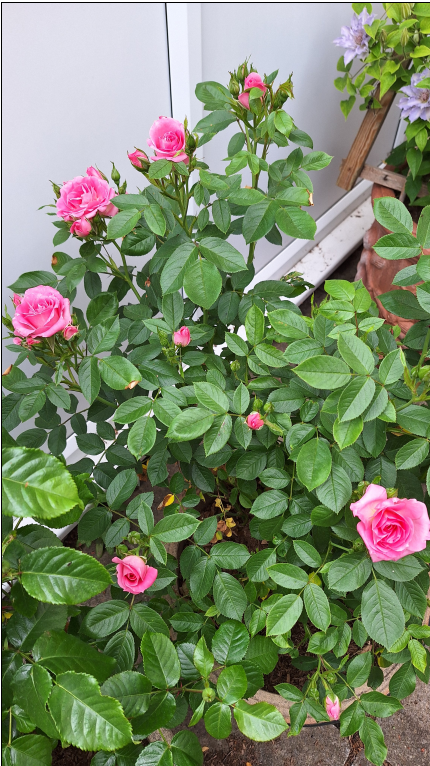
Roses in the Garden at Dunmow. Photo by Mr G.
Mr G. 24th May 2025. [inspired by Rosemary’ Drew’s Garden at Dunmow, Essex, offered as part of the Quiet Garden movement, as a place of spiritual refreshment and re-creation]
[photo from Gill Henwood – of the area near the Black Mountains, Bhutan]
Jesus prays in Gethsemane
On the night of his betrayal, Jesus took his disciples to the Garden of Gethsemane, near the Mount of Olives. He asked them to pray for themselves and then went to a place by himself. He prayed to his Father that he might be released from the trial and crucifixion ahead of him. But he also prayed that his Father’s will should prevail. The humanity of Jesus cried out and his anguish caused his sweat to fall like drops of blood. An angel from heaven came to strengthen him. His disciples were fast asleep. Then the Roman soldiers came to the garden to arrest him…. (St Luke’s Gospel Chapter 22: 39-53)
Gethsemane
This is his Passion. Darkness wraps around his very being, not a warming cloak but a shroud. Silence, punctured by friends snoring off the wellbeing of food, minds sloshed with wine. Alone with the shivers of the night, everything in him protests.
Sometimes, when we know our destiny, our minds close. Not this! No! Never! But our hearts are our undoing: our resolve begins; ends there. So he battles with his need to say ‘Yes’, for himself, for others, for us. How else can the world know what it is to be loved?
Kneeling on the damp ground, tense, numb, scared, uncertain, he waits. And the Father waits too as demons and angels whirl, stirring up the black air, a vortex of cosmic battle. Below them, sweat drops as blood. And still the Father waits, listening expectantly, daring to hope…
God wrestling desperately with God with everything – just everything – at stake. This really is the Passion. He sighs, deeply, calm descends. “Yes, let it be.”
The Father wraps his love around him – and so too around us.
I trace the Rainbow through the rain (George Matheson) photo taken by Gill Henwood of a rainbow archingover the Lakeland fells – a sign of God’s Glory.
My Lord & My God
Much prayer is often confined to asking God for things or seeking to change his mind about things – this of course assumes that we actually know God’s mind.
Louis Evely in his wonderfully challenging book, Teach us how to pray, says that too often people march into church, notify God what they want and leave without bothering to listen to him; without consulting him or taking him into account. They leave without giving God time to act in the way he needs to act which may be to answer our prayer by changing us who pray. Praying for others and casting our anxiety about people onto God is not a bad thing. It is a very good thing but it isn’t the heart of prayer. My understanding is that to travel to the heart of prayer we need to develop a personal relationship with God. In this praying we seek to place ourselves before God in quietness as we travel into a still centre of our very being where we find God waiting to meet and greet us. It is prayer which develops into a sense of God’s nearness as well as otherness and which finds expression in praise, thanksgiving and love for God Himself.
This kind of prayer is what we find at the centre of today’s Gospel (John 20: 22-29)– the prayer of Thomas, whose feast day we keep today, July 3rd.
My Lord And my God!
This is sheer prayer. It asks for nothing and it gives everything. It is a confession of faith; it is total devotion; it is absolutely God-centred. It also recognizes the Divinity of Jesus – He is our Lord and our God.
My Lord and My God. There’s a wealth of theology in those five words and to pray them and mean what we pray could take a lifetime. It would be a lifetime’s work worth doing for it is a prayer which contains the love, devotion and absolute and pure worship as this prayer does. I do wonder if God prevented Thomas from being with the other disciples on Easter Day just so that he could have this intimate moment with this loyal and utterly devoted disciple. It wasn’t just because Thomas needed the reassurance (which he did), nor that he was a natural sceptic. He really, really wanted to believe!
But this incident is bigger than what we see at face value. In the prayer of Thomas we have the picture of where our lives, our witness, our deeds, our words, our very action, and – our souls – are being led – right to the heart of God – and this prayer takes us there and only there.
There is nothing about us or our concerns in this prayer. It is totally centred on God. There are no superfluous babblings here. No manipulation. No bargaining or pleading – if you do this God, I’ll do that. Just simply and profoundly, My Lord and My God! Blessed Thomas, so-called doubter, shows us the way of sheer faith. However we have to make time for God if we are to become close and in the kind of loving, self-giving relationship whereby our hearts and not just our mouths proclaim the prayer of Thomas.
Last month, my Soul Friend, Sister Rosemary of the Sisters of the Love of God, gave me some advice. It was in response to a question she posed about when I just sat down to be still with God. Because she knows that I am a keen gardener, she suggested that I sit quietly in the garden. I was to engage in a sitting which had no agenda save being in God’s Presence.
On one hand, a Garden is quite a good place for quiet contemplation and stillness though, if you are a keen gardener, it may be a distraction. I was reading in the current Royal Horticultural Society Garden Magazine an article by Rachel de Thame, one of the regular contributors. She was writing about time spent just being in the garden She confessed to finding it “impossible to just sit in my garden.” For her, as for many active gardeners, it is a place to be doing – “and the doing is what we enjoy most.” She came to the conclusion that real gardeners simply couldn’t just sit without jumping up immediately to do things. So she decided to find a better balance between “activity and admiration.” She perches on some stone steps which aren’t too comfortable that she might be tempted to linger. Short pauses, she says are just perfect. “for a short time, resting and looking is lovely.” But spotting a stray tendril, she’s off!
I know what that feels like, so on Sister Rosemary’s advice, I have been trying hard to just sit and contemplate the plants and flowers, resisting the temptation to do anything. It is starting to work, though the physical stray tendrils are so often replaced with inner ones as the mind tries to tidy up my life. It’s all too easy to concentrate on oneself and other preoccupations. Becoming still can be hard. I find having a notebook handy. When I realize that I have forgotten to buy the bread or phone a friend, I write it down. I can then forget it for this short time.
Repeating slowly the short mantra of St Thomas’s prayer helps to keep me focused on God. It’s power lies in this. Other short prayers which are your favourites may work just as well, such as the Jesus Prayer. For me, My Lord and My God, addressed by Thomas to Jesus is a kind of version of that though it is totally concentrated on God and it is enough to bring us into the presence of God. If, that is, we ignore the roses which need dead-heading. That’s what your notebook is for!


 Mr G's Ponderings